The best home automation hub for a house you already live in is usually not the newest box with the longest logo row. It is the one that can talk to the devices already screwed into doors, stuck to windows, wired into switches, or hiding behind furniture. Before shopping, make a plain inventory: device name, brand, protocol, and whether it currently depends on a brand hub. That boring list prevents the expensive mistake of buying a Matter-capable hub and then discovering your Z-Wave lock has no radio to answer.
This matters because mixed homes are normal now. SQ Magazine cites Parks Associates Q2 2025 data saying the average U.S. smart home household had 6.2 devices, and it reports that 52% of DIY installers experienced setup or connectivity issues, with protocol mismatch identified as a primary cause [1]. If you are still deciding whether you need a hub at all, start with Hub or No Hub: When You Actually Need a Smart Home Hub in 2026. If you already know you need one, the next question is not “Which hub is best?” It is “Which radios do my devices require?”
Start with the devices, not the hub
A usable inventory does not need to be elegant. It needs to catch the devices most likely to be stranded by the wrong hub: door locks, contact sensors, leak sensors, in-wall switches, older Zigbee bulbs, and anything inherited from a previous owner. Look for labels in the app, the product page, the manual, or the existing hub’s device list.
| What you find in the house | What it usually means for hub choice |
|---|---|
| Mostly Wi-Fi plugs, bulbs, cameras, and cloud app devices | You may not need a heavy hub unless you want automations, local control, or Matter coordination. |
| Thread or newer Matter devices | Choose a Matter controller with Thread border router support if Thread devices are part of the setup. |
| Z-Wave locks, switches, sensors, or thermostats | Buy a hub with a native Z-Wave radio. Matter support alone does not solve this. |
| Zigbee bulbs and sensors from multiple brands | Verify third-party Zigbee support. Do not assume every Zigbee-branded hub is a universal Zigbee bridge. |
| Aqara Zigbee devices only | An Aqara hub can make sense, but the brand boundary matters. |
That table is deliberately blunt because the protocol is the constraint. App polish, voice assistant preference, and brand loyalty can matter after compatibility is settled. They should not be allowed to hide a missing radio.
What Matter fixes—and what it leaves sitting on the bench
Matter is useful. It reduces the old platform drama where a device worked beautifully in one ecosystem and became awkward or unavailable in another. In the 2026 hub market, Matter and Thread support are now central comparison points, and Gadgeteer’s June 2026 hub roundup treats them as the baseline for modern hub shopping rather than exotic extras [2].
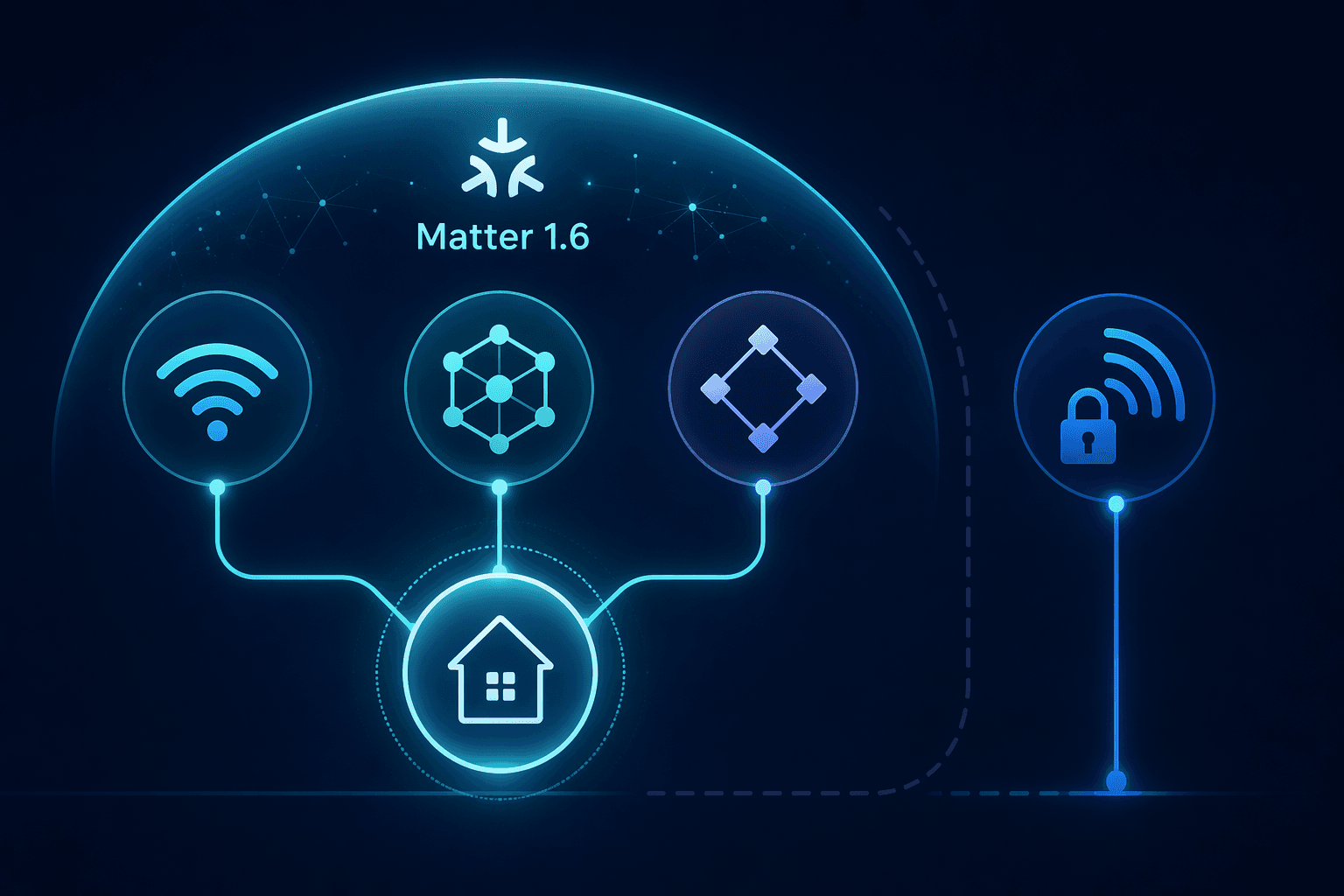
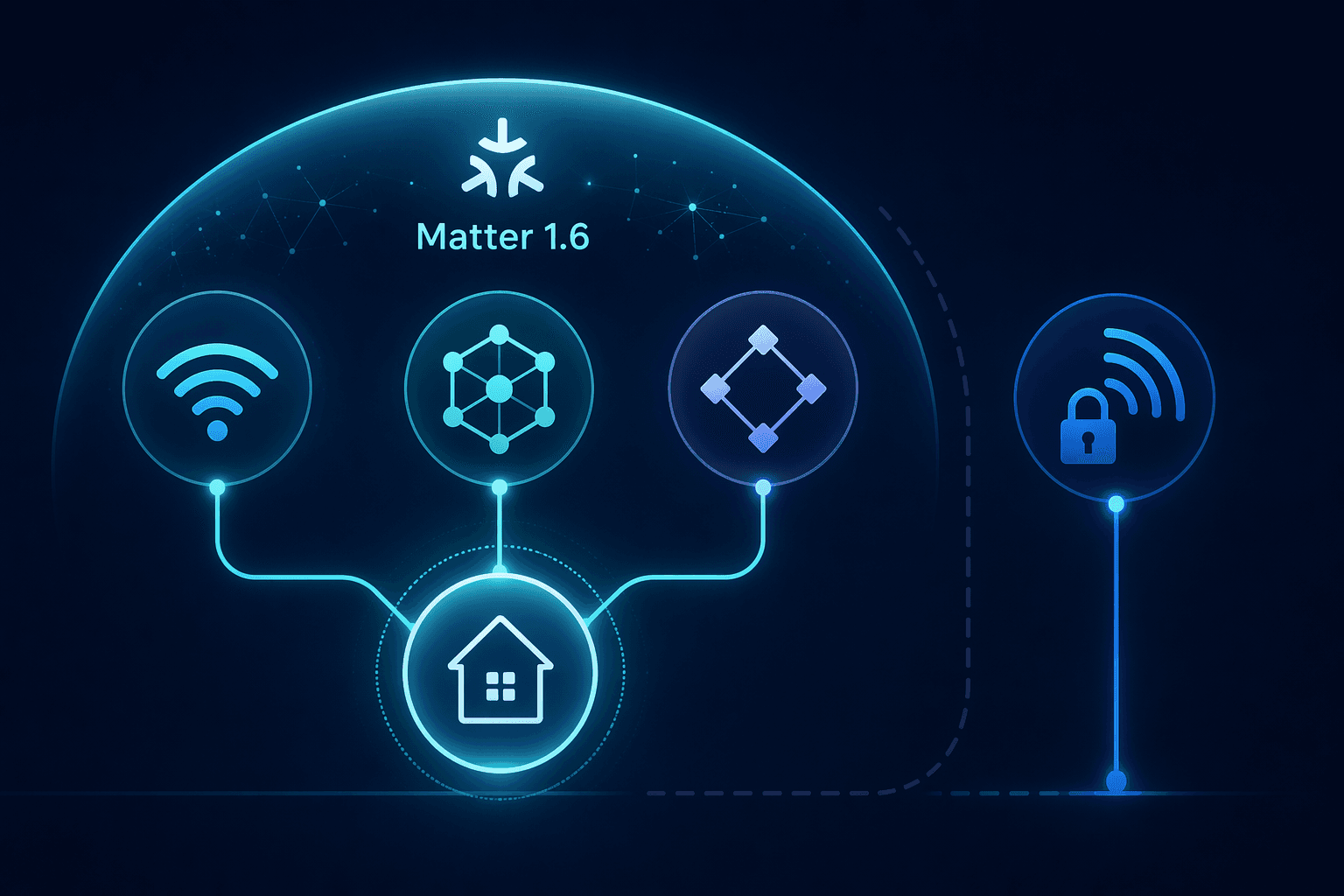
But Matter is an application layer, not a magic radio transplant. In the current 2026 framing used by SQ Magazine and Gadgeteer, Matter 1.6 is described as unifying Wi-Fi, Thread, and Zigbee under a common application layer, while Z-Wave remains outside Matter [1][2]. Exact Matter 1.6 feature claims should still be checked against the Connectivity Standards Alliance’s own release materials before relying on them, especially for appliance and energy-management details. For buying a hub, though, the important consequence is already clear: Matter compatibility does not mean Z-Wave compatibility.
A Matter controller can help modern devices from different brands appear in the same smart home environment. A Thread border router can give Thread devices the network path they need. Neither one gives a hub a Z-Wave radio if the manufacturer did not build one in.
The Z-Wave exception changes the recommendation
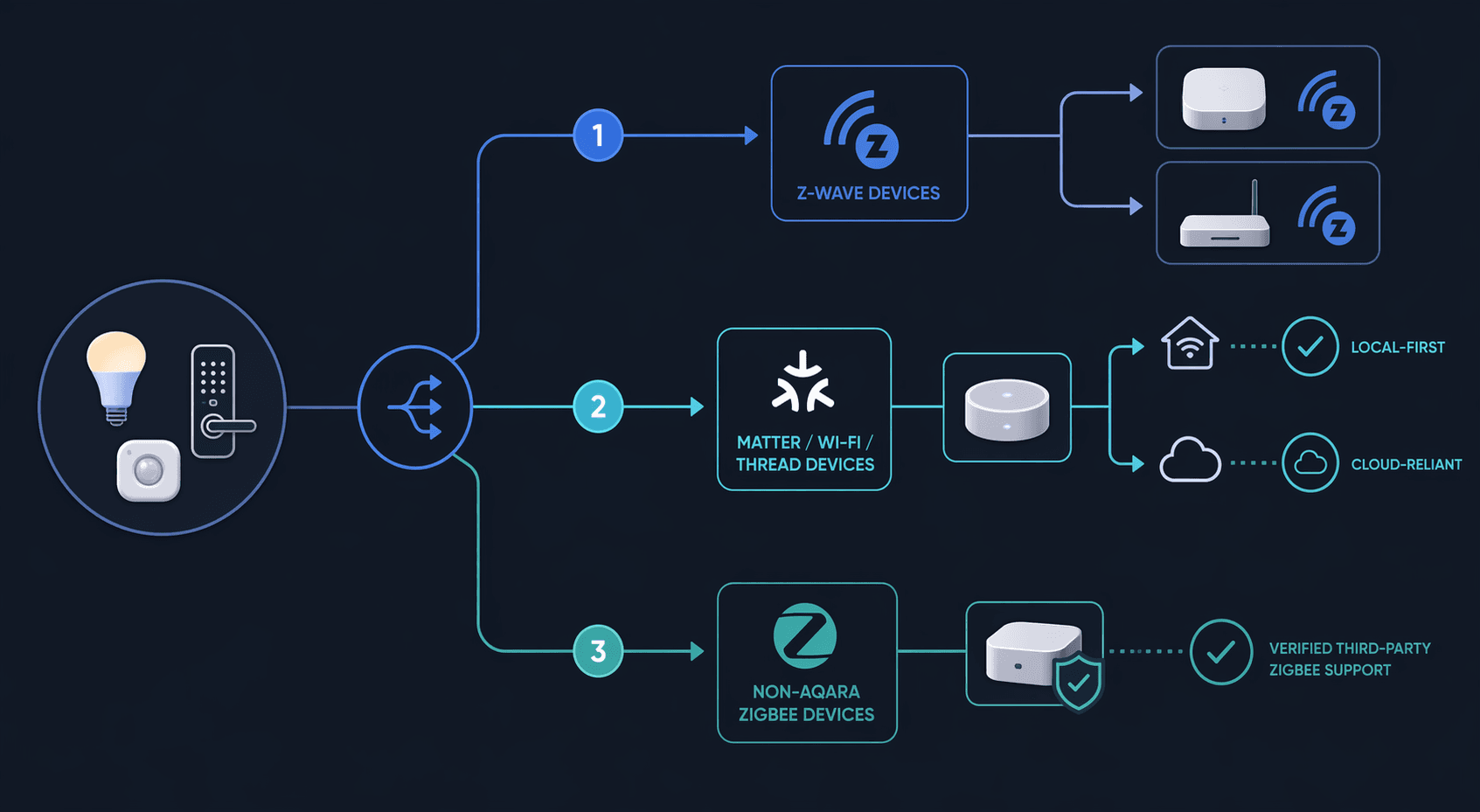
Z-Wave is the reason a generic “best hub” list can send buyers in the wrong direction. If you own Z-Wave locks, switches, sensors, or thermostats, the hub must have native Z-Wave support. Among the top-market hubs in the research set, only Aeotec SmartThings Hub v3 and Hubitat Elevation C-8 Pro have native Z-Wave radios [2].
The trap is that the newer name is not automatically the safer buy. The Aeotec SmartThings Hub 2, introduced in late 2025, dropped Z-Wave entirely [2]. For a home full of newer Matter, Wi-Fi, and Thread devices, that may be acceptable. For a front door with a Z-Wave lock, it is not a minor omission. It is the difference between a working migration and a device that cannot join.
This is also where spec-sheet reading has to slow down. A hub can be Matter-capable, popular, and current while still being the wrong purchase for a Z-Wave household. For a deeper Z-Wave-only buying path, use Best Z-Wave Hub in 2026, or the technical companion Z-Wave Explained if you need the radio behavior spelled out before replacing hardware.
Choose by the protocol problem you actually have
Most buyers fall into one of a few practical groups. These are not lifestyle tribes. They are compatibility conditions.
If the home is mostly Matter, Wi-Fi, and Thread
For newer devices, your choice can focus on ecosystem fit and local-control preference. Gadgeteer’s June 2026 roundup separates hubs partly by local-first versus cloud-reliant behavior, which is more useful than treating all Matter support as equivalent [2]. SafeWise and PCWorld also frame 2026 hub decisions around broader ecosystem fit, including how well the hub sits inside a larger smart home system rather than only how many protocols appear on the box [3][4].
This is the branch where voice assistant preference and app comfort deserve attention. If the devices already speak modern Matter-friendly languages, the hub’s job becomes coordination: automations, reliability, privacy posture, and how much it keeps working when the internet is having a bad day. Home Assistant is part of this conversation for buyers who want more control, but it is worth being precise about what people mean by a “Home Assistant Matter hub”; the phrase can describe several different controller and bridge roles. The distinctions are unpacked in The Three Meanings of a Home Assistant Matter Hub.
If you own Z-Wave devices
The short list gets very short: look at Aeotec SmartThings Hub v3 or Hubitat Elevation C-8 Pro if you want native Z-Wave among the major hubs covered in the 2026 market snapshot [2]. SmartThings is usually the more approachable ecosystem path. Hubitat tends to appeal to people who want stronger local automation control and are willing to spend more time configuring rules.
June 2026 pricing should be treated as market-dependent rather than permanent. Gadgeteer’s snapshot places Aeotec SmartThings Hub v3 around $170–$220, while availability and prices can shift with stock and tariffs [2]. The safer habit is to verify the exact model number and radio list at purchase time, not just the platform name.
If you own Zigbee devices from several brands
Zigbee needs a more careful read than buyers expect. Aqara’s own protocol primer explains the broad differences among Zigbee, Z-Wave, and Matter, but the Aqara Hub M3 is not a universal bridge for every Zigbee device in the drawer: its Zigbee control is limited to Aqara-branded Zigbee devices, not third-party Zigbee gear [5].
That limitation is not a reason to avoid Aqara if your home is already mostly Aqara. The M3 can be a sensible hub inside that ecosystem, and its June 2026 price is listed around $159.99 in the source snapshot [5]. It is a reason not to buy it for a pile of random third-party Zigbee sensors unless you have verified support for the exact models. The word “Zigbee” on a box is not the same as “universal Zigbee bridge.”
If your Zigbee devices repeatedly drop offline, the hub may not be the only culprit. Zigbee shares the crowded 2.4 GHz neighborhood with Wi-Fi, so placement and channel planning can matter. The troubleshooting path in Zigbee Device Drops Offline Repeatedly is the better next stop before replacing everything.
If you want Home Assistant as the controller path
Home Assistant is attractive when the house is mixed and the owner wants one automation brain instead of several brand islands. But it is not one fixed hardware answer. Home Assistant Green is the current recommended entry point in the June 2026 source snapshot after a January 2026 price increase to $159, while Home Assistant Yellow was discontinued by Nabu Casa in October 2025 and remaining retailer stock is finite [2]. Availability should be checked at purchase time.
The important practical point is that Home Assistant still needs the right radio path. If you want Zigbee, Thread, or Z-Wave, confirm the required onboard radio or compatible dongle. Software flexibility does not remove radio requirements; it just gives you more ways to assemble them.
A quick buying flow for mixed-device homes
- List every device you want to keep, especially locks, switches, sensors, and anything already paired to an old hub.
- Mark each device as Wi-Fi, Thread, Matter over Wi-Fi, Matter over Thread, Zigbee, Z-Wave, or brand-restricted.
- If any kept device is Z-Wave, restrict the hub list to models with native Z-Wave before comparing anything else.
- If you have third-party Zigbee devices, verify exact support rather than trusting a general Zigbee claim.
- Only after the radios match should you compare ecosystem, app, voice assistant, automation depth, local control, and price.
If you want a broader controller comparison after doing this protocol sort, use Best Smart Home Controller 2026: 7 Top Hubs Compared. If you want a more formal decision tree, How to Choose a Home Automation Controller in 2026 is the cleaner follow-up.
So which hub should you buy?
If your home is mostly modern Matter, Wi-Fi, and Thread gear, choose the hub based on ecosystem fit, Thread border router needs, automation style, and local-control preference. Matter has made that choice less punishing than it used to be.
If you own Z-Wave devices, do not buy a hub without native Z-Wave. In the current top-market set, that points to Aeotec SmartThings Hub v3 or Hubitat Elevation C-8 Pro, not the newer Aeotec SmartThings Hub 2 [2]. If your next project is a lock, How to Install a Z-Wave Smart Lock is the practical companion after the hub decision is settled.
If you own non-Aqara Zigbee devices, verify third-party Zigbee support device by device. An Aqara hub may be right for an Aqara household, but it should not be treated as a catch-all Zigbee rescue box [5].
A hub is only “best” when it matches the radios in the home. Matter reduces a lot of platform friction. It does not erase Z-Wave, brand-restricted Zigbee, or the need to read the radio list before checkout.
References
- Smart Home Statistics 2026, SQ Magazine.
- 5 Best Smart Home Hubs in 2026: Matter and Thread Compared, The Gadgeteer, June 13, 2026.
- Smart Home Hubs of 2026, SafeWise.
- Best smart home systems 2026, PCWorld.
- Zigbee vs Z-Wave vs Matter: Which is Better, Aqara.
Updates & Corrections
Protocol specifications and platform features change rapidly — especially with Matter version evolution. Report version changes, certification count updates, or platform policy changes that have occurred since the last editorial review.
Comments
Join the discussion with an anonymous comment.