| Buy-first ranking by payback | Device category | What it can realistically save | Typical payback signal | Buy it when... |
|---|---|---|---|---|
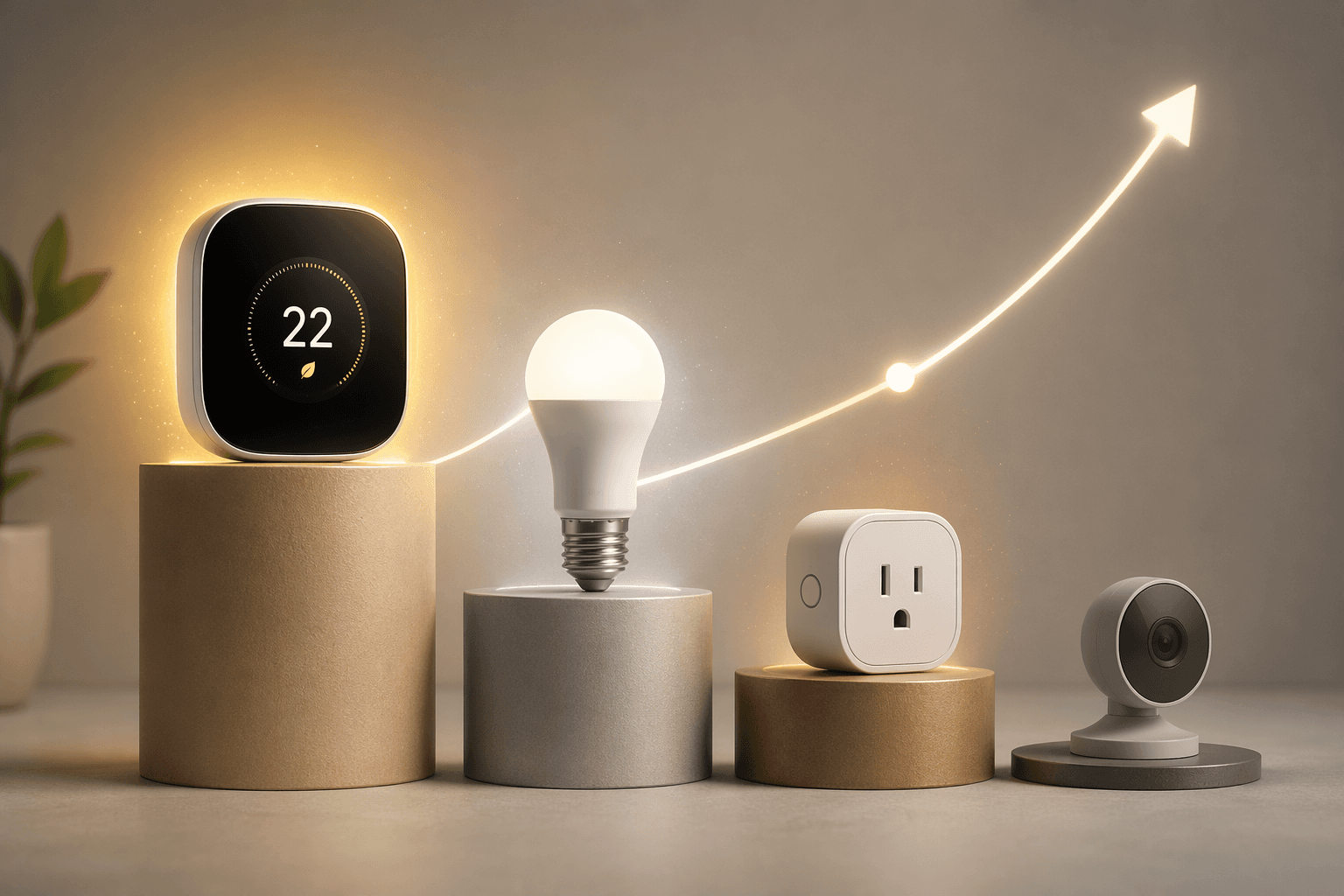
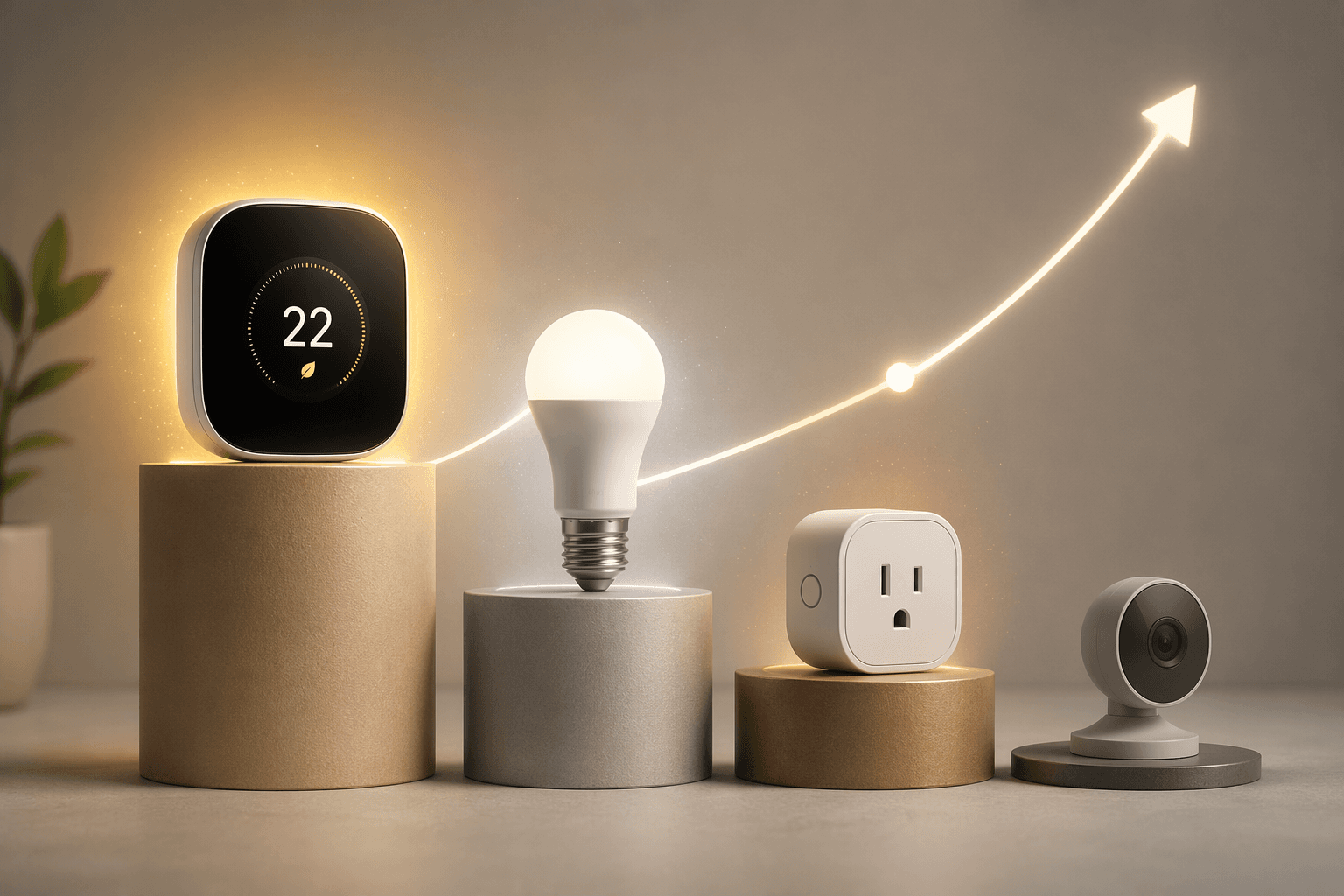
| 1 | Smart lighting: LEDs, smart bulbs, smart switches | LEDs can use up to 90% less energy than incandescent bulbs; automation adds savings when lights are often left on.[1] | About 8-12 months on bulb cost alone in the cited estimate.[1] | You still have incandescent or halogen bulbs, or lights are routinely left on in empty rooms. |
| 2 | Smart thermostat | ENERGY STAR estimates about 8% HVAC energy savings, averaging roughly $50 per year.[2] | Roughly 1.7-2 years in ENERGY STAR's field-based framing.[2] | Heating and cooling are a large part of your bill, and schedules or setbacks are currently inconsistent. |
| 3 | Smart plugs and advanced power strips | Standby load can represent about 5-10% of typical home energy use, often described as roughly $100-$140 per year.[3][4] | Often under 2 years when they control real idle loads.[3] | Entertainment centers, office setups, chargers, or appliances stay powered while nobody is using them. |
| 4 | Smart water heater controls and smart sprinkler controllers | Savings depend heavily on water use, electricity or gas rates, irrigation needs, climate, and existing equipment. | Usually longer and more situational than lighting, thermostats, or standby-load controls. | Your household has predictable hot-water patterns, high water rates, or meaningful outdoor irrigation. |
| 5 | Security cameras, smart speakers, smart displays | Useful for convenience, security, and control, but they deliver negligible direct energy savings. | Do not buy them for energy ROI. | You want the non-energy benefits and are not counting them as bill-reduction devices. |
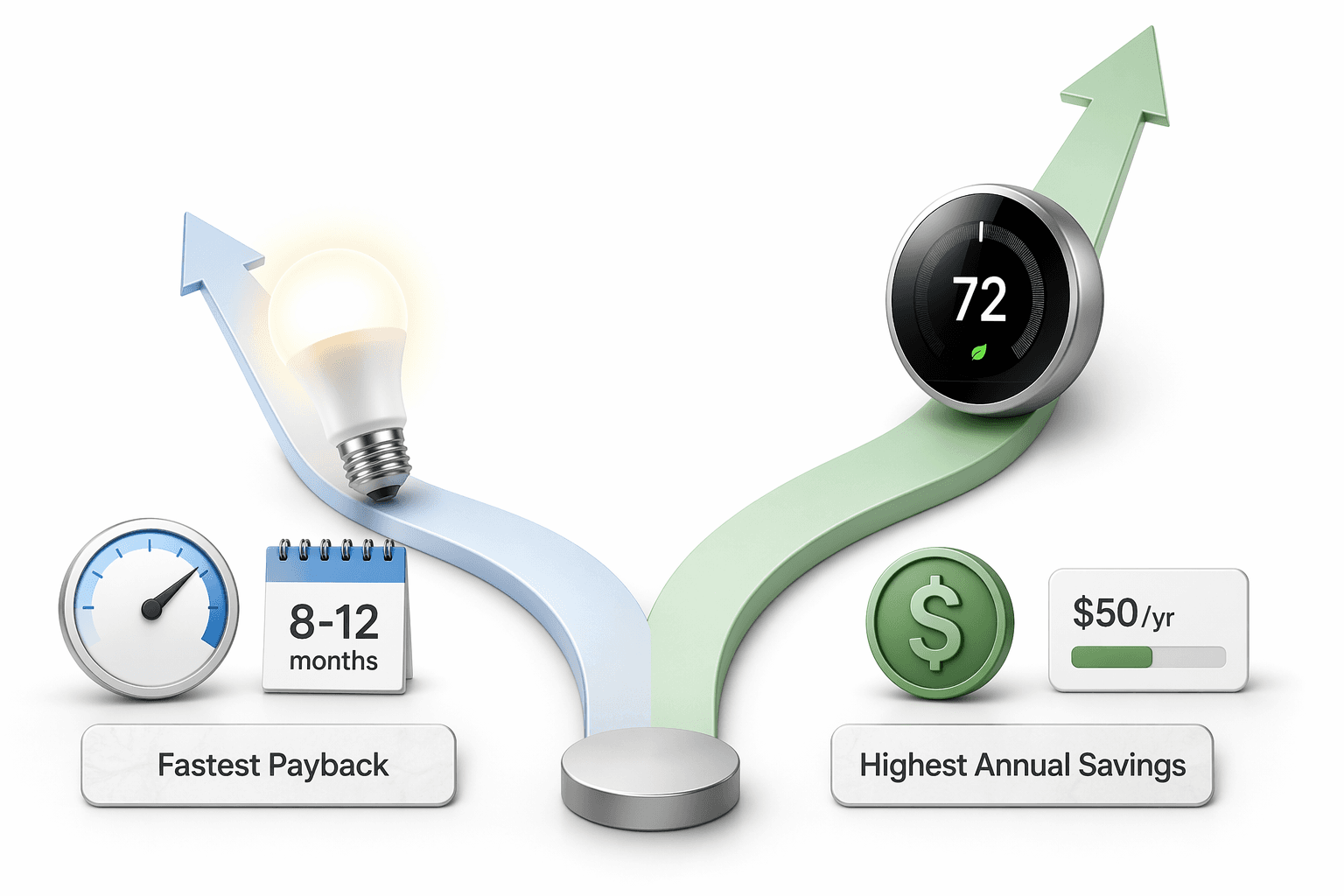
That ranking has one awkward feature: the device with the fastest payback is not the device with the largest annual savings. If the household argument is “when do we get our money back,” smart lighting usually goes first. If the argument is “which smart home devices lower the bill the most each year,” the thermostat gets the serious look.
The purchase order also changes if rebates are involved. The federal tax credit for qualifying smart thermostats expired on Dec. 31, 2025, so in 2026 the practical question is less “does this qualify federally” and more “does my utility still offer a rebate, and does the device qualify for it?”[2] A $50 utility rebate can move a thermostat from a sensible upgrade to a very fast payback; no rebate just means the math has to stand on annual HVAC savings.
Smart Lighting Wins the Speed Test
Lighting is the easiest place to get impatient with vague smart-home promises, because the old-fashioned part of the saving is already proven: replace wasteful bulbs with LEDs. The Department of Energy figure cited in Palmetto’s guide says LED lighting can use up to 90% less energy than incandescent lighting.[1] That is not a claim about an app, a hub, or a voice assistant. It is the bulb doing less work to produce the same light.
The “smart” part matters when it stops repeat waste: porch lights left on after sunrise, basement lights forgotten overnight, kids’ rooms glowing after everyone has gone downstairs. Schedules, motion sensors, dimming, and smart switches do not make an efficient LED magically efficient again; they reduce the hours when the light is on for no reason.
That is why lighting gets the first slot in a payback ranking. The cited estimate puts bulb-cost payback at about 8-12 months.[1] A smart switch or connected bulb costs more than a plain LED, so the payback depends on the specific product and the behavior it fixes. But if the starting point is incandescent or halogen bulbs, the upgrade is usually cleaner than most smart-home purchases: lower wattage immediately, automation if needed, and no dependence on your HVAC system, climate zone, or a complicated setup.
For installation details, a separate smart light switch guide is worth reading before replacing wall controls, especially in older homes where neutral wires are not guaranteed.
Smart Thermostats Save More Per Year, but the Starting Point Matters
A smart thermostat is the stronger annual-savings candidate because heating and cooling are large loads. ENERGY STAR’s FAQ reports average savings of about 8% on heating and cooling bills, or roughly $50 per year, based on field data from certified smart thermostats.[2] That is the number to use when nobody wants to argue about ideal use cases.
There are higher figures in the market, and they are not automatically nonsense. Some users can see 10-15% or more when the thermostat replaces a non-programmable model, when the home previously held one temperature all day, or when the household accepts more aggressive setbacks.[3][4] Manufacturer claims that reach above those conservative averages usually describe better starting conditions, stronger behavior changes, or narrower assumptions. That is not the same thing as the average household result.
The thermostat is therefore the best “absolute dollars” buy when the home has real HVAC waste. It learns or follows schedules, reduces conditioning when the home is empty, and can make setbacks less annoying because the house recovers before people return. The savings show up most clearly when someone used to forget to adjust the thermostat, when the house is empty for predictable blocks of time, or when the previous thermostat was basic and poorly used.
Payback is still purchase-specific. ENERGY STAR’s roughly $50 annual average makes a low-cost or rebated thermostat easier to justify than a premium model bought mainly for display quality or ecosystem features.[2] If a utility rebate knocks the upfront cost down, the payback can compete with lighting. If there is no rebate and the existing thermostat is already programmed well, the annual savings may still be real but slower to recover.
For deeper thermostat math, see Smart Thermostat Savings in 2026 and the Smart Thermostat Buyer’s Guide 2026. Model comparisons matter more here than they do with basic LED replacement, because compatibility, rebates, remote sensors, and HVAC type can change the result.
Smart Plugs Only Pay When They Control Real Standby Waste
Smart plugs are tempting because they are cheap, visible, and easy to install. Their weakness is that they do not save anything by existing. They save when they cut power to devices that draw electricity while idle.
The target is standby load, often called vampire load. The cited estimates put standby use at about 5-10% of typical home energy consumption, or about $100-$140 per year, and suggest smart plugs or power strips can eliminate 80-90% of that waste when applied to the right loads.[3][4] That last condition does a lot of work.
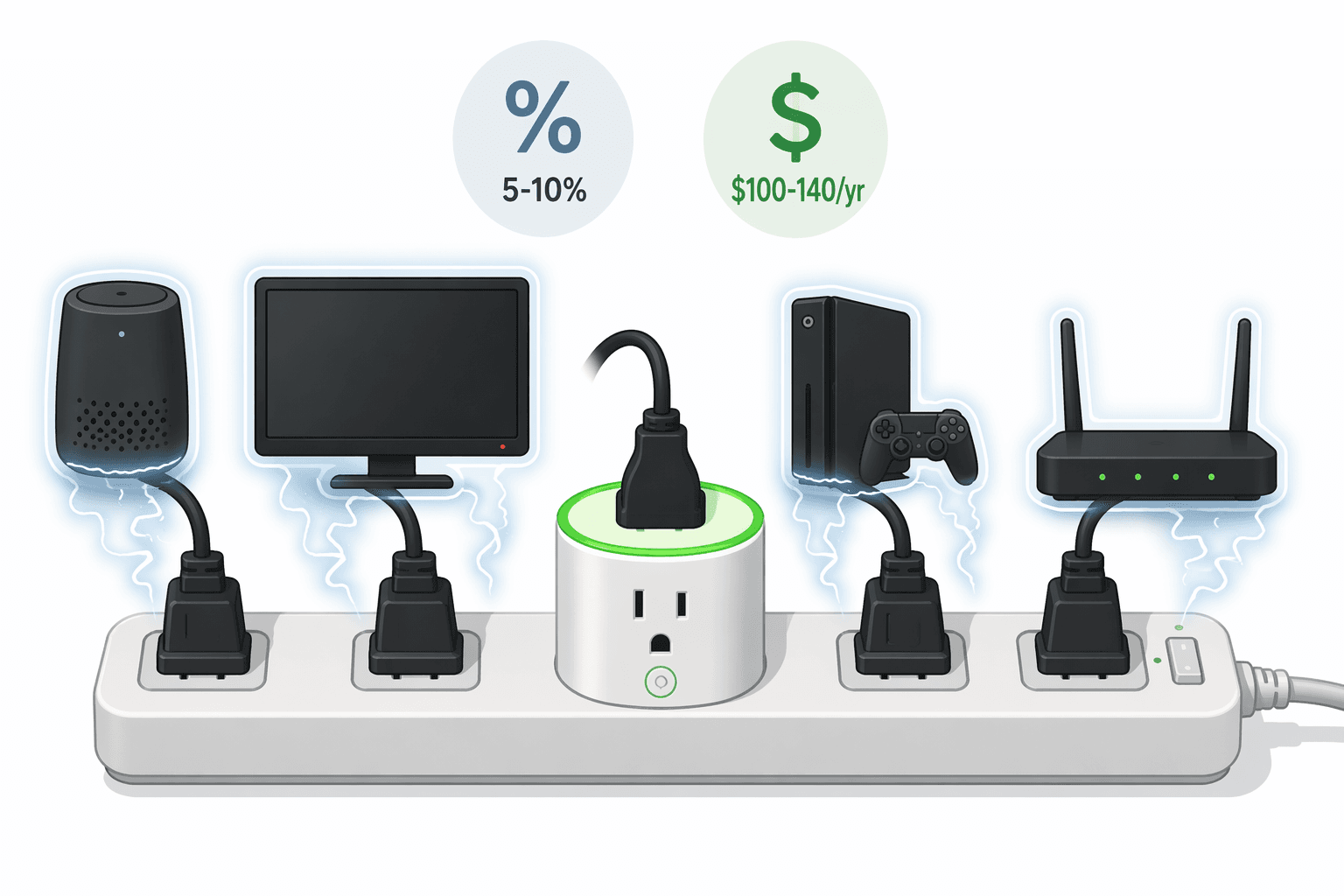
A plug on a lamp that already uses an LED and is rarely left on is mostly a convenience purchase. A plug or smart strip on a TV cabinet, game console cluster, desktop setup, printer, charger station, or guest-room electronics bundle has a better chance of doing bill work. The payback can fall under 2 years when the controlled devices actually had meaningful idle draw.[3]
- Good targets: entertainment centers, computer desks, rarely used printers, chargers, and devices that feel warm while “off.”
- Weak targets: refrigerators, routers, medical devices, security equipment, and anything that should remain continuously powered.
- Best use: group idle devices on one smart strip instead of buying a separate plug for every outlet.
Water Heating and Irrigation Are Fit-Dependent
Smart water heater controls and smart sprinkler controllers belong in the “maybe very good, maybe not worth it” pile. Their value depends less on the category name and more on the home.
A water-heater control has a clearer case when hot-water demand follows a schedule, electricity rates vary by time of use, or the existing water heater keeps a large tank hot during long empty periods. The case is weaker when the household’s hot-water use is unpredictable or when the control adds complexity without changing run time.
A sprinkler controller is similar. It can avoid watering during rain, adjust schedules, and reduce waste in a yard that is currently overwatered. But the energy bill is not always where the savings show up. In many homes the benefit is lower water use, healthier irrigation timing, or avoided runoff. If water is inexpensive, the yard is small, or outdoor watering is already minimal, payback stretches.
Do Not Count Cameras, Speakers, or Displays as Energy Savers
Security cameras, smart speakers, and smart displays can be useful devices. They can make a home easier to control, add security features, and give other smart devices a common interface. That is different from lowering the utility bill.
A speaker that turns lights off by voice is not the source of the energy saving; the lighting control is. A display that shows energy use may help someone notice waste, but the display itself is another powered device. If the purchase has to justify itself through energy ROI, these should sit outside the savings budget.
Be Careful With Whole-Home Savings Claims
Large smart-home savings claims usually come from layered systems, not one gadget. Blue Ridge Energy describes 30-40% smart-home savings as a broad industry estimate, while actual results vary by home, behavior, and device mix.[5] That kind of number should not be used to justify buying a camera, display, and speaker bundle and expecting the bill to drop by a third.
The more defensible whole-home case is a coordinated Smart Home Energy Management System, or SHEMS. ENERGY STAR covers SHEMS as a category, and the ROI material cited in the research brief points to 20-35% total household energy reduction and 300-600% 10-year ROI for layered approaches under favorable assumptions.[3][6] That is a system-level claim, not a shortcut around device-level math.
A SHEMS approach makes sense when the home is ready to coordinate thermostat control, lighting, plugs, energy monitoring, and possibly time-of-use behavior. For a homeowner buying one or two devices at a time, it is better treated as an expansion path than as the first purchase justification. A home automation setup guide is more useful at that stage than another list of gadgets.
Purchase Priority by Goal
| If your goal is... | Buy first | Buy next | Skip for energy ROI |
|---|---|---|---|
| Fastest payback | LEDs, smart bulbs, or smart switches where lights are often left on | Smart plugs for verified standby loads | Cameras, speakers, displays |
| Highest annual dollar savings | Smart thermostat, especially with a utility rebate or poor existing thermostat habits | Lighting upgrades, then plugs | Premium ecosystem devices bought mainly for interfaces |
| Whole-home coordination | Thermostat plus lighting and plug controls that can work together | Energy monitoring, SHEMS-compatible devices, time-of-use routines | Standalone gadgets that cannot control major loads |
| Water or outdoor savings | Smart sprinkler controller or water-heater control only if the use case is strong | Rate-aware or schedule-aware controls | Universal claims that ignore climate, rates, or usage |
The practical order is simple enough to write on the same note as the utility bill: start with smart lighting if payback speed matters most; start with a smart thermostat if annual savings matter most; add smart plugs where standby waste is real; treat water heating and irrigation controls as household-specific; do not buy cameras, speakers, or displays expecting direct energy savings.
References
- Smart Home Energy Saving Devices That Save You Money, Palmetto
- Smart Thermostat FAQ, ENERGY STAR
- Smart Home Energy Savings: A Complete Guide to Cost-Effective Automation and Payback Periods, Vesternet
- Do Smart Home Devices Actually Save Money?, BKV Energy
- Smart Home Devices: Can You Really Save Energy?, Blue Ridge Energy
- Smart Home Energy Management Systems, ENERGY STAR
Data Updates
Know about updated rebate programs, changed subscription prices, or new ENERGY STAR certifications? Submit a note below to help keep this content current. For formal data corrections, use the contact page.
Comments
Join the discussion with an anonymous comment.