Start at the wall, not at the product page. A Z-Wave thermostat only makes sense after you know whether the thermostat location has standard 24VAC HVAC control wiring, line-voltage electric heat wiring, a usable C-wire, or a battery-only situation. Most bad thermostat purchases happen before anyone opens a hub app.
For most standard low-voltage forced-air, boiler, or heat-pump systems, the Honeywell Home T6 Pro Z-Wave TH6320ZW2007/U is the safest general pick in 2026. It supports up to 3H/2C heat pump systems, offers Z-Wave Plus with SmartStart, can run from a C-wire or batteries, and carries a 5-year warranty on the current Resideo-listed model.[1][2] That does not make it universal. It does not solve line-voltage baseboard heat, and battery operation changes how it behaves in the Z-Wave mesh.
| Model | HVAC fit | Power and wiring | Z-Wave features | Hub support | Best fit |
|---|---|---|---|---|---|
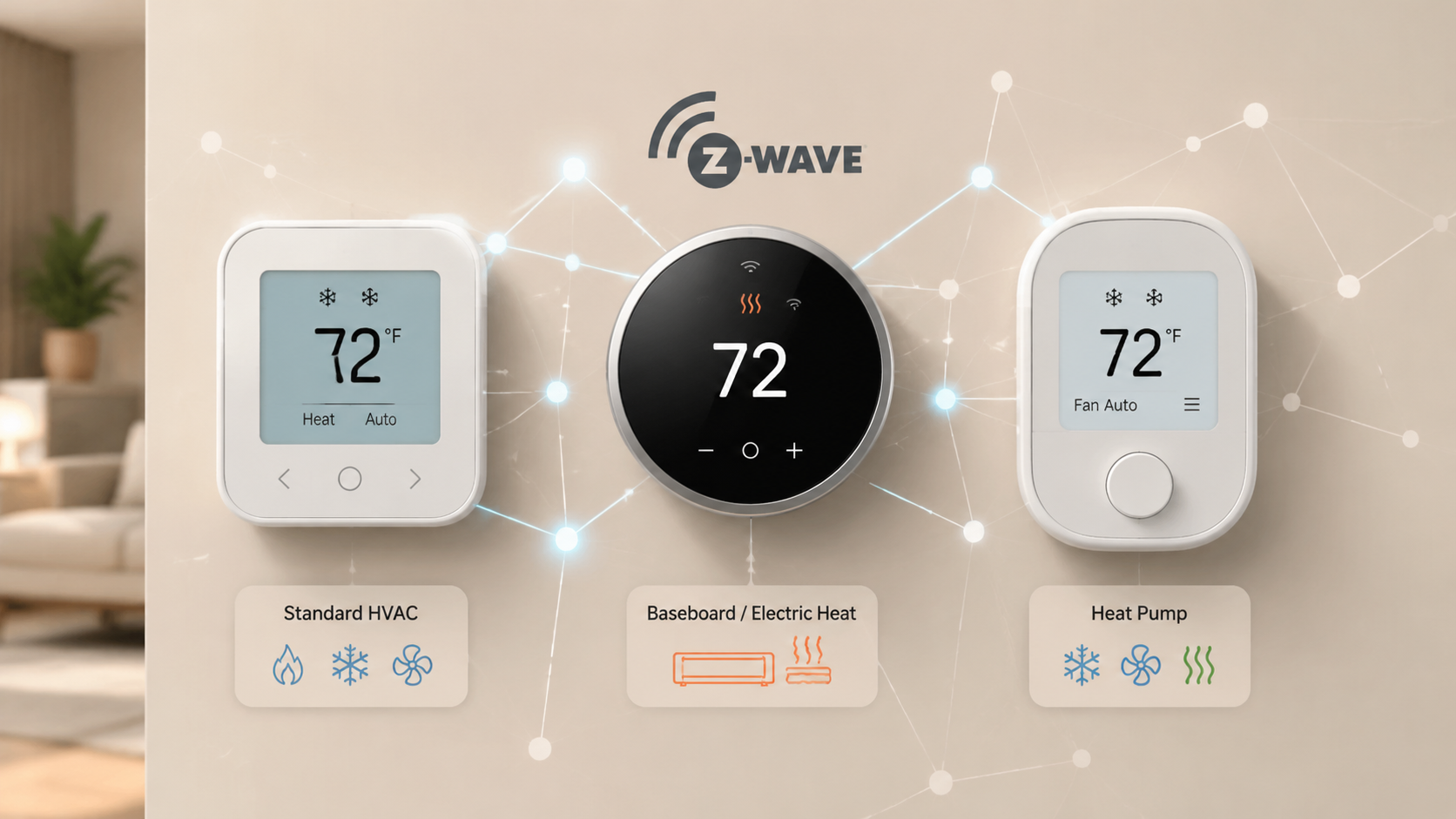
| Honeywell Home T6 Pro Z-Wave TH6320ZW2007/U | Standard 24VAC systems; up to 3H/2C heat pump | C-wire or battery operation | Z-Wave Plus, SmartStart | SmartThings, Hubitat, Home Assistant, HomeSeer, Alarm.com, 2GIG panels, and most Z-Wave controllers; older Vera reports are mixed | Best overall for most low-voltage homes |
| GoControl / 2GIG Z-Wave thermostat | Standard 24VAC systems | Battery-powered; no C-wire required | Older Z-Wave thermostat class depending on version | Commonly used with 2GIG, Alarm.com-adjacent panels, and general Z-Wave hubs | Budget no-C-wire choice when battery maintenance is acceptable |
| Stelpro KI STZW402WB+ | Line-voltage electric baseboard and convector heat | Designed for 120V/240V electric heating circuits | Z-Wave thermostat for electric heat niche | Z-Wave controllers that support thermostat devices | The practical pick for line-voltage baseboard homes |
| Ecolink TBZ500 | Standard 24VAC systems | 4 AA batteries; manufacturer claims up to 24 months | Z-Wave Plus, S2 security, SmartStart, Long Range, OTA firmware updates | Z-Wave hubs with support for newer thermostat features | Newer battery-powered alternative with modern Z-Wave features |
| Ezlo TSTAT 800 and other newer 800-series options | Model-dependent; verify HVAC terminals before buying | Model-dependent | 800-series direction: SmartStart, S2, Long Range where supported | Best with controllers that properly support newer Z-Wave features | Buyers prioritizing current-generation Z-Wave capabilities |
| Remotec ZTS-500 and secondary catalog models | Usually standard low-voltage use; verify model-specific terminals | Model-dependent | Varies by SKU | Depends heavily on controller integration | Replacement or niche situations, not the default first choice |
If you do not already have a controller, keep that decision on the same checklist. Z-Wave thermostats are not Wi-Fi thermostats with a different radio; they need a Z-Wave controller for pairing, automation, and remote access. The hub decision is its own rabbit hole, so readers still choosing hardware should compare options in Best Z-Wave Hub in 2026 or get the protocol basics from Z-Wave Explained before buying a thermostat.
The First Split: Low-Voltage HVAC or Line-Voltage Heat
A standard 24VAC thermostat usually controls equipment somewhere else: furnace, air handler, heat pump, boiler relay, compressor, fan. The thermostat wires are control wires. You will see terminals such as R, Rc, Rh, C, W, Y, G, O/B, Aux, or E. That is the world where the Honeywell T6 Pro, GoControl/2GIG, Ecolink TBZ500, and most Z-Wave thermostats live.
Line-voltage electric heat is a different animal. If the thermostat is directly switching 120V or 240V baseboard or convector load, a low-voltage Z-Wave thermostat does not belong there. The Stelpro KI STZW402WB+ matters because it is listed by Z-WaveProducts as a Z-Wave thermostat for electric baseboard and convector heating, the compatibility dead-end that most general smart thermostat roundups skate past.[3]
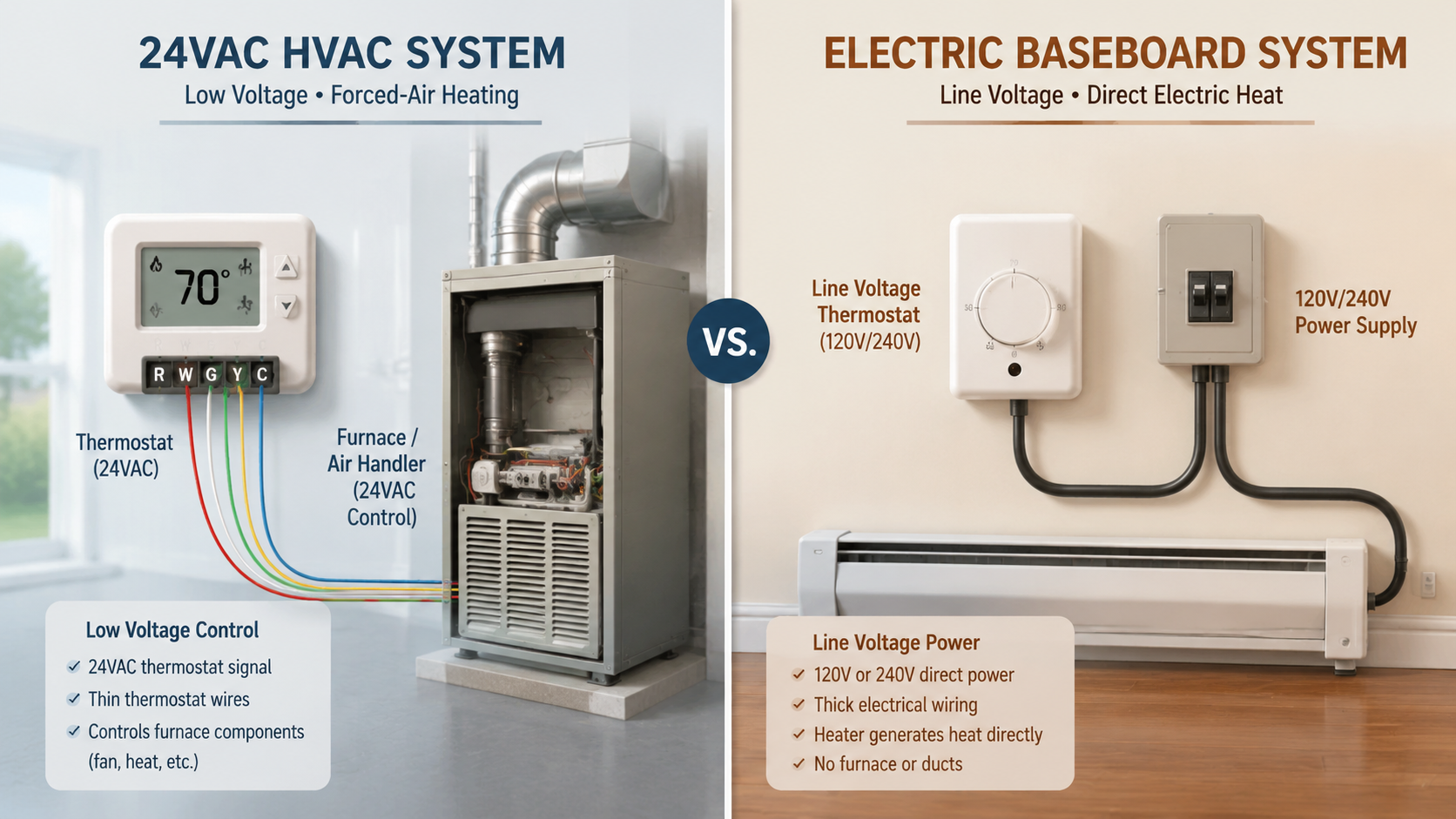
The practical test is simple enough: remove the old thermostat from the wall after cutting power as appropriate and inspect the wiring and labels. Thin low-voltage control conductors on HVAC terminals point one way. Heavier line-voltage wiring, high-voltage labels, or direct baseboard switching points the other way. If the old thermostat controls electric baseboard heat and there is no separate low-voltage relay system, do not try to force a T6 Pro into that box.
Honeywell T6 Pro Z-Wave: The Boring Pick That Usually Wins
The T6 Pro Z-Wave is not exciting in the way new smart home gear tries to be exciting. That is part of the appeal. The current TH6320ZW2007/U model is the one to look for, not older references to the discontinued TH6320ZW2003/U. Resideo lists the TH6320ZW2007/U as a T6 Pro programmable thermostat with SmartStart, and Honeywell Home’s product page describes the T6 Pro Z-Wave as supporting Z-Wave Plus, battery or C-wire power, and up to 3H/2C heat pump configurations.[1][2]
That 3H/2C coverage is why it keeps showing up in real-world recommendations. A basic thermostat that only handles simpler heat/cool systems can be fine in a small gas-furnace house, then become useless when the actual equipment is a heat pump with auxiliary heat. The T6 Pro’s published equipment range covers more of the normal suburban HVAC mess before you have to go hunting for niche models.[1]
Community evidence points in the same direction, with the usual caveat that forums are field reports, not lab testing. A Zooz Community thread from March 2026 recommends the T6 Pro for a Z-Wave setup in a Texas heat-pump context, and a Home Assistant Community thread from 2025–2026 repeatedly treats the T6 Pro as a go-to local-control thermostat option.[4][5] That lines up with the official specs instead of replacing them.
The catch is that “C-wire or battery” is not a cosmetic choice. If you have a C-wire, use it. A C-wire gives the thermostat continuous low-voltage power and can improve how the device participates in the Z-Wave network. If you run it on batteries, it may still control the HVAC system, but it should be treated like a sleepy battery device rather than a powered mesh node.
Where the T6 Pro Does Not Fit
It is not for direct line-voltage baseboard control. It is not a magic fix for missing conductors if your HVAC wiring is unusual. It is also not the best choice if your whole buying reason is the newest Z-Wave silicon. The T6 Pro’s strength is that it is current, widely supported, and electrically appropriate for many 24VAC systems. That is enough, but it is not everything.
Battery Power Changes the Z-Wave Math
Z-Wave buyers often think in terms of mesh strength, and that is fair. Switches, plugs, relays, and powered modules can make a Z-Wave house more resilient by repeating traffic. Battery thermostats are different. Alarm Grid’s guidance is explicit: battery-powered Z-Wave thermostats do not act as repeaters, while hardwired Z-Wave thermostats can repeat depending on how they are powered and designed.[6]
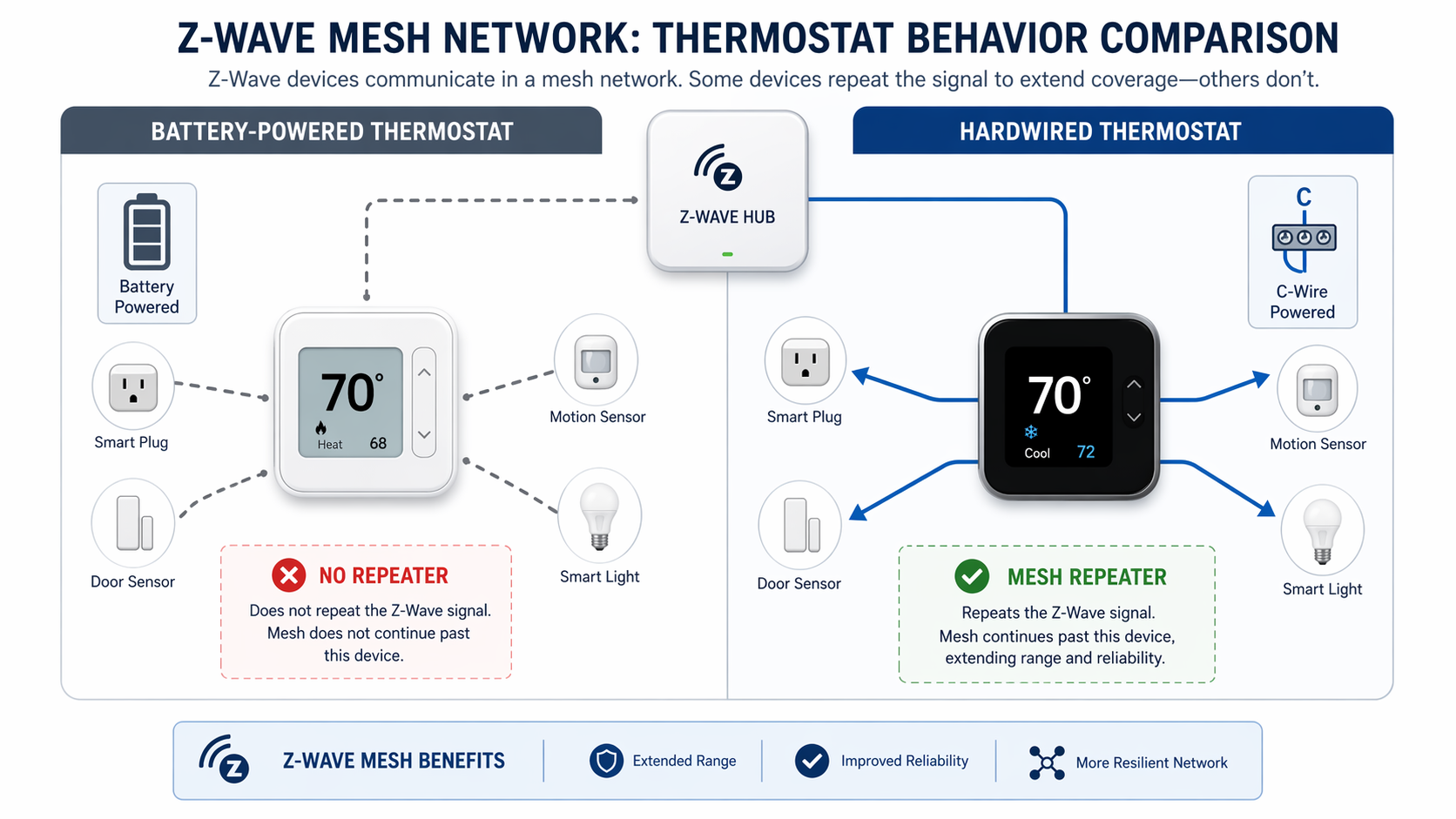
That one detail explains a lot of disappointing installs. A thermostat near the middle of the house feels like it should be a great repeater. If it is sleeping on batteries, it is not doing that job. Build the mesh with powered Z-Wave switches, plugs, or dedicated repeaters, then let the thermostat be a thermostat. If you are expanding the rest of the network, a comparison like Which Z-Wave Smart Switch Should You Buy in 2026? is more relevant to mesh health than another thermostat spec sheet.
Battery life claims deserve the same sober reading. They usually describe favorable conditions: clean mesh, modest wake-ups, limited polling, and normal usage. A thermostat on a chatty or weak network can burn through batteries faster because radio work costs power. That does not make a battery thermostat bad; it makes the maintenance cost part of the purchase.
GoControl and 2GIG: Cheap, Useful, and Not Maintenance-Free
The GoControl/2GIG thermostat earns its place for one boring reason: it can be the cheap no-C-wire answer. The research brief’s market read puts it around $70, and the same hardware is commonly discussed under GoControl and 2GIG branding. That makes it tempting in homes where pulling a C-wire is more work than the thermostat budget can justify.
The price is not the whole cost. Marketing claims around this class of thermostat have often pointed to roughly 2-year battery life, but multiple user reports cited in the research brief describe real-world life closer to about 3 months when the thermostat is active on a Z-Wave network. Treat that as community-reported experience, not a controlled average. Still, it is enough to stop reading “no C-wire required” as “install and forget.”
The right buyer is someone with a compatible 24VAC system, no easy C-wire, a hub that already supports the device, and realistic patience for battery swaps. The wrong buyer is someone expecting it to strengthen the mesh or behave like a modern powered thermostat.
Stelpro KI: The One to Notice for Electric Baseboard Heat
The Stelpro KI is not the broadest thermostat in this comparison, but it may be the most important one for the right house. Electric baseboard and convector homes often get excluded by low-voltage smart thermostat advice. Z-WaveProducts lists the Stelpro KI STZW402WB+ as a Z-Wave thermostat for electric baseboard and convector heating, which is exactly the category most of the better-known models do not cover.[3]
That narrow fit should be treated as a strength, not a limitation. If your wall box contains line-voltage electric heat wiring, the decision tree changes completely. Hub compatibility still matters, but only after the thermostat is appropriate for the electrical load. A beautiful Z-Wave device that belongs on 24VAC control terminals is not a substitute for a line-voltage thermostat.
Ecolink TBZ500 and the Newer 800-Series Direction
The Ecolink TBZ500 is the newer model to watch if you want battery operation but care about modern Z-Wave features. Ecolink lists S2 security, SmartStart, Z-Wave Long Range, OTA firmware updates, and up to 24 months of battery life from 4 AA cells.[7] Those are real feature improvements on paper, especially SmartStart and OTA updates, which answer long-standing pain points around inclusion and firmware maintenance.
The battery claim still belongs in pencil. “Up to 24 months” is a manufacturer claim under favorable conditions, not a promise that every Z-Wave mesh and every polling configuration will get there.[7] The TBZ500 is more interesting than old no-C-wire standbys because it brings newer Z-Wave capabilities, not because it suspends the usual battery-device tradeoffs.
The same caution applies to Ezlo TSTAT 800 and other emerging 800-series thermostats. SmartStart, S2, Long Range, and OTA support are worth caring about when both the thermostat and the hub implement them well. They do not override HVAC compatibility, and they do not help if the controller’s thermostat integration is half-finished.
Hub Compatibility Comes After the Terminals
Once the thermostat is electrically plausible, then it is time to care about the ecosystem. The T6 Pro is the easiest model to recommend here because it is widely used with SmartThings, Hubitat, Home Assistant, HomeSeer, Alarm.com, 2GIG panels, and most Z-Wave controllers, while the research brief notes some reported issues with older Vera setups. Community discussions on Home Assistant and Hubitat also show why local thermostat control remains a recurring reason people stay interested in Z-Wave instead of moving everything to Wi-Fi.[5][8]
Home Assistant users should check the current Z-Wave JS behavior for their exact model, but the T6 Pro has enough field history to be a sensible starting point. For a wider local-control thermostat comparison, see Best Thermostats for Home Assistant. Hubitat users should do the same kind of driver and community-thread check before assuming every thermostat attribute will expose cleanly.
Alarm.com and 2GIG panel users have a different decision pattern: the alarm panel may already be the Z-Wave controller, so thermostat selection often follows the panel’s supported-device list. That can make GoControl/2GIG hardware more attractive than it would be for a Home Assistant build, especially when a professional security ecosystem is already in place.
The oddball in this category is the TRANE XL850. It can act as its own Z-Wave hub, but the research brief notes that expanded device control requires a subscription. That makes it less like a normal Z-Wave thermostat joining your hub and more like a thermostat-panel hybrid. It may fit a specific Trane-centered installation, but it is not the clean answer for someone building around SmartThings, Hubitat, Home Assistant, or HomeSeer.
Local Control Is the Real Reason to Choose Z-Wave
The best reason to buy a Z-Wave thermostat is not that the touchscreen looks nicer. It is that the thermostat can be part of a local automation system. Alarm Grid states that Z-Wave thermostats can be controlled without internet when paired to a local controller, though remote access and app features depend on the broader system.[9] That distinction matters during internet outages, app outages, account migrations, and vendor decisions you did not vote for.
This is where Z-Wave differs from many popular Wi-Fi thermostats. Nest, Ecobee, and similar products can be excellent consumer thermostats, especially for app polish and remote sensors, but they are not the same buying problem. Readers still deciding between cloud-first Wi-Fi thermostats and hub-based thermostats should compare that tradeoff separately in Best Smart Thermostat: Nest vs Ecobee vs Honeywell vs Amazon.
Energy savings are worth keeping in view, but they should not decide this comparison. Alarm Grid cites older smart-thermostat savings estimates of about 10% on heating, 15% on cooling, and roughly $130 per year on average.[10] Those are broad, 2018-era ballpark figures, not guarantees for 2026 utility rates, insulation, climate, or household behavior. A thermostat can make setbacks and automations easier; it cannot fix a leaky house or a badly configured HVAC system by itself.
What to Buy
- Choose the Honeywell Home T6 Pro Z-Wave TH6320ZW2007/U for most standard 24VAC systems, especially if you have or can add a C-wire and want the safest local-control recommendation.
- Choose the Stelpro KI STZW402WB+ for line-voltage electric baseboard or convector heat, where ordinary low-voltage Z-Wave thermostats do not belong.
- Choose the GoControl/2GIG thermostat only when price and no-C-wire operation matter more than modern Z-Wave features and battery maintenance.
- Consider the Ecolink TBZ500 if you want a battery-powered thermostat with newer Z-Wave features such as S2, SmartStart, Long Range, and OTA updates, while treating battery-life claims cautiously.
- Consider Ezlo TSTAT 800 or other 800-series options only after confirming both HVAC terminal compatibility and real support in your chosen hub.
The short version is still the one worth following: match the thermostat to the HVAC wiring first, settle the power question second, then worry about hub support. A Z-Wave thermostat that passes those three checks will be much less dramatic than the one with the better-looking product photo.
References
- Honeywell Home T6 Pro Z-Wave official product page, Honeywell Home.
- Resideo Pro T6 Pro with SmartStart, Resideo.
- Z-WaveProducts Thermostats collection, Z-WaveProducts.
- Best smart thermostat for Z-Wave setup - which one should I buy? Need your advice, Zooz Community, March 2026.
- Thermostat most compatible with HA, Home Assistant Community.
- What is the Best Z-Wave Thermostat?, Alarm Grid.
- Ecolink TBZ500 official page, Ecolink.
- Z-Wave or Zigbee thermostat suggestions please, Hubitat Community.
- Can I Control My Z-Wave Thermostats w/o Internet?, Alarm Grid.
- How Much Money Will I Save Using A Smart Thermostat?, Alarm Grid.
Corrections & Community Notes
Spotted an outdated spec, changed compatibility, or new firmware behavior? Submit a correction below to help keep this profile current. For formal editorial updates, use the contact page.
Comments
Join the discussion with an anonymous comment.