A used Google Home Max in 2026 is still a tempting buy for one simple reason: it remains the most serious speaker Google ever sold under its own smart-home brand. If the listing is around $150–$300, the question is not whether the hardware was ambitious. It was. The question is whether that price makes sense for a discontinued, AC-powered speaker with Bluetooth 4.2, no Matter or Thread, no Gemini support, and a shrinking feature story.
The short verdict: the Google Home Max is still worth considering if you want room-filling sound, deep bass, Google Cast, and Google Assistant in one heavy box. It is a poor buy if you are shopping for a future-facing smart-home hub, TV speaker, portable speaker, or Gemini-first device. This is a speaker to buy for sound first, and only at a price that admits Google has already moved on.
Google Home Max Specs
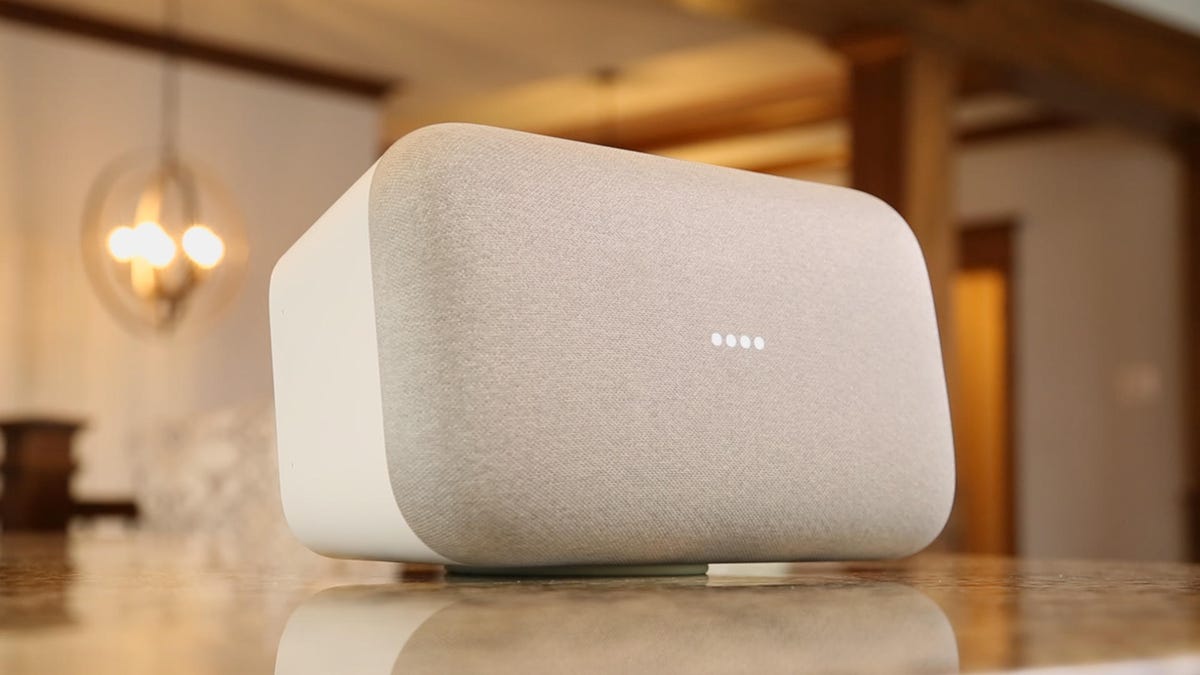
The Home Max is not a Nest Mini scaled up. It is a large, heavy, mains-powered speaker built around a real stereo driver array. Google lists its dimensions at 13.2 × 7.4 × 6.0 inches, or 336 × 190 × 153 mm, with a weight of 11.68 pounds, or 5.3 kg.[1]
| Category | Google Home Max specification |
|---|---|
| Dimensions | 13.2 × 7.4 × 6.0 in / 336 × 190 × 153 mm [1] |
| Weight | 11.68 lb / 5.3 kg [1] |
| Woofers | Two 4.5-inch high-excursion dual voice-coil woofers [1] |
| Tweeters | Two 0.7-inch custom tweeters [1] |
| Microphones | Six far-field microphones [1] |
| Wireless | Wi-Fi 802.11ac, Bluetooth 4.2, Google Cast [1] |
| Smart-home radios | No Matter, Thread, Zigbee, or Z-Wave listed in the official specifications [1] |
| Power | AC powered; no battery [7] |
| Wired source input | No auxiliary input for a wired TV or external source connection [7][8] |
Those numbers explain both the appeal and the inconvenience. At more than 11 pounds, the Home Max feels overbuilt by smart-speaker standards. It is also not something you casually move from room to room. It wants a shelf, console, sideboard, or kitchen counter with a nearby outlet and enough clearance for a front-firing speaker to breathe.
Why It Still Sounds Like the Serious Google Speaker
The Home Max was built around displacement, not just voice-assistant convenience. Two 4.5-inch high-excursion woofers give it bass capability that Google’s smaller smart speakers were never physically equipped to match, while the two 0.7-inch custom tweeters handle the upper range.[1] That driver layout is the main reason the speaker still attracts used buyers years after its retail life ended.
DxOMark gave the Google Home Max an overall speaker score of 145 and measured maximum volume at 91.9 dBA using correlated pink noise. At the time of that review, DxOMark described it as the second-best wireless speaker it had tested, with strong performance for volume and bass.[2] That is not a vague reputation score passed around in forum threads; it is one of the few published test results that puts the Home Max’s output into a comparable frame.
There is a caveat: that DxOMark result belongs to the speaker’s active lifecycle. No published retest confirms whether later firmware changed the tuning, processing, or volume behavior. The score is still useful as evidence of the hardware’s capability, but it should not be treated as a fresh 2026 lab measurement.
The six microphones are not only for hearing voice commands from across a room. They also support Google’s Smart Sound system, which includes Room EQ and Media EQ. Room EQ uses machine-learning-based calibration to adjust playback to room acoustics within seconds, while Media EQ changes equalization depending on content type, such as music, podcasts, or movies.[3]
In practice, that matters because a big smart speaker often ends up exactly where it fits, not where an audio installer would place it. Smart Sound cannot repeal physics, but it was a sensible answer to real placement: pushed near a wall, sitting on a cabinet, or sharing space with hard kitchen surfaces. The Home Max is not just loud; it was designed to notice that the room is part of the sound.
The limitation is dispersion. Reviews noted that the Home Max’s front-firing design can produce less even sound distribution than omnidirectional speakers.[7] That does not ruin it as a music speaker, but it changes placement priorities. It works best when aimed into the room rather than treated like a little voice puck that can be hidden anywhere.
Connectivity Is Useful, but Frozen in an Older Era
For music, the useful pieces are still Wi-Fi, Google Cast, and Bluetooth. The less flattering part is the version line: Bluetooth 4.2 is old, and the official specifications do not list Matter, Thread, Zigbee, or Z-Wave.[1] If you want a speaker that doubles as a modern smart-home bridge, this is the wrong box.
The lack of a wired auxiliary input is also more annoying now than it may have looked at launch. A Home Max can be a strong music speaker, but it is not a clean substitute for a soundbar or powered TV speaker. CNET and SoundGuys both identified the absence of wired input as a practical limitation.[7][8]
That leaves the Home Max in a narrower but still real lane: cast music to it, group it with compatible Google speakers where your setup allows, use voice control for ordinary Assistant tasks, and enjoy a much bigger sound than most Google-branded smart speakers provide. The narrower lane is not a failure if that is exactly what you need. It becomes a failure only if the listing is priced like a modern platform device.
Discontinuation and Support Timeline
Google announced the Home Max on October 4, 2017, and launched it on December 11, 2017, at $399.[4] The price later fell to $349, then $299, then $179 in late 2020, with a $149 Black Friday 2020 price before the product disappeared from Google’s lineup.[4]
Google discontinued the Home Max on December 14, 2020.[4] Remaining stock sold out by January 26, 2021, according to 9to5Google.[5] That retail history matters because it shows both sides of the device: Google built it as a premium speaker, but the market did not keep rewarding it at the original premium price.
At discontinuation, Google said it would continue software updates, but the scope of ongoing support in mid-2026 remains unclear.[4] That distinction matters. A device can still function, still receive some maintenance, and still lose meaningful features over time.
The clearest example is Nest Aware sound detection. Home Max lost support for smoke alarm and glass break listening effective May 8, 2025, while the feature remained on other Nest devices.[6] That is the kind of ownership change that spec sheets hide. The speaker did not stop being a speaker, but it became a little less of the smart-home device some owners had paid for.
What to Check Before Buying Used in 2026
Used Home Max pricing is volatile enough that the number alone should not make the decision. A clean unit around the lower end of the current $150–$300 marketplace range is a different proposition from a worn unit near the top of that range. Stereo pairs can climb higher, but a pair also doubles the risk of buying old hardware with no clear long-term feature roadmap.
- Confirm the speaker powers on and completes setup in the Google Home app before treating it as a safe buy.
- Check the fabric, rubber base, power cable, and rear port area for damage; the 5.3 kg cabinet is sturdy, but drops and cable strain still matter.
- Ask whether the seller has factory reset it and removed it from their home/account.
- Do not pay extra for Nest Aware sound detection; that Home Max feature was removed in May 2025.[6]
- Do not assume Matter, Thread, Gemini, or future Assistant feature parity will arrive later.
- Treat stereo-pair pricing carefully; two old premium speakers are still two discontinued devices.
The best used listings are boring: local pickup or a seller with strong return protection, clear photos, the original power cable, confirmation of factory reset, and no magical claims about future support. The riskiest listings lean on words like “rare” or “legendary” while skipping the ordinary proof that the thing still works.
How It Fits Beside Newer Google Speakers
Google has not released another premium-priced single smart speaker in the same mold since discontinuing the Home Max. The newer direction is different: the Google Home Speaker launched on June 25, 2026, as a $99 product with Gemini, spatial audio, and Matter/Thread support.[9] That makes it a strategic signal more than a direct replacement.
Because full independent comparison data for that new speaker is not established as of July 1, 2026, it would be premature to declare it better or worse for sound. The safer distinction is functional. The new speaker is the modern smart-home and AI direction; the Home Max is the older high-output audio direction.
That split should decide the purchase. If you want Gemini, Matter/Thread, current platform investment, and a product Google is actively selling, the Home Max is the wrong target. If you want the biggest-sounding Google speaker available on the used market, and you can live with the aging platform around it, the Home Max still has a case.
Who Should Still Buy a Google Home Max?
A used Google Home Max makes sense for someone who wants a powerful Google Cast speaker for music, has a fixed AC-powered location for it, and values bass and volume more than current smart-home radios. It also makes sense for current Google Home users who want to add one serious speaker without rebuilding the whole system around a different ecosystem.
It makes less sense for anyone buying a first smart speaker in 2026. The missing Matter and Thread support, Bluetooth 4.2, discontinued status, removed sound detection feature, and uncertain software horizon are not minor footnotes. They are the cost of choosing an older device because its speaker hardware was unusually good.
Buy it only if audio quality inside the Google ecosystem matters more than future platform features, and only at a price that reflects its discontinued status. Skip it if Gemini, Matter/Thread, active feature development, TV connectivity, portability, or long-term support are central to the purchase.
References
- Google Nest and Home device specifications — Google Help
- Google Home Max Speaker review: Powerful and well-balanced — DxOMark
- Smart Sound for Google Home Max — Google Help
- Google Discontinues Home Max Smart Speaker — PCMag
- Google Home Max officially discontinued — 9to5Google
- Google Home Max users are losing one very important feature — Yahoo/T3
- Google Home Max review — CNET
- Google Home Max review — SoundGuys
- Google is set to release the new Home Speaker — Android Central
Corrections & Community Notes
Spotted an outdated spec, changed compatibility, or new firmware behavior? Submit a correction below to help keep this profile current. For formal editorial updates, use the contact page.
Comments
Join the discussion with an anonymous comment.