
Best Smart Home Security Systems for Renters in 2026
Renters face unique challenges when choosing a security system: no drilling, no contracts, and full portability. This guide compares the top renter-friendly systems and recommends the best pick based on your budget, ecosystem, and monitoring needs.
Last updated
Renters are no longer the side audience for smart home security systems. In SafeHome.org’s February 2026 survey of 2,435 U.S. adults, 54% of renters said they had security cameras, up from 42% the year before — the sharpest one-year gain in its dataset.[1] Renters also showed higher purchase intent than homeowners for security cameras, video doorbells, and alarm systems: 30% vs. 28% for cameras, 27% vs. 19% for doorbells, and 14% vs. 10% for alarm systems.[1]
That is the interesting part. The frustrating part is that alarm adoption among renters has stayed at 20% for two years.[1] The gap is not hard to explain if you have ever stood in an apartment doorway wondering whether a “simple” installation is about to become a lease violation. A renter-friendly system has to do more than detect motion. It has to come off cleanly, survive a move, and avoid locking you into a monitoring plan or relocation fee that assumes you own the address.
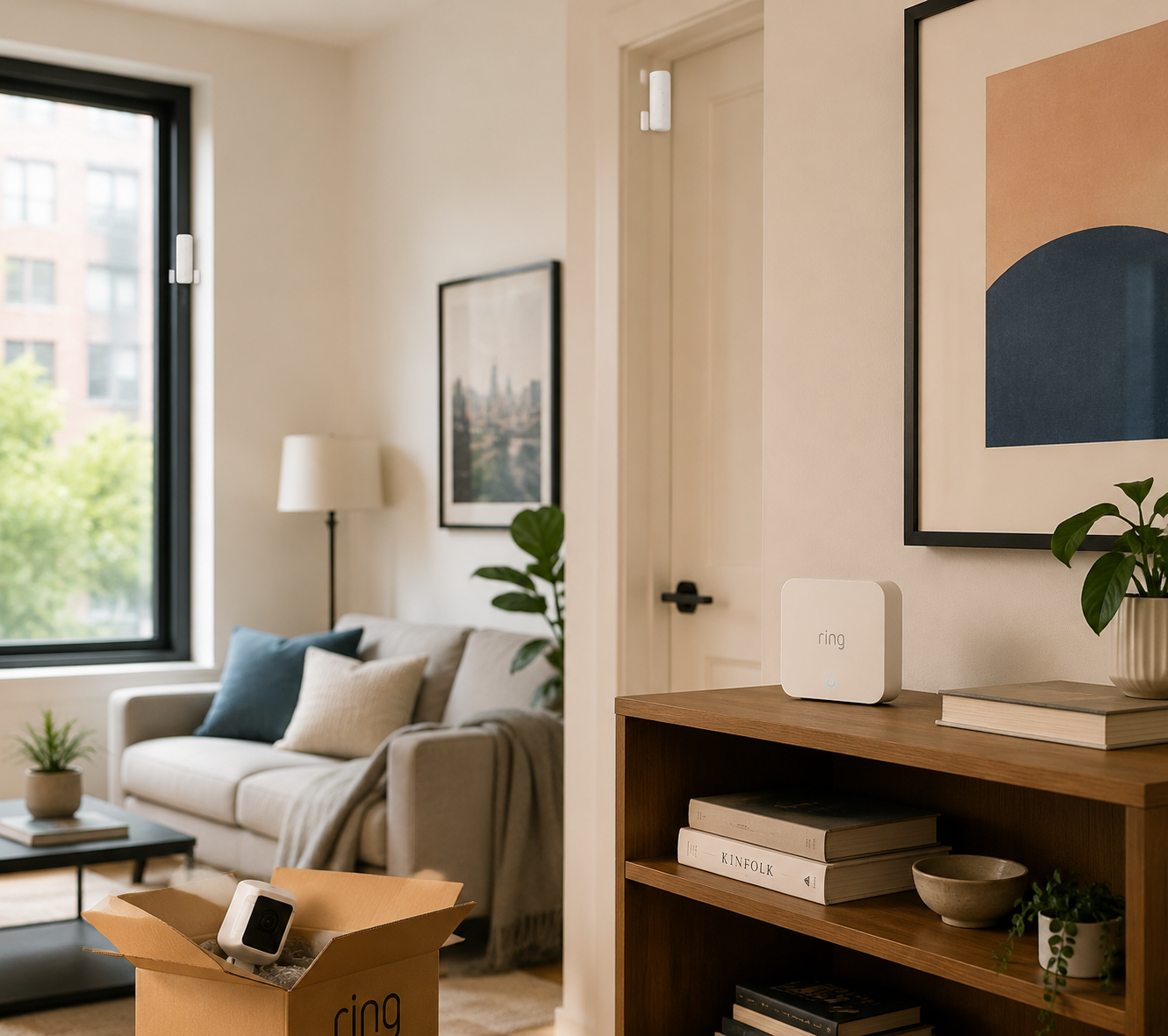
The renter test comes before the brand name
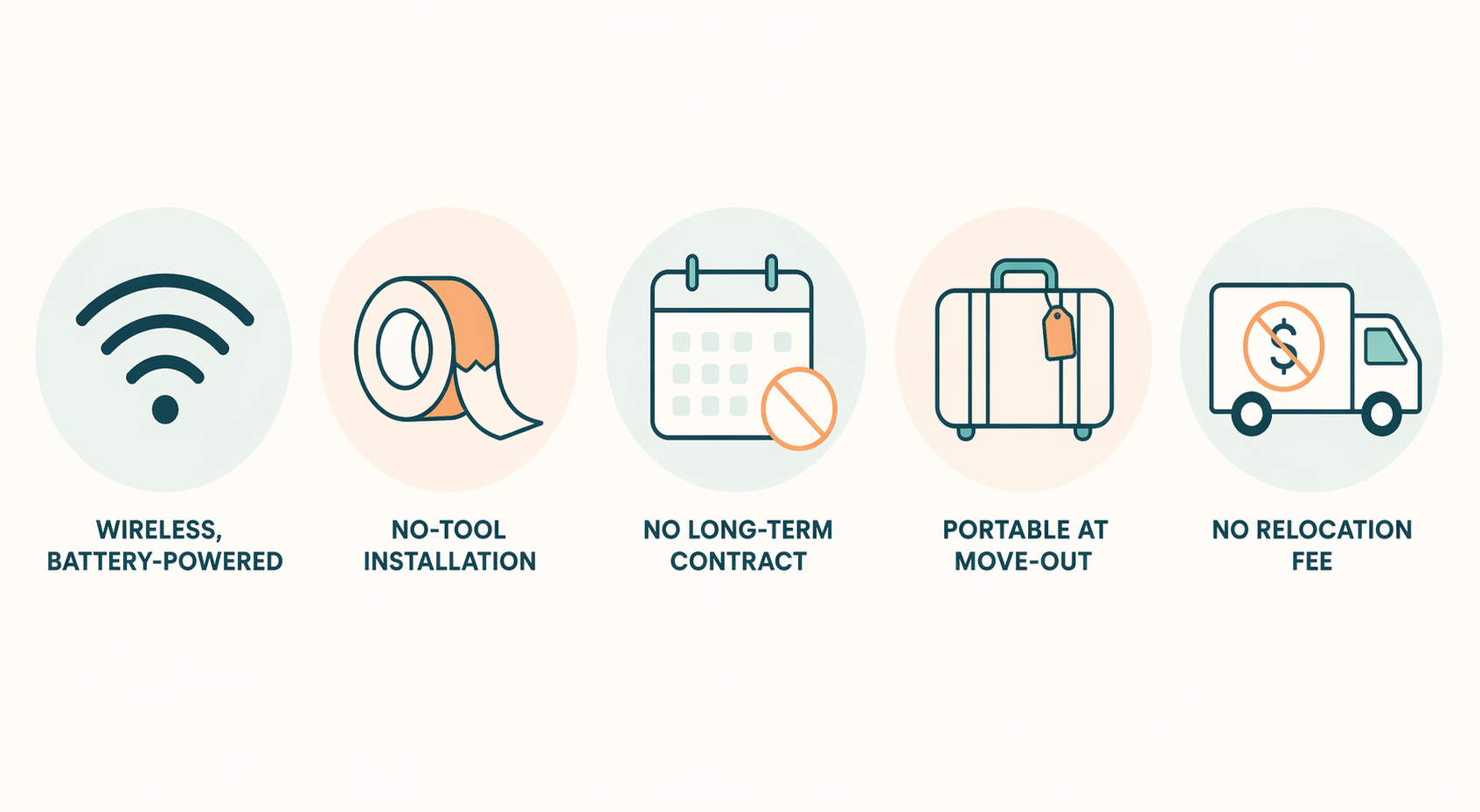
Before comparing kits, I would put every system through five rental-life tests. If a system fails one of these, it may still be a good homeowner system, but it becomes harder to recommend for an apartment.
| Renter test | What it means in practice | Why it matters at move-out |
|---|---|---|
| Wireless or battery-powered hardware | Sensors, keypad, cameras, and hub do not require new wiring | You are not depending on permission to alter the unit |
| Peel-and-stick or no-tool installation | Door and window sensors mount with adhesive or removable hardware | Less wall repair, less deposit anxiety |
| No long-term monitoring contract | Professional monitoring can be month-to-month or skipped | You can change plans when rent, roommates, or building rules change |
| Portable at move-out | The system can be packed and reinstalled elsewhere | The money follows you to the next lease |
| No punitive relocation cost | Moving does not trigger a large service fee | The system does not punish normal renter behavior |
This is also where the broader installation shift matters. SafeHome.org found that 49% of alarm users self-installed their systems, compared with 42% who used professional installation — the first time DIY installation led in its reporting.[1] That does not mean every renter should avoid professional monitoring. It does mean no-drill, self-managed setup is no longer a niche expectation. If you want the longer installation trade-off, start with DIY vs. professional smart home security; for this guide, the key question is narrower: can the system be installed, adjusted, and removed without turning the apartment into a project site?
Best overall for most renters: SimpliSafe
SimpliSafe is the strongest overall pick because it creates the fewest rental-specific problems. SafeHome.org rates it 9.2 out of 10 for apartments and says it can be installed in under 20 minutes with zero tools, using adhesive backing and no required professional monitoring contract.[2] Those details matter more than a long feature list. A system that takes an afternoon to install and leaves you negotiating wall damage at move-out has already failed the apartment test.
The practical advantage is that SimpliSafe separates the security basics from the lease complications. A base station, keypad, entry sensors, motion sensor, and optional camera can cover the usual apartment weak points without drilling into a door frame or tying the system to one address. If you move from a studio to a two-bedroom, the kit can come with you and expand later instead of becoming abandoned hardware.
The trade-off is that SimpliSafe is not the cleanest choice for every smart-home user. Some smart features sit behind its Core plan, listed at $32.99 per month. For renters who mostly want reliable entry sensors and credible monitoring, that may be acceptable. For renters who want deep automations, camera features, and ecosystem control without an ongoing bill, it is a real limitation rather than a footnote.
How the main renter-friendly picks compare
| System | Best fit | Renter advantage | Watch-out |
|---|---|---|---|
| SimpliSafe | Most renters who want balance | No-tool adhesive setup, portable hardware, no required long-term monitoring contract | Some smart features require a paid plan |
| Ring Alarm | Budget-oriented renters already comfortable with Ring | Accessible starter kits and broad device familiarity | Cloud video storage depends on subscription |
| Abode | Renters who care about ecosystem compatibility | Better fit for smart-home and HomeKit-minded setups | Equipment can cost more than budget-first systems |
| Cove | Renters trying to keep upfront cost low | Lower entry cost than many full-service alternatives | Less compelling if ecosystem integrations matter most |
| ADT Blu | Renters who want stronger professional monitoring | Professional-monitoring orientation without a traditional long contract | May be more than a simple apartment needs |
The table is deliberately not a feature-count contest. Renters get punished by the wrong kind of feature: wired panels, irreversible mounts, monitoring terms that outlast the lease, and moving fees that appear exactly when cash is already going to deposits, movers, and utility transfers. The best system is the one whose compromises match the constraint you cannot compromise on.
Ring Alarm if budget is the first constraint
Ring makes the most sense for renters who want to start cheaply, add devices gradually, and are already comfortable living inside Amazon’s smart-home orbit. It is easy to understand, easy to shop, and familiar enough that roommates are less likely to need a tutorial for every alert.
The subscription trade-off deserves attention before purchase, not after the first incident you actually want to review. Ring’s cloud-first video model means the camera experience is much less useful without a subscription. If your main reason for buying a system is recorded footage, not just live alerts, price the plan into the real cost.
Abode if your apartment already has a smart-home ecosystem
Abode is the better fit when the alarm system is not the first smart device in the apartment. If you already care about HomeKit support, automations, or keeping devices inside a preferred ecosystem, Abode is less likely to feel like a security island bolted onto everything else.
That advantage matters most in apartments where small automations carry daily value: a sensor that triggers a light when the door opens, a camera routine that respects presence settings, or a system that does not require a separate app for every minor adjustment. The trade-off is cost. Ecosystem flexibility is useful, but it is not worth stretching for if all you need is a basic door sensor, siren, and optional monitoring.
Cove if upfront cost is the pain point
Cove belongs on the shortlist for renters who want a lower upfront bill and do not need the most polished smart-home integrations. That can be the right call in a first apartment, a temporary lease, or any situation where the budget has to cover deposits, furniture, and moving costs before it covers a premium security kit.
The question is whether the savings still look good after monitoring, accessories, and future expansion. A cheap starter setup is helpful only if the second and third purchases do not erase the advantage. For renters, the better calculation is not “What is the lowest price today?” but “What can I afford to own, monitor, and move?”
ADT Blu if professional monitoring matters most
ADT Blu is for the renter who wants more of the traditional professional-monitoring feel without accepting a traditional long-term contract as the price of entry. That can make sense for ground-floor apartments, frequent travelers, renters who live alone, or anyone who wants alerts routed through a monitoring center rather than handled entirely through phone notifications.
It is probably too much system for someone who only wants a basic entry chime and a camera pointed at the front door. Professional monitoring is valuable when someone is actually going to depend on it. If the plan is likely to be canceled after the first month, choose the simpler system instead of buying the brand halo.
What renters should check before buying
- Read the lease for rules on cameras, doorbells, hallway-facing devices, adhesive mounts, and exterior placement.
- Confirm whether every sensor can be mounted without screws, and whether replacement adhesive is easy to buy.
- Price the monitoring plan you would actually use, not the cheapest plan used in the ad.
- Check whether recorded video, smart alerts, cellular backup, or integrations require a subscription.
- Ask what happens when you move: whether the account, hardware, address, permits, and monitoring plan can transfer without a relocation fee.
Relocation terms are easy to ignore because they do not matter on installation day. They matter when the lease ends. Some brands charge $100 to $200 relocation fees when moving; even when a fee does not apply, it is worth checking whether the company treats a new apartment as a normal account update or a service event.
Camera placement also needs more restraint in apartments than in detached homes. A camera inside your unit is different from a camera aimed across a shared hallway. A video doorbell may be fine in one managed building and prohibited in another. The right system should give you enough flexibility to secure your own door without creating a privacy fight with neighbors or management.
The market is growing, but that does not choose your system
There is plenty of market-growth language around smart home security systems. Fortune Business Insights projects the smart home security market will grow from $33.2 billion in 2025 to $117.37 billion by 2034, but that is a proprietary paid-research estimate, not proof that any specific kit is better for an apartment.
For renters, the useful signal is closer to the wall: adoption is rising, DIY installation is mainstream, and alarm uptake is still held back by the parts of the category that make renting harder. A good system should reduce those frictions, not repackage them in a nicer app.
The decision rule
For most renters, SimpliSafe is the best overall choice because it balances wireless hardware, adhesive no-tool installation, contract-free monitoring, and portability better than the alternatives. It does not win every category. It wins because it creates fewer apartment-specific problems while still offering credible monitoring.
Choose Ring if budget and familiarity matter most, Abode if ecosystem compatibility is the constraint, Cove if the upfront bill has to stay low, and ADT Blu if professional monitoring is the reason you are buying in the first place. Treat portability and contract freedom as non-negotiable. Everything else is a preference.
References
- 2026 Home Security Market Report, SafeHome.org
- Best Home Security Systems for Apartments in 2026, SafeHome.org
Known issues with this device / protocol
Spec-version history
For active regressions on this protocol, see Update Watch.
No linked Update Watch entries yet.