
Best Smart Air Purifiers for Wildfire Smoke, Hub-Tested
The best smoke-clearing and best-connected purifiers are often different units. Find the smart air purifier for wildfire smoke that clears your room and joins your ecosystem, using dated lab results and status-labeled hub compatibility — and skip the ionizer models.
Last updated
The best smart air purifier for wildfire smoke tested is not the unit with the prettiest app, the longest ecosystem badge row, or the loudest “HEPA” claim. Start with Smoke CADR for the room, then check whether that model actually works with Apple Home, Google Home, Alexa, Matter, Home Assistant, or whatever hub is already running your house. AHAM’s wildfire-smoke sizing guidance is blunt: for wildfire smoke, the Smoke CADR should be equal to the room’s square footage; the looser two-thirds rule is for general use, not smoke-event sizing [1].
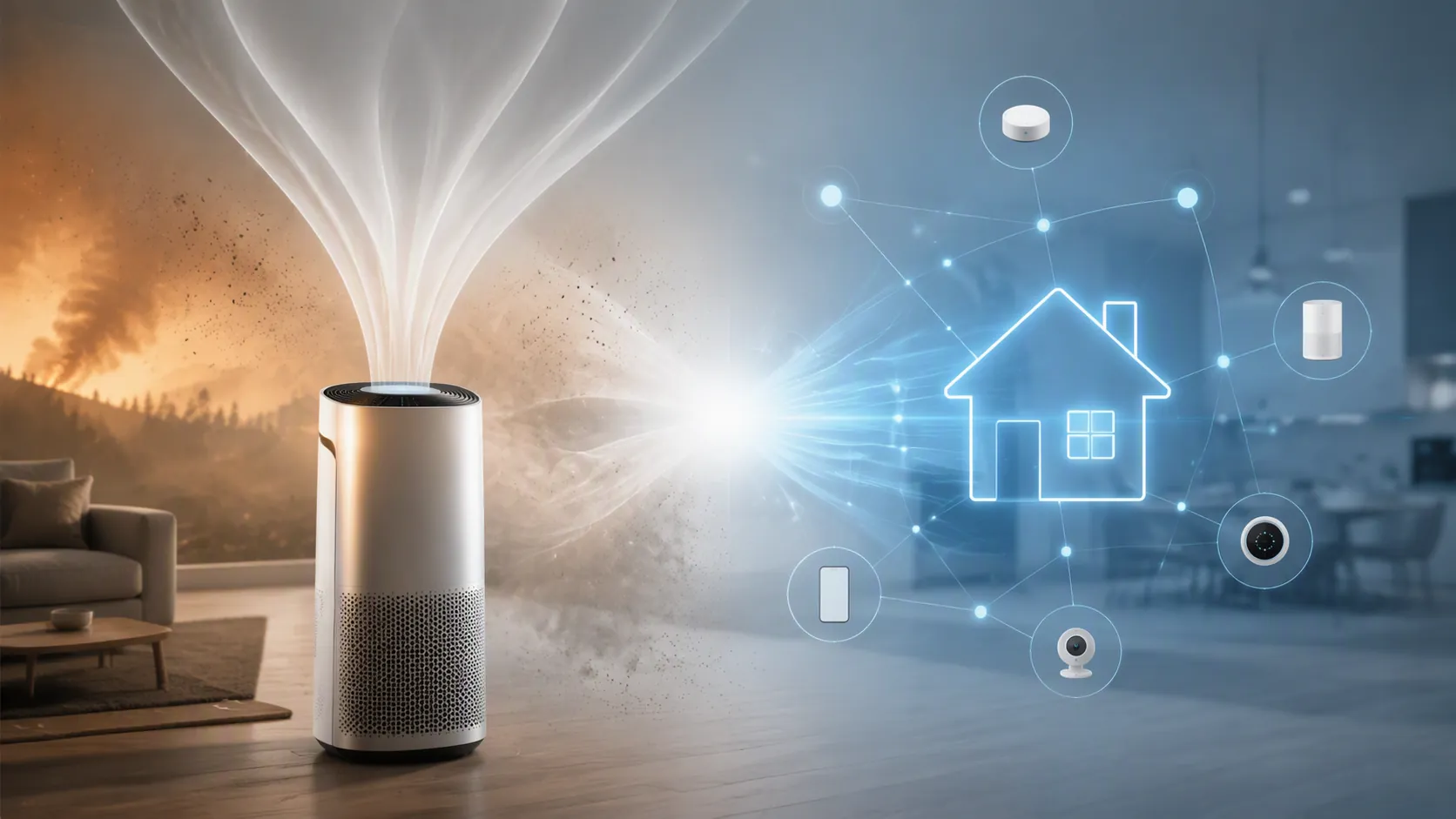
That rule immediately separates two lists that search results often mash together. The Coway Airmega ProX is a serious smoke machine, with a very high AHAM CADR and a fast HouseFresh room-clearing result, but no app connectivity in the cited HouseFresh testing context [2][3]. The Levoit Vital 200S is the more interesting smart-value case because it combines measured smoke-relevant performance with VeSync control, but it still has to fit the room by CADR before its app matters [2].
The evidence table to keep open while shopping
These sources do not measure the same thing in the same way. AHAM-certified CADR, HouseFresh’s PM1 CADR estimates, Wirecutter’s 30-minute smoke-removal percentage, and Consumer Reports’ sealed-chamber smoke testing are useful, but they are not interchangeable units. Treat them as separate pieces of evidence, not a single leaderboard.
| Evidence | What it measures | Why it changes the buying decision |
|---|---|---|
| AHAM Verifide air-filtration standards | For wildfire smoke, AHAM recommends Smoke CADR equal to room square footage; the common two-thirds CADR rule is for general use [1]. | A 250-square-foot room needs roughly 250 Smoke CADR for smoke-event sizing, not merely a “large room” marketing claim. |
| HouseFresh wildfire-smoke testing | Levoit Vital 200S: 249 cfm HouseFresh PM1 CADR estimate, 254 cfm AHAM PM2.5 CADR, VeSync smart features, and an estimated $123.48 per year top-speed running cost [2]. | This is the cleanest smart-value example in the cited data, but it belongs in rooms that match its CADR. |
| HouseFresh high-CADR testing | Coway Airmega ProX: 586 cfm AHAM CADR and 13-minute clearing time in HouseFresh’s 728-cubic-foot test room; HouseFresh notes no app connectivity [2][3]. | This is the obvious reminder that the strongest smoke-clearing choice may be a poor smart-home choice. |
| Wirecutter wildfire-smoke testing | Coway Airmega Mighty and Mighty2 removed more than 99% of smoke particles in 30 minutes on high in Wirecutter’s testing [4]. | A strong smoke result on a specific Coway model should not be casually transferred to every connected Coway model with a similar name. |
| Consumer Reports wildfire-smoke picks and methodology | Consumer Reports evaluates wildfire-smoke performance using a sealed-chamber smoke-removal method [5]. | It gives another independent smoke-testing family, but still has to be matched against smart-platform support model by model. |
| PCMag smart-air-purifier coverage | PCMag reports app and voice-assistant details for smart purifier models, including Coway app plus Alexa/Google voice support and Dyson BP03 Alexa/Google/Siri support [6]. | Useful for connectivity screening, but it is not a substitute for wildfire-smoke sizing. |
| 9to5Mac SwitchBot report | SwitchBot’s Air Purifier gained native Matter and HomeKit support in May 2025 without requiring a hub, as reported by 9to5Mac [7]. | Promising for Apple Home and Matter homes, but still needs smoke-performance evidence and hands-on hub reproduction before it becomes a settled wildfire pick. |
| HouseFresh ionizer exclusion plus EPA guidance | HouseFresh excludes Blueair Blue Pure 211+ from its wildfire recommendations because of a non-disableable ionizer; EPA guidance warns about ionizers and ozone-generating air cleaners [2][8]. | For this shortlist, non-disableable ionization is a hard stop, not a small drawback. |
Size the purifier for smoke before looking at the app
The expensive mistake is buying a connected purifier that is undersized for a smoke wave. If the room is 300 square feet, AHAM’s wildfire-smoke rule points you toward a Smoke CADR around 300. A purifier with a lower CADR may still improve the room, but it is no longer sized to that wildfire-smoke rule. That distinction matters when outdoor smoke keeps leaking in for hours or days.
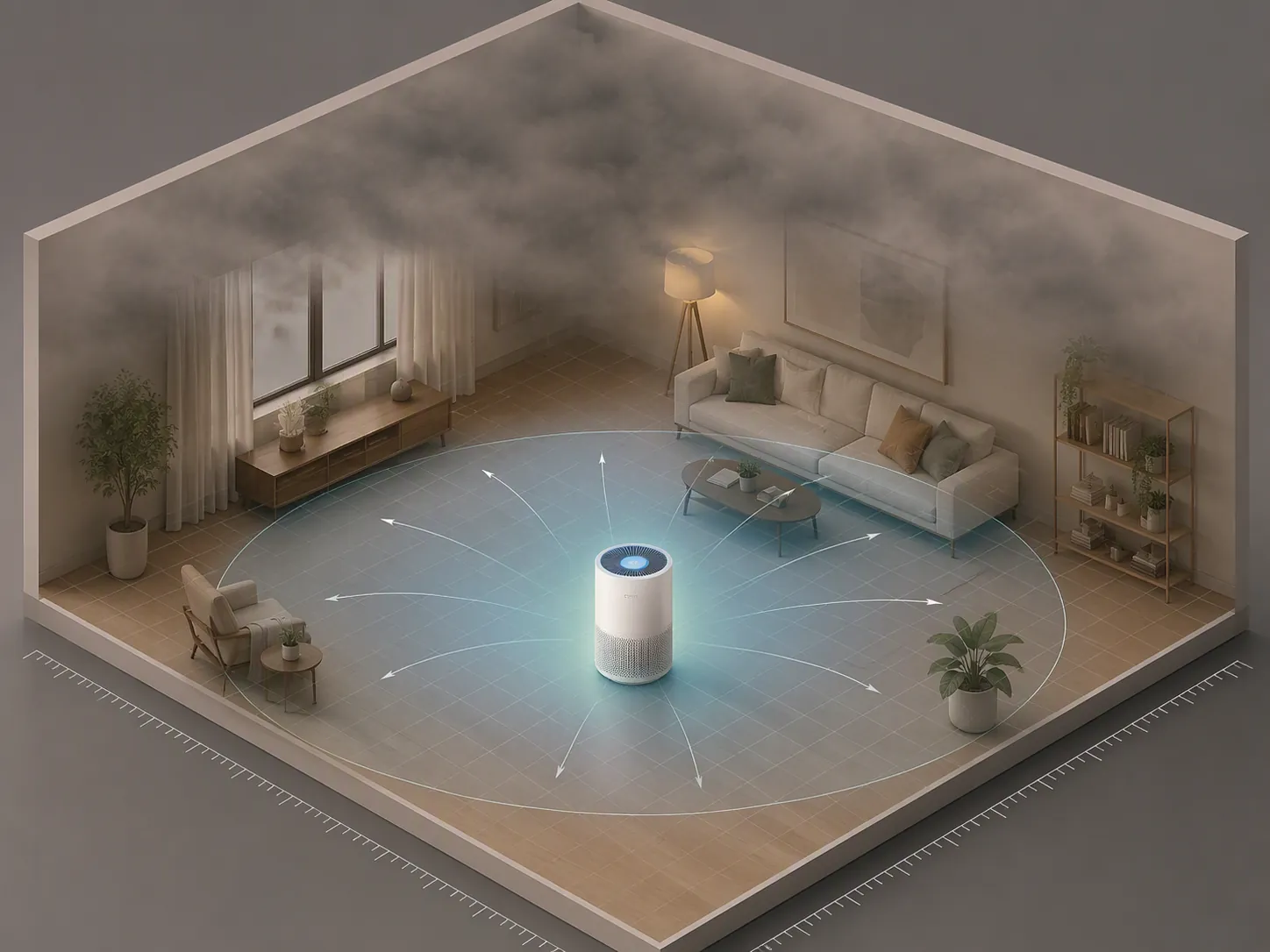
The Levoit Vital 200S illustrates the right way to read mixed evidence. HouseFresh reports a 249 cfm PM1 CADR estimate from its own test method and also cites a 254 cfm AHAM PM2.5 CADR [2]. Those numbers are close enough to point in the same practical direction for many medium rooms, but they are still different measurement families. Do not average them, convert one into the other, or use the HouseFresh PM1 estimate as if it were an AHAM-certified Smoke CADR.
The Coway Airmega ProX sits on the other side of the decision. HouseFresh reports a 586 cfm AHAM CADR and a 13-minute clearing time in its 728-cubic-foot test room, while also noting that the unit has no app connectivity [2][3]. For a large room during smoke, that lack of smart features may be acceptable. For an automation-heavy home, it means the purifier may be monitored by the smart home rather than controlled by it.
Wirecutter’s Coway Mighty and Mighty2 result is also strong: more than 99% smoke-particle removal in 30 minutes on high [4]. The trap is model-name drift. A result for Mighty or Mighty2 does not automatically validate a different Coway smart model, and a Coway app listing does not automatically make a smoke-tested Coway model hub-ready.
For a deeper explanation of what “tested” should mean on a wildfire-smoke unit, keep the AHAM, HEPA, and certification layers separate; NestGrid’s HEPA-tested wildfire-smoke purifier guide goes into that verification layer.
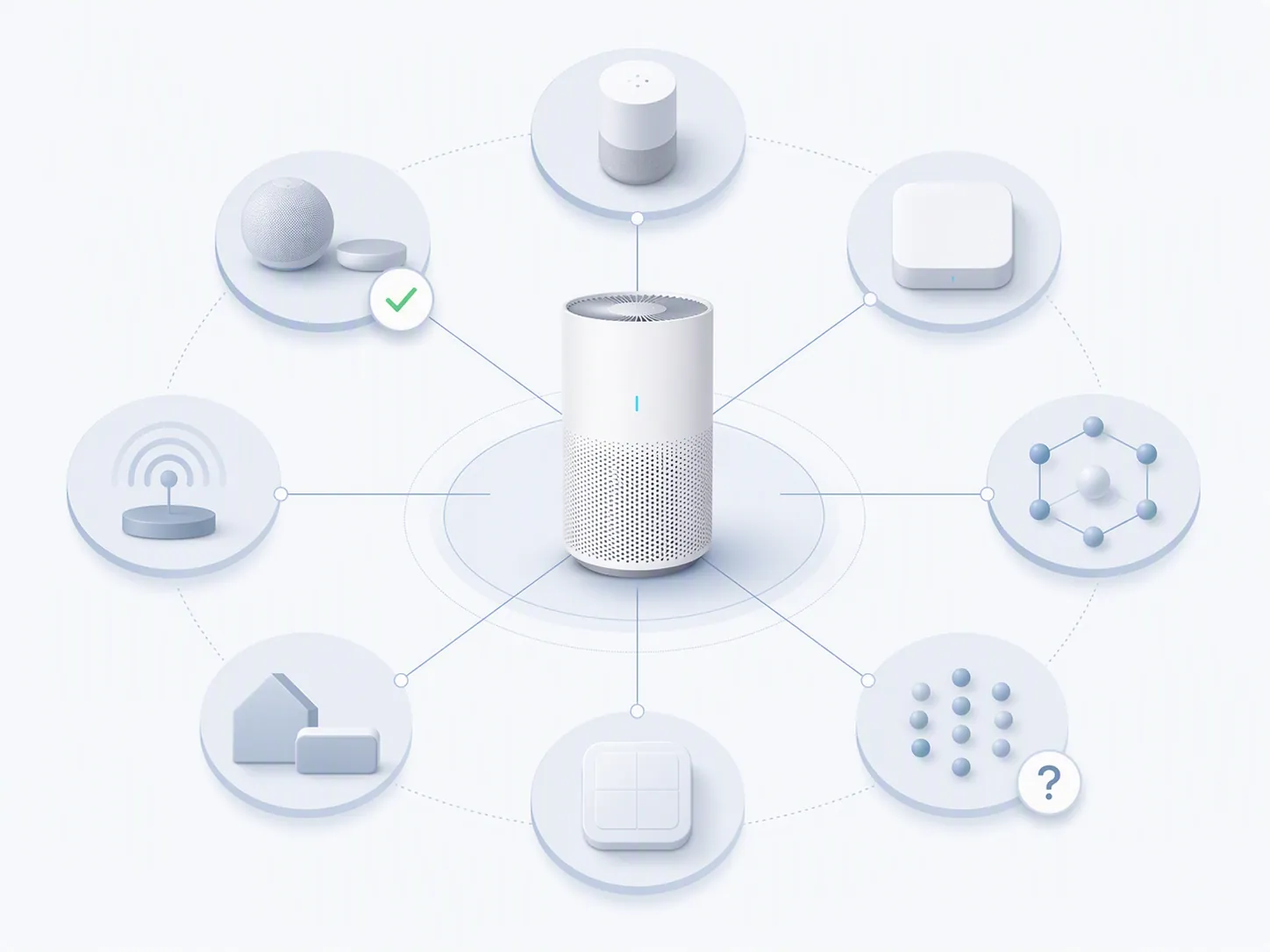
Compatibility matrix: what is confirmed, reported, or still not good enough
A purifier can be excellent on smoke and still fail the smart-home requirement. It can also be delightful in a hub and still be the wrong machine for a smoke event. The labels below are intentionally conservative.
- Confirmed means reproduced in a hands-on hub test. No external vendor claim gets that label by itself.
- Source-reported means a cited review, publication, or vendor-linked report says the feature exists, but it has not been treated here as NestGrid-reproduced.
- Workaround means possible through a bridge, automation layer, plug behavior, or unofficial integration; it is not the same as native support.
- Investigating means the smoke evidence, hub behavior, or both are not strong enough to turn into a buying recommendation.
| Model or model family | Smoke evidence in the cited materials | Apple Home / HomeKit | Google Home / Alexa | Matter / Thread / Zigbee | Home Assistant | Practical status |
|---|---|---|---|---|---|---|
| Coway Airmega ProX | 586 cfm AHAM CADR and 13-minute HouseFresh room clearing in a 728-cubic-foot room [2][3]. | Not reported in cited evidence. | Not reported in cited evidence. | No cited Matter, Thread, or Zigbee support. | No cited native path. | Smoke-first. Excellent candidate when CADR is the priority; not a smart purifier in the cited evidence. |
| Levoit Vital 200S | 249 cfm HouseFresh PM1 CADR estimate; 254 cfm AHAM PM2.5 CADR; HouseFresh smart-value pick with VeSync and estimated $123.48 per year top-speed running cost [2]. | No cited native Apple Home or HomeKit support. | VeSync app route is cited; voice or hub behavior should be verified per account and model before buying [2][6]. | No cited native Matter, Thread, or Zigbee support. | Workaround / investigating unless a local VeSync integration path is reproduced. | Best smart-value candidate in the cited smoke data, but only for rooms that fit its CADR. |
| Coway Airmega Mighty / Mighty2 | Wirecutter reports more than 99% smoke-particle removal in 30 minutes on high [4]. | Not reported for these models in cited evidence. | Do not transfer Coway smart-line claims to these models without checking exact model support. | No cited native Matter, Thread, or Zigbee support. | Investigating. | Strong smoke evidence; model-name drift is the buying risk. |
| Coway connected smart models | Consumer Reports and Wirecutter smoke evidence must be matched to the exact model; do not assume one Coway result covers the app-connected line [4][5]. | No cited native Apple Home or HomeKit support. | PCMag reports Coway app plus Alexa/Google voice support for smart Coway models [6]. | No cited native Matter, Thread, or Zigbee support. | Workaround / investigating. | Potentially useful in Alexa or Google homes, but the smoke result has to be model-specific. |
| SwitchBot Air Purifier | No independent smoke-clearing result is provided in the cited smoke-test materials here. | 9to5Mac reported native HomeKit support in May 2025 [7]. | Not the primary cited smart claim here. | 9to5Mac reported native Matter support without a hub in May 2025; no Thread claim is established here [7]. | Matter path is investigating until locally reproduced. | Promising for Apple Home and Matter homes; not promoted here as a wildfire-smoke pick without matching CADR and smoke testing. |
| Dyson Purifier Big+Quiet Formaldehyde BP03 | No wildfire-smoke clearing result from the core smoke-test sources is provided here. | PCMag reports Siri support, not native Apple Home confirmation [6]. | PCMag reports Alexa and Google support [6]. | No cited native Matter, Thread, or Zigbee support. | Investigating. | Connected-first candidate, not a smoke-first recommendation from the cited evidence. |
| Blueair Blue Pure 211+ | HouseFresh excludes it from wildfire recommendations because of a non-disableable ionizer [2]. | Compatibility not evaluated because it fails the ionizer boundary. | Compatibility not evaluated because it fails the ionizer boundary. | Compatibility not evaluated because it fails the ionizer boundary. | Compatibility not evaluated because it fails the ionizer boundary. | Do not include on this wildfire-smoke smart shortlist. |
Ionizers are not a toggle to ignore
For wildfire-smoke shopping, a non-disableable ionizer is enough to remove a purifier from this shortlist. HouseFresh specifically flags the Blueair Blue Pure 211+ for its non-disableable ionizer in the wildfire-smoke context, and EPA guidance warns about ionizers and ozone-generating air cleaners [2][8].
That does not mean every ionizer behaves identically or that every buyer will weigh the issue the same way. It means this article is not going to recommend a smoke-event purifier whose particle-removal plan depends on a feature the user cannot fully disable. There are enough high-CADR mechanical-filtration options that this compromise is unnecessary.
How to use the intersection
Work in this order. First, measure or confirm the room size. Second, set the minimum Smoke CADR using the AHAM wildfire rule. Third, remove models with ionizer problems or unclear filtration claims. Fourth, check the exact model name against the hub you already use. Only then should app polish, design, and noise comfort become tie-breakers.
Noise still matters. A purifier that technically has the right CADR but is so loud that nobody will run it on high during a smoke day is not practically sized for the way the house will use it. The evidence above tells you which units deserve a place on the shortlist; the real operating setting decides whether that evidence survives contact with the living room.
If the intersection leaves you with no perfect unit, choose the failure mode deliberately. In a large room during an active smoke event, a high-CADR purifier with weak connectivity can still be the right buy. In a smaller room where multiple smoke-tested units meet the CADR bar, the better hub integration can win. What should not win is a beautifully connected purifier that cannot move enough air for the space.
For Apple Home and Matter homes
The SwitchBot development is the one to watch because Matter plus HomeKit support would solve a real gap for Apple Home users, and 9to5Mac reported that support in May 2025 without a required hub [7]. The caution is equally real: the cited smoke-test set here does not provide the same kind of wildfire-smoke clearing evidence for that model that HouseFresh provides for the Levoit Vital 200S or Coway Airmega ProX. Treat it as a promising compatibility candidate, not the default smoke buy.
For Google Home and Alexa homes
Google and Alexa users have more source-reported purifier options, including app-and-voice routes noted by PCMag for Coway smart models and Dyson BP03 [6]. That helps with voice control, schedules, and status checks, but it does not erase the CADR screen. Before picking the most convenient voice-assistant model, match the exact unit to a smoke-test result or a certified Smoke CADR that fits the room.
For Home Assistant, Zigbee, and local-control buyers
Home Assistant users can often make imperfect devices useful, but a workaround is not the same as a confirmed smoke appliance. If the purifier’s only path is a cloud integration, unofficial bridge, smart plug, or forum recipe, test the recovery behavior before smoke season: does the unit resume the right fan speed after power loss, does the filter alert remain visible, and does the automation fail safely if the cloud route disappears?
There is no cited Thread-native or Zigbee-native purifier in this smoke-tested set that changes the core recommendation. If local control is mandatory, you may end up pairing a high-CADR non-smart unit with a separate indoor air-quality monitor and using the smart home for alerts rather than direct purifier control.
Automations should prove the room improved
AQI-triggered automations are useful when they make the purifier run earlier, run harder, and stay on long enough. A better smoke setup has three parts: an outdoor trigger or warning, an indoor monitor placed away from the purifier’s clean-air stream, and a rule that escalates fan speed when indoor particles rise. The point is not to admire an app graph; it is to verify that the room air is improving.
For the operating side of a smoke event, use NestGrid’s wildfire-smoke purifier playbook. For the automation loop, see Improve Indoor Air Quality with Smart Home Automations. If you are trying to validate the monitor itself, use Can You Trust Smart Air Quality Monitors in Wildfire Smoke? and How to Check Air Quality at Home During Wildfire Smoke.
Running cost belongs in the same conversation because smoke waves punish undersizing and under-use. HouseFresh’s Levoit Vital 200S estimate of $123.48 per year at top speed is useful precisely because it attaches a cost to the setting people may actually need during smoke [2]. Filter cadence matters for the same reason: if the purifier becomes expensive or annoying to maintain, it is more likely to be run too low or too late.
Where the buying decision lands
There is no single best smart air purifier for wildfire smoke until the room size and hub ecosystem are known. The Coway Airmega ProX is the clearest example of smoke-clearing strength without smart-home convenience. The Levoit Vital 200S is the clearest cited smart-value example that still has measurable smoke-relevant performance. SwitchBot is the compatibility development to watch for Apple Home and Matter buyers, but the smoke-test evidence has to catch up before it belongs in the same confidence tier.
If you want the final picks by hub after applying this verification layer, use NestGrid’s best smart air purifier for wildfire smoke by ecosystem. Bring two numbers with you: the room’s square footage and the minimum Smoke CADR you are willing to accept.
References
- AHAM’s Air Filtration Standards — AHAM Verifide
- Air purifiers for wildfire smoke — HouseFresh
- Best air purifiers we tested — HouseFresh
- The Best Air Purifier for Wildfire Smoke — Wirecutter
- Best Air Purifiers for Wildfire Smoke — Consumer Reports
- The Best Smart Air Purifiers — PCMag
- SwitchBot launches new air purifier with Matter, HomeKit support, and more — 9to5Mac, May 30, 2025
- What are ionizers and other ozone generating air cleaners? — U.S. Environmental Protection Agency
Known issues with this device / protocol
Spec-version history
For active regressions on this protocol, see Update Watch.
No linked Update Watch entries yet.