
How to Check Air Quality at Home During Wildfire Smoke
During wildfire smoke, check air quality at home as a three-layer loop: outdoor PM2.5 on the AirNow Fire and Smoke Map, indoor PM2.5 from a home monitor, and the gap between them. Indoor staying clearly below outdoor is the only evidence your purifier, MERV-13+ filter, and closed windows are working.
When wildfire smoke is outside and the house is already closed up, “check the AQI” is only the first move. To check air quality at home during wildfire smoke, use a three-layer loop: read outdoor PM2.5 on the AirNow Fire and Smoke Map, read indoor PM2.5 on a home monitor, then compare the two. If indoor PM2.5 stays clearly below outdoor PM2.5, your closed windows, purifier, HVAC filter, and recirculation setup are probably helping. If indoor PM2.5 rises and falls almost with outdoor PM2.5, the house is not getting much protection.
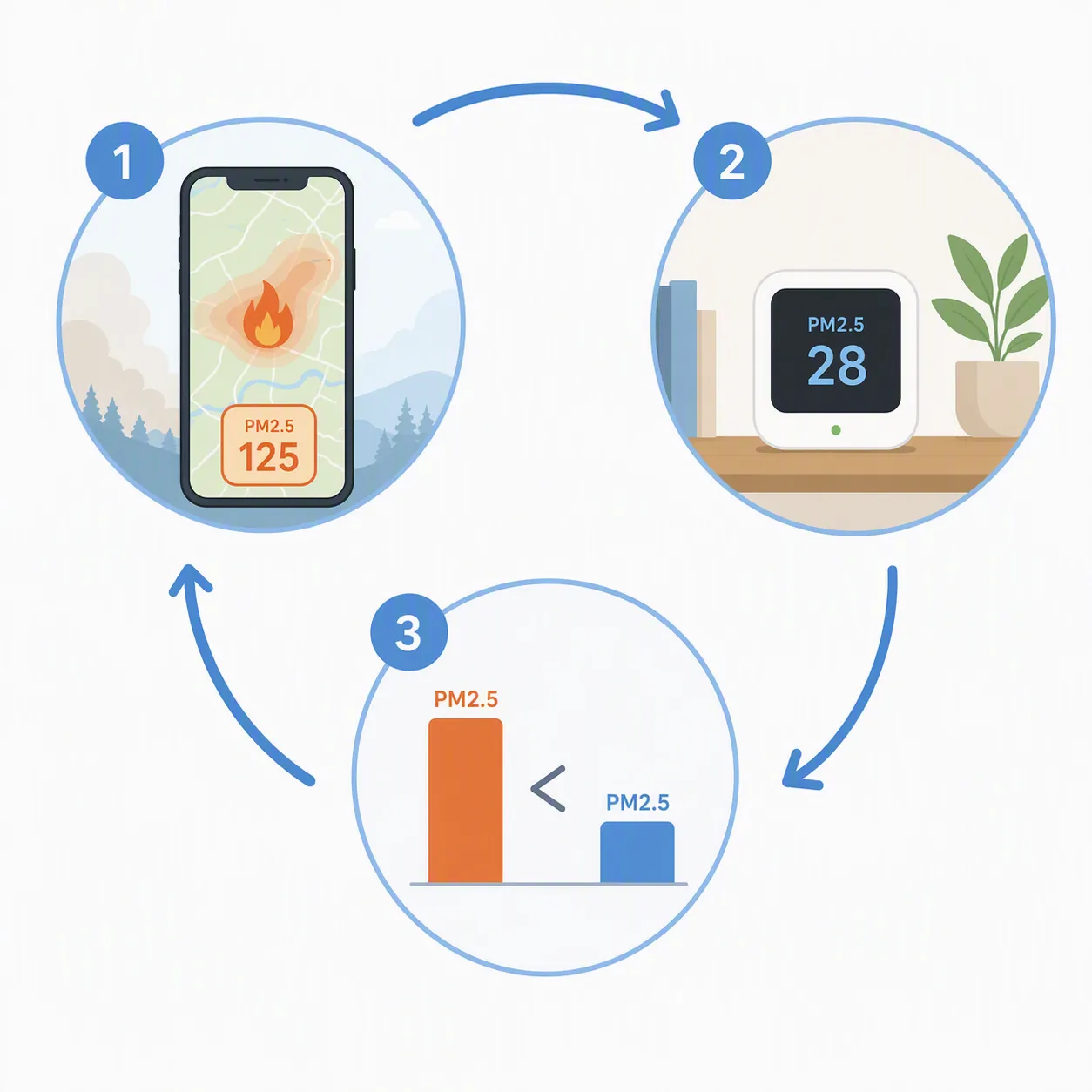
That comparison matters more than the color on a city-wide dial. Outdoor smoke can vary across a metro area, and the number inside your bedroom or clean room is the one your lungs are actually getting. Health Canada’s cleaner-air-space guidance uses a simple test for smoke events: indoor PM2.5 should be lower than outdoor PM2.5, and indoor PM2.5 should be kept as low as possible while smoke is present.[1]
The smoke-day loop
| Layer | What to check | What it tells you |
|---|---|---|
| Outside | Outdoor PM2.5 on the AirNow Fire and Smoke Map | What smoke load is approaching or already around your home |
| Inside | Indoor PM2.5 from a home monitor placed in the room you are trying to protect | How much fine particle pollution actually got indoors |
| Gap | Indoor PM2.5 compared with outdoor PM2.5 | Whether filtration and building closure are working well enough to create cleaner indoor air |
Use PM2.5 for this loop, not carbon dioxide, not humidity, and not a generic “air quality” score from a device app. PM2.5 means fine particles small enough to get deep into the lungs, which is the main pollutant tracked for public smoke guidance. AirNow’s wildfire guidance tells people to use the Fire and Smoke Map when smoke is in the air, and the map is built around PM2.5 conditions along with fire and smoke information.[2]
You do not need perfect lab-grade readings for this to be useful. You need the same outdoor source, the same indoor monitor, and a repeatable comparison. The goal is not to certify the house. The goal is to catch the difference between “the purifier is actually lowering particles in the bedroom” and “the numbers inside are just following the smoke outside.”
Layer 1: read outdoor PM2.5 from the Fire and Smoke Map
Start outside, but do not stop at the nearest city AQI tile. During wildfire smoke, open the AirNow Fire and Smoke Map and look at the PM2.5 conditions around your address, not just the regional headline. AirNow directs smoke users there because it shows fire locations, smoke plumes, permanent monitors, and corrected low-cost sensor information in one smoke-specific map.[2]
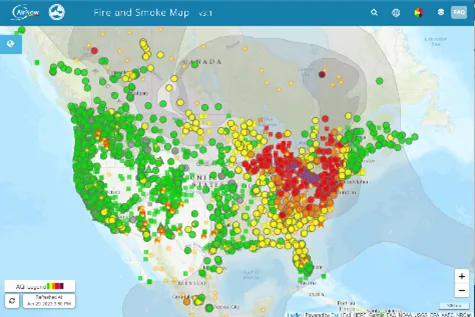
The practical reason is simple: wildfire smoke is patchy. A city AQI value can be useful for public communication, but it may not show the smoke band sitting over your side of town or the sensor closest to the wind path. On the Fire and Smoke Map, zoom in until nearby monitors and sensors are visible, then use the PM2.5 value closest to your home as your outdoor comparison point.
- Use the Fire and Smoke Map when wildfire smoke is present, rather than a general weather-app AQI tile.
- Look for PM2.5 near your actual location, not only the name of the nearest large city.
- Check whether smoke plumes or fire icons explain a fast change in nearby readings.
- Write down or screenshot the outdoor PM2.5 number before comparing it with your indoor monitor.
Do not over-polish this step. If you have a nearby regulatory monitor, use it. If the closest information is a corrected low-cost sensor on the Fire and Smoke Map, use that consistently and treat it as a trend-and-comparison reading. The comparison works best when you stop hopping between apps every fifteen minutes looking for the friendliest number.
Layer 2: measure the room you are actually trying to protect
Put the indoor PM2.5 monitor in the room where people will spend smoke hours: a bedroom overnight, a living room during the day, or a chosen clean room. Do not put it directly in the purifier’s clean-air stream, right beside a leaky window, on the floor, or in the kitchen while cooking. You want the air people are breathing, not the best or worst micro-spot in the house.
A workable placement is usually on a table, shelf, or dresser away from direct purifier exhaust, open doors, candles, frying pans, and supply vents. Leave it in the same place during the smoke event. Moving it from the bedroom to the hallway to the purifier outlet will make the graph look interesting and the comparison nearly useless.
Low-cost home monitors have real limits. Berkeley Lab reported that, during the 2018 Camp Fire, four low-cost home air monitor models overreported PM2.5 compared with a regulatory reference monitor by about 1.6 to 2.4 times. The same report also found that the monitors tracked the reference monitor proportionally, which means the trend was still useful even when the absolute value was high.[3]
That caveat changes how you use the monitor. Do not treat a cheap monitor as a laboratory instrument, and do not assume its smoke reading can be corrected by a universal multiplier. Use it to answer the home question: when outdoor PM2.5 goes up, does indoor PM2.5 stay much lower, rise slowly, or track it closely?
If you are still choosing a device, keep the buying decision separate from the smoke-day routine. The useful minimum is a monitor that exposes PM2.5 clearly and updates often enough to show changes after you turn on filtration. If you also want hub visibility or automations, use a compatibility guide such as how to test smart air quality monitors for wildfire smoke. Do that shopping before smoke season if possible; in the middle of an event, consistency beats feature hunting.
Layer 3: compare indoor PM2.5 with outdoor PM2.5
Now put the two numbers next to each other. Outdoor PM2.5 is the load on the house. Indoor PM2.5 is what got through the shell, HVAC behavior, filter, purifier placement, and indoor activities. The gap between them is the evidence.
| What you see | Likely meaning | Next move |
|---|---|---|
| Indoor PM2.5 stays clearly below outdoor PM2.5 | The house and filtration setup are creating cleaner indoor air | Keep the routine running and avoid adding indoor particle sources |
| Indoor PM2.5 is lower at first, then creeps upward | Smoke may be infiltrating faster than filtration can remove it, or an indoor source may be active | Increase purifier/HVAC filtration, tighten the clean room, and check for cooking, candles, vacuuming, or door openings |
| Indoor PM2.5 rises and falls close to outdoor PM2.5 | The building is not well protected from smoke, or filtration is undersized/off/poorly placed | Shift people to a smaller clean room, run filtration continuously, and reduce fresh-air intake |
| Indoor PM2.5 spikes while outdoor PM2.5 is steady | The source is probably indoors | Stop the source, ventilate only when outdoor air improves, and let filtration run |
Berkeley Lab’s wildfire indoor-air work gives useful scale without turning it into a promise. In older, unfiltered homes, indoor particle levels can reach 70% to 80% of outdoor levels even with windows closed. With good filtration, including MERV 12 or higher in the Berkeley Lab discussion, indoor levels can drop below 20% of outdoor levels. The same Berkeley Lab Q&A also reported that upgrading school HVAC filters from MERV 8 to MERV 13 cut classroom fine particles by 40% in that setting.[4]
Those numbers are not a guarantee for your house. They are a useful warning against false comfort. Closed windows alone may still leave a lot of outdoor smoke indoors. Filtration can make a large difference, but the only way to know whether it is making that difference in your room is to compare the readings during the event.
Give changes enough time to show up
After you turn a purifier to high, close a door, or switch the HVAC fan behavior, watch the indoor PM2.5 trend rather than one instant reading. A monitor may jump around for a few minutes. What matters is whether the indoor line bends downward, flattens below outdoor, or keeps climbing with it.
This is also where the low-cost monitor limitation becomes less scary. If heavy smoke makes your monitor overreport, both the “before” and “after” indoor readings are still coming from the same device in the same room. The exact number may be imperfect, but a sustained drop after filtration starts is still meaningful. Berkeley Lab researcher Woody Delp’s work found consumer monitors useful for identifying indoor PM sources and judging filter effectiveness, with low-cost monitors tracking within a factor of two across 21 indoor sources in that testing.[3]
If indoor PM2.5 is not staying low enough
Once the indoor/outdoor comparison looks bad, adjust the house before you keep staring at the monitor. The usual failure is not that the number needs more interpretation. It is that too much smoky air is entering, too little air is being filtered, or particles are being made indoors.
- Run portable air cleaners continuously, and use the highest setting people in the room can tolerate during the smoke period.
- Use a MERV-13-or-higher HVAC filter if the system can handle it, and make sure it is installed correctly.
- Set the HVAC fan to circulate indoor air through the filter rather than waiting only for heating or cooling calls.
- Close outdoor-air intakes or fresh-air dampers when smoke is present, unless your system or local code requires a different setting.
- Keep windows and exterior doors closed as much as practical.
- Avoid indoor particle sources: frying, broiling, candles, incense, smoking, vacuuming without a high-efficiency filter, and unnecessary use of gas appliances.
AirNow and EPA indoor-air guidance for wildfire smoke emphasize the same cluster of actions: reduce smoke entry, filter indoor air, and avoid making particles indoors while smoke is present.[2][5] The comparison loop tells you which action deserves attention first. If indoor PM2.5 jumps after cooking while outdoor is flat, the problem is indoors. If indoor PM2.5 climbs all afternoon as outdoor smoke thickens, the clean room or filtration setup is probably not keeping up.
A smaller room is often easier to protect than a whole house. If the living room will not stay below outdoor PM2.5, move the purifier and monitor into a bedroom, close the door, and treat that as the clean room. If you are choosing a purifier or checking whether a smart model fits your ecosystem, keep that as a separate sizing and compatibility task; a guide like best smart air purifier for wildfire smoke belongs there.
What not to let the numbers hide
A low indoor reading does not mean the outdoor smoke is harmless. It means your protected room is doing better than outside by the measurement you can make. Keep following public health instructions, evacuation notices, and local emergency guidance. The home loop is for indoor verification, not for deciding whether a fire is safe.
Also watch heat. Closing windows and recirculating air can conflict with staying cool during hot smoke events. If the cleanest room becomes dangerously hot, the particle number is no longer the only household risk. Berkeley Lab’s wildfire IAQ discussion notes the practical role of using HVAC filtration and portable air cleaners during smoke, but the safe setup still has to fit the building and the people inside.[4]
If you automate the response, automate the loop rather than replacing it. Outdoor-smoke early warnings, purifier speed rules, and shutoff delays are useful when they are tied back to PM2.5 readings you have checked. Recipes such as wildfire smoke air purifier automation or a DIY wildfire early-warning setup should extend the same pattern: check outside, check inside, compare, then act.
A repeatable smoke-day routine
- Open the AirNow Fire and Smoke Map and note nearby outdoor PM2.5.
- Check the indoor PM2.5 monitor in the room you are trying to protect.
- Compare indoor with outdoor, using the same outdoor source and the same indoor monitor placement each time.
- If indoor PM2.5 is clearly lower than outdoor, keep filtration running and avoid indoor particle sources.
- If indoor PM2.5 tracks outdoor closely, tighten the room, increase filtration, recirculate through a good HVAC filter if available, and reduce fresh-air intake.
- Recheck the indoor trend after the change instead of assuming the adjustment worked.
That is the whole test. Outdoor PM2.5 tells you what the house is up against. Indoor PM2.5 tells you what got through. The gap tells you whether the work you did—taping a gap, changing a filter, moving the purifier, closing the fresh-air intake—actually changed the air people are breathing.
References
- Guidance for Cleaner Air Spaces during Wildfire Smoke Events, Health Canada.
- When Smoke is in the Air, AirNow.
- Low-Cost Home Air Quality Monitors Prove Useful for Wildfire Smoke, Lawrence Berkeley National Laboratory, August 18, 2020.
- Improving Indoor Air Quality During Wildfires, Lawrence Berkeley National Laboratory, October 25, 2019.
- Wildfires Could Impact Your Indoor Air Quality (IAQ), U.S. Environmental Protection Agency.