
Set your smart air purifier for wildfire smoke and heat wave
When a heat wave and wildfire smoke hit together, cooling advice (open windows, run fans) and smoke advice (seal everything) point in opposite directions. This playbook resolves the conflict — windows closed, HVAC recirculating with a MERV 13+ filter, one correctly sized purifier running 24/7 in a clean room — and sorts which smart features protect you across a multi-day event.
Last updated
When cooling advice starts fighting smoke advice
A normal heat-wave checklist tells you to dump hot indoor air when outdoor temperatures fall: open windows at night, use fans, pull cooler air through the house. A wildfire-smoke checklist says the opposite: shut the windows, seal the gaps, stop bringing outside air indoors. When both hazards arrive together, the smoke rule has to win. The house still needs cooling, but it has to cool with windows closed and air recirculating through filtration.
That is the real test for anyone searching for the best smart air purifier for wildfire smoke during a heat wave. The question is not which app looks cleanest. It is whether the setup keeps one breathable, cooler room operating through the stretch when nobody has the energy to keep adjusting every device by hand.
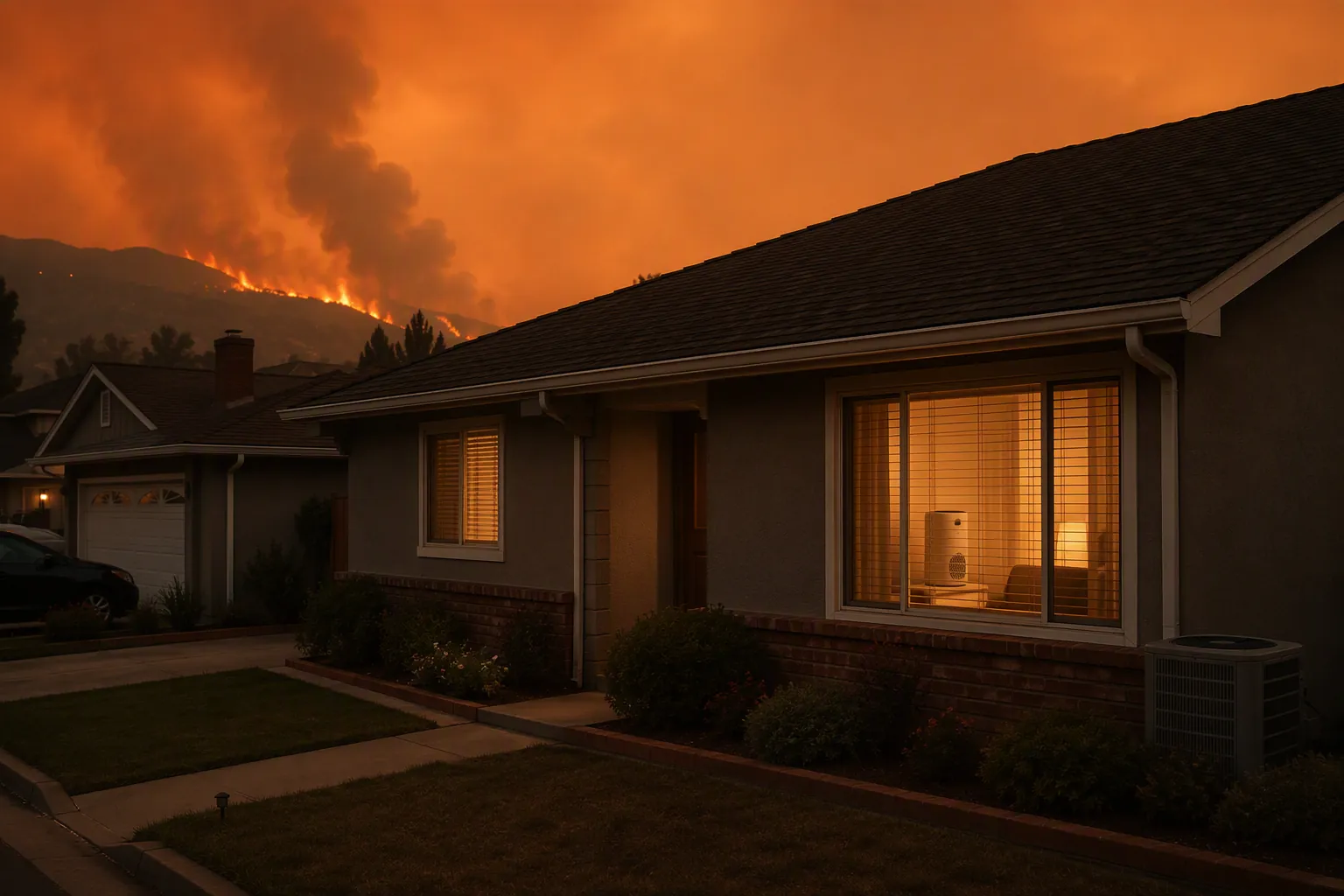
The July 2026 smoke event made the conflict hard to dismiss as a fringe problem. Yale Climate Connections reported 24-hour PM2.5 AQI readings of 934 in Duluth, compared with an old record of 159; 511 in Chicago; 490 in Detroit; and 246 in Washington, DC. On July 16, 50 official EPA monitors were in the Hazardous range, and five of the world’s most polluted cities were in North America during the event. [1]
The health stakes are not a purifier sales pitch. They are a reason to stop treating heat and smoke as separate chores. An American Heart Association summary of Circulation research reported that days combining extreme heat and high fine-particle pollution were associated with nearly doubled risk of fatal heart attacks. [2] That does not prove a particular purifier prevents a particular outcome. It does mean the household air plan deserves the same seriousness as the thermostat plan.
The compound protocol: sealed, recirculated, filtered, concentrated
Do this in order. If the air outside is smoky, do not start by trying to flush heat out of the whole building. Start by reducing outdoor particle entry, then concentrate filtration where people will actually spend time.
| Move | What changes in the house | Why it matters during heat plus smoke |
|---|---|---|
| Close windows and exterior doors | Outdoor smoke stops getting a free path indoors | The usual night-cooling move can raise indoor PM2.5 when smoke is present |
| Run AC or HVAC on recirculate where possible | The system cools indoor air instead of intentionally pulling in more outdoor air | Cooling continues without turning the house into an intake vent |
| Use the best HVAC filter the system can support, commonly MERV 13 or higher where compatible | Central air movement removes more fine particles while it runs | Whole-home particle load drops before air reaches the clean room |
| Choose one clean room | Filtration is focused in a smaller volume with the door closed | A realistic shelter beats an under-filtered whole house |
| Run one correctly sized portable purifier continuously in that room | The room gets dedicated particle removal even when the HVAC cycles | Protection does not depend on someone remembering to restart the purifier |
EPA wildfire indoor-air guidance supports the core pieces: keeping smoke out, using HVAC filtration where appropriate, and using portable air cleaners indoors. [3] The Conversation’s guidance for the combined threat of wildfire, smoke, and extreme heat also points to the same practical collision: protect indoor air while managing heat, rather than treating window ventilation as automatically safe. [4]
If your central system can safely handle a higher-efficiency filter, MERV 13 or better is the usual target for smoke planning. The catch is airflow. A filter the blower cannot handle can reduce system performance, which is a bad trade in a heat wave. Check the HVAC manual, the filter slot, and the condition of the system before forcing an upgrade during the event.
For a more detailed thermostat-and-purifier sequence, use NestGrid’s smart thermostat and air purifier heatwave setup. If you are trying to decide what your AC can and cannot do for smoke on its own, the companion guide on smart air purifiers versus AC during wildfire smoke is the better place to separate cooling from filtration.
Why one clean room beats trying to rescue the whole house
A leaky home during a smoke event behaves like a slow refill problem. You can reduce what comes in, but you usually cannot stop it completely. Trying to purify every hallway, bedroom, kitchen, and open stairwell with one portable unit spreads the machine too thin just when the outdoor air is worst.
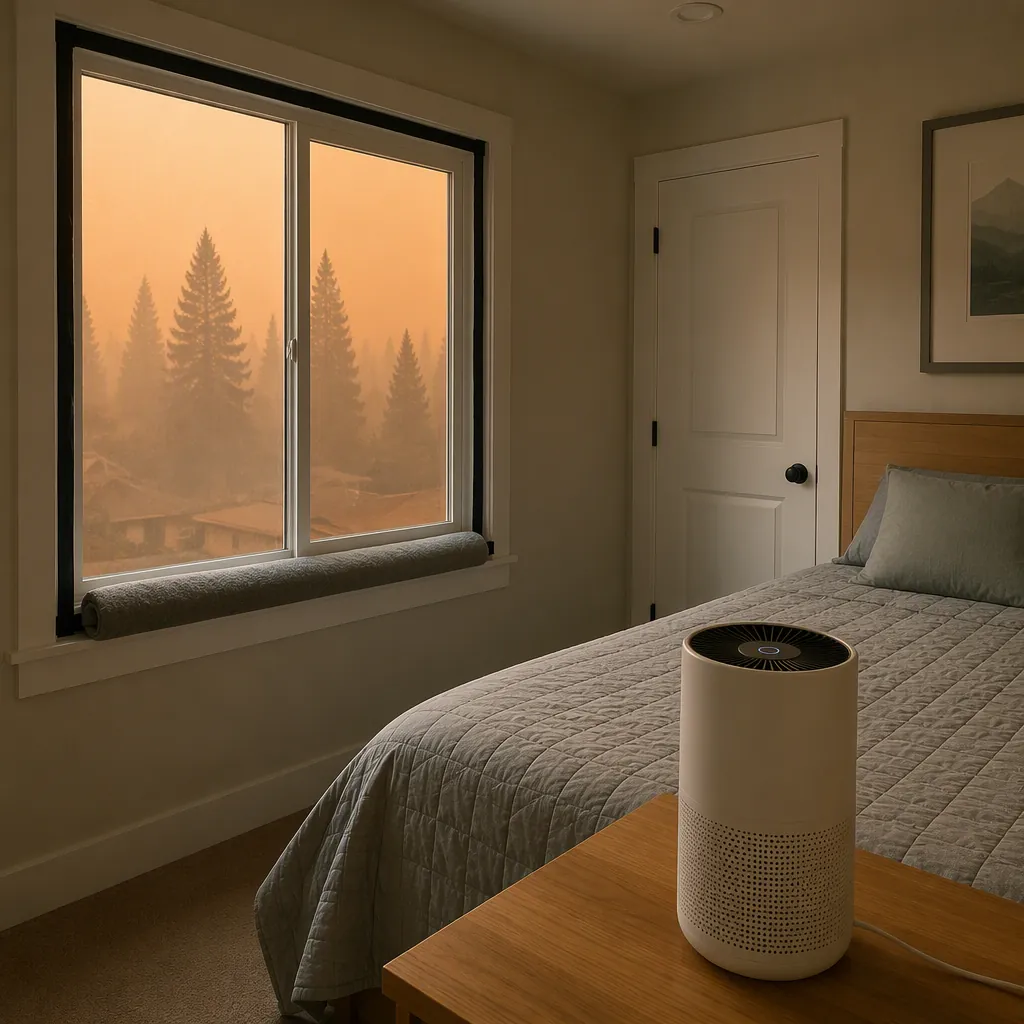
The clean room is a concession to reality. Pick a bedroom, den, or living room that can be closed off. Shut the door. Seal obvious window gaps if you can do it safely. Keep the purifier away from curtains and walls so air can move through it. Bring in what the household actually needs: water, chargers, medications, pet supplies, and somewhere to sleep or sit through the worst hours.
The clean room does not replace the HVAC strategy. The HVAC strategy lowers the burden across the house while cooling continues; the portable purifier gives the shelter room its own dedicated filtration. If the HVAC cycles off, the clean room still has a machine working. If someone opens an interior door for a minute, the room has a way to recover.
Size the purifier for smoke, not for a pleasant spring pollen day
For heavy smoke, AHAM Verifide gives a useful sizing shortcut: choose a portable air cleaner whose smoke CADR roughly matches the room’s square footage. A 300-square-foot clean room calls for roughly 300 smoke CADR; a 150-square-foot bedroom calls for roughly 150 smoke CADR. [5]
That rule is deliberately more demanding than the loose “up to” room-size claims printed on many boxes. Smoke is fine-particle pollution, not a mild odor problem. If the room is open to a hallway, has a vaulted ceiling, or has people moving in and out often, treat it as harder than the square footage suggests.
Do not buy for the whole floor unless you are actually creating a whole-floor clean zone with enough airflow to match it. Most households do better by making one bedroom or living room work properly than by asking a single purifier to chase smoke through an open-plan home.
Settings: high first, then continuous
When the clean room is closed and the purifier is in place, start on high. Give the room the first hour of serious airflow before judging noise or comfort. That first stretch is not about elegance; it is about quickly moving smoky indoor air through the filter after the room has been sealed.
After that, drop to the highest setting the household can actually live with, or use auto mode if the sensor is responsive and the unit does not become lazy at low fan speed. Medium all day is usually more useful than high for 20 minutes followed by silence for three hours. Smoke does not stop entering just because the purifier is annoying.
Cycling the purifier off is the failure point. Indoor particles rebound because infiltration continues, people move through the room, doors open, fabric sheds, and the HVAC may cycle. During a multi-day smoke event, the purifier should be treated like the refrigerator: adjust it, tolerate its working noise, but do not keep turning it off and hoping the room stays fixed.
The smart features that matter when people are tired
Smart features earn their keep only when they remove a real failure point. A household three days into smoke and heat does not need another dashboard to admire. It needs the purifier to speed up when air gets worse, stay on when people fall asleep, warn before a clogged filter quietly ruins performance, and respond when smoke arrives before anyone is standing next to the machine.
| Feature | Useful version | Weak version to ignore |
|---|---|---|
| Auto mode | Uses a particle sensor that ramps fan speed quickly when PM rises | A comfort mode that stays quiet while smoke levels climb |
| Remote control | Lets you boost the clean-room purifier before people arrive home or before bedtime | An app that duplicates the physical buttons but does not improve operation |
| Filter-life alerts | Tracks runtime and loading well enough to prompt inspection during heavy smoke | A calendar reminder that assumes ordinary household dust |
| AQI-based automation | Uses a reliable outdoor AQI source or local monitor to raise fan speed before indoor air degrades | A brittle routine triggered by a distant city reading that does not match your smoke plume |
| Voice control | Acceptable as a backup | Not a substitute for continuous operation or automatic response |
Auto mode is the easiest feature to overrate. It is useful when the onboard particle sensor notices a spike and the fan curve responds aggressively enough to matter. It is not useful when the purifier stays whisper-quiet because the manufacturer tuned auto mode for bedrooms and customer reviews rather than smoke events. During wildfire smoke, quiet is good only after filtration is already keeping up.
Remote boost is less glamorous and often more valuable. If smoke rolls in while everyone is at work, or if the outdoor AQI deteriorates before a vulnerable person comes home, the ability to raise the clean-room purifier from the phone can prevent the room from starting the evening already behind. The same logic applies before sleep: boost early, then let the unit settle into a sustainable overnight setting.
AQI automation should be built carefully. Outdoor AQI is not the same as indoor PM2.5, and a regional monitor may miss neighborhood-level smoke. Still, a reliable trigger can be useful when it raises filtration before the room has degraded. NestGrid’s wildfire-smoke air purifier automation recipe is the place for copyable routines; the compatibility guides for smart air-quality monitors and wildfire-smoke monitor compatibility are better references for deciding whether a sensor belongs in the loop.
Filter alerts matter more during smoke than during ordinary use. A filter that would have lasted comfortably through a mild season can load faster in a dense smoke period. Keep at least one spare for the clean-room purifier before fire season if you can. After a serious event, inspect the filter instead of trusting the old schedule.
A short product lens, not another ranking
Model choice comes after the room and protocol. A purifier that is excellent in a lab but undersized for the clean room is the wrong purifier for this job. A purifier with a polished app but timid auto mode is not much help during a smoke surge. Treat product lists as a way to find candidates, then check the smoke CADR, filter availability, noise at usable speeds, and automation behavior against your room.
| Candidate type | Where it may fit | What to verify before relying on it |
|---|---|---|
| Large-room smart purifier, such as Coway Airmega ProX | A larger clean room or open living area that still can be closed off | Current smoke CADR, filter cost, noise on medium/high, and whether app controls remain dependable during long runtime |
| Bedroom-sized smart purifier, such as Levoit Vital 200S | A smaller bedroom clean room where continuous operation is realistic | Smoke CADR against actual room size, app behavior, auto-mode aggressiveness, and spare-filter availability |
| Compact connected purifier, such as Blueair Blue Pure 311i Max | A modest clean room where lower noise may help the unit stay on overnight | Smoke CADR, filter replacement timing, sensor response, and whether any voice or ecosystem features add real operational value |
Prices, app integrations, CADR listings, and review-lab results change often enough that they should be rechecked at purchase or publication time. The durable comparison is not “which purifier won July’s roundup.” It is whether the unit can clean the room you will actually shelter in, at a fan speed you will actually leave running.
Small operating details that keep the plan from falling apart
- Pre-place the purifier in the clean room before smoke arrives if there is warning. Moving it after the house already smells smoky is still worth doing, but the room starts behind.
- Keep the clean-room door closed. If pets, children, or caregiving needs make that impossible, choose the room with the fewest unavoidable door openings.
- Do not aim a box fan in an open window during smoke just because the house is hot. Use closed-window cooling tactics instead; NestGrid’s heat-wave cooling myths guide covers the cooling side without undermining the smoke plan.
- Avoid ozone-producing devices for occupied clean rooms. Stick with mechanical filtration unless current EPA and CARB guidance has been rechecked for the exact device category.
- Expect the event to consume filters faster than normal use. A spare filter is not an accessory when the purifier is the clean room’s main protection.
- If the purifier must be quiet overnight, find the highest sleepable setting before the event. The worst time to negotiate fan noise is 2 a.m. with smoke outside and the room already warming.
In a heat-plus-smoke event, the best smart purifier is not simply the highest-ranked model. It is the correctly sized unit that can keep running inside a sealed clean room while the home cools on recirculated, filtered air. The smart features that matter are the ones that keep that setup working when people are asleep, away, distracted, or too tired to babysit the buttons.
References
- Dangerous and historic wildfire smoke pollution event engulfs the U.S. and Canada, Yale Climate Connections
- A clear message: Wildfire smoke plus summer heat is double trouble for heart health, American Heart Association
- Wildfires and Indoor Air Quality (IAQ), U.S. Environmental Protection Agency
- How to stay safe from the triple threat of wildfires, smoke and extreme heat, The Conversation
- Using an Air Cleaner to Manage Wildfire Smoke, AHAM Verifide
Known issues with this device / protocol
Spec-version history
For active regressions on this protocol, see Update Watch.
No linked Update Watch entries yet.