
Best Smart Air Quality Monitor for Your Pollutant, Tested
The best smart air quality monitor is the one wired for the pollutant actually affecting your home. This tested shortlist matches each pick to smoke, gas-stove NOx, radon, or CO2 concerns, with dated verification evidence and the hub and protocol notes you need before buying.
Last updated
The wrong way to shop for the best smart air quality monitor for home pollution tracking is to ask which one shows the most numbers. The useful question is narrower: what pollutant are you actually going to act on?
Smoke, gas-stove nitrogen oxides, basement radon, ventilation-related CO2, and VOC odors are different measurement problems. A pretty app that compresses them into one “air quality” score may be pleasant to glance at, but it can leave the person in the kitchen, nursery, basement office, or asthma/COPD household without the one signal they needed.
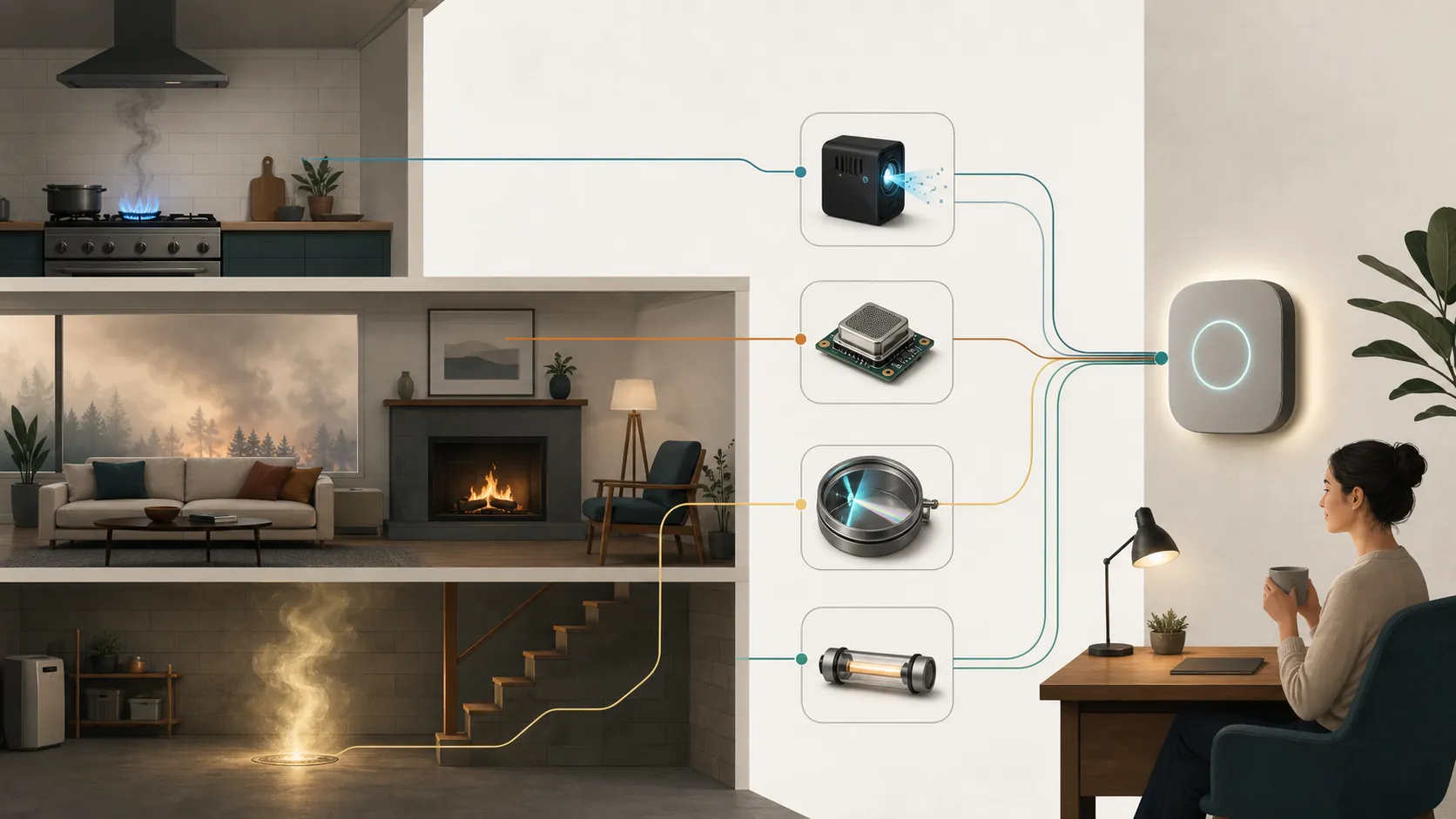
Start with the pollutant, then pick the monitor
This is the short version I would use before opening a product page. It is not a universal ranking. It is a fit check: pollutant first, sensor class second, product third, then the dated evidence that keeps “tested” from becoming a decorative word.
| Household concern | Sensor class that matters | Defensible pick or lane | Verification status as of Aug. 25, 2026 |
|---|---|---|---|
| Gas stove or gas appliances | NOx-capable metal-oxide gas sensor, specifically Sensirion SGP41-class NOx capability | AirGradient One | Confirmed for sensor fit: Wirecutter preferred AirGradient One over Airthings View Plus because AirGradient includes a Sensirion SGP41 NOx sensor and View Plus does not; testing was dated September 2025 despite the 2026 title. [1] |
| Wildfire smoke, wood smoke, purifier automation, asthma/COPD smoke signal | Laser particle counting for PM, especially PM2.5 trends | PurpleAir Zen for the strongest smoke-tracking evidence; IKEA Vindstyrka as a budget PM display with limits | Confirmed for smoke usefulness, not lab-grade absolute accuracy: HouseFresh uses PurpleAir Zen as a reference sensor in purifier testing, while LBNL found low-cost monitors overreported PM2.5 during the Camp Fire by 1.6–2.4x but tracked relative changes well. [2][3] |
| Basement, ground-floor, or radon-zone concern | Alpha-spectrometry radon sensing | Airthings View Plus | Confirmed for radon fit: View Plus measures radon by alpha-spectrometry; its value here is the radon hardware, not having the longest list of tiles. [1] |
| When to ventilate a bedroom, office, classroom-like room, or crowded living space | NDIR CO2 sensing for a number you can treat as a number | Qingping Lite, SwitchBot Meter Pro CO2, or Aranet4; AirGradient One also uses a SenseAir S8 NDIR-class CO2 sensor | Confirmed for the NDIR lane: BreatheSafeAir distinguishes NDIR choices from IKEA ALPSTUGA’s thermal-conductivity CO2 estimate, which it treats as trend-only. [4] |
| Paint, cleaning products, cooking odors, general VOC concern | Broad gas/VOC sensors treated as trend indicators | Use trend arrows and “something changed” alerts; do not buy as if this were chemical identification | Trend-only: broad VOC readings can be useful as a prompt to ventilate, but they do not deserve the same confidence as PM, radon, or NDIR CO2. |
If your first concern is wildfire smoke, there is a deeper smoke-specific comparison in Best Smart Air Quality Monitors for Wildfire Smoke, Tested. If your question is whether your own unit is drifting, the more useful next stop is the home protocol in Test your smart air quality monitor's accuracy at home, not another spec sheet.
Gas-stove homes: the NOx sensor is the point
For a gas-stove household, I would rather see one monitor with the right NOx capability than a broader monitor that cannot see the pollutant family that made me shop in the first place. This is where the AirGradient One versus Airthings View Plus comparison becomes unusually clarifying.
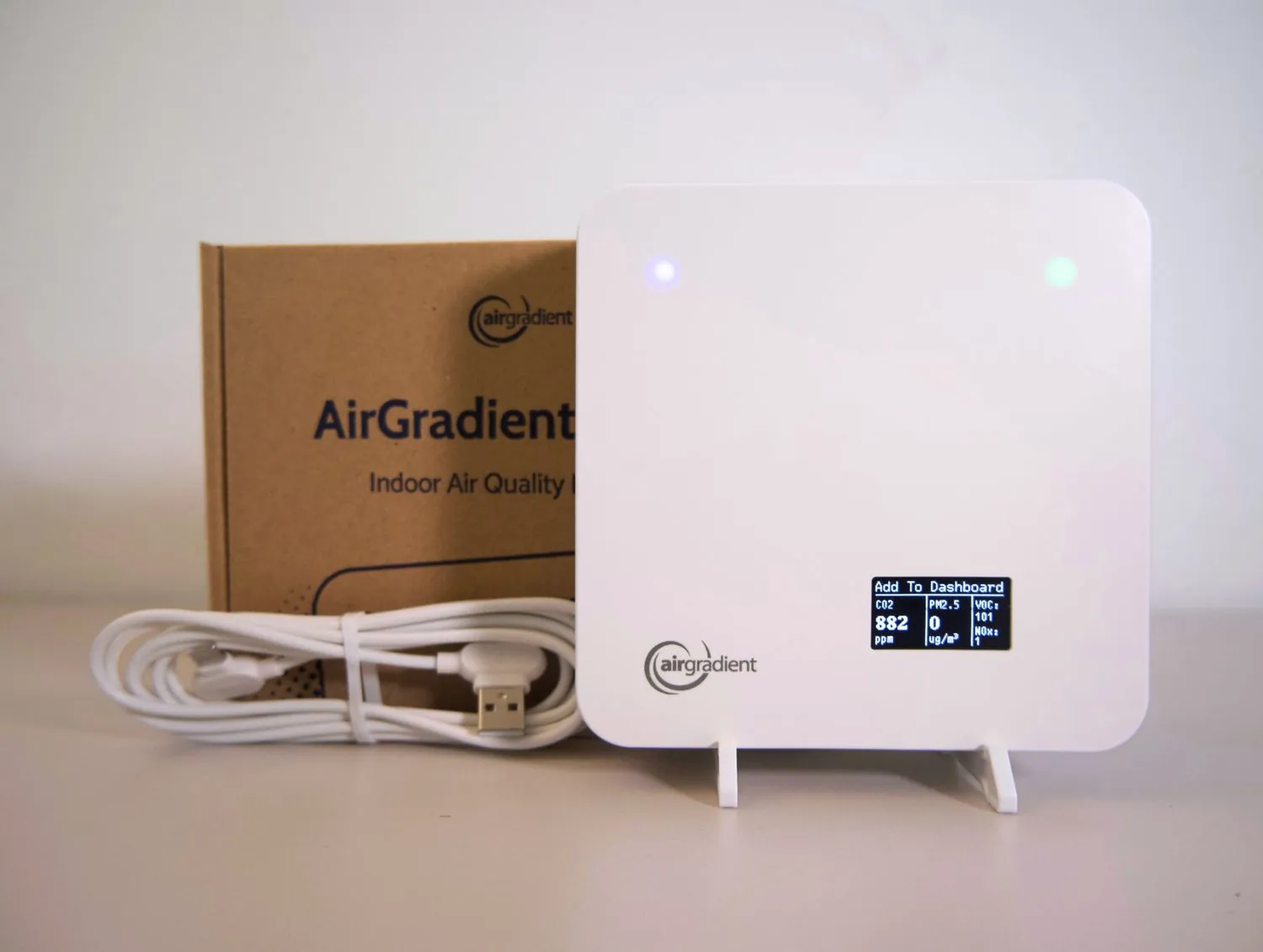
Wirecutter’s 2026-titled guide names the AirGradient One as its top choice over the Airthings View Plus specifically because the AirGradient includes a Sensirion SGP41 sensor for NOx, while the View Plus lacks NOx monitoring. The date matters: the testing behind that comparison is September 2025, so its integration and setup observations should be read as dated to that test window, not as a permanent guarantee across every later firmware or hub change. [1]
That is not a small footnote. A gas-stove buyer is not mainly buying a household weather station. They need a signal that responds to combustion-related NOx concern. If a product gives you radon, CO2, PM2.5, VOCs, temperature, humidity, and pressure but omits NOx, it may still be a good monitor for another home. It is just not the cleanest fit for this one.
AirGradient’s own comparison also points out that the View Plus uses a Cubic CM1106SL-NS CO2 sensor with a stated ±50 ppm +3% specification, while the AirGradient One uses a SenseAir S8 with a stated ±30 ppm +3% specification. That comparison is useful, but it is vendor-published, so I would treat it as a disclosure of component choices and stated specifications rather than independent proof that one unit will outperform the other in every room. [5]
The practical verdict is simple: if your home’s dominant worry is gas combustion, the AirGradient One is the better fit because its sensor suite lines up with the pollutant. Before buying, still check the current hub behavior for your ecosystem in Which Smart Air Quality Monitor for Home Works With Your Hub. Sensor fit comes first; automation reliability decides whether anyone in the home will actually see and use the alert.
Smoke and PM: useful does not mean perfectly absolute
Smoke monitoring is where low-cost air sensors become most obviously useful, and also where they are easiest to oversell. A laser particle counter can give a household a timely PM trend: the smoke is getting in, the purifier is catching up, the bedroom is worse than the living room, the filter should run overnight. That is the signal many people need.
The PurpleAir Zen has the strongest support here among the available materials. HouseFresh says it uses the PurpleAir Zen, which contains dual Plantower PMS6003 sensors plus a Bosch BME688, as its reference sensor for air-purifier testing. The same HouseFresh review cites AQMD field reports finding the Zen’s PM1.0 results highly aligned with a roughly $25,000 GRIMM EDM 180 reference instrument. [2]
That does not license the lazy sentence “PurpleAir is accurate” without context. Lawrence Berkeley National Laboratory reported in 2020 that low-cost home monitors overreported PM2.5 during the Camp Fire by factors of 1.6 to 2.4, while still tracking relative changes well. LBNL also describes that work as the basis for the PurpleAir PA-II correction factor of about 0.48, available as the LRAPA option. [3]
That combination is exactly what I want to know before trusting a smoke monitor. The raw number may not equal a reference instrument during wildfire conditions, but the direction and timing can still be good enough to run an air purifier, close a window, or compare rooms. If your automation is built around “PM is rising fast, turn the purifier up,” relative tracking matters more than a ceremonially precise-looking display.
For a smoke-first household, PurpleAir Zen is the pick with the clearest dated evidence. For smoke automation ideas rather than another ranking, the Portland recipe in indoor air monitor Portland wildfire smoke is a better use of time.
Where IKEA Vindstyrka fits
IKEA Vindstyrka is the budget PM monitor to consider when the need is local, visible, and modest: a screen in a room, a rough PM condition, and a smart-home path for people already comfortable with IKEA’s ecosystem. BreatheSafeAir reports that the $49.99 Vindstyrka contains a Sensirion SEN54 module, which has a roughly $30 retail value, and cites a ±10% PM specification and peer-reviewed support for that sensor family. [6]
The caveat is that Vindstyrka’s interface can make PM look calmer than some buyers will want. BreatheSafeAir notes that its PM color thresholds mark 0–35 µg/m³ as green, while also pointing to a 24-hour WHO guideline of 25 µg/m³. It also displays VOCs only as trend arrows, not as a defensible chemical reading. [6]
So I would not buy Vindstyrka as the most evidence-backed wildfire monitor. I would buy it as an inexpensive PM-aware room display if its thresholds, hub path, and VOC limitations are acceptable.
Radon: Airthings View Plus earns its place for the right reason
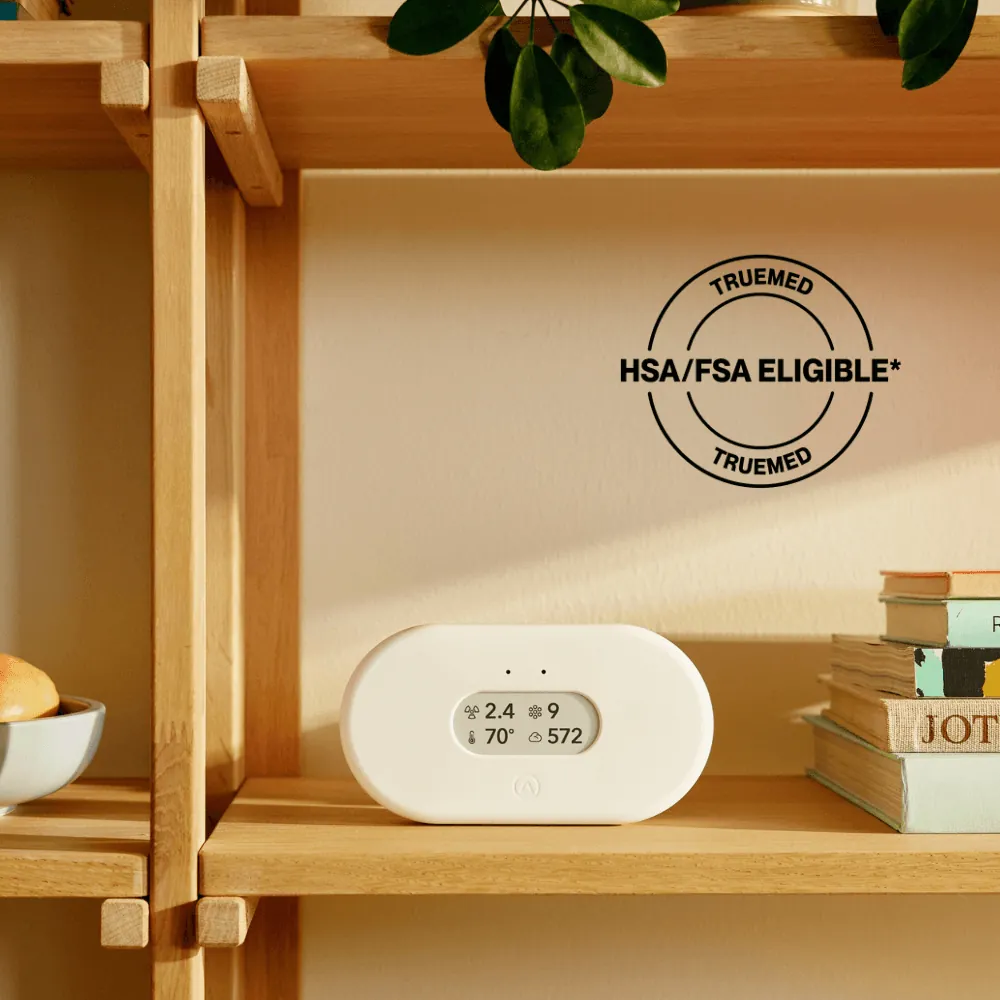
Airthings View Plus is not my gas-stove pick, but it makes immediate sense when radon is the dominant concern. Wirecutter identifies the View Plus as measuring radon via alpha-spectrometry, and that is the relevant technology for a basement or ground-floor buyer who is worried about radon exposure. [1]
This is where product breadth can be helpful without becoming the reason to buy. View Plus also measures CO2, PM2.5, VOCs, temperature, humidity, and pressure, and AirGradient’s comparison notes that it offers no manual recalibration. Those details matter for ownership, but they should not distract from the main fit: choose View Plus when radon is the pollutant that will drive action. [5]
If you mostly want CO2 or smoke tracking, its extra radon capability may be irrelevant. If you are setting up a basement office in a radon-prone area, the alpha-spectrometry sensor is not an extra; it is the reason the device is in the conversation.
CO2: buy NDIR if you want a number
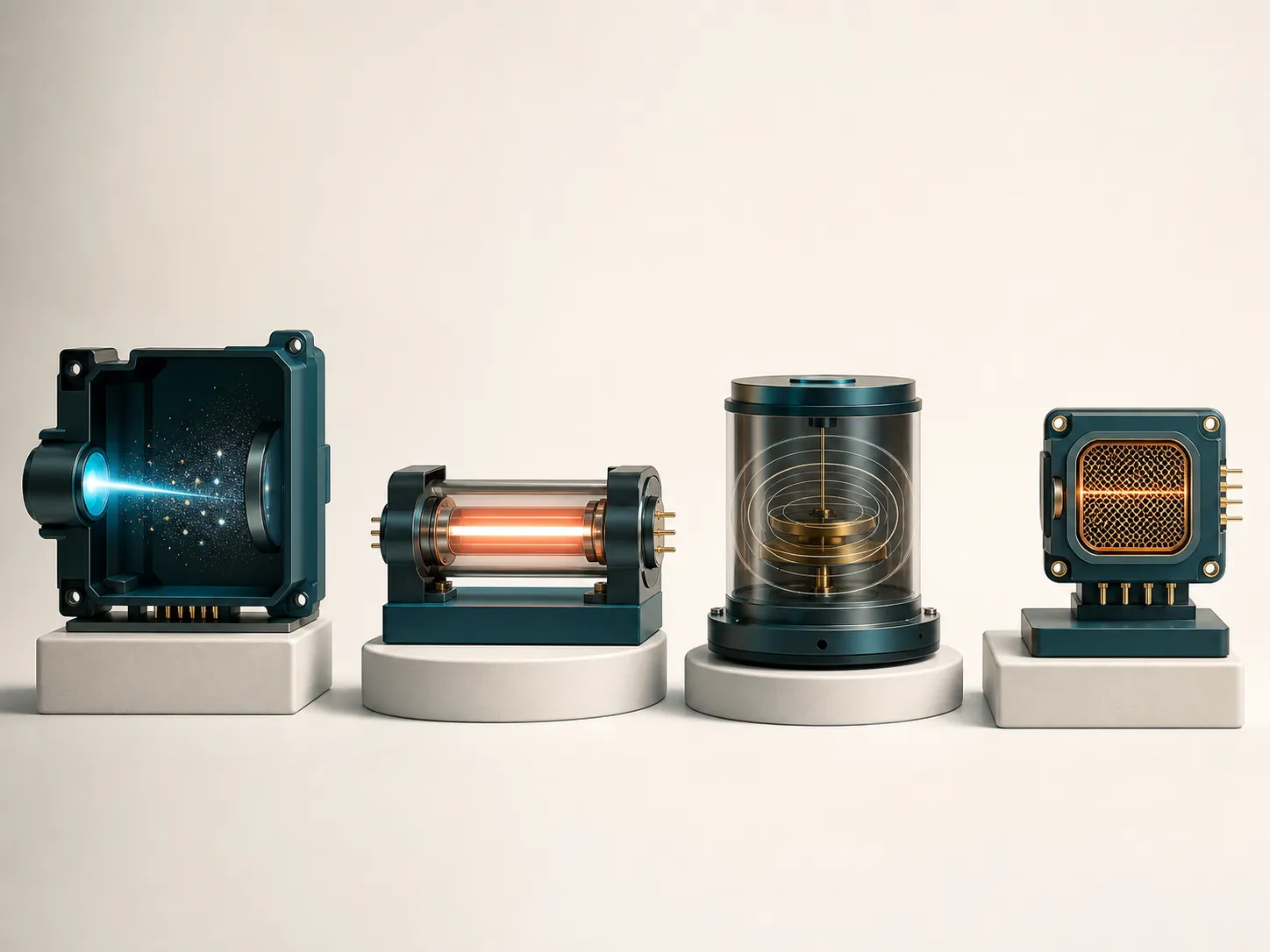
For CO2, the dividing line is not app polish. It is whether the device uses NDIR-class sensing or a cheaper indirect method. If you want a ventilation number you can compare across rooms and days, stay in the NDIR lane.
BreatheSafeAir’s July 2026 IKEA ALPSTUGA review is useful because it draws that line cleanly. ALPSTUGA uses a thermal-conductivity SEN63C CO2 sensor with an approximately ±100 ppm stated specification, and the review warns that it is best treated as trend-only because the reading can drift with room temperature. The same review places Qingping Lite at about $80, SwitchBot Meter Pro CO2 at about $70, and Aranet4 in the accurate-number lane because they use NDIR CO2 sensing; it also notes Aranet4’s ±30 ppm +3% specification. [4]
That does not make ALPSTUGA useless. A trend-only device can still tell you that a room is getting stuffy and that opening a window changed something. It just should not be sold to a buyer who expects an accurate CO2 number. Those are different promises.
For ecosystem-specific CO2 choices, use Your Smart Home Hub Decides the Best CO₂ Monitor for Health. CO2 is one of the places where the monitor can be technically sound and still be a bad purchase if the hub path is clumsy enough that nobody sees the alert in time.
VOCs: useful arrows, weak certainty
VOCs are where I would be most suspicious of confident marketing. Broad gas sensors can notice that the air changed after cleaning, painting, cooking, or bringing in something new. That is useful. It can prompt ventilation, source removal, or a closer look at a room that suddenly behaves differently.
But a general VOC tile is not the same kind of evidence as laser PM counting for smoke trends, alpha-spectrometry for radon, or NDIR for CO2. The honest ceiling is trend interpretation: something rose, something fell, something changed. If a household’s real concern is a specific chemical exposure, a consumer smart monitor’s VOC score should not be treated as identification or proof of safety.
What “tested” should mean before you buy
A manufacturer accuracy specification is a claim. An independent field comparison, a dated hands-on review, or a known component disclosure is evidence of a different kind. They should not be mashed together into one blob called “tested.”
| Evidence type | What it can support | What it cannot prove by itself |
|---|---|---|
| Independent field or lab comparison | How a device or sensor behaved against a known reference under stated conditions | That every future firmware version, room, pollutant mix, or unit will behave identically |
| Hands-on editorial testing | Setup, readings, app behavior, and relative performance during a dated test window | Permanent hub compatibility or universal accuracy |
| Manufacturer-stated sensor specification | The claimed capability of a component or product | Independent validation in your home |
| Vendor-published comparison | Useful component disclosures and arguments to investigate | Neutral proof, especially when the vendor is comparing against a competitor |
This is why the date stays attached to each pick. Wirecutter’s AirGradient-versus-Airthings judgment is useful, but its testing is September 2025. HouseFresh’s PurpleAir Zen discussion is July 2026. BreatheSafeAir’s ALPSTUGA review is July 2026. Prices and hub behavior can move after a crawl; sensor physics moves more slowly, but even there, firmware and calibration choices matter. [1][2][4]
Before spending, do three checks in this order:
- Name the pollutant you will act on: smoke PM, gas-stove NOx, radon, CO2, or a loose VOC trend.
- Confirm the sensor class: laser PM counter, Sensirion SGP41-class NOx capability, alpha-spectrometry radon, NDIR CO2, or broad gas trend sensor.
- Check the dated evidence and hub path, especially if you expect automations rather than just a screen.
That leaves a conditional verdict, not a crown. Buy AirGradient One if gas-appliance NOx and strong sensor transparency are the reason you are shopping. Buy PurpleAir Zen if smoke tracking is the main job and you understand the correction-factor nuance. Buy Airthings View Plus when radon is the dominant household concern. Buy an NDIR CO2 monitor such as Qingping Lite, SwitchBot Meter Pro CO2, Aranet4, or another verified NDIR option when ventilation is the question. Treat VOC readings as change signals, not chemical certainty. Whichever lane fits, check the dated test evidence and current hub behavior before you spend.
References
- The 3 Best Home Air Quality Monitors of 2026, Wirecutter
- The best air quality monitors we have tested, HouseFresh, July 2026
- Low-Cost Home Air Quality Monitors Prove Useful for Wildfire Smoke, Lawrence Berkeley National Laboratory
- IKEA Alpstuga Review, BreatheSafeAir, July 2026
- AirGradient vs Airthings, AirGradient
- IKEA Vindstyrka Review, BreatheSafeAir
Known issues with this device / protocol
Spec-version history
For active regressions on this protocol, see Update Watch.
No linked Update Watch entries yet.