
Can You Trust Smart Air Quality Monitors in Wildfire Smoke?
During wildfire smoke, low-cost optical PM2.5 monitors are biased high or low against reference instruments — one lab test found four monitors overreporting by 1.6–2.4x — so uncorrected readings can't be trusted. Before buying, check the monitor's sensor module, correction algorithm, and published field-test history; those disclosures, not price, are what make smoke-season numbers believable.
Last updated
If you are shopping for the best smart air quality monitors for wildfire smoke, the first filter is not price, screen quality, Matter support, or whether the app looks tidy on your phone. The first filter is whether the PM2.5 number is corrected and documented well enough to act on during smoke.
Hub compatibility still matters. If a monitor cannot report into the system that runs your purifier automation, it may be a nice desktop display and still fail the job you bought it for. NestGrid already covers that side in How to test smart air quality monitors for wildfire smoke and Which Air Quality Monitor for Allergies Works With Your Hub?. This article is the second filter: whether the smoke-season number itself deserves trust.
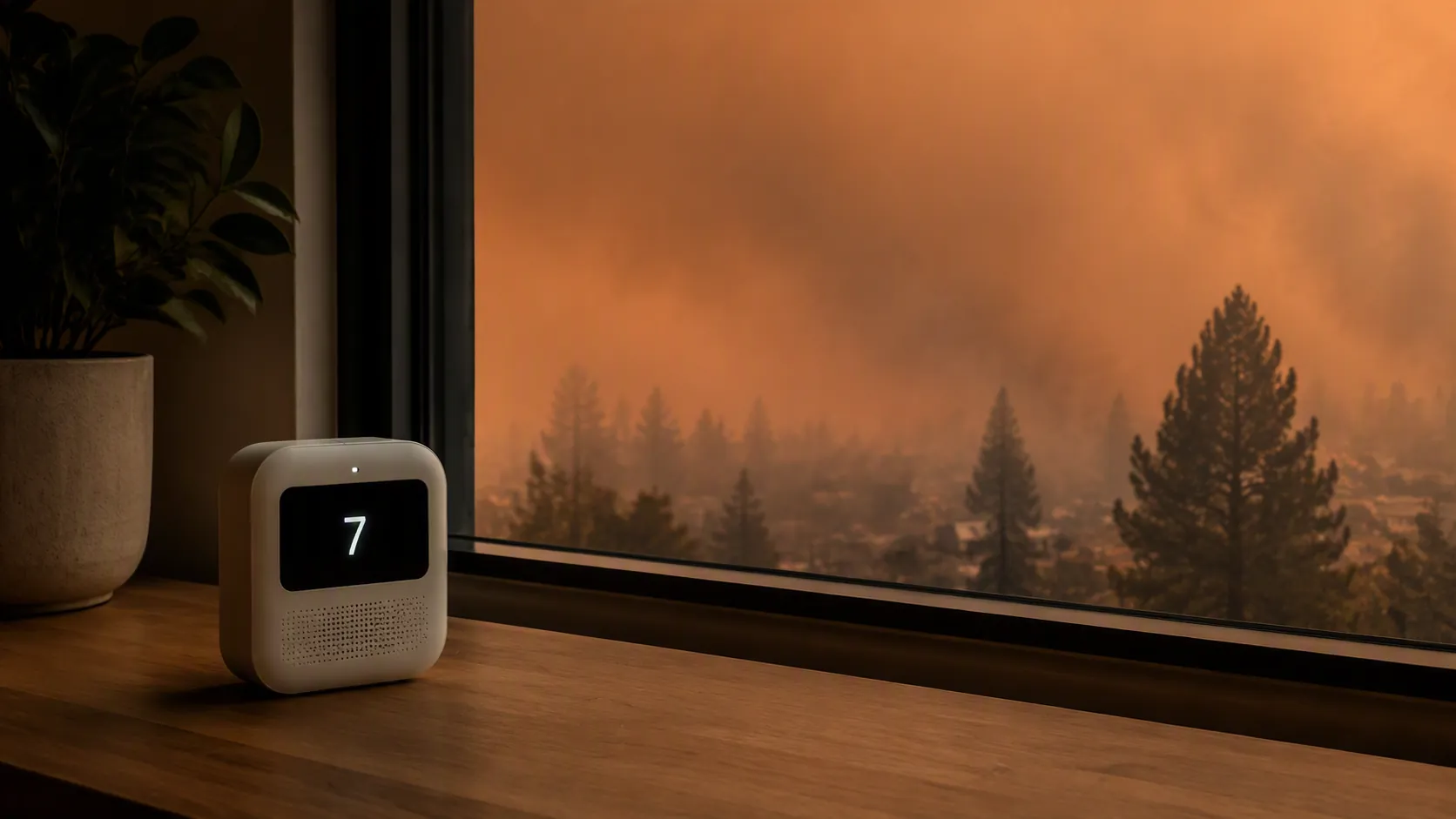
A PM2.5 sensor is not the same thing as a smoke-accurate monitor
Most consumer wildfire-smoke monitors rely on low-cost optical particle sensors. They shine light through sampled air and infer particle mass from how particles scatter that light. That can be useful. It is also exactly where smoke gets messy: particle size, composition, humidity, and aerosol type can push the inferred PM2.5 value away from what a reference instrument would report.
The useful but uncomfortable finding from Berkeley Lab’s Camp Fire work is that low-cost monitors did track relative changes in smoke, but their raw values were not reference-grade. In that study, four low-cost monitors overreported PM2.5 by 1.6 to 2.4 times compared with a regulatory reference monitor during wildfire smoke exposure.[1]
That distinction matters in a house. If a monitor rises when smoke enters, it can still help you see that the purifier is gaining or losing ground. But if the absolute value is biased, the display can push you into the wrong AQI category, the wrong automation threshold, or the wrong level of urgency.
Clarity’s smoke-calibration analysis puts that problem in household terms. In its comparison of hourly averages, the calibrated monitor assigned the correct AQI category 80% of the time, while the uncalibrated monitor did so 41% of the time. The uncalibrated monitor overestimated the AQI category for 59% of hours and was more than four times as likely to overestimate.[2]
Overreporting is not harmless just because it is conservative. A monitor that cries hazardous too easily teaches the household to ignore alarms, drives unnecessary purifier noise, and makes automations look broken. Underreporting is worse in the obvious way: the bedroom looks calm while smoke is rising. Either failure is a problem when the reading is being used as a decision instrument rather than a curiosity.
What “corrected” actually means
A correction is an equation or calibration method that adjusts the raw sensor output toward a reference instrument under defined conditions. It may be built into the device firmware, applied in the cloud, selected in a public map, or calculated later when data is exported. Those are not equivalent for a buyer. The number on the screen, the number in the app, the number sent to Home Assistant, and the number shown on a public map may not all be the same number.
For Plantower-based monitors, the EPA smoke adjustment is the correction most buyers should know by name. AirGradient’s December 2025 discussion, citing AMT 2023, describes the EPA Plantower correction as significantly improving accuracy during wildfire smoke, while also warning that it is smoke-tuned and should not be treated as a general correction for dust or every aerosol type.[3]
Verification note, August 4, 2026: check EPA’s own current documentation before relying on a specific Plantower smoke-correction claim. The practical buying rule still holds: look for a documented smoke correction and do not assume raw Plantower output is smoke-accurate. Do not extend that correction to every sensor module or every particle source.
This is where a lot of product pages become too vague. “Measures PM2.5” is a component claim. “Uses a Plantower PMS5003 with the EPA wildfire-smoke correction applied to displayed and exported PM2.5 values” is a much more useful disclosure. “Factory calibrated” may be meaningful, but only if the manufacturer says what it was calibrated against and under what conditions.
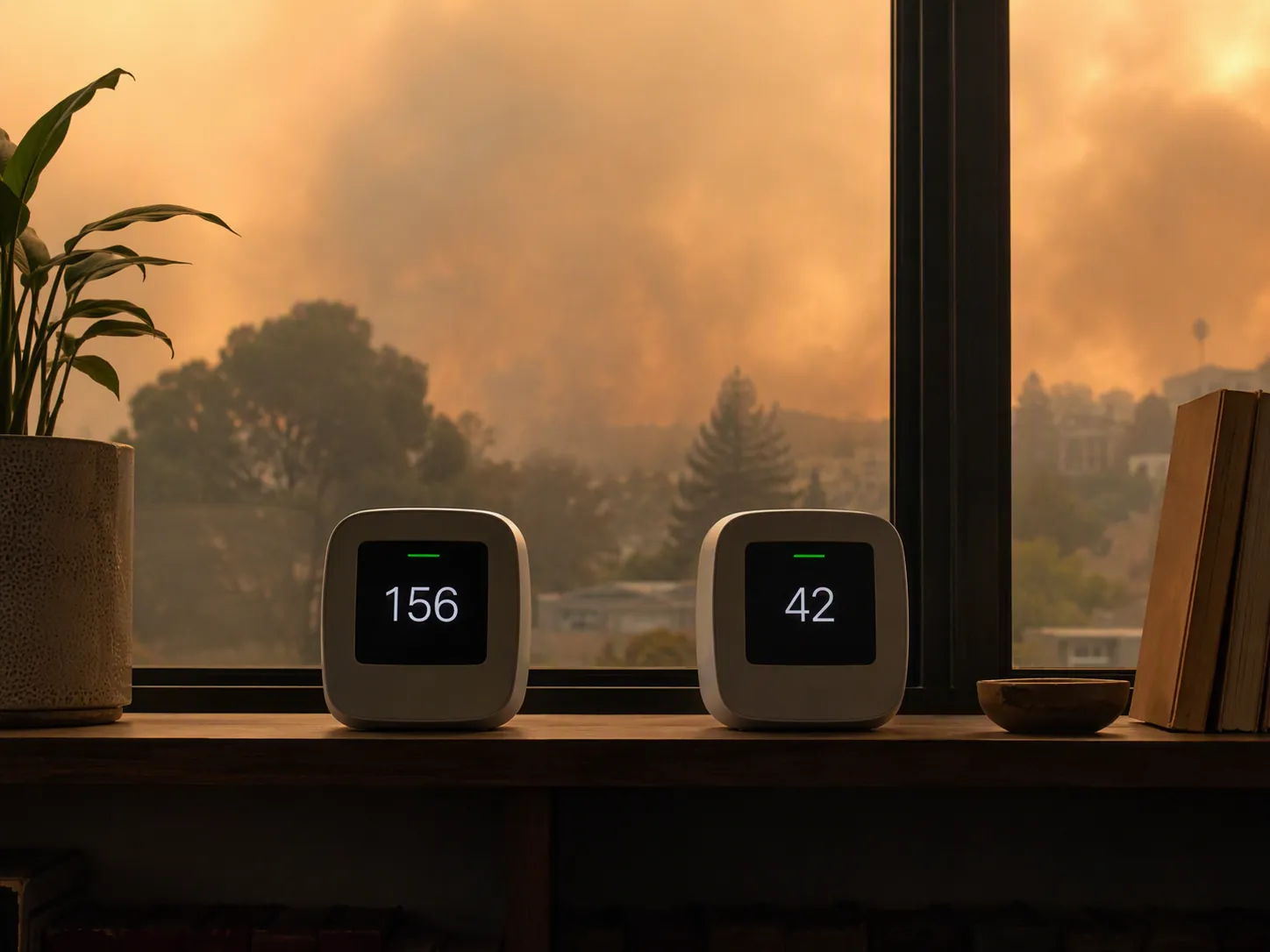
The purchase test I would run before trusting a monitor in smoke
Before comparing displays or automations, run the monitor through this smoke-specific verification sequence:
- Identify the PM2.5 sensor module. Look for Plantower, Cubic, Sensirion, or another named module. If the product page only says “laser PM2.5 sensor,” treat the sensor as undisclosed.
- Find the correction method. The manufacturer should say whether the displayed PM2.5 value is raw, factory-calibrated, EPA-corrected, map-corrected, locally corrected, or corrected through a proprietary model.
- Check what the default display shows. A correction buried in an export option does not help the person looking at the bedside screen at 2 a.m.
- Look for field or colocation testing against a reference instrument. Lab precision is useful, but smoke-season behavior needs outdoor or real-world comparison data.
- Separate smoke claims from general air-quality claims. A correction tuned for wildfire smoke may not behave the same way with dust, cooking aerosol, or other particle sources.
- If the manufacturer hides the module, the correction, and the test history, classify the monitor as unverified for wildfire-smoke decisions.
This test is stricter than a normal smart-home review because the consequence is different. A slightly clumsy app is annoying. A hidden PM2.5 correction path can change whether someone tapes a leaky window, starts a purifier, or decides a child’s room is safe enough for the night.
Price does not solve the sensor problem
Expensive monitors can have better housings, better apps, better support, and better integration paths. That does not automatically mean the PM2.5 measurement chain is more trustworthy in smoke. AirGradient’s comparison work notes that monitors across price ranges may use sensor modules from the same families, including Plantower, Cubic, and Sensirion.[4]
So the buying question is not “Which one costs more?” It is “Which one tells me what sensor is inside, how the raw output is corrected, and how that corrected value performed next to a reference?” A polished app can still be wrapped around an opaque number.
Use monitor examples as evidence signals, not as trophy categories
The names people ask about — AirGradient, PurpleAir Zen, IQAir AirVisual Pro or Outdoor, and similar smart monitors — are useful here only when they reveal something about the measurement chain. A device with public correction behavior and field comparisons is easier to judge than one with a beautiful app and no disclosed PM2.5 path.
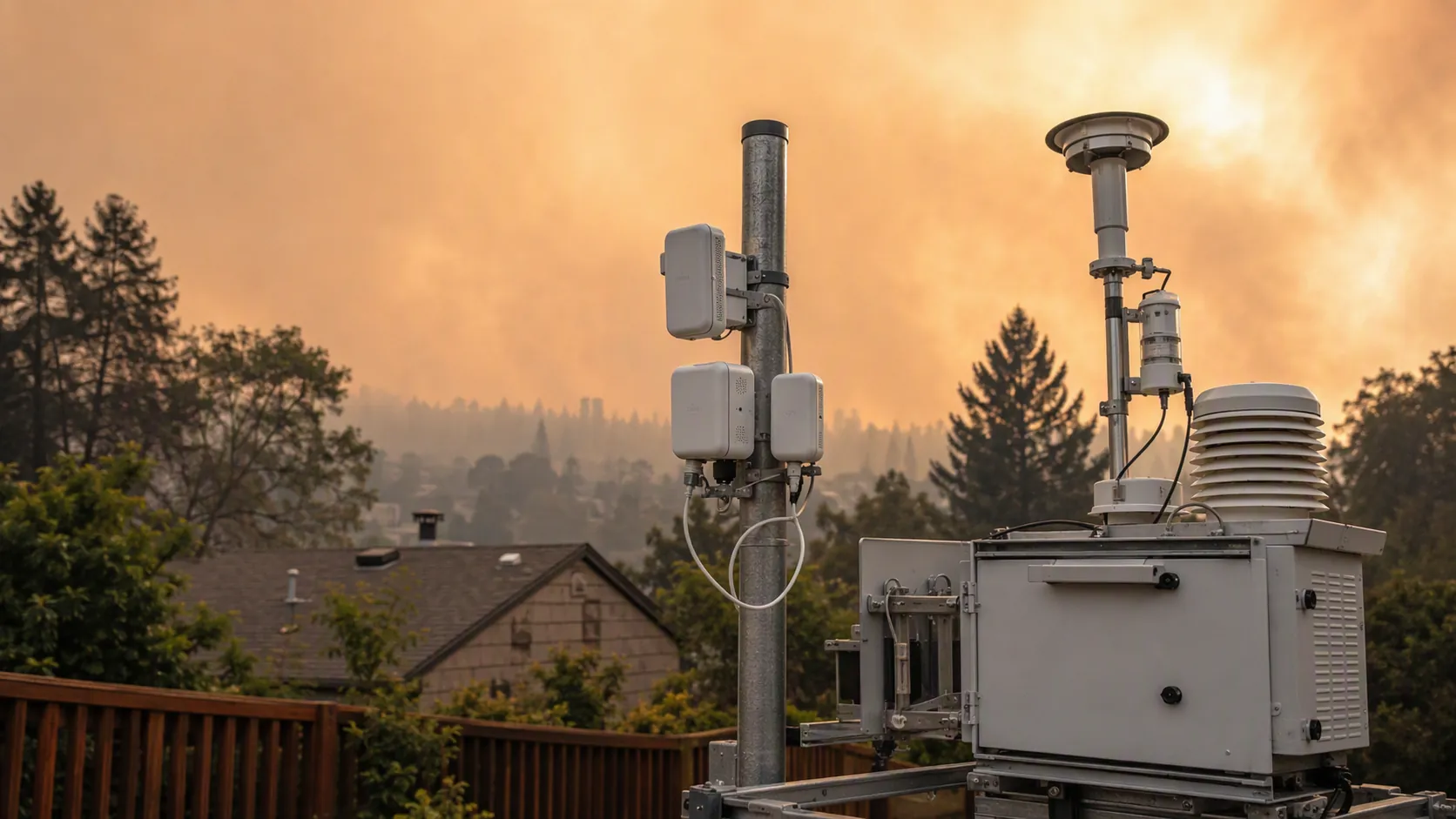
AirGradient’s outdoor reference testing against a Palas Fidas 200S reported a PurpleAir Zen outdoor R² of 0.88 and an IQAir AirVisual Outdoor R² of 0.92, while also describing behavior that diverged by aerosol type.[5] That is the kind of material worth reading closely. The correlation number is not the whole answer, but the existence of reference comparison work gives a buyer something real to inspect.
The IQAir AirVisual Pro is a good example of why lab and field numbers should not be casually blended. A BreatheSafeAir review, citing AQMD AQ-SPEC information, reported field R² values of 0.63 to 0.81 versus 0.99 in lab testing.[6] Because that claim depends here on a review citing AQMD rather than the AQMD source itself, verify the source before making a strong product claim. The broader lesson is still sound: lab agreement does not guarantee field agreement during the air events people actually care about.
PurpleAir is also a reminder to check which value you are viewing. Public maps and exports can offer correction choices, and those choices can materially change the displayed PM2.5 or AQI estimate. Before buying a monitor for a dashboard or automation, confirm whether your integration receives raw data, a default corrected value, or a selectable correction.
What still matters after the PM2.5 number passes the test
Once the monitor clears the smoke-accuracy filter, the ordinary smart-home questions come back into play. Does it update often enough for your purifier automation? Can your hub read the PM2.5 value locally or does it depend on a cloud service? Is the display readable from across the room? Does the app expose historical data without a subscription? Can you set a threshold without fighting the interface?
VOC, CO2, temperature, and humidity sensors may be useful, but they do not substitute for a trustworthy PM2.5 reading during wildfire smoke. CO2 can tell you about ventilation. VOC sensors can react to many indoor sources. Humidity can help interpret particle readings. None of those extras answers the core smoke question by itself.
If you are using the monitor to drive a purifier, set thresholds with the corrected PM2.5 behavior in mind. NestGrid’s Automate a Smart Air Purifier for Wildfire Smoke covers the automation side, and How to Check Air Quality at Home During Wildfire Smoke is the better place for day-of-smoke operating habits.
The disciplined buying rule
A smart air quality monitor can be useful for wildfire smoke. The evidence does not say low-cost optical monitors are worthless; it says raw readings can be badly biased while still tracking changes. That is a very different purchase decision.
Buy the monitor whose PM2.5 sensor module is named, whose smoke correction is explained, whose displayed and exported values are clear, and whose field-test history can be inspected. If a monitor hides those details, it may still be a fine smart-home accessory. It should not be the number your household trusts when wildfire smoke arrives.
References
- Wildfire Smoke Adjustment Factors for Low-Cost and Professional PM2.5 Monitors with Optical Sensors, MDPI Sensors
- PM Smoke Calibrations, Clarity, updated May 2026
- Air Quality Monitoring Myths, AirGradient, December 2025
- AirGradient vs PurpleAir, AirGradient
- Can You Trust Consumer-Grade Outdoor Air Quality Monitors?, AirGradient, March 2026
- IQAir AirVisual Pro Review, BreatheSafeAir, updated July 2026
Known issues with this device / protocol
Spec-version history
For active regressions on this protocol, see Update Watch.
No linked Update Watch entries yet.