
Which Air Quality Monitor for Allergies Works With Your Hub?
Which smart air quality monitor you should buy for allergies depends on the hub you already own, not the sensor specs. Get per-model verdicts for Apple Home, Google Home, Alexa, Home Assistant, and SmartThings — local vs. cloud control, which readings reach automations, and which 'Matter compatible' labels are only a floor.
Last updated
Start with the hub you already own. A smart home air quality monitor for allergies is only useful as a control device if PM2.5, PM10, CO2, humidity, or VOC readings can leave the vendor app and become automation inputs. If they cannot, you bought a dashboard, not a trigger.
The compatibility status below is dated to the 2026-08-03 crawl. “Confirmed” means the cited material supports the pairing or integration path. “Workaround” means the device can be made useful, but usually through a cloud service, bridge, or non-primary ecosystem. “Investigating” means the available material does not prove that the allergy-relevant readings appear as usable automation entities in that controller.
Compatibility verdicts by monitor and hub
| Model | Protocol / hub required | Local vs. cloud behavior | Allergy-relevant sensors in the provided material | Apple Home | Google Home | Alexa | Home Assistant | SmartThings |
|---|---|---|---|---|---|---|---|---|
| AirGradient One | Wi-Fi; native Homey and Home Assistant support reported by Wirecutter; Home Assistant route is official ESPHome/local in HA-focused material [1][2]. | Best case is local via ESPHome/Home Assistant. Re-check any vendor-app-only features separately. | PM2.5 is specifically documented; Wirecutter cites AirGradient’s published PM2.5 accuracy of ±4 µg/m³ from 0–100 µg/m³, RESET Air certification, and per-unit test reports [1]. Verify the current SKU if you need CO2/VOC/humidity entities. | Investigating: no confirmed Apple Home entity exposure in the provided material. | Investigating / not a clean Google buy: Wirecutter reported no Google Home integration as of September 2025; re-verify before purchase [1]. | Investigating / not a clean Alexa buy: Wirecutter reported no Alexa integration as of September 2025; re-verify before purchase [1]. | Confirmed: official local ESPHome/Home Assistant path is the reason this model stays on the list [2]. | Investigating: no confirmed SmartThings entity exposure in the provided material. |
| IKEA ALPSTUGA | Matter over Thread; requires a Matter controller and Thread border router. Matter Alpha lists it at roughly $30, USB-C powered, and able to act as a Thread relay [3]. | Matter local fabric is the promise; actual reading exposure still depends on the controller. | PM2.5, CO2, temperature, and humidity [3]. No PM10 in the provided material. | Investigating: Matter pairing is the baseline; unverified community claims that some HomeKit setups expose only an aggregate air-quality value need hands-on confirmation. | Investigating: likely pairable through Matter, but individual PM2.5/CO2 automation fields need controller verification. | Investigating: likely pairable through Matter, but individual PM2.5/CO2 automation fields need controller verification. | Investigating: viable for a Matter-over-Thread HA setup, but confirm entity exposure after commissioning. | Investigating: likely pairable through Matter, but individual PM2.5/CO2 automation fields need controller verification. |
| Sonoff AirGuard 07P | Matter over Wi-Fi; Matter Alpha lists it at roughly $39.90 [3]. | Matter over Wi-Fi avoids a vendor Zigbee bridge, but controller-side automation support still has to be checked. | PM2.5, PM10, plus siren/light features [3]. This is the cheapest model here with PM10 in the provided material. | Investigating: Matter pairing is not the same as confirmed PM2.5/PM10 automation triggers. | Investigating: confirm whether Google Home receives PM2.5 and PM10 as usable automation inputs. | Investigating: confirm whether Alexa receives PM2.5 and PM10 as usable routine inputs. | Investigating: promising if HA exposes the Matter attributes cleanly; confirm after pairing. | Investigating: confirm whether SmartThings exposes PM2.5 and PM10 as usable conditions. |
| LG Air Quality Sensor | Thread; Matter Alpha lists it among Matter-compatible air quality sensors [3]. | Thread/Matter path, subject to controller feature exposure. | Matter Alpha says it adds PM1.0 and CO2 and has an LED status ring [3]. The provided material does not prove PM10 exposure. | Investigating: Matter pairing likely matters less than whether Apple Home surfaces the readings you need. | Investigating: confirm readable and triggerable entities in Google Home. | Investigating: confirm readable and triggerable entities in Alexa routines. | Investigating: should be treated as a Matter commissioning test until HA entity exposure is verified. | Investigating: confirm SmartThings entity exposure. |
| Aqara TVOC sensor | Zigbee; requires an Aqara Zigbee hub, according to Matter Alpha [3]. | Bridge-dependent. It can be useful for Aqara users, but it is not a direct Matter-over-Thread particulate monitor in the provided material. | TVOC; e-ink display [3]. No PM2.5 or PM10 support is documented in the provided material. | Workaround: only consider if your Aqara bridge path exposes the value you want; not a particulate allergy trigger. | Workaround: same bridge caveat; not a PM2.5/PM10 buy. | Workaround: same bridge caveat; not a PM2.5/PM10 buy. | Workaround: useful only if the Aqara integration exposes the entity you want. | Workaround: useful only if the Aqara bridge path exposes the entity you want. |
| Amazon Smart Air Quality Monitor | Alexa app required to function, per BreatheSafeAir; designed around Amazon’s ecosystem [4]. | Cloud/app dependent. BreatheSafeAir reports no data export, and TechHive criticized the product as having “far better options” [4][5]. | Sensor details are not the deciding factor here: no export and peak-value graphing make it a poor fit for allergy automations outside Alexa [4]. | Dead end: no supported Apple Home path in the provided material. | Dead end: no supported Google Home path in the provided material. | Confirmed but narrow: Alexa-centered monitoring. Buy only if Alexa routines give you the exact conditions you need. | Dead end for local-control buyers: no export and no supported local HA route in the provided material. | Dead end: no supported SmartThings path in the provided material. |
| Airthings View Plus | Wi-Fi/internet device; SmartHomeScene reports IFTTT, Alexa, and Google Assistant pairing [2]. | Cloud-dependent. SmartHomeScene reports it requires internet/Wi-Fi to work at all and that the Home Assistant integration is cloud-polled [2]. | Airthings is relevant for indoor allergy context and pairs indoor readings with outdoor pollen context in its app, but this guide treats the app as secondary to automation exposure [6]. | Investigating: no confirmed Apple Home automation entity exposure in the provided material. | Workaround: Google Assistant pairing is reported, but verify which readings can actually trigger routines [2]. | Workaround: Alexa pairing is reported, but verify which readings can actually trigger routines [2]. | Workaround: Home Assistant cloud-polled integration; acceptable for dashboards and slower automations, not the local-control gold standard [2]. | Investigating: no confirmed SmartThings entity exposure in the provided material. |
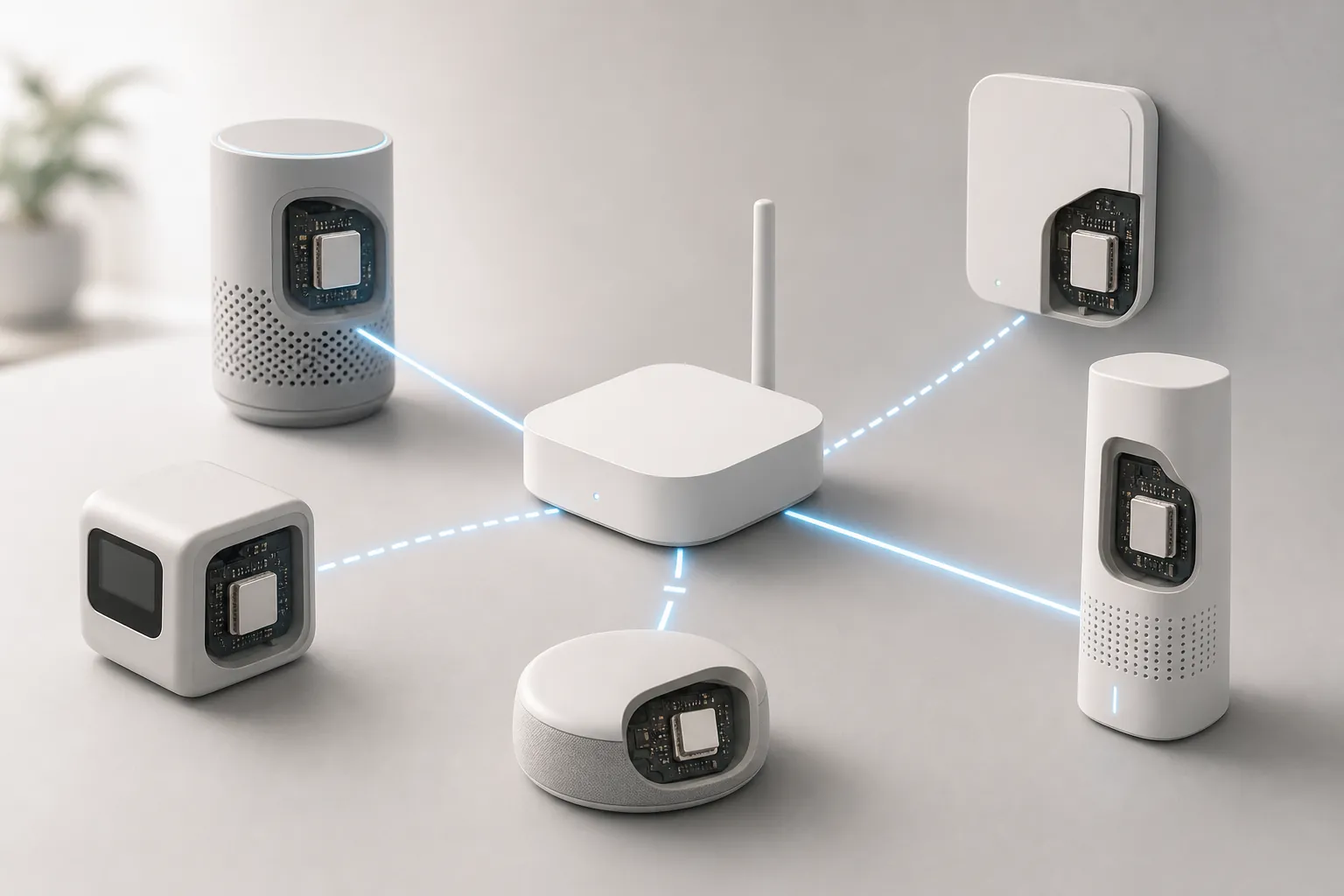
The sensor chip is not the whole product
PM10 is the particulate reading I look for first when the allergy target is pollen, mold spores, and dust. PM2.5 matters too, especially for fine particles from combustion and smoke. CO2, humidity, and VOC readings are supporting signals: they can tell you when a room is stale, damp, or chemically loaded, but they do not replace particulate triggers for pollen-season purifier control.
That is why a cheap monitor with PM10 exposed to automations can be more useful than a prettier monitor that traps its readings in a vendor graph. AirGradient’s own state-of-monitoring report tested 50 monitors and found the same Plantower PMS5003/PMS6003 modules inside products ranging from roughly $125 kits to more than $1,000-per-year professional units; the same vendor report also notes that several devices could not be set up because their apps or cloud services had already shut down [7]. That is first-party vendor research from a company selling monitors, so it should not be treated as neutral lab arbitration. It is still a useful reminder: the module inside is only one part of the buying decision.
The health motivation is real enough without turning this into a particulate-science lecture. Airthings says people spend about 90% of their time indoors, cites about 25 million Americans with asthma, and says damp or moldy homes are associated with about 40% higher asthma likelihood [6]. For a sibling compatibility matrix focused specifically on CO2 monitors, see Your Smart Home Hub Decides the Best CO₂ Monitor for Health. The same rule applies here: a reading matters more when your hub can act on it.
Matter is the starting line, not the allergy automation
Matter Alpha counted roughly 13 Matter-certified air quality sensors in its database, with some region-locked, as of the material used for this crawl [3]. That is enough to make the category interesting, especially with ALPSTUGA, AirGuard 07P, and LG’s Thread sensor pushing air monitoring into the same conversation as lights, plugs, and locks.

The catch is familiar: certification can get a device commissioned, but it does not prove that every useful feature becomes an automation condition in every app. A Matter air monitor can pair and still expose only a generic air-quality summary, or expose readings in a tile but not in the automation builder. That is the same protocol-literacy issue covered in our Matter smart lock guide: Matter is a baseline, not a promise that the feature you care about will appear exactly where you need it.
For ALPSTUGA in particular, unverified community reports have suggested that some HomeKit setups may expose only an aggregate air-quality value. That is not strong enough to publish as fact. It is strong enough to keep Apple Home status at Investigating until a hands-on check confirms whether PM2.5 and CO2 appear as separate, usable automation inputs.
Short model verdicts
AirGradient One
This is the strongest pick here for Home Assistant users who care about local control. The official ESPHome path means the monitor can become a real set of HA entities instead of a screenshot inside a branded app [2]. Wirecutter’s September 2025 note that AirGradient had no Alexa or Google Home integration keeps it from being a universal recommendation, and that status needs re-verification before anyone buys it for those ecosystems [1].
IKEA ALPSTUGA
ALPSTUGA is the most tempting Matter-over-Thread budget device in the list because it combines PM2.5, CO2, temperature, and humidity at about the price of a smart plug, and it can act as a Thread relay [3]. The missing piece is controller behavior. Buy it only if you are comfortable testing whether your chosen controller exposes the individual readings, not just an air-quality badge.
Sonoff AirGuard 07P
AirGuard 07P is the most allergy-specific Matter entry in the provided material because it includes both PM2.5 and PM10 [3]. PM10 is the reason it stays interesting. The question is whether Apple Home, Google Home, Alexa, Home Assistant, or SmartThings will expose those two readings separately enough to drive a purifier.
LG Air Quality Sensor
LG’s sensor belongs on a Matter watchlist, not at the top of an allergy-trigger shopping list. The provided material confirms Thread, PM1.0, CO2, and an LED status ring [3]. It does not prove PM10 support or controller-level automation exposure, so it remains Investigating for the use case that matters here.
Aqara TVOC sensor
Aqara’s TVOC sensor is not a particulate allergy monitor in this evidence set. It may be useful if you are already in Aqara’s Zigbee ecosystem and want VOC visibility, but it requires an Aqara hub and the provided material does not document PM2.5 or PM10 [3]. For pollen, dust, and mold-spore automations, start elsewhere.
Amazon Smart Air Quality Monitor
Amazon’s monitor is the cleanest example of why “smart” can still be a dead end. BreatheSafeAir reports that it requires the Alexa app to function and has no data export; the same review also criticizes its peak-value graphing rather than average-value graphing [4]. TechHive’s verdict was blunt: “far better options” [5]. If your home is already all-in on Alexa and you only want Alexa-facing routines, it may be serviceable. If you want portable data, local control, or Home Assistant entities, skip it.
Airthings View Plus
Airthings View Plus is better treated as a polished environmental monitor with cloud integrations than as a local allergy automation sensor. SmartHomeScene reports IFTTT, Alexa, and Google Assistant pairing, but also says the device needs internet/Wi-Fi to work at all and that the Home Assistant integration is cloud-polled [2]. That can be acceptable for trend charts and slower decisions. It is not the same buying category as a local ESPHome device.
Ecosystem verdicts
Apple Home
Apple Home buyers should treat Matter air-quality monitors as promising but unproven until the exact entities are visible in the Home app. ALPSTUGA is the obvious budget experiment because it is Matter over Thread and includes PM2.5 plus CO2 [3]. AirGuard 07P is more directly allergy-relevant because it includes PM10 [3]. Neither earns a full Apple Home recommendation here until PM2.5 or PM10 can be confirmed as usable automation conditions.
AirGradient One is not supported as an Apple Home pick by the provided material. Aqara’s TVOC sensor is a bridge-dependent VOC device, not a pollen-focused particulate monitor. Amazon’s monitor is an Alexa product. Airthings View Plus stays Investigating for Apple Home because the provided material does not confirm Apple Home automation exposure.
Google Home
For Google Home, the best candidates are the Matter devices, with the same caveat: pairing is not enough. ALPSTUGA gives you PM2.5 and CO2 on paper; AirGuard 07P gives you PM2.5 and PM10 on paper [3]. The purchase decision is whether Google Home exposes those readings as automation inputs in your account and region.
AirGradient One should not be bought for Google Home without a fresh check, because Wirecutter reported no Google Home integration as of September 2025 [1]. Airthings View Plus has reported Google Assistant pairing, but that is not the same as confirmed PM-triggered Google Home automations [2]. Amazon’s monitor is not a Google Home solution.
Alexa
Alexa has the most obvious vendor-native option in Amazon’s own monitor, and that is also why it needs the most skepticism. The Alexa dependency may be convenient if every automation you want already lives in Alexa. It becomes a wall when you want data export, local processing, or cross-platform control [4].
Matter devices are the better direction for an Alexa home if Alexa exposes their readings as routine conditions. AirGuard 07P is the one to watch for allergy use because it has PM10 [3]. AirGradient One is not an Alexa pick unless its integration status has changed since Wirecutter’s September 2025 note [1]. Airthings View Plus has reported Alexa pairing, but verify the actual routine fields before buying [2].
Home Assistant
Home Assistant is where the difference between “monitor” and “control sensor” becomes easiest to see. AirGradient One is the cleanest answer because the official ESPHome route is local [2]. That means the readings can be ordinary HA entities, available to automations without waiting on a consumer cloud to translate them.
Airthings View Plus is the contrast case. It can be integrated, but SmartHomeScene describes the Home Assistant integration as cloud-polled and says the device needs internet/Wi-Fi to work at all [2]. That is not useless; it is simply a different reliability and latency profile. If the goal is a local purifier trigger during a bad indoor-air event, local entities win.
For ALPSTUGA, AirGuard 07P, and LG’s sensor, Home Assistant buyers should be ready to test Matter entity exposure. If you are commissioning Matter sensors through HA, start with the Home Assistant Matter controller guide and verify the actual entities before building the automation around them.
SmartThings
SmartThings buyers have the same Matter opportunity and the same Matter uncertainty. ALPSTUGA and AirGuard 07P are the models to test first because one is cheap Thread with PM2.5/CO2 and the other includes PM10 [3]. The test is not whether they join SmartThings; it is whether PM2.5 or PM10 appears as a condition in the routine builder.
The non-Matter devices in this list do not have enough confirmed SmartThings support in the provided material to recommend them for allergy-triggered automations. That keeps AirGradient, Airthings, Amazon, and Aqara in Investigating or workaround territory for SmartThings unless a separate verified integration path is available in your setup.
Automation patterns that only work if the reading is exposed
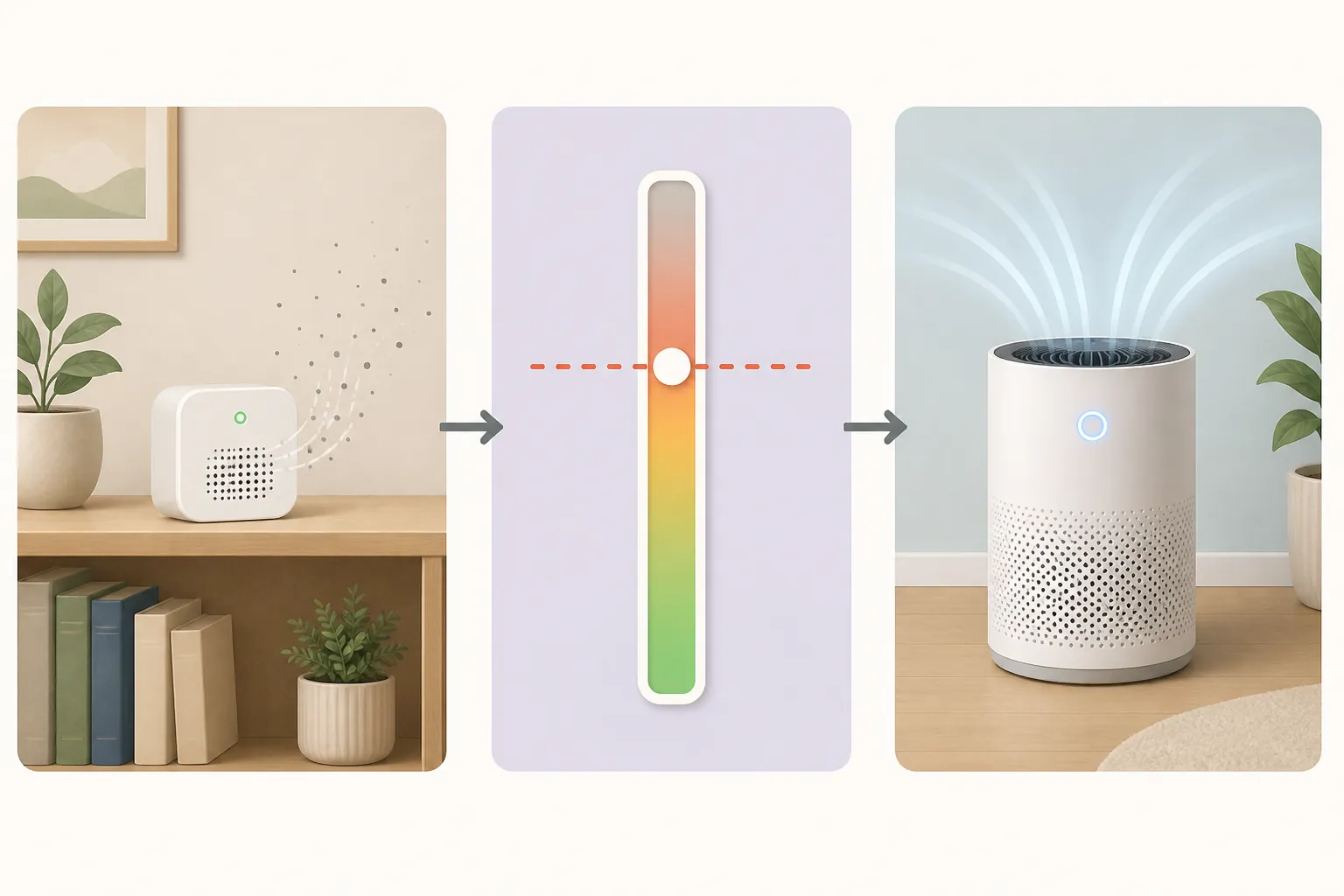
Do not copy these into a shopping decision until your hub shows the relevant reading as an automation trigger. A PM2.5 value visible only in a device tile may still be useless for automation. A PM10 value inside a vendor app may be invisible to the hub that controls your purifier.
| Use case | Required exposed entity | Copyable pattern |
|---|---|---|
| Fine-particle response | PM2.5 as a numeric automation condition | When PM2.5 rises above your chosen threshold and stays high after a short confirmation delay, turn the purifier on or raise fan speed. When PM2.5 falls back below your chosen recovery level, return the purifier to auto. |
| Pollen / dust / mold-spore response | PM10 as a numeric automation condition | When PM10 rises above your chosen threshold during occupied hours, run the purifier in the affected room and optionally pause fan-only circulation that might move particles between rooms. |
| Damp-room prevention | Humidity as a numeric automation condition | When humidity remains above your chosen comfort range, run ventilation or a dehumidifier. Use this as a supporting indoor-air automation, not as a substitute for PM triggers. |
| Stale-air alert | CO2 as a numeric automation condition | When CO2 rises above your chosen ventilation threshold, send a notification or run ventilation if your HVAC setup supports it. |
The hub-based buying answer
If you run Home Assistant and want the most controllable allergy setup, start with AirGradient One because the official local ESPHome route is the strongest integration in this evidence set. If you want a cheap Matter-over-Thread experiment, ALPSTUGA is attractive, but keep it at Investigating until your controller exposes more than an aggregate air-quality value. If PM10 matters most, Sonoff AirGuard 07P is the Matter model to watch because the provided material confirms both PM2.5 and PM10.
If you live in Alexa and only want Alexa-facing behavior, Amazon’s monitor may be convenient, but its no-export, Alexa-required design makes it a poor cross-platform buy. If you want a polished cloud monitor with outdoor pollen context and slower dashboard-style decisions, Airthings View Plus has a case; if you want local allergy automations, it is a workaround. If your current hub keeps turning good sensors into weak automations, the better upgrade may be the hub itself; the broader ecosystem tradeoffs are covered in our best home automation hub guide.
Buy the monitor that exposes the allergy-relevant readings to the hub you already use. Treat “Matter compatible” as the starting line. Anything not verified as a usable PM2.5, PM10, CO2, humidity, or VOC automation input stays Investigating until hands-on testing proves otherwise.
References
- The Best Home Air Quality Monitor, Wirecutter, September 2025.
- Best Air Quality Sensors for Home Assistant, SmartHomeScene.
- Best Matter-Compatible Air Quality Sensors, Matter Alpha.
- Amazon Smart Air Quality Monitor Review, BreatheSafeAir.
- Amazon Smart Air Quality Monitor review: A simple but flawed smart home accessory, TechHive.
- Asthma, allergies and hay fever, Airthings.
- The State of Air Quality Monitoring, AirGradient.
Known issues with this device / protocol
Spec-version history
For active regressions on this protocol, see Update Watch.
No linked Update Watch entries yet.