
What 'HEPA Tested' Means on a Wildfire-Smoke Air Purifier
On a smart air purifier, 'HEPA tested' is an unregulated label claim, not a certification. The only claims backed by independent verification are AHAM Verifide CADR and CARB ozone safety — here's what each means and how to check both on the model you're considering before wildfire season.
Last updated
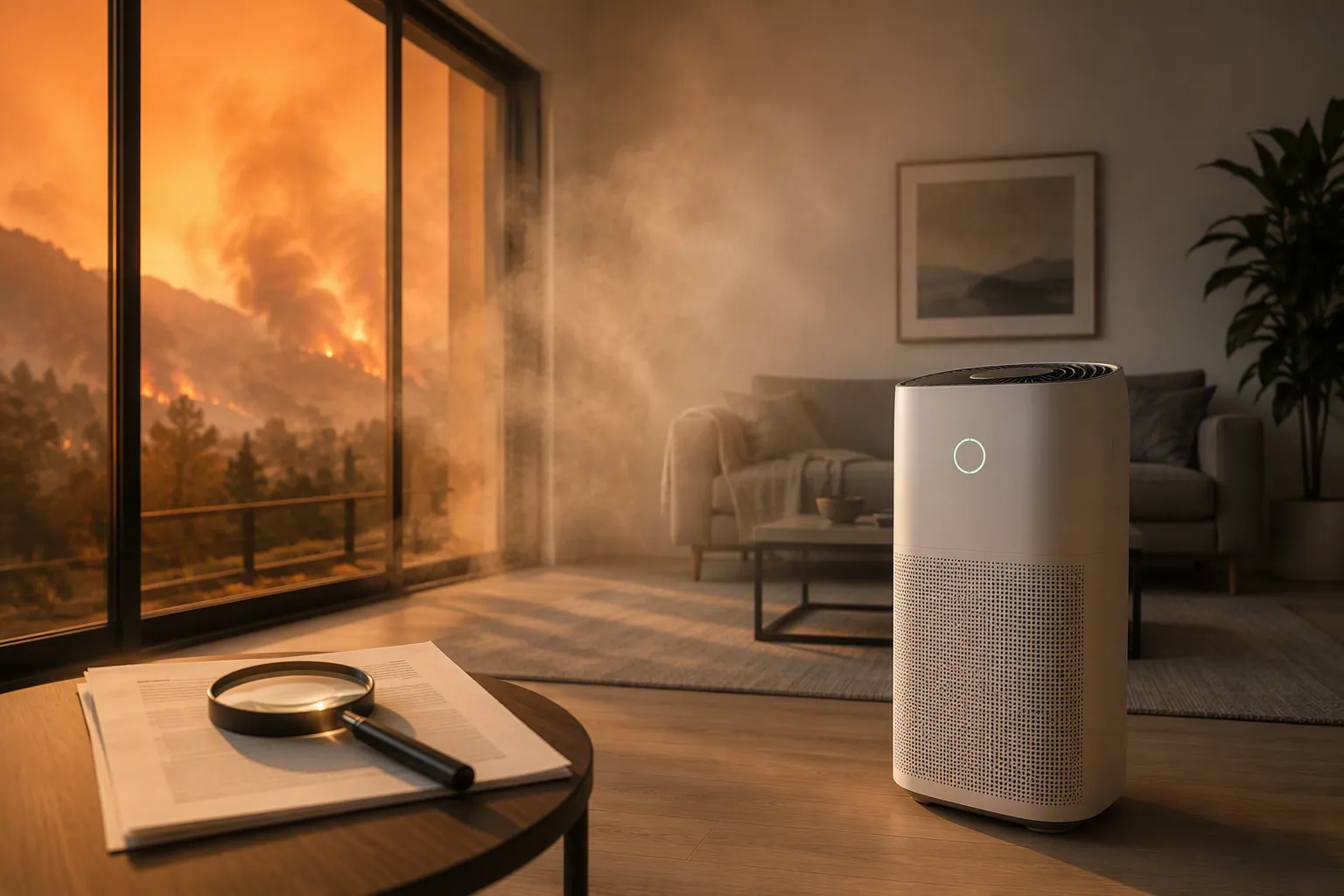
A smart air purifier advertised as “HEPA tested” for wildfire smoke has not, by that phrase alone, proved much. It may contain a capable filter. It may also be using a label that sounds like certification without pointing to an independent certifier. In the consumer purifier aisle, “HEPA,” “True HEPA,” and “HEPA tested” are claims to verify, not proof that a specific model will clear a smoky bedroom before the sky turns orange.
That distinction matters because wildfire-smoke buying is usually time-compressed. You are not comparison-shopping for a wellness gadget; you are trying to protect a room while delivery windows, filter stock, and air-quality alerts all move faster than you want. The first useful cut is simple: for a smart air purifier for wildfire smoke, the two independently checkable claims that matter most are AHAM Verifide CADR for smoke removal and CARB ozone compliance for safety. “HEPA tested” sits below those. So do Wi-Fi control, app polish, auto mode, sensor claims, and ecosystem badges.
There is no single independent body that must verify a consumer purifier’s HEPA label before that label appears on a box; Vacuum Wars, reproducing and fact-checking IQAir’s position, makes the practical point that HEPA wording on consumer air purifiers is not the same thing as a mandatory certification program for the whole product.[1]
Start with CADR, not the room-size claim
The number to look for is CADR: clean air delivery rate. AHAM Verifide certifies CADR separately for smoke, dust, and pollen under ANSI/AHAM AC-1 testing, and the smoke CADR is the one that should drive a wildfire-smoke purchase.[2] A big “covers up to 1,200 sq ft” badge can be built from assumptions that are not obvious on the retail page: lower air changes per hour, open layouts, ideal placement, or a fan speed you may not tolerate overnight. Certified smoke CADR is narrower and more useful.
AHAM’s own sizing rule says smoke CADR should be at least two-thirds of the room area in square feet for normal use. For wildfire events, the practical rule is more aggressive: match smoke CADR to the room’s square footage.[2] That means a 180 sq ft bedroom should be treated as needing roughly 180 smoke CADR during smoke season, not merely a purifier whose marketing page says it can handle a much larger room under unspecified conditions.
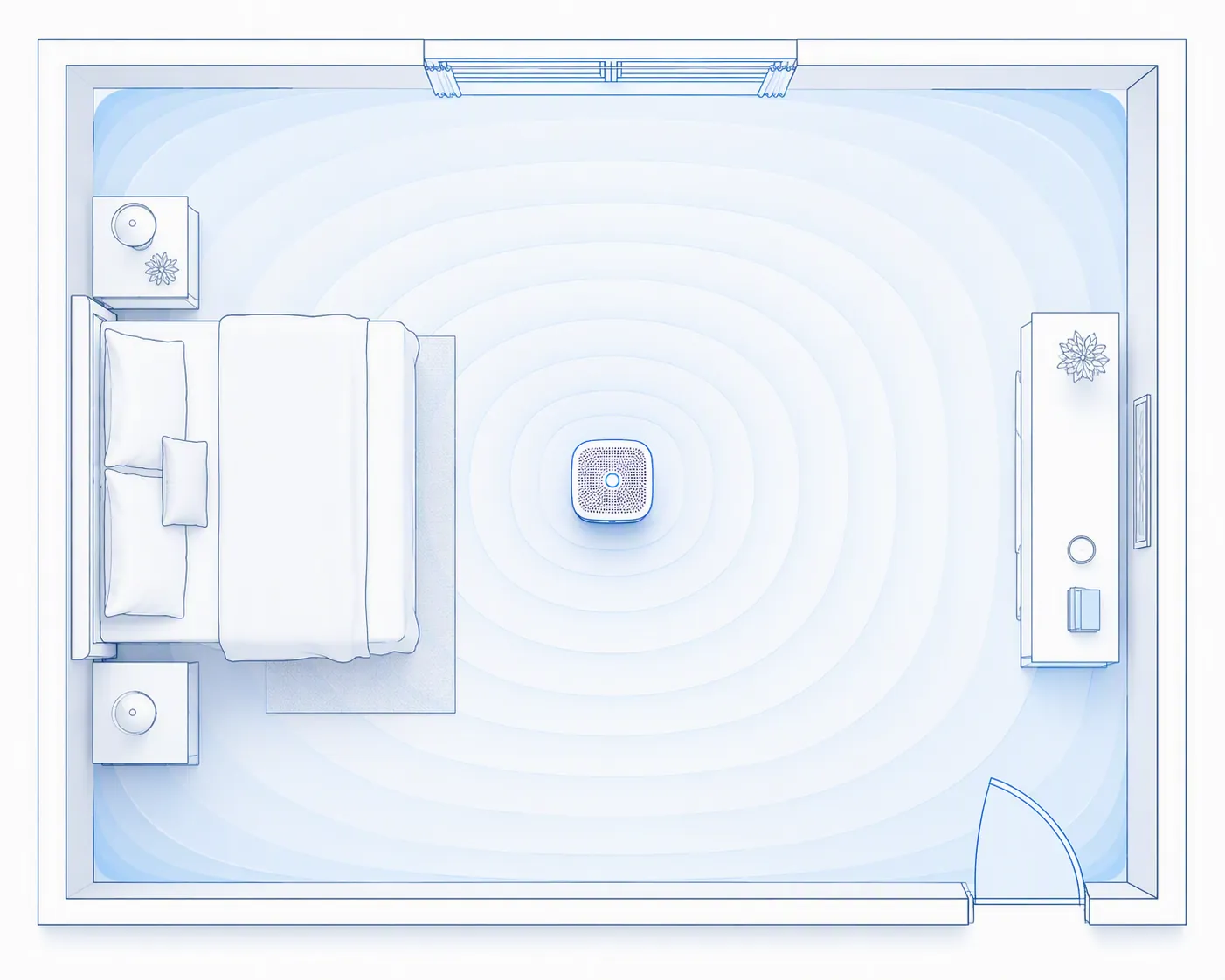
This is the verification path I would use before buying:
- Find the exact model number, not just the product family name.
- Search for that model in the AHAM Verifide directory.
- Use the certified smoke CADR, not the largest advertised room-size number.
- For wildfire smoke, choose smoke CADR approximately equal to the room’s square footage.
- Write down the date you checked, because directories, model numbers, prices, bundles, and smart-platform claims can change by the next smoke season.
The directory step is not decorative. AHAM maintains a searchable directory of certified air cleaners, and that is where a buyer can check whether the model being sold is actually listed.[3] If a product page says “AHAM certified” but the model number cannot be found, treat the claim as unresolved until the brand can explain the mismatch.
| Spec-sheet phrase | What it proves | How to treat it before wildfire season |
|---|---|---|
| HEPA tested | Only that the brand is making a filter-related claim; it is not, by itself, a product certification | Do not size or buy from this phrase alone |
| True HEPA | A marketing claim about the filter type, unless backed by product-level verified performance data | Look for certified smoke CADR anyway |
| AHAM Verifide CADR | Independently checkable smoke, dust, and pollen clean-air delivery numbers | Use smoke CADR to size the room |
| CARB compliant | A checkable ozone-safety claim for California requirements | Prefer it, especially if the purifier advertises ionization or electronic air-cleaning features |
| Smart app, auto mode, voice assistant, ecosystem support | Convenience claims, usually not independently verified as smoke-removal performance | Verify separately and do not let them substitute for CADR |
What AHAM Verifide does and does not cover
AHAM Verifide is useful because it separates performance into measurable categories. Smoke, dust, and pollen CADR are not interchangeable, and the smoke number is the one closest to the wildfire-smoke problem. AHAM’s published materials identify certified CADR ranges of 10–450 CFM for smoke, 10–400 CFM for dust, and 25–450 CFM for pollen.[2]
A vendor-authored Blueair certification explainer, consistent with AHAM’s public framing, adds two details buyers should understand: AHAM Verifide includes annual random retesting of production units, and tested values must remain within specified tolerances of the certified values — within 90% for smoke and dust and within 80% for pollen.[4] Because Blueair is a purifier manufacturer, I would not use its explainer as a substitute for AHAM’s own pages. I would use it to understand the mechanics, then still check the model in AHAM’s directory.
What AHAM does not certify is just as important. A purifier can have a certified CADR and still make separate claims about app reliability, sensor accuracy, voice-assistant behavior, filter-life prediction, or ecosystem support that AHAM is not validating. Those smart features may be genuinely useful. A quiet auto mode can keep a bedroom tolerable at night, and an app that exposes filter status is better than a blinking light you forget to check. They just belong in the usability column, not the smoke-removal proof column.
Check ozone safety before trusting electronic features
The other independently checkable claim is CARB ozone compliance. Blueair’s certification explainer describes California’s requirement for air cleaners sold in the state to meet an ozone emission limit below 50 parts per billion, using a UL 867-recognized test framework.[4] The American Lung Association also warns buyers to avoid air cleaners that generate ozone and to be careful with ionizers or electronic air cleaners that may produce it.[5]
This is where smart-purifier marketing can get especially blurry. “Plasma,” “ion,” “active,” and “electrostatic” features may be presented as premium technology, while the shopper is focused on smoke. If a purifier includes any electronic air-cleaning feature, ozone compliance is not a footnote. It is a safety check. If the model is not CARB compliant, I would not buy it for wildfire smoke when there are mechanical-filter purifiers with verified smoke CADR available.
Certified CADR is a clean-filter number
Once a purifier passes the certification checks, there is still a wildfire-season catch: CADR describes lab performance under test conditions. Heavy smoke is a filter-loading event. The purifier may keep moving air while its ability to remove particles drops.
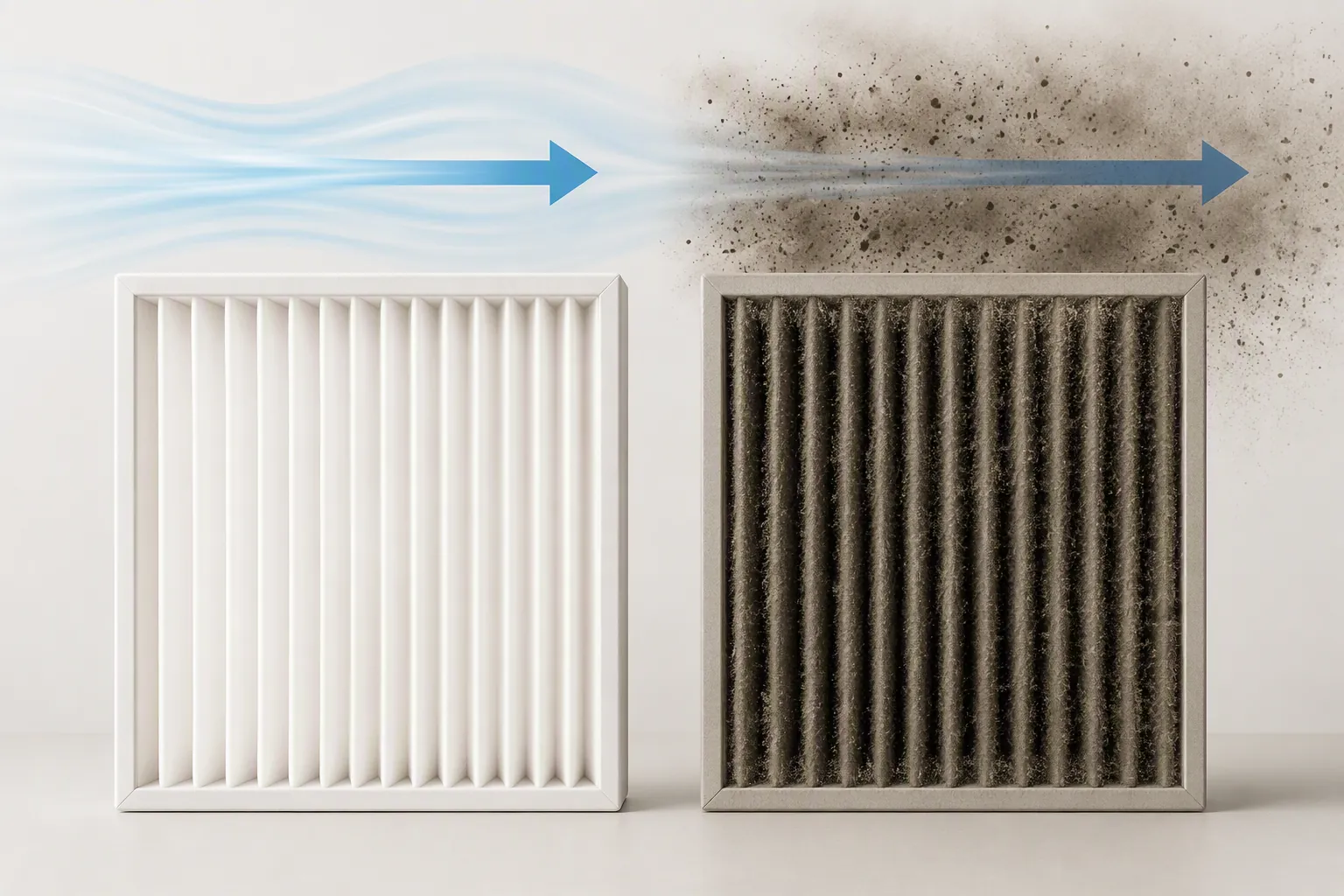
The cleanest caution comes from Harvard’s Healthy Buildings work on wildfire-smoke filtration. In chamber testing of DIY electrostatic MERV-13 cleaners, the devices lost roughly 95% of CADR under smoke loading while airflow held.[6] That does not prove every packaged smart purifier degrades at the same rate, and it should not be used that way. It does prove the mechanism buyers often miss: airflow can make a purifier look alive while particle-removal performance has collapsed.
During a real smoke event, the filter is not an abstract replacement interval in an app. It is the part doing the work. If a purifier runs hard through several smoky days, inspect the filter afterward, keep replacements on hand before the season starts, and do not assume the original CADR still describes the unit after a major smoke load. Filter-life algorithms may help, but unless the brand shows how the algorithm responds to smoke loading, treat the app estimate as a prompt to check, not as a verified measurement.
This is also why buying the purifier and forgetting the replacement filter is a weak plan. The filter is often the supply-chain item that disappears when smoke is already in the forecast. If the unit uses a proprietary filter, verify that replacements are available before you commit to the device.
What independent smoke tests add
Independent reviewers can add useful information, especially when they show how they test. They do not replace AHAM certification as the spec-sheet check, but they can reveal whether a purifier performs plausibly under smoke-like particle challenges and whether its fan speeds, noise, and controls make the certified performance usable at home.
Consumer Reports describes a smoke-removal method built around injecting cigarette smoke into a sealed room and using particle counters to measure particles as small as 0.1 micron at high and low speeds. In its wildfire-smoke guidance, CR also cites the EPA’s view that the best HEPA purifiers can reduce particle concentrations by up to 85%.[7] The useful part for a buyer is not a vague “it smelled better” impression; it is the controlled smoke source, defined room, particle measurement, and separate high- and low-speed results.
CNET Labs publishes smoke-chamber testing with T90 timing — the time needed to reduce measured particles by 90% — and reports examples such as a Blueair Blue Pure 311i Max reaching T90 in 1 minute 28 seconds and a Coway Airmega 400S reaching it in 21 seconds at high fan speed.[8] Those numbers are model-specific lab results, not a universal ranking system for every home. They are still more meaningful than reviewer anecdotes because they expose the test method and the measured endpoint.
The same discipline applies when reading any purifier review: look for a sealed or controlled room, a defined smoke or particle source, particle-counting instrumentation, time-to-reduction data, and fan-speed context. If a review mainly reports odor impressions, app screenshots, or a single air-quality sensor reading without explaining the room and source conditions, it may still be useful for usability, but it is thin evidence for wildfire-smoke removal.
Smart features are comfort features until tested
A good smart purifier can make smoke season less chaotic. Remote control helps when the bedroom door is closed. Filter reminders can prevent the “when did I last replace this?” problem. Auto mode can keep the fan from roaring all night when indoor air is already clean. Voice control and automations can be convenient if the purifier is part of a larger home setup.
None of that verifies smoke removal. Built-in sensors may be poorly placed, slow to react, or tuned for a display experience rather than for independent measurement. Auto mode can under-run the fan if the onboard sensor fails to see the same particle load an external monitor sees across the room. Ecosystem support can change with app updates, regional SKUs, and bridge requirements. Treat every one of those claims as separate from CADR.
If you want model picks after the verification work, use NestGrid’s smart purifier wildfire-smoke buying guide. For operation during a multi-day event, the more useful follow-up is the smart purifier wildfire-smoke playbook. If you are trying to confirm that the purifier is actually changing the room, pair it with an independent monitor and the same date-stamped verification habits used in the air-quality monitor guide, or use the practical recipes for checking air quality at home during wildfire smoke and setting up an indoor air monitor for Portland wildfire smoke.
A wildfire-smoke verification checklist
Before buying a purifier because the box says “HEPA tested,” run the claims in this order:
- Confirm the exact model number. Retail pages often mix product families, bundles, colors, and regional versions.
- Look up the model in the AHAM Verifide directory and record the certified smoke CADR.
- Size by smoke CADR, not advertised maximum room size. For wildfire smoke, match smoke CADR to the room’s square footage.
- Confirm CARB ozone compliance, especially for models with ionization, plasma, electrostatic, or other electronic air-cleaning features.
- Treat “HEPA,” “True HEPA,” and “HEPA tested” as filter claims, not product-level performance certification.
- Treat app control, auto mode, onboard sensors, voice assistants, and smart-home ecosystem compatibility as convenience claims until you verify them separately.
- Buy replacement filters before smoke season and reassess the filter after a heavy smoke event.
- Date-stamp your verification. As of Q3 2026, this matters for directories, prices, model availability, filter stock, and ecosystem claims.
A smart purifier can be the right tool for a smoky bedroom or nursery, but the proof is not the word “HEPA” and it is not the app. Buy by certified smoke CADR and CARB ozone compliance. Then keep enough filter capacity on hand for the kind of smoke season that does not wait for a delivery window.
References
- Not All HEPA Filters Are Created Equal — Vacuum Wars.
- AHAM’s Air Filtration Standards — AHAM Verifide.
- Directory of Air Cleaners — AHAM Verifide.
- Air Purifier Certifications and Standards — Blueair.
- How to Choose an Air Cleaner — American Lung Association.
- Protecting Your Health from Wildfire Smoke: Spotlight on Filters — Harvard Healthy Buildings.
- Best Air Purifiers for Wildfire Smoke — Consumer Reports.
- Best Air Purifier — CNET.
Known issues with this device / protocol
Spec-version history
For active regressions on this protocol, see Update Watch.
No linked Update Watch entries yet.