
Columbus did not get a theoretical purifier-shopping problem this week. On July 17, 2026, the local AQI reached 179, in the “Unhealthy” range, after four consecutive air quality alerts; the air mass included Canadian wildfire smoke and ozone, which makes the problem more complicated than simply buying the biggest fan in a box.[1]
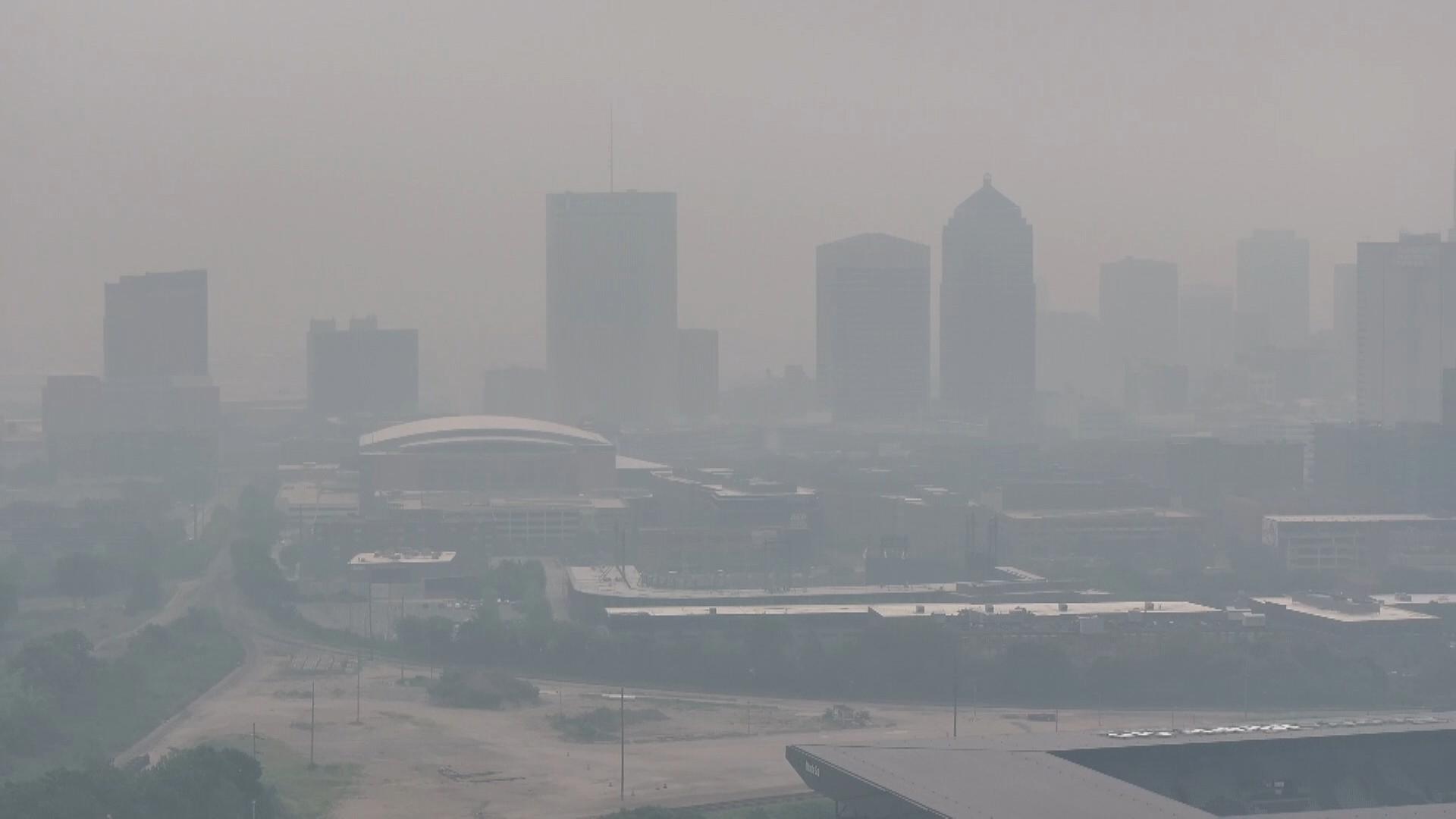
That is the right way to judge a smart air purifier for wildfire smoke in Columbus, Ohio: not by whether the app looks polished on a normal spring afternoon, but by whether auto-mode can keep making decent decisions when PM2.5 stays elevated for days and nobody wants to keep walking over to the machine.
The best balance for that job in Q3 2026 is the Coway Airmega 250S. It pairs a laser-based PM2.5 sensor with proportional auto-mode, a smoke CADR reported around 455 CFM, and a mid-2026 street price around $220–250.[2][3] The Dyson Big Quiet Formaldehyde has a more advanced sensing package, including particle, gas, and formaldehyde sensing, but its roughly $1,008 first-season cost is hard to justify if the main job is smoke PM2.5 control in one Columbus room.[4]
The cheaper Levoit Core 400S and Winix 5510 still have a lane. At about $180 each, both can move a useful amount of smoky air for the price, with reported smoke CADR figures around 231 CFM for the Levoit and 232 CFM for the Winix.[5][6] The trade-off is not that they are useless. It is that their sensing and auto-mode behavior ask for more cleaning, checking, and tolerance for less refined decisions during a multi-day event.
Auto-Mode Is Only As Good As What It Sees
A purifier’s CADR tells you how much clean air it can deliver under test conditions. It does not tell you whether the unit notices smoke early, ramps in proportion to the room, or waits until the air is already irritating before jumping to a louder speed. During a single short cooking spike, that may be annoying. During a stretch of AQI 150+ outdoor air, it becomes the difference between a device that fades into the room and one that needs supervision.
The important distinction is between laser particle sensing and simpler infrared sensing. Laser PM2.5 sensors draw air through a sensing chamber and count particles as they cross a focused beam. Infrared sensors generally measure reflected light across a broader volume of air, which can be less precise and more prone to drift when particle load stays high.[2]
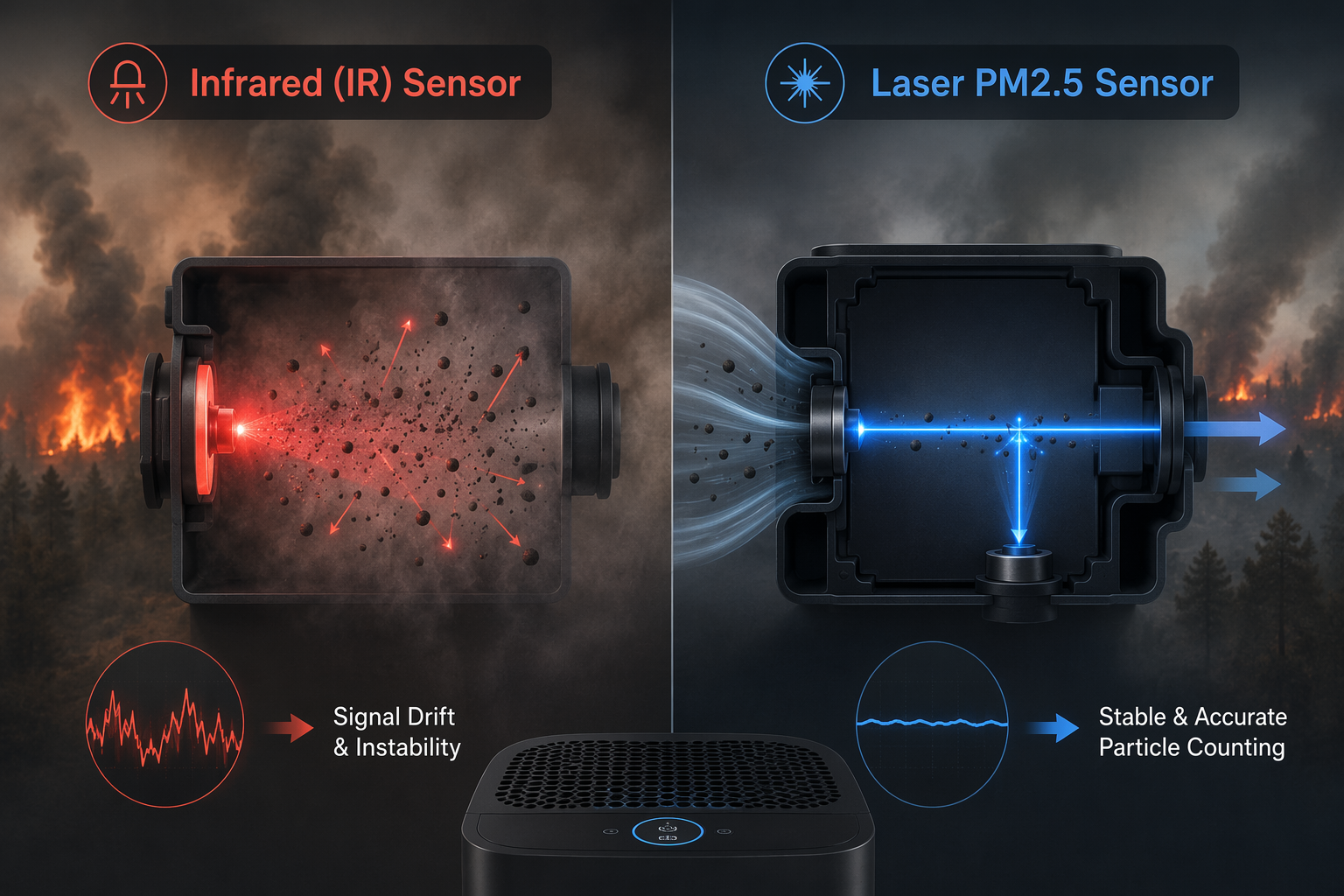
That does not mean every infrared-sensor purifier should be thrown out. It means the owner becomes part of the sensing system. Dust on the sensor window, filter loading, and a room that has stayed smoky for several days can all make a budget purifier’s “smart” behavior feel less smart unless the sensor path is cleaned and the app reading is occasionally checked against reality.
For readers who want an independent room-level monitor rather than trusting a purifier’s built-in sensor, the site’s guide to choosing a smart air quality monitor for sensitive groups is the better detour. A separate monitor is especially useful if someone in the home has asthma, COPD, heart disease, pregnancy-related risk concerns, or a child’s bedroom that should not depend on a purifier’s internal reading alone.
Why Proportional Fan Logic Matters During Smoke
The second half of auto-mode is the fan decision. A purifier can read PM2.5 reasonably well and still behave badly if its software treats air quality like a light switch: low speed until a threshold, then a sudden jump, then a drop back down once the reading improves. That pattern is easy to sell as automatic, but it can create avoidable swings in both noise and air quality.
Proportional auto-mode is calmer. As particle concentration rises, fan speed rises in steps that are closer to the scale of the problem. When the air improves, the purifier backs off more gradually. In a living room where windows are closed, a dog keeps moving around, and smoke continues to seep in through normal leakage, gradual response is exactly what you want: enough fan to prevent buildup without the machine repeatedly startling the room.
This is where the Coway Airmega 250S earns its recommendation. Its laser PM2.5 sensor and proportional auto-mode are a better fit for sustained smoke than cheaper infrared-sensor models with cruder automatic logic.[2][3] Its reported smoke CADR around 455 CFM also gives it more overhead than the Levoit Core 400S or Winix 5510, so auto-mode is not trying to solve a large-room smoke problem with a small-room motor.[3][5][6]
The practical effect is less babysitting. You still need to close windows, avoid adding indoor particles, and replace filters sooner during smoke season. But you are less likely to spend the worst air days wondering whether the purifier’s colored ring is underreacting, whether the fan should be forced to high, or whether the app number is lagging behind the room.
| Model | Best Lane | Smoke CADR | Sensor / Auto-Mode Takeaway | Mid-2026 Price |
|---|---|---|---|---|
| Coway Airmega 250S | Best hands-off smoke pick | Around 455 CFM | Laser PM2.5 sensor with proportional auto-mode | About $220–250 |
| Levoit Core 400S | Budget smart pick for small-to-medium rooms | Around 231 CFM | Infrared sensor with acceptable but less precise auto-logic | About $180 |
| Winix 5510 | Brute CADR value with simpler controls | Around 232 CFM | Basic sensor and less responsive auto-logic | About $180 |
| Blueair Blue Pure 311i+ Max | Bedroom-friendly quiet operation | Around 300+ CFM | Particle sensor; strongest case is low-speed noise | About $240–260 |
| Dyson Big Quiet Formaldehyde | Premium sensing, weak value for smoke-only buying | Not the main reason to buy it here | Particle, gas, and formaldehyde sensing | About $1,008 first-season cost |
The Coway Airmega 250S Is The Least Fussy Choice
The Airmega 250S is not the cheapest way to get filtration, and it is not the most elaborate sensing platform in the category. Its advantage is that the parts that matter most during wildfire smoke line up: strong smoke CADR, laser PM2.5 sensing, proportional fan response, and a price that still belongs in a normal household decision rather than a luxury appliance conversation.[2][3]
That matters in Columbus homes that were not designed around sealed mechanical ventilation. A second-floor apartment may have hallway leakage, older windows, and limited control over the building envelope. An older Worthington or Clintonville house may have a furnace filter that helps somewhat but does not turn every bedroom into a clean room. In those settings, a single-room purifier has to win by consistently managing the room it is in.
The Airmega 250S also avoids the worst version of “smart” design: a machine that has an app but still makes the user interpret vague colors and decide when the air is bad enough. App control is useful, especially when the unit is across the room or in a child’s bedroom, but the best app is not a substitute for competent automatic behavior.
Filter cost is the place to be honest. Replacement filters for the Coway are reported around $50–60 on a normal 6–12 month schedule, but smoke can load HEPA filters 2–3 times faster, shortening that interval to roughly 3–6 months during heavy use.[3][7] A buyer who stretches the filter to preserve the budget gives back some of the performance that made the machine worth buying.
Where The Budget Models Still Make Sense
The Levoit Core 400S is the budget smart model that makes the cleanest argument. At roughly $180, it keeps app support through VeSync, carries a reported smoke CADR around 231 CFM, and has auto-logic that is acceptable for the price.[5] For a small-to-medium bedroom, home office, or apartment living room where cost is the first constraint, that is a reasonable compromise.
The compromise is the infrared sensor. Under ordinary indoor particle changes, it can be good enough. Under sustained wildfire smoke, it deserves more owner attention: keep the sensor area clean, watch whether auto-mode seems to lag, and do not be shy about manually raising the fan when outdoor AQI is ugly and the room still smells or feels smoky.
The Winix 5510 belongs in a slightly different lane. Its appeal is value airflow, with a reported smoke CADR around 232 CFM and an approximately $180 price.[6] Its auto-mode is more basic, and it should be kept separate from the older Winix 5500-2, which lacks app/smart features; newer model availability and feature sets should be verified before purchase.[6]
If the choice is between one Coway for the main living area and two less expensive units for two closed rooms, the cheaper path may be more sensible. Smoke protection is local. A purifier in the living room does not clean a bedroom well if the door is closed all night. The budget models become stronger when the plan is room-by-room coverage and the owner accepts some monitoring.
The Bedroom Exception: Blueair Blue Pure 311i+ Max
Bedrooms punish loud auto-mode. A purifier that performs well on paper but keeps surging near the bed may end up turned down, moved, or unplugged. That is why the Blueair Blue Pure 311i+ Max deserves its own mention. Its reported smoke CADR is around 300+ CFM, its mid-2026 price is about $240–260, and low-speed noise is reported around 25 dB.[8]
That does not make it the overall winner for a Columbus smoke event. The Airmega 250S still has the better combination of sensor-and-auto-mode confidence for hands-off wildfire use. But if the room is a bedroom and the most likely failure is “we turned it down because we couldn’t sleep,” quiet operation becomes a real performance feature, not a comfort bonus.
Why The Dyson Is Hard To Recommend For This Specific Job
The Dyson Big Quiet Formaldehyde is not being dismissed because its sensing is weak. The opposite is the issue: it brings a broader sensor suite than most buyers need if the urgent question is how to reduce PM2.5 from wildfire smoke in one room. Its particle, gas, and formaldehyde sensing can be useful for a household that wants a wider indoor-air dashboard, but its first-season cost is around $1,008, roughly 3.5 times the Coway’s smoke-focused cost case.[4]
There is also a pollutant boundary that no premium branding removes. The July 2026 Columbus alerts involved wildfire smoke and ozone.[1] HEPA filtration helps with particles such as PM2.5. It should not be treated as an ozone solution. Readers who want to understand what a purifier can and cannot tell them about ozone, VOCs, and other pollutants should use a broader monitor guide such as How to Choose a Smart Home Air Quality Monitor in 2026.
Smart-Home Support Has A Ceiling
Smart support in this category is still narrower than many HomeKit households would like. As of mid-2026, no smart purifier in this class has Matter or Apple HomeKit support; Alexa and Google Home are the practical voice-platform options.[9] That means a Columbus buyer with an Apple-heavy home should not assume the purifier will drop neatly into existing automations.
For one room, that limitation is tolerable if the purifier’s own auto-mode is trustworthy. For a whole-home response — purifier on high, HVAC fan behavior adjusted, alerts sent, windows left closed, and a separate monitor used as the trigger — the better path is a monitor-led automation setup. The site’s guide to automating a smart home air quality monitor for wildfire smoke covers that broader approach.
If a purifier’s app reading suddenly looks wrong during a smoke alert, do not build an elaborate automation around a possibly dirty sensor. Clean the sensor area according to the manufacturer’s instructions, compare the trend against a separate monitor if available, and use the troubleshooting guide Your Smart Air Quality Monitor Detected Smoke: Now What? before assuming the room has changed as much as the number says.
What To Buy In Columbus In Q3 2026
Choose the Coway Airmega 250S if the main goal is a smart air purifier that can be trusted in auto-mode during multi-day wildfire smoke. Its laser PM2.5 sensor, proportional response, strong reported smoke CADR, and $220–250 mid-2026 price make it the best-supported balance in this group.[2][3]
Choose the Levoit Core 400S if the budget ceiling is closer to $180 and the room is small to medium. Accept the infrared-sensor maintenance trade-off, keep the sensor clean, and use manual fan speed when outdoor smoke is severe and auto-mode seems too relaxed.[5]
Choose the Winix 5510 if airflow value matters more than refined smart behavior, but verify the exact model’s app and smart features before buying because the Winix lineup includes closely named models with different capabilities.[6]
Choose the Blueair Blue Pure 311i+ Max when bedroom noise is the deciding factor and low-speed quiet operation is more likely to keep the purifier running all night.[8] Consider the Dyson Big Quiet Formaldehyde only if premium multi-pollutant sensing is worth its much higher first-season cost for your household, not because a HEPA purifier solves ozone.[4]
For the July 2026 Columbus smoke pattern, the cleanest answer is still the least dramatic one: buy the purifier whose sensor and fan logic reduce the need for vigilance. Do not confuse a smart app with smart automatic control, and do not confuse PM2.5 filtration with ozone removal.
References
- July 2026 Columbus smoke context, The Columbus Dispatch, Ohio EPA, MORPC, July 2026.
- Laser vs. infrared sensor distinction, SmartHomeExplorer SHE methodology.
- Coway Airmega 250S test data, HouseFresh and SmartHomeExplorer.
- Dyson Big Quiet Formaldehyde cost and sensor suite, mid-2026 pricing and product data.
- Levoit Core 400S test data, HouseFresh, SmartHomeExplorer, Wirecutter.
- Winix 5510 test data, HouseFresh and PureAir Lab.
- Filter loading data, multiple source summaries.
- Blueair Blue Pure 311i+ Max test data, SmartHomeExplorer and Wirecutter.
- Smart purifier ecosystem limitation, mid-2026 compatibility review.
Reader Feedback
Share your purchase experience, flag outdated picks, or ask clarifying questions about the checklist items.
Comments
Join the discussion with an anonymous comment.