The best smart home weather alert systems for tornado safety are not one product. They are three layers that fail in different ways: a NOAA Weather Radio for official warnings without internet or cellular service, a smart weather station for hyperlocal thresholds and automations, and smart speakers or hubs to make the warning harder to miss across the house. NOAA Weather Radio All Hazards is the base layer because it broadcasts official National Weather Service warnings and does not depend on your Wi-Fi router or a cell tower reaching your phone.[1]
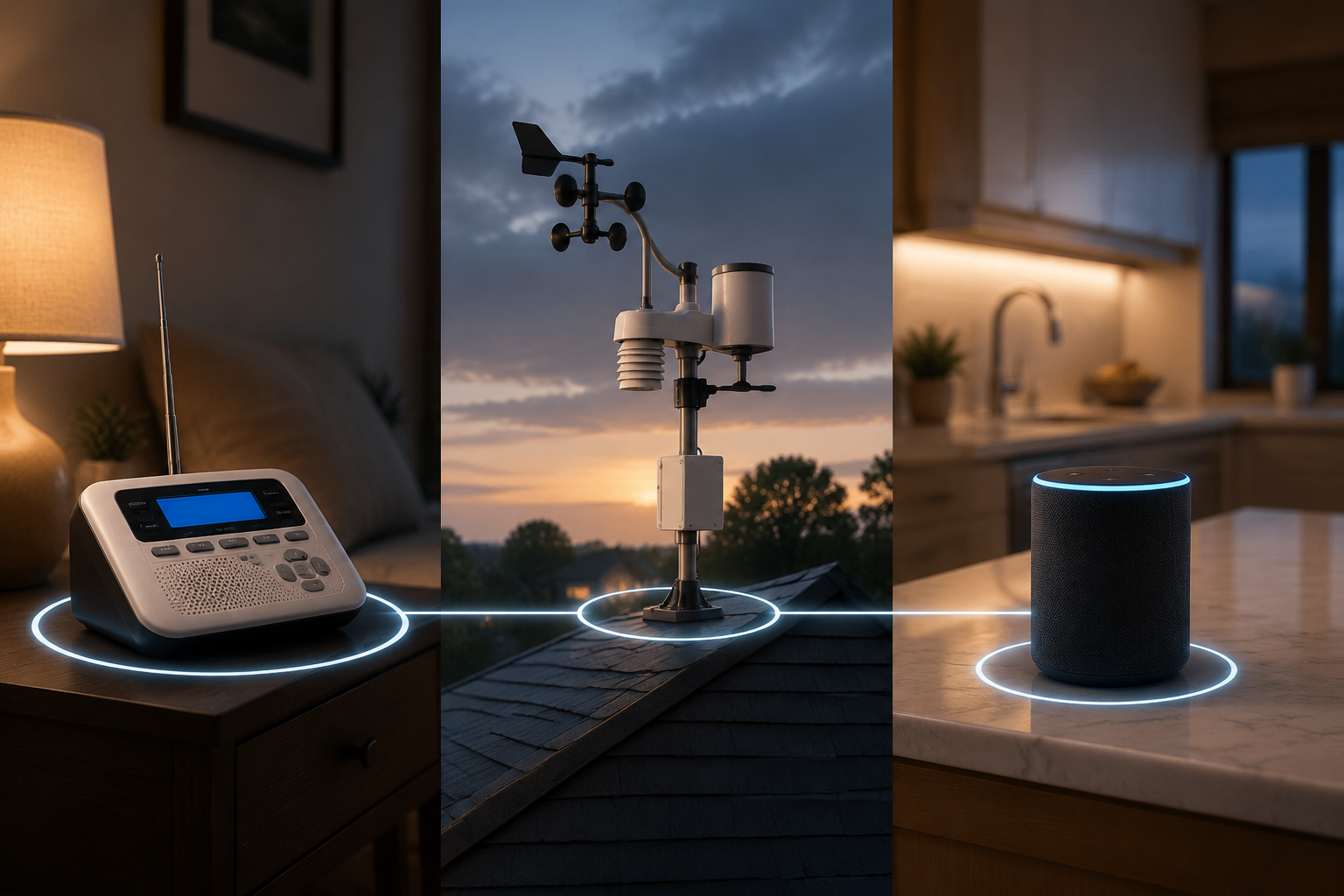
That distinction matters most at the worst possible hour. Tornado warnings often fail at the household level, not because nobody issued an alert, but because the alert landed on a muted phone, arrived through an app with delay, stayed in the kitchen while someone slept upstairs, or depended on a broadband connection that was already gone. A good buying decision starts by asking which failure each device covers.
| Layer | Best role | What it depends on | What it does not solve |
|---|---|---|---|
| NOAA Weather Radio | Official tornado warning audio, especially overnight | Radio reception, batteries or AC power with backup | Room-by-room coverage unless placed well or paired with accessories |
| Smart weather station | Local conditions, custom thresholds, and smart-home triggers | Power, home network, cloud or local integration depending on model | It does not replace official NWS tornado warnings |
| Smart speaker or automation hub | Voice announcements, lights, routines, and whole-house attention | Configuration, power, network, integrations | It should not be treated as the primary warning source |
This layered approach is especially relevant in 2026 because the geography of tornado risk is no longer just a Plains-state habit problem. A 2024 Nature study found an eastward displacement of tornado activity toward states including Mississippi, Alabama, and Tennessee, where nighttime tornadoes, terrain, tree cover, and older warning habits can make household alerting more fragile.[2] At the same time, spring 2026 reporting citing National Weather Service data counted 12 tornado fatalities, well below prior averages for the season; that is encouraging, but it should be read cautiously as one seasonal snapshot, not proof that any single technology has solved tornado safety.[3]
Start With the NOAA Radio, Not the App
If you buy only one device for tornado warnings, make it a dedicated NOAA Weather Radio with Specific Area Message Encoding, usually called SAME. SAME filtering lets the radio alert for your selected county or counties instead of waking the house for every advisory in broadcast range. That is the difference between a device people keep turned on and a device they unplug after the third irrelevant midnight alert.
The Midland WR400 is the strongest home-base pick in this category. Wirecutter’s 2026 emergency weather radio recommendations identify it as a top home alert radio, with pricing captured around $55 to $65 in July 2026; the same research notes optional Midland accessories including a pillow shaker around $30 and a strobe around $40.[4] Those accessories are not gimmicks in a tornado setup. A pillow shaker addresses the person who sleeps through audio. A strobe helps someone who is hard of hearing or is working in a noisy room. The point is not to make the nightstand look like a command center; it is to get one unmistakable cue to the person who has to move.
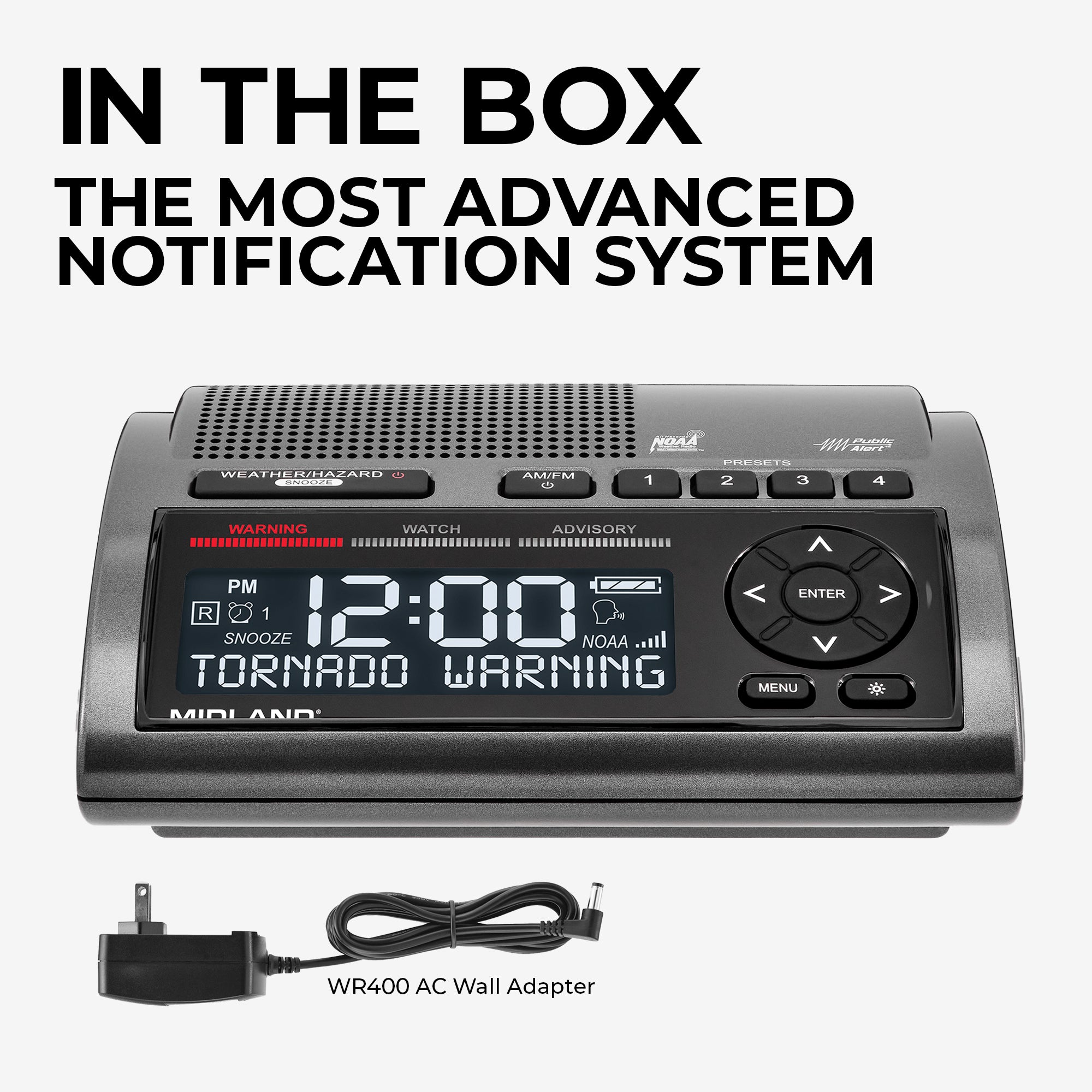
Placement matters more than most product pages admit. A WR400 in a home office may be technically functional and practically useless if the tornado warning arrives at 2:17 a.m. Put the primary radio where it can wake the decision-maker. In many homes that means the main bedroom, not the kitchen counter. If an older adult sleeps on the other side of the house, or if someone sleeps in a basement bedroom, that may justify a second alert radio or an accessory rather than a louder phone notification.
The Midland ER310PRO has a different job. Wirecutter’s 2026 research places it in the portable emergency-radio lane, with a 10,000 mAh battery and July 2026 pricing around $70 to $80.[4] It belongs in the storm bag, basement shelf, or interior safe room as a backup for power outages and post-storm information. It should not be confused with the dedicated always-on home alert radio. A portable radio that lives in a drawer is useful after someone is already awake; it is weaker as the thing expected to wake the house.
| Radio | Best use | July 2026 price range | Buyer note |
|---|---|---|---|
| Midland WR400 | Primary home NOAA alert radio with SAME filtering | $55–$65 | Best first purchase; consider pillow shaker or strobe where audio alone is not enough |
| Midland ER310PRO | Portable backup radio for safe room, travel, or outage kit | $70–$80 | Large battery helps during outages, but it is not the main overnight alert layer |
Add a Smart Weather Station When You Want Local Triggers
A smart weather station does not issue tornado warnings. It measures what is happening at your property and can trigger alerts or automations from local conditions. That makes it valuable, but in a narrower way than some smart-home shoppers expect. It can tell you pressure is dropping, wind is rising, lightning is nearby, or rain is intensifying at your house. It cannot replace the National Weather Service warning polygon or the NOAA radio on your nightstand.
The Ambient Weather WS-2000 is the best fit for households that want weather data to become smart-home behavior. Wirecutter’s 2026 home weather station research lists it at $299.99, with Alexa, Google, and IFTTT support and expansion up to 31 sensors.[5] Ambient Weather’s own product materials also describe customizable email, SMS, and push alerts for parameter thresholds, including sudden pressure drops.[6] That combination is the reason it stands out here: not because pressure drop equals tornado, but because local thresholds can start useful household actions before or alongside official warning channels.
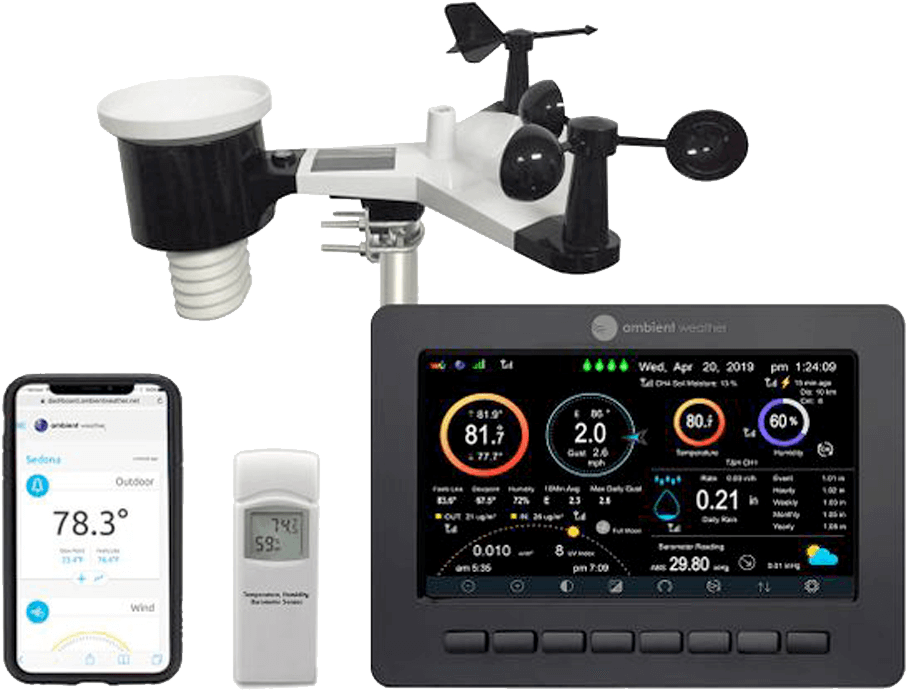
For example, a homeowner might set a hypothetical rule that says: if the local station reports a rapid pressure drop and a severe weather alert is active, then turn on hallway lights and announce the safe-room location. The precise threshold should be chosen carefully and tested locally; the station data is a trigger input, not a tornado diagnosis. If you want the deeper accuracy argument for owning a station at all, this comparison of a smart weather station versus broad forecasts is the better place to go after choosing your hardware.
The Tempest Weather Station is the cleaner choice for buyers who want a modern, compact station with lightning detection. Wirecutter’s 2026 research places it around $300 and highlights lightning detection as a meaningful feature.[5] Lightning detection is not a tornado-warning feature by itself, but it is a useful storm-escalation signal for households that want outdoor chores stopped, devices charged, and kids brought inside before the warning phase.
AcuRite Iris is the budget-minded station in this group. Wirecutter’s 2026 research places it under $200.[5] It is the better fit when the buyer wants a local display and basic smart weather awareness without building a large sensor network. The tradeoff is not that it is unsafe; the tradeoff is that it gives you fewer reasons to make it the center of a broader automation system.
| Weather station | Approx. July 2026 price | Integration notes | Best reason to buy |
|---|---|---|---|
| Ambient Weather WS-2000 | $299.99 | Alexa, Google, IFTTT; up to 31 sensors | Best smart-home expansion and custom threshold alerting |
| Tempest Weather Station | About $300 | Smart-home friendly ecosystem; lightning detection highlighted | Best compact station if lightning awareness matters |
| AcuRite Iris | Under $200 | More budget-oriented than the WS-2000 | Best lower-cost local weather station |
Use Smart Speakers as Attention Amplifiers
Alexa, Google Home, Home Assistant, and IFTTT can be useful in a tornado warning system, but only if their role is kept honest. They are excellent at making a warning visible and audible: announce in multiple rooms, flash smart bulbs, turn on stair lights, unlock an interior path if appropriate, or tell everyone to move to the safe room. They are weaker as primary warning devices because behavior depends on user configuration, integrations, cloud services, and network power.
IFTTT is the fastest path for many households. Its weather automation materials say the platform has run more than one billion applets and describes weather applets, including severe-weather-style automations, as quick to create in under five minutes.[7] Treat that as a convenience claim, not a reliability guarantee. An applet that flashes lights during a tornado warning is helpful if your internet, IFTTT service path, smart-light bridge, and speaker ecosystem are all working. It is not a replacement for the radio that wakes you when those services are not working.
Team Rubicon’s tornado warning app guidance and Warren Schuitema’s Alexa/Google Home tornado-safety guidance both point in the same practical direction: use apps and speakers to widen the warning path, not to narrow it to one vendor’s notification channel.[8][9] In an Alexa household, that may mean routines that announce severe weather alerts, turn on smart lights, and send attention toward the shelter area. In a Google household, be more careful: native automatic severe weather broadcasting from Google Home is not confirmed as a built-in feature in official documentation, and user-forum reports are not the same as a dependable safety specification.[9]
Home Assistant can be powerful for households already comfortable maintaining it, especially with National Weather Service alert integrations. The caveat is important: the NWS Alerts integration commonly referenced for this purpose is community-maintained through HACS, not a core Home Assistant feature.[10] That does not make it unusable. It means the homeowner owns more of the maintenance burden, including updates, testing, and deciding what happens if the integration breaks.
Why App-Only Tornado Alerts Are Too Thin
Phone apps belong in the system, but they are a poor foundation for the system. A phone can be silenced, charging in another room, out of service, battery-dead, or buried under bedding. Cellular networks can be congested in severe weather. Push notifications can arrive quickly, but the app path still assumes the person and device are in the same place at the right time.
Latency claims also need caution. A commercial Alibaba buying guide reports premium severe-weather app alert latency at 9 seconds or less and free-tier latency at 22 to 45 seconds, but that source is vendor-oriented and should be cross-checked before treating those ranges as independent benchmarks.[11] Even if those numbers are accurate in a given test, they measure delivery speed under certain app conditions. They do not solve the sleeping child, the dead phone, or the basement dead zone.
The useful question is not whether an app is fast. It is what happens after the app receives the alert. Does the warning turn on lights? Does it speak in the bedroom? Does it reach the person who cannot hear a phone? Does it still have a non-internet backup? If the answer is no, the system is still app-only with extra decoration.
Which Bundle Should You Buy?
The minimum reliable setup is a Midland WR400 in the bedroom, configured with SAME for your county and nearby counties when appropriate, plus fresh backup batteries. Add the pillow shaker or strobe if anyone in the home may not wake to audio alone. This is the best first purchase because it covers the official-warning layer without requiring your phone, internet, or smart-home platform.
The stronger smart-home setup is a WR400 plus an Ambient Weather WS-2000 and a configured speaker or hub ecosystem. This is the bundle for someone who wants local weather thresholds, expansion sensors, Alexa or Google visibility, IFTTT applets, and whole-house behaviors. It also separates official warnings from local measurements and household attention, which is what a tornado alert setup needs to do in 2026.
A Tempest-based bundle makes sense if you value a simpler outdoor station and lightning detection more than broad sensor expansion. An AcuRite Iris bundle makes sense if the weather station is mainly for local readings and budget control. In both cases, keep the NOAA radio as the base.
The portable add-on is the Midland ER310PRO. Put it where the household actually shelters or where you can grab it on the way there. Its job is to keep information available during and after an outage, not to replace the always-listening WR400.
If you want a simpler single-device shopping pass before building the whole stack, start with these smart home tornado safety device recommendations. If you already know you want the larger architecture, the tornado alert devices and apps guide goes deeper on the layers. Once the purchase decision is made, move to building a smart home tornado warning system or the step-by-step guide to setting up local tornado warnings.
Buyer Verdict
Buy the NOAA radio first. The Midland WR400 is the right primary home alert radio for most tornado-prone households because it gives you official warnings with SAME filtering and can be paired with physical wake-up accessories. Add the Midland ER310PRO only as a portable backup.
Add a smart weather station if you want local thresholds and automations. Choose the Ambient Weather WS-2000 for the most flexible smart-home setup, Tempest if lightning detection and simplicity matter more, and AcuRite Iris if price matters most.
Use Alexa, Google Home, IFTTT, or Home Assistant to make warnings harder to miss, not to replace the warning source. A smart speaker announcement is useful. A smart speaker treated as the only tornado warning device is a weak link.
References
- NOAA Weather Radio All Hazards, National Weather Service.
- Changes in tornado geography and environments over the contiguous United States, Nature, 2024.
- Spring 2026 tornado fatality reporting citing National Weather Service data, Fox Weather, 2026.
- The Best Emergency Weather Radios, Wirecutter, 2026.
- The Best Home Weather Stations, Wirecutter, 2026.
- Ambient Weather WS-2000 Smart Weather Station, Ambient Weather.
- Weather Underground integrations and weather automations, IFTTT.
- Tornado Warning Apps Guide, Team Rubicon.
- Alexa and Google Home for Tornado Safety, Warren Schuitema.
- National Weather Service Alerts integration, Home Assistant Community Store.
- Weather Alert App Buying Guide, Alibaba.
Policy Updates & Reader Notes
Privacy policies, monitoring plan prices, and security disclosures change frequently. Report new data retention terms, updated plan pricing, or new vulnerability disclosures below. For formal editorial corrections, use the contact page.
Comments
Join the discussion with an anonymous comment.