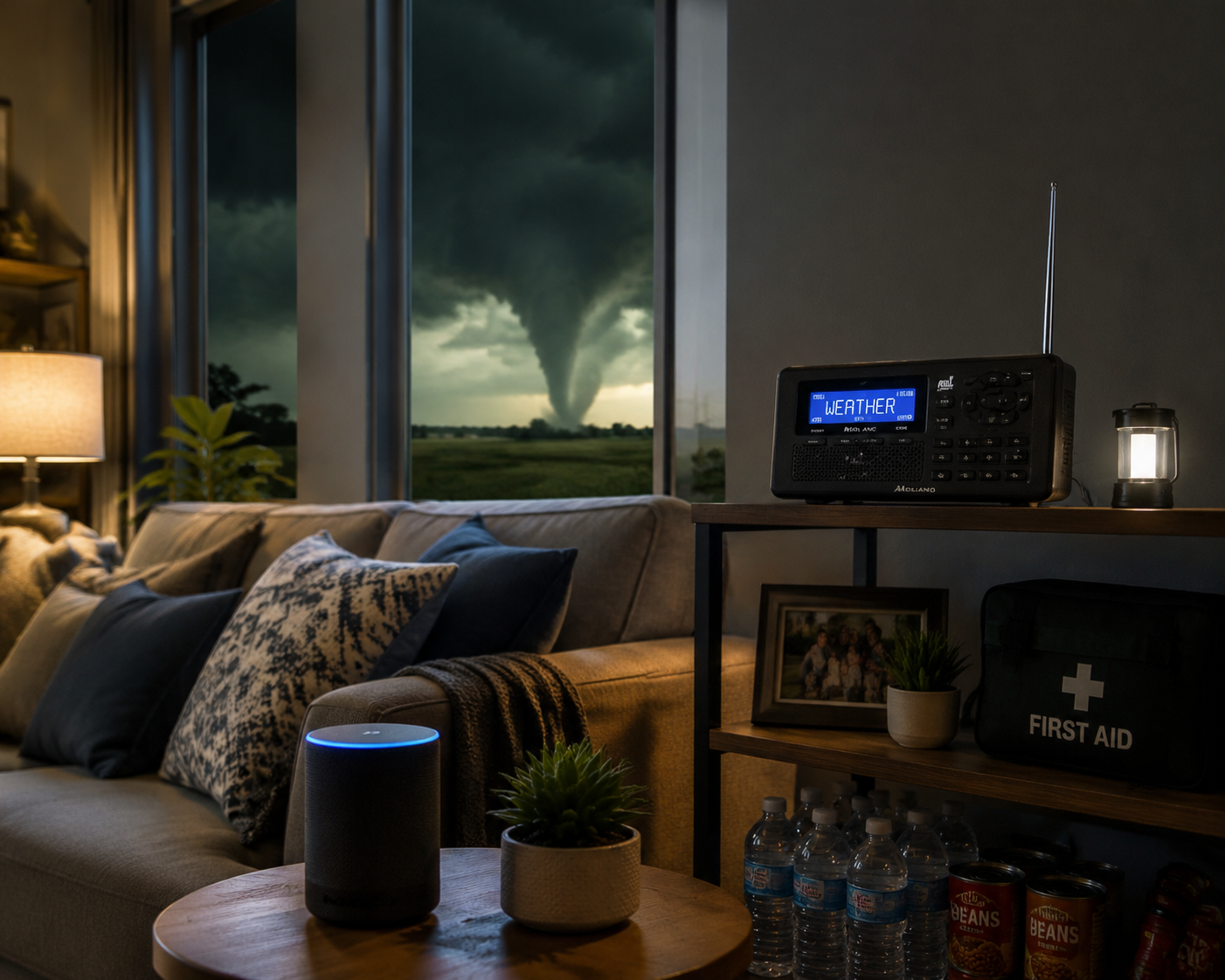
The best smart home devices for tornado safety alerts are not all trying to solve the same problem. A NOAA weather radio is the device I would want still working when the Wi-Fi is down. An Echo is the device that can shout through the hallway while dinner is on. A Vivint panel can make sense in a monitored smart-home system you already pay for. Tempest is useful for local storm sensing and automation, but it is not a replacement for an official tornado warning path.
If you only buy one device for tornado alerts, buy a dedicated NOAA weather radio with battery backup. If you already have Alexa speakers, turn on proactive severe weather alerts too. That pairing covers the two failure modes that matter most in a real house: the internet goes out, and people do not hear the one phone on the nightstand.
Quick Verdict by Device Type
| Device or category | Approx. price | Alert method | Power and connection dependency | Setup difficulty | Best fit |
|---|---|---|---|---|---|
| Midland WR400 NOAA Weather Alert Radio | $100 | NOAA Weather Radio with SAME localized alerts, tone, siren, voice, and optional strobe or pillow shaker [1][2] | Wall power with backup batteries; does not need home internet | Moderate: choose county/SAME settings and alert preferences | Households that want the most reliable main tornado-warning device |
| Midland ER310PRO Emergency Crank Weather Radio | $80 | NOAA weather radio plus emergency radio features [1] | 10,000 mAh battery; Wirecutter found over 6 weeks standby; can charge a phone [1] | Easy to moderate | Outage-prone homes, renters, car kits, and backup power planning |
| Amazon Echo / Alexa | Varies by Echo model | Proactive severe weather alerts on Echo devices; activated by asking Alexa about severe weather alerts [3][4] | Needs power and internet for smart-speaker alerts | Easy | Homes that already use Alexa and want loud, hands-free announcements |
| Vivint Smart Hub | Subscription-dependent | On-screen weather alerts and audible beeps for tornado warnings [5] | Backup cellular and 24-hour battery cited by Vivint [5] | Professional ecosystem setup | Homes already committed to Vivint monitoring and proprietary hardware |
| Google Home with Home Assistant | Depends on existing hardware | No native automatic NOAA alert path in the cited sources; strongest route uses Home Assistant plus a third-party NWS Alerts custom integration [6][7] | Depends on Home Assistant server, internet, Wi-Fi, and speaker power | Hard | Technical users who already maintain Home Assistant |
| Tempest Weather System | $339 | Hyperlocal weather station; detects lightning up to 25 miles away and integrates with IFTTT and Rachio [8] | Depends on station, hub/app, and integrations | Moderate | Storm-aware automation, irrigation response, and local condition tracking |
| Mobile alert apps | Free | FEMA, Red Cross Emergency, CodeRED, MyRadar, and similar app alerts [9] | Phone battery, location settings, notification settings, and cellular/data coverage | Easy | Backup layer, especially when away from home |
| TornadoAlert Detector | $200 | Manufacturer says it independently detects tornadoes within a 30-mile radius with 95% accuracy [10] | Marketed as independent of internet and NWS alerts [10] | Unclear; no independent testing is cited here | Only for buyers comfortable with manufacturer-sourced claims that are not independently verified here |
The First Device Should Usually Be a NOAA Weather Radio
A dedicated weather radio is boring in exactly the right way. It does not need your phone to be charged, a smart-home routine to stay intact, or a cloud service to deliver a warning. It listens for NOAA Weather Radio alerts, and models with SAME technology can be programmed for specific counties or areas instead of waking the whole house for every alert in the broadcast range [2].
That localization matters. A radio that screams for every distant county will eventually train people to ignore it. A radio that is narrowed to the places your household actually needs to act on is much more likely to stay plugged in, enabled, and trusted.
Midland WR400: best main alert radio for a home
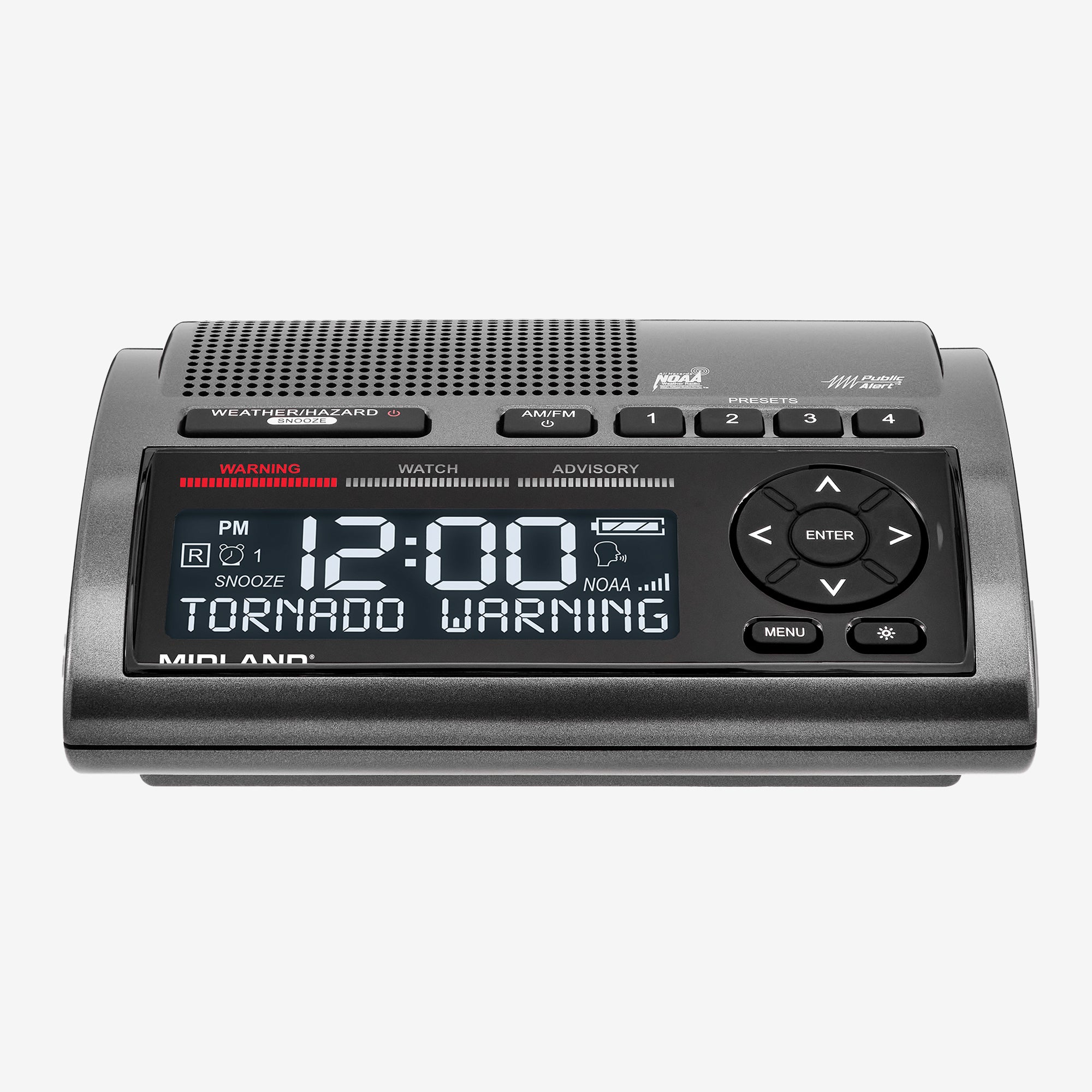
The Midland WR400 is the better fit for a kitchen counter, hallway shelf, or bedroom dresser where the job is simple: wake people up and make the warning hard to miss. Wirecutter lists it at about $100 and highlights its SAME localized alerts, customizable voice, tone, and siren alerts, and support for add-ons such as a strobe light or pillow shaker [1].
Those add-ons are not a luxury detail. They are the difference between a device that works for the person who hears well and sleeps lightly, and a device that can help someone who is hard of hearing, behind a closed bedroom door, or asleep when the siren outside is muffled by rain. In tornado safety, accessibility is reliability.
Midland ER310PRO: better when outage endurance matters most
The Midland ER310PRO is the one I would look at for long power outages, a storm kit, or a household that wants one radio to do more than sit on a shelf. Wirecutter lists it at about $80 and says it had the largest battery of any tested weather radio, with a 10,000 mAh battery, more than 6 weeks of standby time, and phone-charging ability [1].
The tradeoff is role. The WR400 feels like a purpose-built home alert station. The ER310PRO feels like an emergency tool that also handles NOAA alerts. A lot of homes could justify both, but if the budget only allows one, choose based on where the device will live. A bedroom or hallway alert device points toward the WR400. A go-bag, basement shelf, or outage kit points toward the ER310PRO.
Alexa Is Useful, as Long as It Is Not Your Only Warning Path
Alexa deserves a practical nod because it is already in a lot of homes and does not require a special paid weather-alert skill for this job. Gearbrain reports that proactive severe weather alerts work on all Echo models and can be activated by saying, “Alexa, tell me about severe weather alerts” [3]. Reviewed also describes Echo severe-weather uses, including getting alerts and weather information through Alexa [4].
That is useful in the messy middle of a storm night. A voice announcement can reach the hallway, kitchen, or living room while phones are charging elsewhere. It can also help the least technical person in the house, because they do not have to open an app, check a radar layer, or know which county polygon they are in.
The limitation is just as plain: Echo speakers need power and an internet connection for these smart alerts. If the storm has already knocked out power or your router is down, Alexa is no longer the dependable layer. Use it because it is convenient and loud, not because it replaces a weather radio.
- Best Alexa use: add voice alerts in rooms where people actually spend time.
- Weak point: internet and power dependency.
- Good pairing: Echo speakers plus a SAME-capable NOAA weather radio.
- Bad plan: relying on Alexa alone while every phone is silenced overnight.
Vivint Makes Sense Inside Its Own System
Vivint’s Smart Hub is not a casual add-on purchase in the way an Echo or weather radio is. It belongs to a monitored, proprietary smart-home system. Vivint says its Smart Hub Panel can display on-screen weather alerts and provide audible beeps for tornado warnings, and the company cites backup cellular plus a 24-hour backup battery for the hub [5].
That combination is meaningful if you already want Vivint for security, monitoring, and whole-home control. A wall panel that beeps, shows the alert, and stays connected through cellular backup has real value during a storm. But with monitoring plans running $24.99 to $44.99 per month, the buying question changes. This is not the cheapest way to get tornado warnings; it is a weather-alert feature inside a broader security contract [5].
If you are comparing Vivint mainly as a security platform, the better question is whether the full system is worth the premium, not whether its tornado alert feature beats a $100 weather radio. For that broader tradeoff, see Vivint Smart Home Security System: Is the Premium Worth It?.
Google Home Needs a Power-User Detour
Google Home is where the smart-home answer gets less friendly for a normal household. Google speakers should not be treated as having the same native, easy automatic severe-weather alert path as Alexa. The stronger route described for Google Home uses Home Assistant and an NWS Alerts custom integration to push warnings to Google speakers [6][7].
That can be a fine setup for someone who already runs Home Assistant, understands HACS components, and accepts that custom integrations may need maintenance after updates. It is not the same as telling a smart speaker one sentence and being done. The person who will be asleep during the warning should not also be responsible for remembering whether a third-party component broke last month.
For technical readers, Google Home can become part of a tornado alert system. For everyone else, it is safer to treat Nest or Google speakers as helpful output devices only after a more reliable alert source is already in place.
Tempest Is for Hyperlocal Storm Awareness, Not Official Tornado Warnings
The Tempest Weather System sits in a different category. It is not mainly an alert radio or a smart speaker. It is a local weather station that can feed automations. Tempest lists the system at $339, says it can detect lightning strikes up to 25 miles away, and describes integrations with IFTTT and Rachio for storm-related automation [8].
That makes Tempest useful when the question is, “What is happening at my house?” It can help trigger practical responses around irrigation, outdoor devices, or storm routines. It is much weaker as the main answer to, “Has the National Weather Service issued a tornado warning for my location?” For that, official alert paths still matter more than a backyard sensor.
If you like severe-weather automation, Tempest can earn its spot. Just do not let a clever local sensor crowd out the plain device that wakes people up.
Mobile Apps Belong in the Backup Layer
Free phone apps are worth installing, especially because they travel with you. Team Rubicon lists options including the FEMA app, Red Cross Emergency, CodeRED, and MyRadar for tornado warning and emergency alert use [9].
The problem is the phone itself. Notifications can be muted, location permissions can be wrong, batteries can be low, and the device may be in another room. Apps are a good backup and a good away-from-home layer. They are not the device I would choose as the only overnight warning method for a family.
Be Careful With Standalone Detection Claims
TornadoAlert is the kind of product that sounds tempting because it promises independence from the internet and official warning channels. The manufacturer markets a $200 detector that claims 95% detection accuracy within a 30-mile radius and says it operates independently of internet and NWS alerts [10].
That claim may interest some buyers, but the accuracy statement is manufacturer-sourced. Without independent verification in the cited sources, it should not outrank NOAA Weather Radio, official alerts, or a properly configured smart-speaker backup. Treat it as a possible extra device, not the foundation of a tornado safety plan.
Which Device Fits Your Household?
| Household situation | Best first buy | Good add-on | What to avoid |
|---|---|---|---|
| You want the most reliable tornado alert device under about $100 | Midland WR400 | Free mobile apps | A smart speaker as the only warning source |
| You worry about long outages | Midland ER310PRO | WR400 for a fixed home alert location | Devices that need Wi-Fi during a power failure |
| You already have Echo speakers in several rooms | WR400 or ER310PRO | Alexa proactive severe weather alerts | Assuming voice alerts replace NOAA radio |
| You are already paying for Vivint | Use Vivint Smart Hub alerts as part of the system | NOAA weather radio for independent backup | Buying Vivint only for tornado alerts |
| You run Home Assistant and like custom automations | NOAA weather radio first | Google speakers via NWS Alerts custom integration | Depending on an unmaintained automation |
| You want hyperlocal storm data and outdoor automation | Tempest Weather System | NOAA radio and phone apps | Treating local sensing as an official warning source |
A good tornado-alert setup does not need to be elegant. It needs to be loud, local, powered, and understandable to the person least interested in maintaining smart-home gear. That is why the plain recommendation is still a SAME-capable NOAA weather radio first, then smart-home alerts where they genuinely help.
Choose the Midland WR400 if you want the strongest fixed home alert radio. Choose the ER310PRO if battery endurance and emergency utility matter more. Add Alexa if you want easy whole-room voice announcements. Consider Vivint only if the monitored security system already makes sense for your home. Use Tempest for hyperlocal sensing and automations, not as your primary tornado warning source.
For broader planning beyond product selection, compare this with Choose the Right Smart Home Tornado Alert Devices and Apps. If you are building out other severe-weather routines, the same reliability questions apply to smart home flood alarms and red flag warning automations.
References
- The 4 Best Emergency Weather Radios of 2026 — Wirecutter
- SAME Weather Radios — National Weather Service
- Alexa can now tell you about severe weather alerts — Gearbrain
- 7 ways an Amazon Echo can help you in severe weather — Reviewed
- How a smart home protects during a natural disaster — Vivint
- Google Home, Alexa, Tornado Safety, Michigan — Warren Schuitema
- Home Assistant discussion on NWS Alerts and Google speakers — Reddit
- Spring storm prep — Tempest
- Tornado Warning Apps: Be Prepared and Stay Safe — Team Rubicon
- TornadoAlert — EarlyAlert
Policy Updates & Reader Notes
Privacy policies, monitoring plan prices, and security disclosures change frequently. Report new data retention terms, updated plan pricing, or new vulnerability disclosures below. For formal editorial corrections, use the contact page.
Comments
Join the discussion with an anonymous comment.