
What Plug-In Solar Panels Require Before Saving You Money?
Before buying a plug-in solar kit, you have to clear a short requirements stack: state legality and wattage caps, UL 3700 certification, a GFCI-protected dedicated circuit, and landlord/HOA or utility permission. This checklist covers what's verifiably required at your address and what such a kit realistically saves in 2026.
Before a plug-in solar kit can save you money, six things have to be true at your address: your state must allow it, the kit must fit your state’s wattage cap, the product must carry the right safety certification, the outlet must be on an appropriate dedicated GFCI-protected circuit, your lease or HOA rules must permit the physical installation, and your utility process must be clear. Only after those gates are settled does the advertised $15–$50 monthly savings range become a real estimate instead of a shopping-cart hope.[1]

Use this as the pre-purchase recipe. Do it before ordering the panel, before asking a landlord to approve balcony hardware, and before assuming the kit will qualify for any solar incentive.
- Look up your state’s plug-in solar status and wattage cap. If your state has no signed plug-in solar law, assume your utility may treat the system more like standard rooftop solar until proven otherwise.
- Match the kit size to that cap. A legal 420W DIY kit in Maine is a different buying decision from a 1,200W kit in Utah or a 1,920W system allowed under Colorado’s 2027 law.
- Check the product label for UL 3700 certification or, at minimum, a microinverter certified to UL 1741 SB where the state or utility accepts that path.
- Confirm the receiving outlet is not just nearby, but appropriate: dedicated circuit, GFCI protection, no extension cord, no power strip, and no shared mystery load already sitting on the breaker.
- Get the property permission in writing if you rent, own a condo, or live under CC&Rs. Tenant-friendly laws help in some states, but they do not make balcony clamps invisible.
- Follow the utility notification rule for your state. Some laws remove prior utility approval; some require notification; gray-area states may still have interconnection paperwork.
- Then run the savings math against your actual bill, not the prettiest rate example on a product page.
Start with state law, because it decides whether the rest matters
The most useful question is not whether plug-in solar is technically possible. It is whether your state has made a clean path for a small, grid-connected, outlet-tied system. As of the July 2026 consumer trackers and reporting available, eight states had signed plug-in or balcony-solar laws in place or on a set effective date, while New York’s SUNNY Act had passed both chambers and was awaiting signature.[1][2][3]
That date matters. Plug-in solar policy is moving quickly, and source dates do not always line up. A vendor tracker, an energy marketplace article, and a legislative-news story can all be directionally useful while still disagreeing on whether a state is signed, pending, or effective. Treat the table below as a July 2026 buying screen, then verify against your state legislature, utility tariff, or public utility commission page before purchase.
| State | July 2026 status | Wattage cap / threshold | What it changes for the buyer |
|---|---|---|---|
| Utah | Signed law: HB 340, March 2025 | 1,200W | Allows qualifying plug-in systems without utility approval or utility fees, with UL or equivalent equipment requirements.[1][2] |
| Maine | Signed law: LD 1730, April 6, 2026 | DIY under 420W; above that, licensed electrician plus 30-day utility notification | A small kit may be a true DIY purchase; a larger one changes labor and timing before savings start.[1][2] |
| Virginia | Signed plug-in solar law | 1,200W | Adds tenant protections, which matters for renters who can otherwise be stopped before the electrical question is even reached.[1][2] |
| Colorado | Signed law: HB26-1007, May 7, 2026; effective January 1, 2027 | 1,920W | Highest cap in the listed state set; bars landlord and HOA bans and references UL 3700, but buyers still need to respect the effective date.[1][2][3] |
| Maryland | Utility RELIEF Act signed May 12, 2026 | 1,200W; 391W UL-exemption threshold | Uses a post-install notification model rather than prior approval for covered systems, so the utility step is still present but less of a pre-approval bottleneck.[1][2] |
| New Hampshire | Signed plug-in solar law | 1,200W | Creates a defined state path, but the buyer still has to confirm product certification and utility procedure.[1][2] |
| Connecticut | Signed law; effective October 1, 2026 | 1,200W | Do not treat the law as already effective before the effective date; timing affects whether a 2026 purchase is premature.[1][2] |
| Vermont | Signed plug-in solar law | 1,200W | A defined cap makes product selection easier, but property and circuit requirements remain separate gates.[1][2] |
| New York | SUNNY Act passed both chambers May 28, 2026; awaiting signature in cited reporting | Pending in the cited materials | Not the same as signed law. A buyer should wait for enactment and final utility instructions before treating it as open permission.[1][2] |
The wattage cap is not a footnote. It decides what you can buy, who may install it, and whether the utility gets a notice before or after installation. A renter comparing two online kits might see a 400W package and an 800W package as the same product in two sizes. Maine law makes that a different installation category: DIY is only under 420W, while larger systems require a licensed electrician and 30-day utility notification.[1][2]
Utah’s 1,200W cap is more forgiving for a typical balcony kit, and its law is notable because covered systems do not require utility approval or utility fees.[1][2] Maryland is also buyer-friendly, but in a different way: its cited 2026 law uses post-install notification for qualifying systems rather than making the utility approval step the thing that delays the purchase.[1][2]
Colorado is the one to read twice. Its 1,920W cap is the highest in this state set, and the law bars landlord and HOA bans, but the effective date in the cited reporting is January 1, 2027.[1][2][3] That makes it important for anyone shopping in Q3 2026: a product can match the future cap and still be too early for the legal protection you are counting on.
If your state is not on a signed-law list, the safe assumption is not “illegal forever.” It is “not yet simplified.” In gray-area states, a utility may still treat a plug-in solar device like a conventional interconnected generator, which can mean applications, fees, review time, or a flat refusal until a standard exists. That practical uncertainty is enough reason not to buy a kit first and ask questions later.
Certification is not an upgrade option
The certification gate is where “plug-in” language gets too casual. A grid-tied solar device is not a lamp. It can feed power back into a household branch circuit, and it must stop doing that under the wrong conditions.
UL Solutions announced a testing and certification framework for safer plug-in solar across the United States, and UL 3700 became the key standard for this product category. The standard addresses touch-safe plug behavior, anti-islanding during outages, overload and breaker-masking protection, ground-fault protection, and weather exposure.[4] In practical terms, the prongs should not stay energized when the plug is pulled, the unit should not keep feeding a dead grid during an outage, and the system should not hide an overloaded circuit from the breaker.
The 2026 timing is important. UL 3700 was published in December 2025, the certification program went live on January 8, 2026, and July 2026 reporting identified the Hoymiles HiFlow Pro as the first UL 3700-certified balcony solar microinverter.[3][4] That means many products advertised before or during 2026 may use older language, foreign approvals, or microinverter certifications that are not the same thing as a complete UL 3700 plug-in solar certification.
UL 1741 SB still matters because it is a major smart-inverter certification bar for grid-interactive equipment, and some state or utility language may accept a UL 1741 SB-certified microinverter as part of the path.[3][5] But do not read “UL 1741 SB microinverter” as automatically meaning “the whole plug-in kit is UL 3700 certified.” Before buying, ask for the exact listing or certification documentation for the product being sold in the United States, not just a badge in a thumbnail.
The outlet has to be treated like part of the system
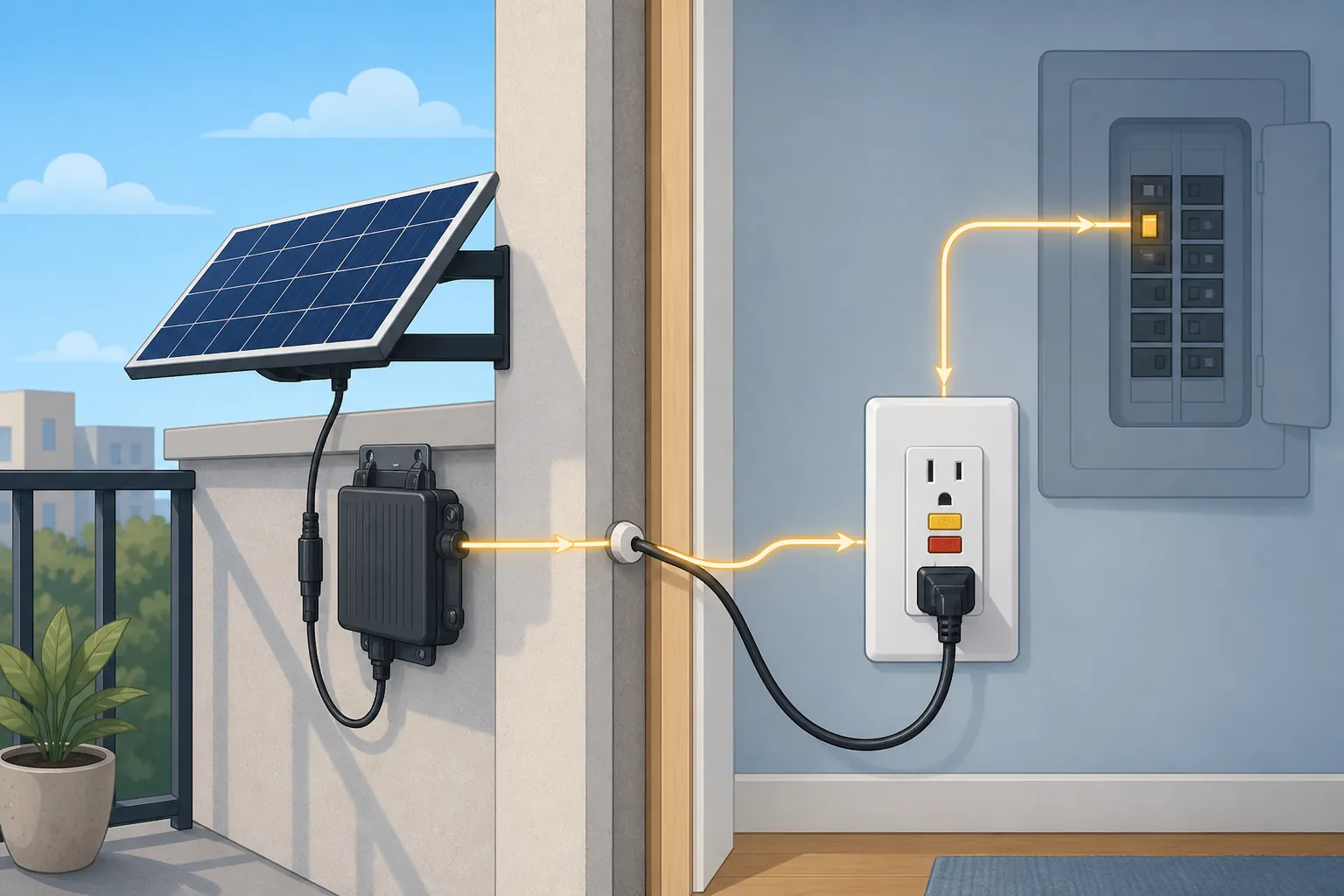
For a plug-in solar panel installation, the wall outlet is not just the last inch of convenience. It is the point where a power-producing device meets the home’s wiring. The code-grounded standard described in installation guides is a dedicated, GFCI-protected circuit, with no extension cords and no power strips between the kit and the receptacle.[6][7]
That should be read carefully. The GFCI-protected dedicated-circuit requirement is best treated as the safety standard to meet, grounded in NEC Articles 690 and 705 reasoning and vendor installation guidance, not as a single uniform statutory sentence repeated in every state law.[6][7] A state law may tell you the wattage cap and utility process; it may not inspect your apartment branch circuit for you.
- Dedicated circuit: the solar kit should not share the breaker with a microwave, space heater, portable air conditioner, or a row of unknown receptacles.
- GFCI protection: use a GFCI receptacle or GFCI-protected branch circuit appropriate for the installation environment.
- No extension cords: a cord stretched through a door track, window gap, or balcony threshold is not an installation plan.
- No power strips: the kit should connect to the approved receptacle path, not to a surge strip already feeding household loads.
- Weather-aware routing: balcony hardware, cable entry, strain relief, and drip paths all matter even when the product itself is outdoor-rated.
There is also a backfeed math issue. A commonly cited continuous backfeed figure is about 1,440W on a 15A/120V circuit and 1,920W on a 20A circuit, but those numbers should be verified against the product instructions, circuit rating, and local electrical requirements before you treat them as your limit. For a buyer, the conservative move is simpler: do not size the kit to the largest number someone mentioned online. Size it to the stricter of your state cap, the certified product instructions, the actual branch circuit, and any utility requirement.
If you do not know which breaker controls the outlet, what else is on that circuit, whether the receptacle is GFCI-protected, or whether the balcony cable route can be made without damage, pause the purchase. This is the step where a small electrician visit may cost less than returning a kit that never should have been ordered.
Renters and condo owners need property permission, not just electrical permission
A balcony rail, exterior wall, window frame, or shared facade is usually not yours to modify freely. Even when the electrical side is clean, a renter still has to deal with the lease, and a condo owner still has to deal with CC&Rs, architectural rules, or HOA procedures.
Virginia and Colorado are important because their plug-in solar laws are described as tenant- or owner-protective. Virginia’s law includes tenant protection, and Colorado’s HB26-1007 bars landlord and HOA bans when it takes effect.[1][2][3] Those protections change the opening conversation. They do not erase reasonable rules about safe mounting, damage, aesthetics, emergency access, or insurance.
For a renter, the useful permission request is boring and specific: the kit model, wattage, certification document, mounting method, whether drilling is required, cable route, outlet location, utility notification process, and removal plan. The more the request looks like a removable appliance with documented safety behavior, the less it sounds like an unreviewed electrical alteration.
Utility notification and tax treatment can change the payback
Utility handling is state-specific. Utah’s cited law removes utility approval and fees for qualifying systems, Maine requires 30-day utility notification above its DIY threshold, and Maryland uses a post-install notification model for covered systems.[1][2] Those are very different timelines for someone expecting the kit to arrive on Friday and start saving money on Saturday.
In a state without a clear plug-in solar statute, utility paperwork can become the hidden cost. The kit may be small, but if the utility treats it as interconnection, the process can add forms, waiting, fees, or requirements that make a $500–$2,500 product much less casual than the advertisement suggested.[1]
The federal tax-credit answer for 2026 buyers is plain: the residential clean energy credit under Section 25D expired December 31, 2025, and post-2025 installations do not receive the federal 30% credit in the cited EnergySage tax explainer.[8] If a seller’s payback math still assumes a federal 30% discount for a 2026 purchase, rerun the numbers without it. For broader rooftop-solar affordability math in the same post-credit environment, NestGrid’s guide to 2026 solar cost barriers and smart-home savings is the better place to continue that comparison.
What the savings look like after the gates are cleared
Once the address passes the legal, certification, electrical, property, and utility checks, the savings math can be useful. EnergySage’s July 2026 plug-in solar guide puts common 400W–800W kits around $500–$1,500 and estimates savings around $15–$50 per month, or $150–$600 per year, with an 800W system producing about 70–110 kWh per month.[1] That is the right scale for this product category: a bill shaver, not a whole-home solar replacement.
For apartments, the offset is usually modest but noticeable. The cited estimates support a rough 12–18% offset for a typical 1,200-square-foot apartment using about 600 kWh per month, with other consumer estimates landing around 10–30% or 15–25% depending on kit size, sun exposure, and electric rate.[1][9][10] A sunny balcony in a high-rate city can do better than a shaded north-facing rail, but the high-rate example is not the national baseline.
| Kit situation | What to expect | What can break the estimate |
|---|---|---|
| Small 400W-class kit | Lower upfront cost and easier fit under strict caps; savings may be visible but small | Shade, poor orientation, utility minimum charges, or no clear legal path |
| 800W-class kit | EnergySage cites about 70–110 kWh per month in production and $15–$50 monthly savings across common cases.[1] | State cap below the kit size, shared circuit, landlord refusal, or no qualifying certification |
| 1,200W-class kit | Fits several signed state caps, including Utah, Virginia, Maryland, New Hampshire, Connecticut, and Vermont in the cited materials.[1][2] | May exceed what the specific branch circuit, utility process, or property rules can support |
| Colorado 1,920W-class planning | Potentially larger offset under Colorado’s signed 2027 law | Effective date, circuit capacity, certification, and mounting limits still need address-level confirmation.[1][2][3] |
Payback estimates in the cited sources cluster in the low single digits when rates are favorable and the install is simple: EnergySage cites a typical 2–5 year payback, WattBuild gives a Los Angeles example around 2.8 years at $0.28/kWh, Solar.com gives a 3–6 year range, and Solar United Neighbors describes about a five-year average payback while noting equipment costs are expected to keep falling.[1][9][10][11] Those are not interchangeable promises. A local electric rate, balcony exposure, kit price, and any electrician cost can move the result quickly.
A clean way to estimate your own number is to start with monthly production, not percent offset. If an 800W kit is expected to make 70–110 kWh in a month, multiply that by your delivered electricity rate. Then subtract any monthly fees that do not change when usage falls. NestGrid’s guide to lowering an electric bill after a rate hike uses the same basic payback discipline for other household energy devices.
This is also where plug-in solar should stay in its lane. It can trim daytime consumption. It is not the same purchase as backup power, battery storage, or outage load management. If the real problem is resilience during grid failures, NestGrid’s separate guide to home energy solutions for grid crises is a different calculation.
The address-level buying decision
A plug-in solar kit is worth pricing only after these answers are yes or clearly manageable: your state has a signed and effective path for the kit size, the product has the right certification documentation, the outlet is on an appropriate dedicated GFCI-protected circuit, the property owner or HOA process is settled, and the utility notification or approval step is known.
If those gates are clear, compare kit size against your bill and use a modest savings range. If any gate is unresolved, do not buy yet. The kit may be simple to operate later, but the installation requirements come first.
References
- Plug-In & Balcony Solar Panels: Are They Worth It? — EnergySage — July 29, 2026 — https://www.energysage.com/news/plug-in-balcony-solar-panels/
- Plug-In Solar Legality in the US — EcoFlow — https://www.ecoflow.com/us/blog/plug-in-solar-legality-us
- US first UL 3700 balcony solar microinverter: Hoymiles — Electrek — July 20, 2026 — https://electrek.co/2026/07/20/us-first-ul-3700-balcony-solar-microinverter-hoymiles/
- UL Solutions Debuts Testing and Certification Framework for Safer Plug-in Solar Across the United States — UL Solutions — https://www.ul.com/news/ul-solutions-debuts-testing-and-certification-framework-safer-plug-solar-across-united-states
- What You Should Know About Plug-In Solar — Exact Solar Substack — https://exactsolar.substack.com/p/what-you-should-know-about-plug-in
- Apartment Solar Installation Guide — PlugInSolarUS — https://pluginsolarus.com/learn/apartment-solar-installation-guide
- Plug-In Solar 101 — PlugInSolarUS — https://pluginsolarus.com/learn/plug-in-solar-101
- Solar Tax Credit Explained — EnergySage — https://www.energysage.com/solar/solar-tax-credit-explained/
- Balcony Solar — WattBuild — https://www.wattbuild.com/learn/about/477/balcony-solar
- Guide to Balcony Plug-In Solar — Solar.com — https://www.solar.com/learn/guide-to-balcony-plug-in-solar/
- What to Know About Plug-in Solar — Solar United Neighbors — https://solarunitedneighbors.org/resources/what-to-know-about-plug-in-solar/