
Solar cost barrier? Smart home savings make it work in 2026
Without the federal tax credit, solar seems unaffordable. But zero-down financing combined with smart home devices can create immediate monthly savings, making solar work in 2026.
Last updated
The hard objection is fair: an average 12 kW home solar system is listed at $31,135 before incentives in EnergySage H1 2026 Marketplace data, or about $2.60 per watt.[1] That is not a casual home upgrade. It is a car-sized check attached to a roof project, and in 2026 the old consumer 30% federal tax credit under Section 25D is no longer there for a homeowner who buys the system with cash or a loan.[2]
But that does not make the cost barrier disappear. It changes where the math has to happen. The useful 2026 question is not “Can I claim the old tax credit?” It is: after the solar payment, lease charge, thermostat behavior, standby loads, and energy monitoring are counted, is the household spending less this month than it did on the grid-only bill?
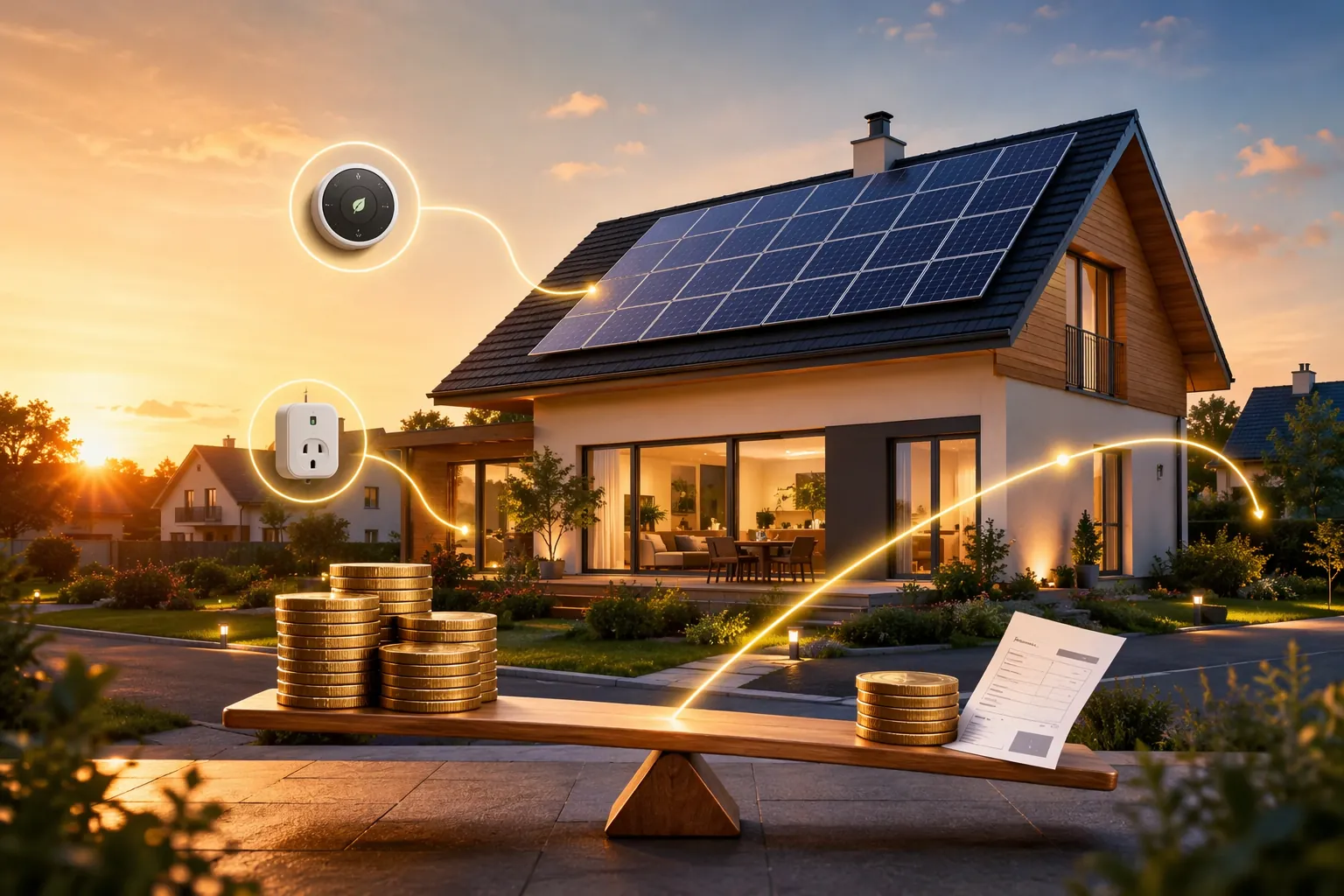
The policy split matters because it is easy to get wrong. Section 25D expired at the end of 2025 for consumer-owned systems, so cash purchases and ordinary solar loans no longer get that consumer credit in 2026. Section 48E, however, still supports third-party-owned systems, which is why leases and power purchase agreements now deserve more attention than they did in the old “buy it and take the credit” conversation.[2]
That does not make a lease automatically good. It only means the affordability test has moved from tax paperwork to monthly cash flow.
The 2026 Affordability Test Is Monthly, Not Theoretical
A tax credit lowers the cost of ownership once. A smart-home energy layer tries to lower demand every month. Those are different tools, and mixing them up is how a spreadsheet starts lying.
The zero-down paths are real enough to evaluate. EnergySage describes solar loans with no down payment, fixed monthly payments, and terms that can run from 5 to 25 years.[3] SolarReviews’ 2026 cost analysis projects lease pricing around $18 per kW per month, which would put a 10 kW leased system near $180 per month before household-specific details.[4] PPAs work differently: the homeowner pays for the power generated rather than leasing the equipment, while the provider owns the system and can use the third-party ownership tax structure.
| 2026 option | Upfront cash | Who owns the system | What the homeowner mainly has to test |
|---|---|---|---|
| Cash purchase | High | Homeowner | Whether the full installed price still beats grid costs without Section 25D |
| Zero-down loan | $0 down may be available | Homeowner | Whether the loan payment is lower than avoided utility purchases |
| Lease | $0 down may be available | Provider | Whether the monthly lease charge leaves room for bill savings |
| PPA | $0 down may be available | Provider | Whether the contracted solar rate beats the utility rate over time |
The uncomfortable part is that all four can be sold with cheerful language. “Zero down” removes the upfront check; it does not remove the obligation. A loan can preserve ownership but loses the old consumer tax credit. A lease or PPA can benefit indirectly from Section 48E through the provider, but the homeowner is signing a long-term contract whose value depends on local utility rates, escalation terms, roof life, usage, and the household’s ability to keep demand under control.
Why Solar Alone Leaves Money On The Table
A solar array reduces grid purchases. It does not know that the upstairs air conditioner is running harder because the schedule is sloppy, or that a media cabinet is sipping power all night, or that an old freezer in the garage has started behaving like a space heater with shelves. Panels produce. Loads consume. The bill is the fight between the two.
That is why the smart-home layer belongs in the same calculation as the solar payment. Not because every device pays for itself in every house, but because a few targeted devices attack the parts of consumption that solar financing does not touch.
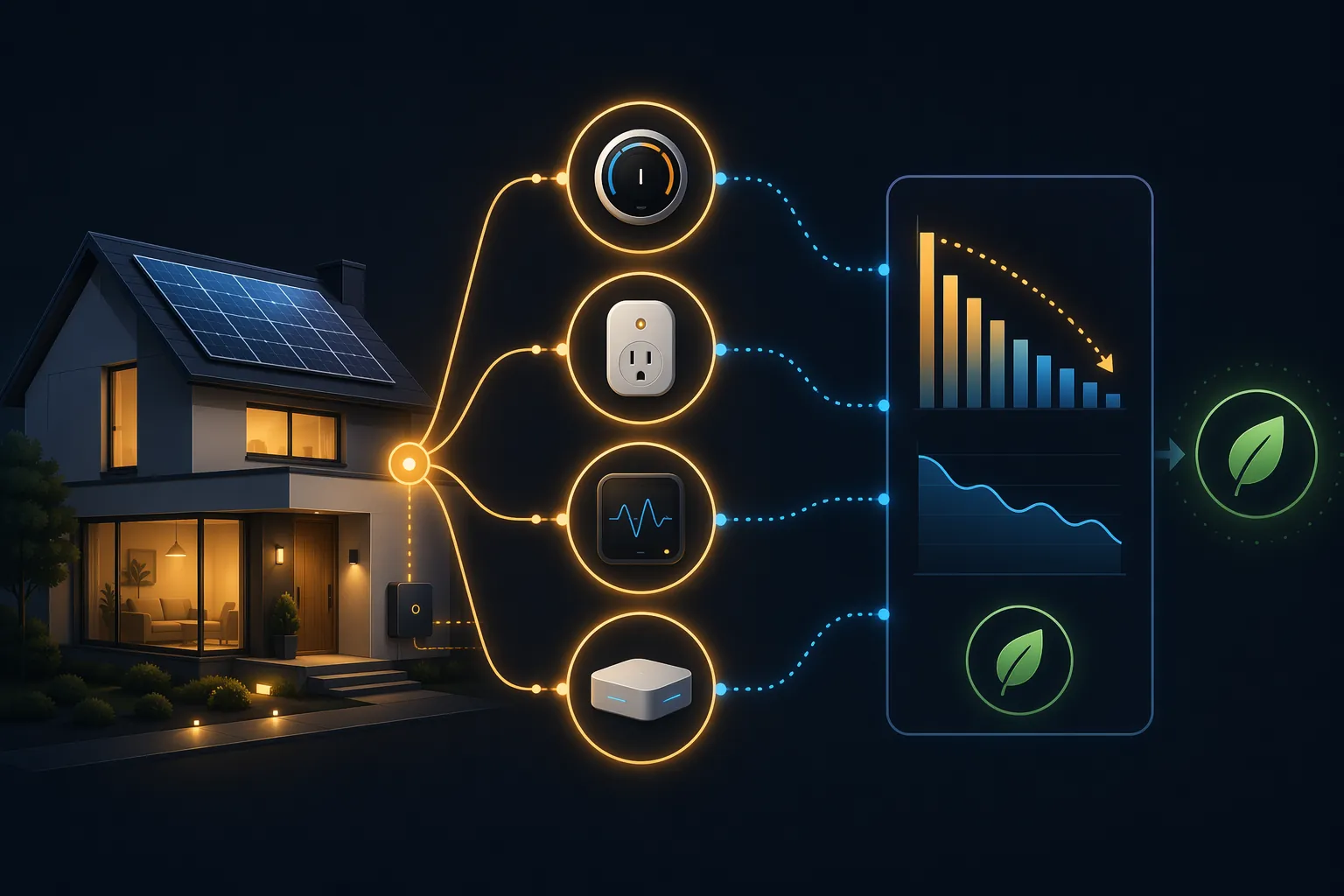
A smart thermostat is the obvious first device because HVAC is usually the load with enough size to matter. Vesternet’s guide reports smart thermostat savings in the range of 12% to 26% on HVAC, with annual savings of about $155 to $237, and it also cites Nest study results of 10% to 12% on heating and 15% on cooling.[5] Those figures do not mean every home gets the same number. A tight house in a mild climate has less waste to remove than a leaky house in a long cooling season. Still, if a thermostat cuts runtime during empty hours without making the house miserable, it changes the solar equation because the system has fewer kilowatt-hours to cover.
Smart plugs are smaller, but they are good at exposing an annoying class of load: devices that do little work while staying half-awake all day. Vesternet reports that smart plugs can eliminate 80% to 90% of standby waste and points to standby power as roughly 5% to 10% of total household energy, equal to about $100 to $140 per year.[5] For setup details, NestGrid’s guide to smart plugs and phantom energy savings is the more practical place to decide which always-on devices are worth controlling.
Energy monitors are less glamorous because they do not directly turn anything off. Their job is to make invisible waste visible. Smart-eco-home reports that monitoring in a 200-plus-home field dataset revealed more than $200 per year in waste within the first month.[6] That is a measurement claim, not a guarantee that a monitor magically saves money. The savings arrive only if somebody acts on the odd pattern: a well pump cycling too often, a dehumidifier running continuously, a base load that never drops at night.
A home energy management system is the bigger version of the same idea. Palmetto describes whole-home energy management systems as capable of reducing total consumption by 20% to 35%, with system costs from $2,000 to $9,000.[7] That cost range is why HEMS does not belong in every first-year affordability plan. For some homes, a thermostat, smart plugs, and a monitor are the sensible first stack. For larger homes, time-of-use rates, batteries, EV charging, or frequent peak pricing may justify deeper automation.
The modest version of the smart-home stack is easier to defend: roughly $500 to $800 for a thermostat, selected plugs, and monitoring, with a plausible monthly savings target around $50 to $100 or more when the house has real controllable waste. That target has to be earned by the house. It is not a label on the box.
The Kitchen-Table Math
Start with the lease example because it makes the monthly pressure visible. A 10 kW zero-down lease at the projected $18 per kW per month lands around $180 per month.[4] If the current grid-only bill is already high enough, the solar production can replace a large share of utility purchases. The smart-home layer then has a different job: reduce the load that remains, especially HVAC waste, standby draw, and poorly timed usage.
| Line item | Monthly effect in the simple model | What can make it wrong |
|---|---|---|
| Solar lease payment | About $180 for a 10 kW system | Regional lease pricing, escalators, production assumptions, roof conditions |
| Smart thermostat, plugs, and monitor | Roughly $50 to $100+ in monthly savings when controllable waste exists | Climate, insulation, comfort settings, household follow-through |
| Grid bill after solar | Lower than before if production offsets high-priced utility power | Net billing rules, seasonal mismatch, shading, rising fixed charges |
| First-year cash flow | Works only if avoided grid cost plus device savings exceed the new payment stack | Bad contract terms or low utility rates |
This is where a lot of solar sales math gets too smooth. If a household was paying $260 per month to the utility, and the new setup creates a $180 solar lease plus a smaller remaining utility bill, the answer depends on the remaining bill and the device savings. If the remaining bill is $70 and the smart devices save $60, the month looks better. If the remaining bill is $120 and the devices save $20, it does not. Same roof size, same lease headline, different result.
That is also why the expired tax credit is not the whole story. The old Section 25D credit reduced the owner’s solar cost once. A thermostat schedule that trims runtime, plugs that kill standby waste, and a monitor that catches a broken load keep working against consumption. The device layer can partly replace the missing tax-credit benefit in monthly cash flow, but only when the home’s loads are actually adjustable.
I would not count theoretical savings from devices that nobody will configure. A smart thermostat left in permanent hold is an expensive wall ornament. A plug behind a TV that never gets scheduled is just a remote switch. The useful devices are the ones tied to a behavior change or an automation: pre-cool before a peak window, drop HVAC runtime when the house is empty, shut down office equipment overnight, alert when the base load never falls. NestGrid’s smart home automations that save money are useful here because the automation is the savings mechanism, not the device purchase.
Where The Math Has A Real Chance
The cleanest boundary is the electricity rate. The first-year cash-flow case is strongest in states where retail electricity is above about $0.17 per kWh. Below that, the avoided grid cost may be too small to cover a solar payment quickly, even if the system is sized well. Above that, every kilowatt-hour avoided or shifted has more value.
That is why markets such as Florida, Texas, California, New York, Massachusetts, and Hawaii belong in the tipping-point conversation. They are not interchangeable. A Texas home with brutal summer cooling, a California home under time-of-use rates, and a Hawaii home facing very high grid prices can all produce different answers. The common feature is that the utility bill is large enough for monthly optimization to matter.
The same boundary protects against overpromising. If the roof is shaded, the house has low daytime usage, the lease escalator is aggressive, or the household already has unusually efficient loads, the combined package may not beat the grid-only bill in year one. Solar panels are hardware. Financing is a contract. Smart devices are control points. All three have to line up.
The lower-income gap makes zero-down access more than a convenience
The upfront-price problem is not evenly distributed. Utility Dive, citing a Cornell study, reported that low-income households spend 8.6% of income on energy compared with 3% for other households, and that low-income areas had 47% fewer solar installations despite 14.7% higher offset potential.[8] The Department of Energy’s Solar Futures Study found that only 31% of residential solar adopters earn below area median income.[9]
That gap is exactly why dismissing solar because the cash price is above $30,000 misses part of the 2026 market. The households that most need monthly relief are often the least able to pay upfront. Zero-down structures do not solve every equity problem, and a bad lease can still be a bad lease. But access to a lower monthly energy cost without a five-figure check is not a minor detail for a household already squeezed by electric bills.
What To Put In The Smart-Home Stack First
The first pass should be boring on purpose. Buy the devices that can change the biggest or most persistent loads before chasing a whole-home dashboard that looks impressive in an app.
- Start with HVAC control if heating or cooling dominates the bill; use schedules, occupancy, temperature setbacks, and peak-period pre-cooling instead of manual fiddling.
- Use smart plugs only on loads that are actually worth controlling: entertainment centers, office gear, chargers, dehumidifiers, and other devices with measurable standby draw.
- Add monitoring when the bill feels too high but the culprit is unclear; the monitor earns its keep only if unusual patterns lead to repairs or changed schedules.
- Consider HEMS, battery automation, or EV charging control when the home has time-of-use rates, backup needs, large flexible loads, or enough solar production to make self-consumption valuable.
Battery and AI automation can improve the timing side of the equation. Smart-eco-home reports that solar battery plus AI energy arbitrage can move self-consumption from about 55% to about 85%, with a 200-home UK study showing £450 to £820 per year in savings.[6] That is useful evidence, but it should not be pasted directly onto a U.S. bill without checking local tariffs. U.S. time-of-use windows, export rates, battery incentives, and demand charges can change the answer.
For a U.S. homeowner, the more practical step is to map the control path before buying hardware. If the solar inverter, battery, thermostat, plugs, and utility rate plan cannot talk to the same automation layer, the system may still save money, but it will depend more on manual discipline. NestGrid’s smart home solar and battery compatibility guide is the check I would do before ordering devices, and the solar battery smart home automation guide is where the battery logic belongs if storage is part of the plan.
A Decision Rule For 2026
Solar is not automatically affordable in 2026. Smart thermostats, plugs, monitors, and HEMS do not guarantee savings. The old “no federal tax credit means no deal” conclusion is still too simple.
The first-year case can work when three conditions line up: the home is in a high-rate market, preferably above about $0.17 per kWh; the homeowner can access a zero-down loan, lease, or PPA with terms that survive a plain monthly-bill comparison; and the smart-home layer will actually reduce demand rather than just add more gadgets to the Wi-Fi network.
The comparison is simple enough to do before signing anything: current grid-only bill versus post-solar payment plus remaining utility bill minus realistic smart-home savings. If the second number is lower in the first year, then the missing Section 25D credit may not kill the project. If it is not lower, the financing pitch is asking the household to wait for a future benefit while paying more now.
Before buying devices, verify compatibility, thermostat control, plug scheduling, monitoring support, and battery or time-of-use automation paths. The useful question is not whether solar “pays for itself” someday. It is whether the combined solar-and-smart-home setup leaves more money in the household budget this month.
References
- Solar Panel Cost in 2026, EnergySage
- Are Solar Panels Worth It in 2026?, SolarReviews
- Zero-down solar financing options, EnergySage
- Solar panel cost, SolarReviews
- Smart Home Energy Savings: A Complete Guide to Cost-Effective Automation and Payback Periods, Vesternet
- Smart Home Energy Management Guide, smart-eco-home
- Smart Home Tech and Rooftop Solar integration, Palmetto
- Rooftop solar is booming, but not in the communities that need it most, Utility Dive
- Will I Save Money with Solar Energy?, U.S. Department of Energy
Known issues with this device / protocol
Spec-version history
For active regressions on this protocol, see Update Watch.
No linked Update Watch entries yet.