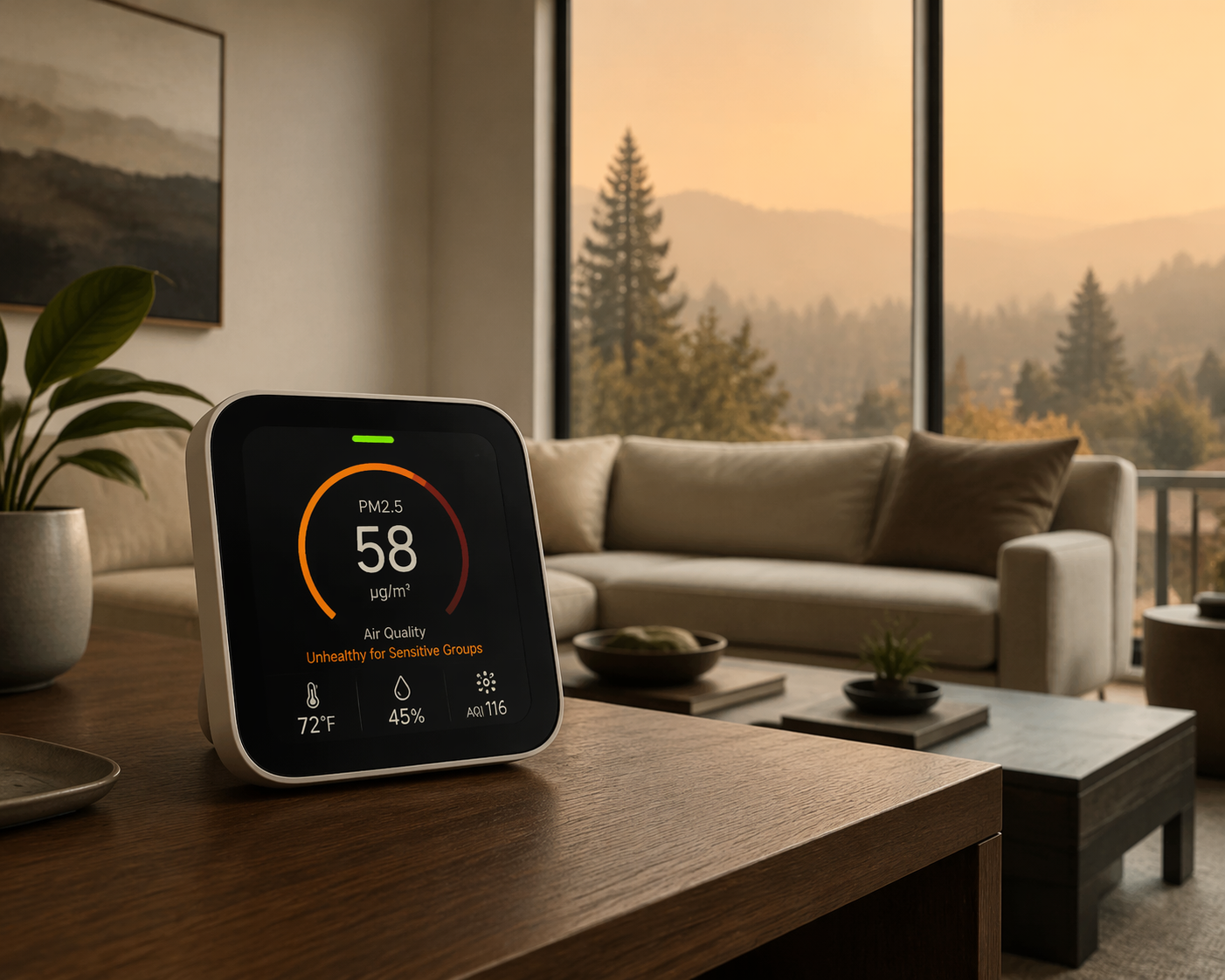
A smart home air quality monitor for smoke is, first of all, a PM2.5 monitor. That sounds less dramatic than “smoke detector,” but it is the distinction that keeps the purchase useful and safe. Wildfire smoke outside the window, cooking smoke drifting down a hallway, and tobacco smoke in an apartment all matter here because of fine particulate pollution. The monitor’s job is to notice those particles indoors, log them continuously, and, if your setup allows it, tell an air purifier to turn up before the room feels bad.
That is especially relevant in July 2026, with Canadian wildfire smoke again affecting multiple U.S. states and driving fresh demand for indoor PM2.5 monitoring during smoke alerts.[1] But the right device is not simply the one with the longest pollutant list. For smoke, PM2.5 sensor performance comes first. Smart-home automation comes next. Extra sensors only matter when they solve a real household problem, such as CO2 in a home office or radon in a basement.
Start With The Smoke Metric, Not The Product Name
If a monitor cannot measure PM2.5, it is not the right tool for smoke awareness. It may still be useful for comfort, ventilation, or fire safety in a different category, but it cannot tell you whether fine smoke particles have entered the room.
That single filter clears up most of the confusing shelf labels. “Indoor air quality” can mean VOCs, humidity, temperature, CO2, radon, pressure, particulates, or some blended score. “Smart smoke” can mean a life-safety alarm, a pollution monitor, or a product trying to sound like both. For this buying decision, the useful question is narrower: does the device continuously track PM2.5 well enough to support a smoke response?
The response matters because a display by itself still leaves someone watching numbers. A better smoke setup lets the monitor trigger a purifier, or at least send a phone alert, when indoor PM2.5 rises. If you are sizing the purifier side of that setup, the next practical question is CADR; this guide to CADR ratings for wildfire smoke is the right companion piece.
The 2026 Shortlist
| Device | Typical Price | Why It Belongs In The Conversation | Smart Home Fit | Main Caveat |
|---|---|---|---|---|
| Govee Smart Air Quality Monitor | $35–60 | Budget PM2.5 monitor with side-by-side accuracy evidence, fast refresh, history, export, and Govee purifier automation | Govee ecosystem | Automation is limited to Govee devices |
| Amazon Smart Air Quality Monitor | $50–70 | Alexa-friendly PM2.5, VOC, and CO monitor for routines | Alexa | No display and no data export |
| AirGradient ONE | $195–230 | Accuracy-focused open monitor with PM2.5, PM10, CO2, VOC, NOx, temperature, and humidity | Home Assistant and open-source users | Costs several times more than budget smoke monitors |
| Airthings View Plus | $300 | Seven-sensor monitor including radon, plus PM2.5, CO2, VOC, temperature, pressure, and humidity | Airthings app ecosystem | Best justified when radon is part of the purchase |
| Kidde P4010ACSCOAQ-WF | $90 | UL-listed smoke/CO alarm with IAQ monitoring | Kidde smart alarm ecosystem | Its IAQ monitoring does not include PM2.5 |
| IKEA Alpstuga | $30 | Matter over Thread air quality monitor | Matter/Thread homes | Reported poorly in a cigarette-smoke room test |
| uHoo Smart Monitor | Varies | Broad indoor air quality dashboard | uHoo ecosystem | Reported poorly in a cigarette-smoke room test |
That table is not a feature contest. It is a purchase map. A renter with a Govee purifier does not need the same device as a Home Assistant user building automations around raw sensor data. A homeowner with a radon concern should not be pushed toward the cheapest PM2.5 box and told the job is done. But nobody should pay extra for pollutant breadth before confirming that smoke particulates are actually measured.
The Budget Pick That Deserves Serious Attention: Govee
The Govee Smart Air Quality Monitor is the pleasant surprise in this category because it does the smoke-monitoring job cheaply without looking like a toy in the data. BreatheSafeAir’s April 2026 review identified a Cubic PM2008MS sensor inside the Govee unit and found that it tracked a factory-calibrated AirGradient ONE within 2–3 µg/m³ over months of side-by-side testing.[2]
That does not make it a laboratory instrument. It does make it credible for the use case most people actually have: deciding whether indoor smoke is rising, whether the purifier is catching up, and whether one room is behaving worse than another. At roughly $35–60, staying that close to a calibrated reference monitor is the kind of result that changes a buying guide.
The practical features line up well with smoke days. The monitor offers a 2-second data refresh, a 4-level LED indicator, a 13-day on-screen graph, and exportable 1-minute resolution data for up to 2 years.[2] Fast refresh is useful when someone starts frying dinner, opens a leaky window during a smoke alert, or turns a purifier from auto to high and wants to know whether the PM2.5 number is actually moving.
The catch is platform lock-in. Govee can automatically trigger Govee air purifiers, which is exactly the kind of automation a smoke-aware room needs.[2] If your purifier is from another brand and your smart home is built around Home Assistant, Apple Home, SmartThings, or Alexa routines, the Govee monitor may become a good screen with a less useful automation path.
For many apartments, bedrooms, nurseries, and home offices, that trade-off is acceptable if you are already in the Govee ecosystem or are willing to pair the monitor with a compatible Govee purifier. If you want a broader smoke plan across alerts, filtration, and alarms, the more complete setup lives in a four-layer smoke-ready smart home rather than in one monitor.
Amazon Is The Alexa Branch, Not The Universal Pick
The Amazon Smart Air Quality Monitor makes sense when Alexa already runs the home. It measures PM2.5, VOCs, and CO, and BreatheSafeAir found that its PM2.5 readings were accurate after applying EPA correction factors.[3] That last clause matters: the device can be useful for smoke, but its raw interpretation needs to be understood carefully.
Its appeal is routine-building. An Alexa household can use the monitor as a trigger for alerts or compatible devices, which may be enough for a kitchen, bedroom, or rental where adding another ecosystem is a nonstarter. The cost, usually around $50–70, also keeps it in the impulse-buy range for people who want smoke awareness before the next bad-air week.
The limitations are not subtle: no display and no data export.[3] No display means you are checking the app or relying on Alexa. No export means it is harder to review what happened over a long smoke event, compare rooms, or troubleshoot whether an automation reacted late. For Alexa-only homes, it is a reasonable branch. For everyone else, it is not the device to bend your setup around.
AirGradient ONE Is For Accuracy, Openness, And More Pollutants
AirGradient ONE changes the recommendation for people who want more than a basic smoke alert. It measures PM2.5, PM10, CO2, VOC, NOx, temperature, and humidity, and AirGradient identifies it as the most accurate multi-pollutant indoor monitor under €500 in the AIRLAB Microsensors Challenge 2023.[4]
For smoke, the important part is still PM2.5. The difference is that AirGradient gives you that reading inside a more open and expandable device. It is open source, has native Home Assistant support, and is a better fit for people who want automations they can inspect, modify, and connect across brands.[4]
The added sensors also change what the monitor can explain. PM2.5 can tell you that smoke or fine particles rose. CO2 can show whether a closed bedroom or office is under-ventilated. VOC and NOx readings can help flag other indoor pollution events. PM10 adds a broader particulate view. None of those extras should distract from smoke, but in a room where multiple air-quality problems overlap, they reduce guesswork.
At roughly $195–230, AirGradient ONE is not the cheap answer. It is the cleaner answer for Home Assistant users, data-minded buyers, and households that want one monitor to cover smoke plus ventilation-related questions. If someone in the home is especially vulnerable to poor air, this is also where the buying decision starts to overlap with the more careful criteria in a smart air quality monitor guide for sensitive groups.
Choose Airthings View Plus When Radon Is Part Of The Reason
Airthings View Plus should not be treated as the default smoke pick just because it is expensive and sensor-rich. Its special value is that it includes radon alongside CO2, VOC, PM2.5, temperature, pressure, and humidity. In this group, that seven-sensor package is the reason to consider the $300 price.
If the household question is “Did smoke get into the bedroom during the alert?”, Govee or Amazon may answer it for much less, and AirGradient may answer it with more openness. If the question is “Can one device help me watch smoke while also keeping an eye on radon?”, Airthings View Plus becomes much easier to justify.
That distinction keeps the purchase honest. Radon is not a bonus icon for most buyers; it is a separate monitoring concern. Pay for it when you actually need it.
The Kidde Trap: A Real Smoke Alarm That Is Not A PM2.5 Smoke Monitor
The Kidde P4010ACSCOAQ-WF is the device most likely to confuse careful buyers, because part of its job sounds exactly like what this guide is about. TechHive reviewed it as a UL-listed device combining a smoke/CO alarm with indoor air quality monitoring.[5] That is meaningful for life safety. It is not the same as measuring smoke particulates.
The IAQ side of the Kidde device measures TVOCs, temperature, and humidity, not PM2.5.[5] So it cannot serve the wildfire-smoke, cooking-smoke, or tobacco-smoke monitoring role described here. It may alarm in a fire because it is a smoke/CO alarm, but it will not give you continuous fine-particle readings that can tell a purifier to react to smoke drifting indoors.
For life-safety alarm comparisons, a smart smoke detector compatibility guide is the better place to evaluate that layer. Just do not buy this Kidde model expecting it to behave like a PM2.5 smoke monitor.
Two Cautionary Examples: IKEA Alpstuga And uHoo
IKEA Alpstuga is tempting because it is inexpensive and supports Matter over Thread. uHoo is tempting for a different reason: it presents itself as a broad indoor air quality monitor. Neither should move to the top of a smoke-focused list without better smoke-performance evidence.
Consumer Reports reported in April 2026 that IKEA Alpstuga and uHoo Smart Monitor “never reported unhealthy air in a room full of cigarette smoke.”[6] That is a sharp warning, but it should be read narrowly: it is one test protocol, not proof that every unit will fail every smoke scenario. For a buyer choosing specifically around smoke, though, a monitor that misses a cigarette-smoke room test has not earned the benefit of the doubt.
How To Match The Monitor To The Room
A smoke monitor should be placed where the decision will happen. In a bedroom, that decision may be whether to run the purifier higher overnight. In a kitchen-adjacent living room, it may be whether cooking smoke is spreading past the range hood. In a home office, it may be whether outside smoke is creeping in during a closed-window workday.
- Choose Govee if you want the least expensive credible PM2.5 smoke awareness and are willing to use Govee purifier automation.
- Choose Amazon if your home runs on Alexa and you care more about routines than local display or exported data.
- Choose AirGradient ONE if PM2.5 accuracy, Home Assistant support, and open data matter more than the lowest price.
- Choose Airthings View Plus if radon is part of the reason you are buying an air monitor, not just a nice extra.
- Do not choose a monitor for smoke if it lacks PM2.5, even if the product name mentions smoke, safety, or indoor air quality.
Automation should be simple enough to trust. A practical smoke rule might turn a purifier to high when PM2.5 rises above your chosen threshold, then return it to auto after the reading stays lower for a while. The exact threshold depends on household tolerance and health needs, but the structure is the same: monitor the particles, move air through a smoke-capable filter, and avoid making someone stare at an app all afternoon.
For people still picking the purifier itself, the monitor is only half of the system. A good PM2.5 sensor can tell you the room is smoky; it cannot clean the room. Pair it with a purifier selected for smoke health risks, room size, and filter maintenance, not just app compatibility.
Do Not Let Air Quality Monitoring Replace Smoke Alarms
A smart air quality monitor can notice fine particles. A smoke alarm is a life-safety device designed and listed to wake people during a fire. Those are different jobs, and they should stay different in your buying decision.
The air-Q analyzer’s own fire-alarm FAQ is useful precisely because it draws this line: even a device that may detect fire-relevant substances quickly cannot legally replace a conventional smoke detector.[7] The same caution applies across this category. PM2.5 monitors, dashboards, and smart automations are not substitutes for UL-listed smoke alarms with built-in sounders installed where required.
That is the final purchase boundary. Buy a PM2.5 monitor to understand indoor smoke and trigger filtration. Keep smoke alarms for fire safety. If one product seems to promise both, read the sensor list twice.
References
- GoveeLife smart air quality monitor deal, USA Today, July 17, 2026
- Govee Air Quality Monitor Review, BreatheSafeAir, April 2026
- Amazon Smart Air Quality Monitor Review, BreatheSafeAir
- AirGradient ONE Indoor Air Quality Monitor, AirGradient
- Kidde Smart Fire + Carbon Monoxide Alarm with Indoor Air Quality Monitor review, TechHive
- Consumer Reports air quality monitor testing, Consumer Reports, April 2026
- Can the air-Q be used as a fire alarm or smoke detector?, air-Q
Reader Feedback
Share your purchase experience, flag outdated picks, or ask clarifying questions about the checklist items.
Comments
Join the discussion with an anonymous comment.