A smart home air quality monitor for Chicago wildfire smoke has one job before it has any right to be cute, voice-controlled, or dashboard-friendly: it needs to tell you whether PM2.5 is getting into your actual room. During the July 16, 2026 smoke event, Chicago-area reports did not even agree on one clean peak number. WTTW reported hazardous pollution conditions and an air quality alert, CBS Chicago reported AQI at 753, and the Chicago Tribune reported PM2.5 above 900 AQI in north suburban spots including Winnetka, with Cook County PM2.5 levels quadrupling the prior 2023 record.[1][2][3]
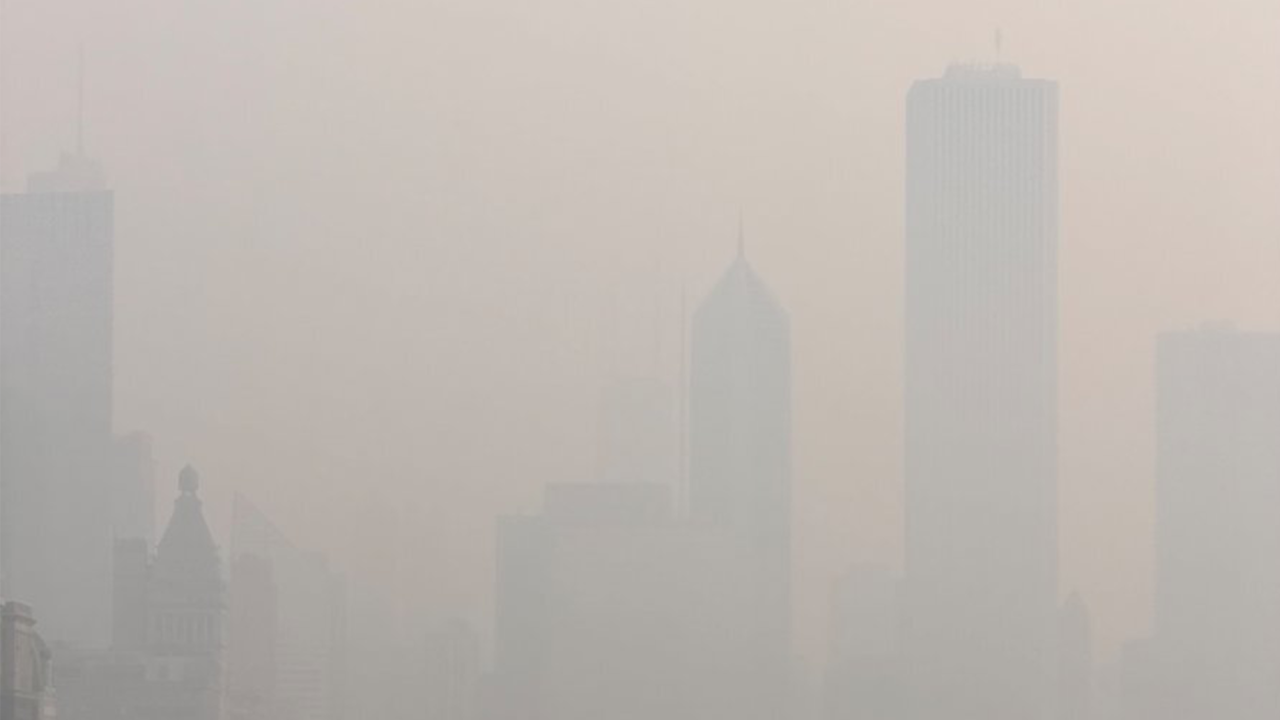
That range matters because it is not just app drama. Federal monitors, media summaries, and hyperlocal sensors can show different peaks. Outdoor AQI tells you when to take the smoke seriously. An indoor PM2.5 monitor tells you whether closing the windows, running the purifier, and sealing one bedroom are actually working.
For Chicago homes, the useful shortlist is smaller than most buyer guides make it look. If wildfire smoke is the reason you are buying, prioritize PM2.5 behavior, data access, automation path, maintenance, and price. CO2, VOCs, and temperature are nice; they do not decide whether a child sleeps in the back bedroom or whether the purifier needs to kick up right now.
The Shortlist
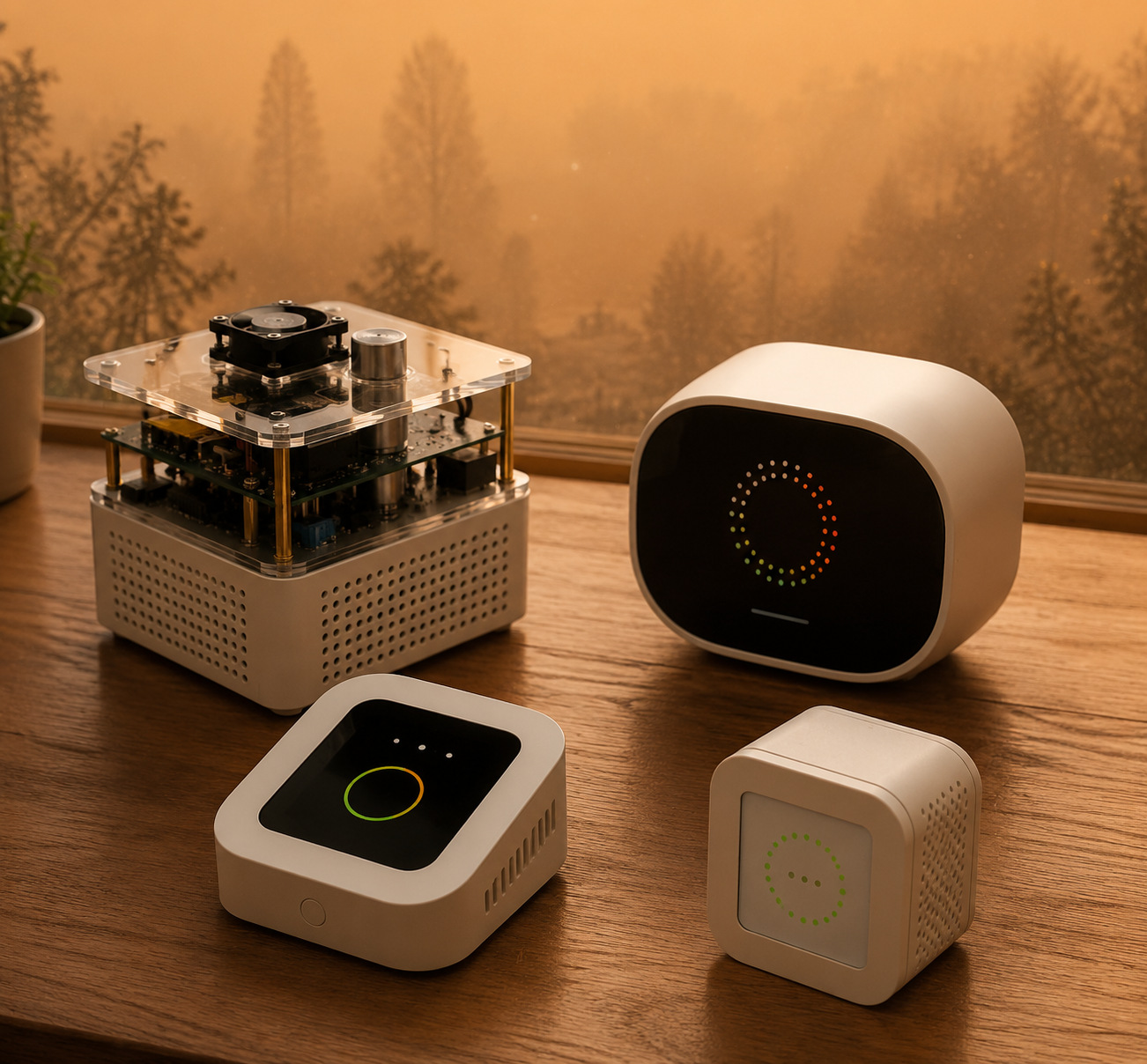
| Monitor | Best for | PM2.5 credibility | Smart home path | Maintenance story | Approx. price |
|---|---|---|---|---|---|
| AirGradient One | Home Assistant users and data-friendly households | Strong overall smoke-use candidate; Wirecutter top pick, with Plantower PMS5003 PM sensor | Native Home Assistant, ESPHome, Homey, community HomeKit bridge, open API | Replaceable Plantower PMS5003 and SenseAir S8 components | ~$220 |
| PurpleAir Zen | PM2.5-first buyers who want smoke confidence over simplicity | Highest consumer PM2.5 performer in cited AQMD/HouseFresh testing | Works best for people comfortable using PurpleAir data and integrations rather than a closed purifier bundle | Dual replaceable Plantower PMS6003 sensors plus Bosch BME688 gas sensor | ~$299 |
| GoveeLife Smart AQM | Budget users already in the Govee app | Useful for smoke-spike awareness, with low-cost sensor caveats | Pairs directly with Govee air purifiers in the Govee app | Budget device; treat readings directionally | ~$40 |
| IKEA Vindstyrka | Renters using IKEA Dirigera and Starkvind | Useful for PM2.5 trend watching, with low-cost sensor caveats | Zigbee through Dirigera; can trigger IKEA Starkvind purifiers | Budget device; ecosystem matters more than raw precision | ~$50 |
Prices are approximate list prices checked for this guide and can move. The bigger issue is not whether one sale saves $20. It is whether the monitor gives you a reading you can act on during smoke, in the smart home system you actually use.
Best Overall for Chicago Smoke: AirGradient One
AirGradient One is the best fit for a Chicago apartment or house where someone wants the monitor to become part of the smoke plan, not just another app to check. Its strongest case is the combination: PM2.5, CO2, NOx, and VOC sensing; native Home Assistant support; ESPHome and Homey support; a community HomeKit bridge path; and an open API for custom automations.[4] Wirecutter named AirGradient One its top home air quality monitor pick in its September 2025 update.[5]
The open API is not a hobbyist footnote during wildfire smoke. It is the difference between “my phone says the bedroom is getting worse” and “when bedroom PM2.5 rises, the purifier switches to high, the HVAC fan routine changes, and the living-room lamp turns amber.” If you already run Home Assistant, AirGradient is the cleanest recommendation in this group because its data is meant to leave the device.
It also has a better maintenance story than sealed, disposable-feeling monitors. The AirGradient One uses replaceable Plantower PMS5003 and SenseAir S8 sensor components, so its long-term value is not only about day-one accuracy.[4] Smoke season is hard on sensors; a device that acknowledges parts wear out earns more trust than one that behaves as if calibration drift is somebody else’s problem.
The caveat is that AirGradient is not directly validated by the Berkeley Lab 2020 wildfire-smoke study, which tested older models, not the AirGradient One. The case for AirGradient comes from its integration design, component choices, and third-party review placement, not from pretending every low-cost sensor study applies to every newer monitor.
Buy it if you want one monitor that can serve both ordinary indoor-air tracking and smoke-day automation. Skip it if you do not want to touch Home Assistant, APIs, bridges, or advanced settings; a simpler app-first device may be less elegant and still be the better fit.
Best PM2.5-First Pick: PurpleAir Zen
PurpleAir Zen is the monitor to consider when the buying question is less “Will this fit my smart home nicely?” and more “Do I trust this PM2.5 reading when wildfire smoke is moving fast?” HouseFresh’s 2026 comparison identifies PurpleAir Zen as a top performer for PM2.5 accuracy, citing AQMD field-evaluation results and its own smoke testing.[6]
Its hardware is built around dual replaceable Plantower PMS6003 sensors and a Bosch BME688 gas sensor. The dual-sensor setup is valuable because PM2.5 is the smoke metric that changes the household decision. If the number rises while windows are shut and the purifier is running, the room plan is failing. If it drops after moving the purifier closer to the sleeping area, the change worked.
The tradeoff is price and simplicity. Around $299, PurpleAir Zen is not the sympathetic answer for every renter trying to protect one room. It also is not the neatest closed-loop smart purifier purchase. It makes the most sense for people who prize PM2.5 confidence, are comfortable reading PurpleAir-style data, and do not mind doing more integration work if they want automation.
For a Chicago household that already checks outdoor PurpleAir-style maps during smoke episodes, the Zen can feel familiar. Just keep the distinction clean: an outdoor network can warn that smoke has arrived; the indoor monitor is what tells you whether your living room or bedroom is protected.
Best Budget App Pairing: GoveeLife Smart AQM
GoveeLife Smart AQM is the budget pick I would take seriously for one reason: it can pair directly with Govee air purifiers in the Govee app. That is the kind of closed-loop behavior a normal person expects when a box says “smart.” During smoke, the monitor sees a PM2.5 spike, the app can tell the purifier to respond, and nobody has to build a Home Assistant automation at midnight.
At about $40, though, it should not be sold as if it were a reference instrument. Berkeley Lab reported in 2020 that consumer PM2.5 monitors under $300 tracked wildfire-smoke changes “phenomenally well” against reference instruments, but the same research found low-cost sensors under $50 overreported PM2.5 by factors of 1.6 to 2.4 compared with reference monitors.[7]
That still leaves room for a useful product. If the GoveeLife monitor says PM2.5 jumped after the hallway window was opened, you do not need it to be perfect to close the window and turn the purifier up. Directional smoke awareness is a legitimate use case. The problem is when a cheap monitor’s exact number gets treated like a lab-grade measurement.
Buy it if you already own or plan to buy a compatible Govee purifier and want a simple app-controlled room setup. If your purifier is from another brand, confirm the automation path before buying; “works with Alexa” is not the same thing as “uses this PM2.5 sensor to control that purifier.”
Best Cheap Zigbee Option: IKEA Vindstyrka
IKEA Vindstyrka is the sensible cheap pick when the home is already leaning IKEA: Dirigera hub, Zigbee devices, maybe a Starkvind purifier. In that setup, the point is not to win an accuracy contest. The point is to get indoor PM2.5 trend information into a hub that can make an IKEA purifier react.
For renters, this can be enough. Put the monitor in the room you are actually protecting, keep the purifier in that same zone, and watch whether PM2.5 drops after the purifier ramps up. If the number is directionally useful and the ecosystem is already there, the Vindstyrka can be a practical smoke-day tool.
The same budget warning applies: do not treat a low-cost PM2.5 number as absolute truth. Treat it as a room signal. If it rises, something changed. If it falls after a filtration change, your response probably helped. That is enough for many households, as long as nobody mistakes it for a calibrated outdoor station.
Choose by Household, Not by Spec Sheet
| If this sounds like your home | Buy this | Why |
|---|---|---|
| You use Home Assistant or want local-friendly data access | AirGradient One | Best balance of sensing, open API access, integrations, and replaceable components |
| You care most about PM2.5 confidence during smoke | PurpleAir Zen | Strongest PM2.5-first case, especially for people comfortable with PurpleAir-style data |
| You want the cheapest app-first monitor-to-purifier loop | GoveeLife Smart AQM | Direct Govee purifier pairing makes smoke response simple inside that ecosystem |
| You already use IKEA Dirigera or Starkvind | IKEA Vindstyrka | Low-cost Zigbee room monitoring with practical IKEA purifier control |
| You only want outdoor warnings | Use AirNow and Open Air Chicago | Good for knowing when smoke is outside; not a substitute for indoor measurement |
If you are still deciding how much monitor you need, the broader smart air quality monitor smoke primer is useful for sorting PM2.5 from the other indoor-air metrics. If your main project is making the purifier respond automatically, start with the wildfire-smoke automation workflow before buying a monitor that traps its best data inside an app.
The Ecosystem Trap: Voice Control Is Not PM2.5 Automation
This is where a lot of smart-home marketing gets slippery. Alexa or Google Home support can mean voice commands, schedules, and on/off control. It does not automatically mean your indoor PM2.5 monitor can tell your purifier to speed up when smoke leaks into the bedroom.
Coway Airmega 250S is a good caution. SmartHomeExplorer named it a top smart purifier for wildfire smoke in 2026, and it works with Alexa and Google Home for voice control and scheduling. But the available sources do not support a direct monitor-to-purifier pairing; you would need a bridge such as Home Assistant or a smart-plug workaround for sensor-driven automation.[8]
Before buying any monitor-purifier pair, check the exact path:
- Same-brand app pairing: simplest when supported, as with Govee monitor-to-purifier setups.
- Hub-based pairing: useful when a Zigbee monitor and purifier live in the same ecosystem, as with IKEA Dirigera and Starkvind.
- Home Assistant automation: most flexible when the monitor exposes useful sensor entities.
- Smart plug workaround: possible for some purifier routines, but only if the purifier safely resumes the desired mode after power is restored.
For purifier sizing and setup, pair the monitor decision with a separate smart purifier for wildfire smoke guide or the purifier setup companion. A monitor can prove the room is improving; it cannot make an undersized purifier clean a leaky space.
Use Outdoor Data as the Starting Bell
Chicago now has better free outdoor context than it did a few smoke seasons ago. Open Air Chicago launched with 277 Clarity Node-S sensors on light poles, measuring outdoor PM2.5 and NO2 through a public map and alert system.[9] The City of Chicago also describes Open Air Chicago as a neighborhood-scale air-quality sensor network.[10]
That is genuinely useful. If the Open Air map shows smoke moving into your part of the city, or if the federal AirNow app shows an unhealthy outdoor AQI, close windows, switch the HVAC strategy if needed, and start watching the indoor monitor. But neither Open Air Chicago nor AirNow measures your bedroom, your nursery, or the one room where the purifier is running.
There is also a data caution. The Open Air Chicago network was new in early 2026, and the available sources do not identify independent published verification of its real-time performance during AQI 747-plus extreme PM2.5 events. Use it as outdoor context, not as proof that your sealed apartment is safe.
Accuracy Caveats That Actually Matter
Consumer PM2.5 monitors do not need to be perfect to be useful during wildfire smoke. Berkeley Lab’s 2020 study found that low-cost home air quality monitors under $300 correlated very well with reference monitors for smoke-driven changes, even when their absolute readings differed.[7]
That finding should not be stretched too far. Berkeley Lab tested four older models: IQAir AirVisual Pro, PurpleAir Indoor, Air Quality Egg, and eLichens. It did not test AirGradient One, GoveeLife Smart AQM, IKEA Vindstyrka, or newer devices introduced after that study. So the safe conclusion is narrower: consumer PM2.5 monitors can be very useful for detecting wildfire-smoke direction and change, but individual model performance still matters.
For smoke decisions inside a Chicago home, directional accuracy often matters first. If the bedroom PM2.5 line rises after the back door opens, act. If it drops after the purifier moves closer to the bed, keep that setup. Save the exact-number arguments for later, preferably not in the building group chat.
Placement and Maintenance
Put the monitor where the decision happens. If you are protecting one room, measure that room. A monitor in the living room will not tell you whether the back bedroom stayed clean overnight. Keep it away from a purifier’s direct exhaust, kitchen bursts, humidifier mist, and open windows unless those are the conditions you are intentionally testing.
Heavy smoke can foul optical PM2.5 sensors. WIRED advises cleaning PM2.5 sensor optics with cool air from a hairdryer to clear filter fouling during heavy smoke exposure.[11] Use cool air, not heat, and follow the device maker’s instructions if they are more specific.
For a more detailed setup pass, use a dedicated indoor air quality monitoring placement guide. Placement errors can make an expensive monitor look bad and a cheap monitor look falsely reassuring.
Practical Verdict
Choose AirGradient One if you want the best overall balance for Chicago wildfire smoke: strong sensing, open automation, Home Assistant friendliness, an open API, and replaceable sensor components. Choose PurpleAir Zen if PM2.5 confidence is the priority and you are willing to pay more for a smoke-focused monitor.
Choose GoveeLife Smart AQM if you want a low-cost, app-first monitor that can pair with Govee purifiers. Choose IKEA Vindstyrka if your home already runs on Dirigera and Starkvind. Use AirNow and Open Air Chicago as outdoor signals that tell you when to start watching your indoor monitor, not as replacements for the monitor in the room you are trying to protect.
References
- Wildfire Smoke Blankets Chicago; Air Quality Alert Issued Amid Hazardous Levels of Pollution, WTTW Chicago, 2026-07-16
- Chicago Air Quality Bad From Canada Wildfires 2026, CBS Chicago, 2026-07-16
- Wildfire Smoke Air Quality Illinois, Chicago Tribune, 2026-07-16
- AirGradient Integrations, AirGradient
- The Best Home Air Quality Monitor, Wirecutter, September 2025
- Air Quality Monitors, HouseFresh, 2026
- Low-Cost Home Air Quality Monitors Prove Useful for Wildfire Smoke, Berkeley Lab, 2020
- Best Smart Air Purifiers for Wildfire Smoke 2026, SmartHomeExplorer
- Open Air Chicago: Chicago Department of Public Health, University of Illinois Chicago and ComEd Launch Largest Air Quality Sensor Network in the United States, Clarity.io
- Open Air Chicago, City of Chicago
- Best Indoor Air Quality Monitors, WIRED, 2025
Reader Feedback
Share your purchase experience, flag outdated picks, or ask clarifying questions about the checklist items.
Comments
Join the discussion with an anonymous comment.