Outdoor AQI apps are useful for the moment when smoke is moving toward your neighborhood. They are much less useful for the question that actually matters at 2 a.m.: has fine particle smoke reached the bedroom, nursery, office, or rental unit where people are breathing?
The best smart air quality monitor for smoke detection is not simply the one with the prettiest dashboard. It is a monitor with a laser PM2.5 sensor that can pass a smoke signal to something that cleans the air: a HEPA purifier, a smart plug controlling a purifier, or an alert that reaches the person at home without requiring them to keep checking an app.
That makes the buying decision more practical than most monitor rankings admit. Pick the automation pathway you will actually use, then check the PM2.5 sensor, response behavior, and placement. A monitor stranded outside your smart home platform may be interesting data. During smoke season, interesting data is not the same as a house that reacts.
Start With The Automation Path, Not The Monitor Brand
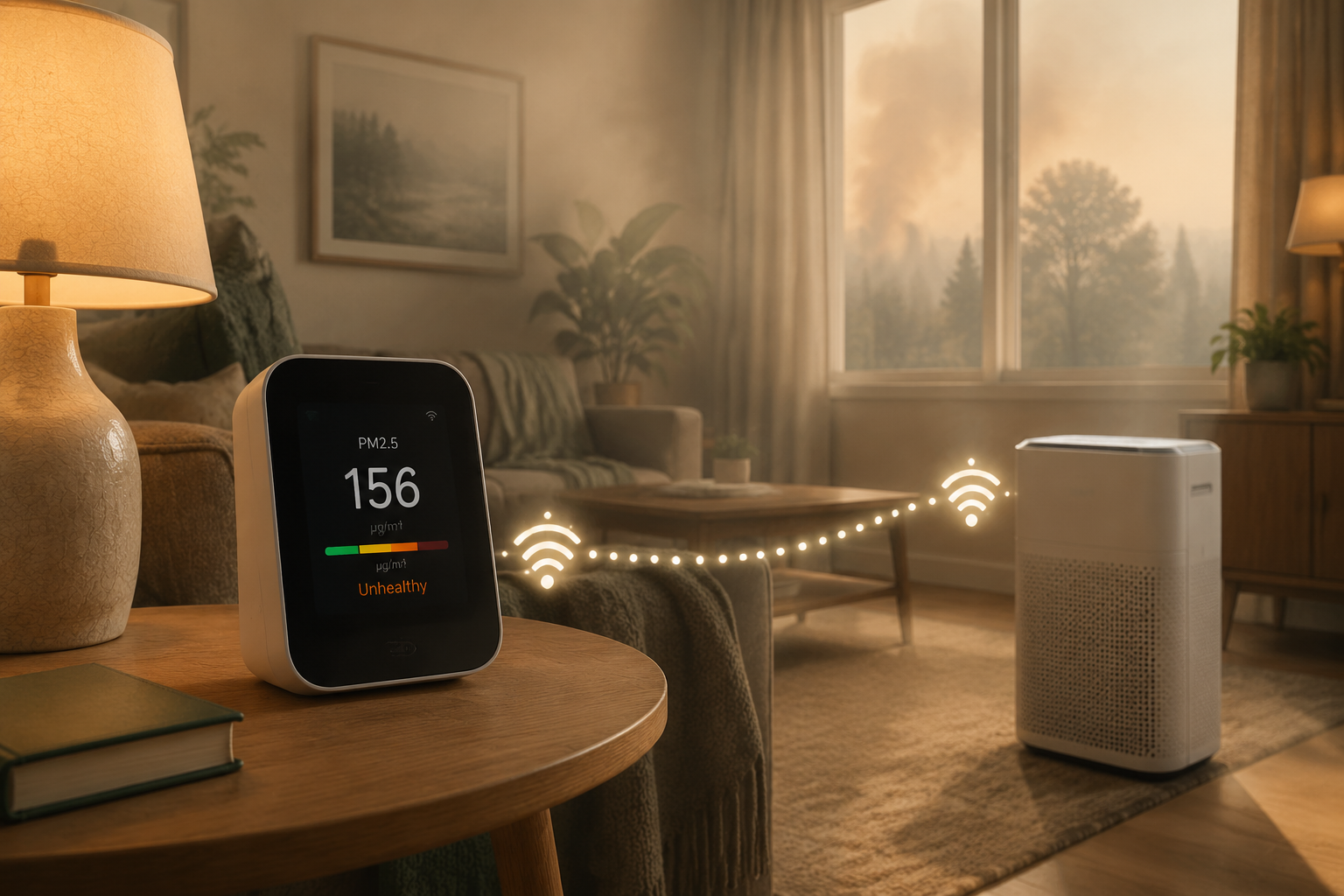
A smoke-ready setup has three moving parts: the monitor sees PM2.5 rising, the platform decides what to do, and the purifier or alert responds. If one of those links is missing, the system falls back into passive monitoring.
| Household setup | Best starting point | Why it fits | Main caveat |
|---|---|---|---|
| Alexa household or renter who wants the cheapest closed loop | Amazon Smart Air Quality Monitor + Alexa-compatible purifier or smart plug | Low-cost PM2.5 trigger inside Alexa routines | No display, no CO2 sensor, no data export |
| Home Assistant or Homey household | AirGradient ONE + smart purifier or smart plug | Flexible, data-visible, repairable path with native Home Assistant and Homey support | No native Alexa or Google Home support |
| Govee budget household | GoveeLife Smart Air Quality Monitor + Govee purifier | Simple same-brand automation at a low entry price | Less sensitive than stronger sensor-focused options |
| Google Home household | Qingping Pro Gen 2, after checking current compatibility | Potentially cleaner fit for Google-centered homes | Compatibility needs confirmation before purchase |
| Sensor/map enthusiast or mixed indoor-outdoor watcher | PurpleAir Zen | Dual Plantower sensors and crowdsourced map contribution | No native purifier pairing |
That table is the real shortlist. The right answer depends less on whether a monitor can make a nice graph and more on whether the signal can cross the room and turn on the purifier before someone notices the air changing.
Alexa: The Cheapest Practical Closed Loop
For many households, the Amazon Smart Air Quality Monitor is the least expensive way to make indoor smoke detection do something. At roughly $70 as of mid-2026, it can feed PM2.5 readings into Alexa routines, where a rising particle level can trigger a compatible purifier or a smart plug attached to a purifier.[1]
That matters because the device does not have to be impressive by itself to be useful. It has no display, no CO2 sensor, and no data export, so it is not the monitor to buy if you want a transparent local data archive. But if the goal is to make a bedroom purifier start automatically when PM2.5 rises, Alexa integration is the point, not a side feature.[1]
A renter can build the basic loop without rewiring anything: place the monitor in the occupied room, plug a HEPA purifier into an Alexa-compatible smart plug if the purifier itself is not smart, and create a routine that turns the purifier on when PM2.5 crosses the chosen threshold. The setup is not elegant in the power-user sense. It is the kind of cheap system that can be installed before the next smoke plume arrives.
The caveat is threshold discipline. If the routine fires too low, cooking, candles, or a badly placed monitor can make the purifier run constantly. If it fires too high, the loop waits too long. For platform-specific routine examples, see our companion guide to automating a smart home air quality monitor for wildfire smoke.
AirGradient ONE: The Flexible Choice If You Run Home Assistant
AirGradient ONE is the monitor to look at first if your home already runs through Home Assistant or Homey. Wirecutter named it a top pick in its September 2025 update, noting that it tracks PM1, PM2.5, PM10, and NOx, and that it works natively with Home Assistant and Homey.[2]
Its appeal is not just the spec list. AirGradient is the more open, data-visible route. In a smoke-season system, that means you can create automations that fit the actual house: turn on the bedroom purifier first, send a notification if the office rises while the door is closed, or use a smart plug with a purifier that does not belong to the same brand ecosystem.
The tradeoff is equally important: AirGradient ONE does not natively support Alexa or Google Home.[2] If you want a simple Alexa routine, do not buy it assuming the platform gap will magically close by smoke season. It belongs in homes where Home Assistant, Homey, or another bridging plan is already part of the system.
In return, you get the kind of monitor that can grow with the house instead of locking every decision to one purifier brand. For a household with asthma, older relatives, pets, or kids sleeping in different rooms, that flexibility is not hobbyist decoration. It lets the smoke response follow the rooms people actually occupy.
GoveeLife: A Simple Budget Pairing When You Stay Inside One Brand
The GoveeLife Smart Air Quality Monitor is the budget path for someone who wants a low-friction brand pairing rather than a home automation project. At roughly $40, it can pair directly with Govee air purifiers, and the monitor stores two years of data.[3]
This is not the setup to choose if you want the strongest sensor platform or the most flexible automations. Its case is simpler: a low-cost monitor and purifier from the same ecosystem can create a basic closed loop for under $150 total.[3]
That can be enough for a small apartment, spare bedroom, or work-from-home room where the purifier and monitor are in the same space. The less you expect it to coordinate a whole-house strategy, the more sense it makes.
Google Home: Check Qingping Compatibility Before You Build Around It
Google Home households have a narrower path. Qingping Pro Gen 2, at roughly $150, is the monitor to investigate first if you want a Google-centered smoke detection setup, but the compatibility check has to happen before purchase, not after the box is opened.[4]
The question is not simply whether the monitor can show PM2.5. It is whether the current app, region, firmware, and Google Home integration can expose the reading in a way that actually triggers the purifier or at least sends the right household alert. If the answer is unclear, treat that uncertainty as a system limitation.
PurpleAir Zen Is A Strong Sensor Choice, But Not A Native Purifier Controller
PurpleAir Zen belongs in a slightly different category. It uses dual Plantower PMS6003 laser sensors and connects to PurpleAir’s crowdsourced real-time map, which makes it attractive if you care about sensor redundancy, local smoke patterns, and contributing readings beyond your own household.[5]
During smoke events, AirGradient’s comparison of Plantower-based monitors and EPA correction formulas reports that AirGradient and PurpleAir devices can track within 15–20% of reference-grade equipment, with the important caveat that the EPA correction formulas were developed for outdoor use and may not transfer perfectly indoors.[5]
That makes PurpleAir Zen a good smoke watcher, but not the easiest smoke actor. It does not offer native purifier pairing or a native app in the same way a closed brand ecosystem does.[5] If your goal is to see smoke data clearly, it is compelling. If your goal is to make a HEPA purifier respond without another bridge, Alexa or Home Assistant paths are usually cleaner.
What The Sensor Needs To See
For wildfire smoke, the monitor needs PM2.5. Fine particles are the signal you are trying to catch indoors, so a device that measures only temperature, humidity, TVOC, or general comfort conditions is not a smoke-particle detector.
Most useful consumer monitors in this category use laser particle sensors, often Plantower-class sensors such as the PMS5003 or PMS6003. These are not laboratory instruments. Particle composition, humidity, airflow, calibration, and correction formulas can all affect the number on the screen. For household smoke response, the more practical question is whether the reading deteriorates quickly and consistently enough to start remediation.
Consumer Reports’ 2026 PM2.5 response testing is useful here because it measured how quickly monitors reacted when particle levels deteriorated. Its best monitors detected PM2.5 deterioration in under 30 seconds in a cigarette-smoke test, while some budget models, including IKEA Alpstuga, never reported unhealthy air even in dense smoke.[6]
That result should not be stretched too far. Cigarette smoke is not the same as wildfire smoke, and the test is better read as a relative response comparison than as a promise about every real smoke plume. Still, response time matters. A monitor that notices the room is getting worse while the purifier can still catch up is more useful than one that produces a cleaner-looking chart after the room has already been smoky for a while.
Do Not Mistake A Smoke Alarm Combo For A PM2.5 Monitor
The Kidde Smoke + CO + IAQ device deserves a short, firm warning because the name sounds close to what smoke-season buyers want. It is useful for fire safety and some indoor air quality signals, and it is described as a UL-listed combo device that merges smoke, carbon monoxide, and IAQ monitoring. But it does not include a PM2.5 sensor; its IAQ measurements cover TVOC, temperature, and humidity.[7][8]
That means it should not be relied on to detect particle-level wildfire smoke indoors. A fire alarm and a smoke-season PM2.5 monitor solve different problems, even if the product name makes the boundary easy to miss.
Placement Can Decide Whether The Automation Fires In Time
The monitor has to sample the air people are breathing. EPA siting guidance places air sensors at breathing height, roughly 3–5 feet above the floor, and away from distorted locations such as floors, windows, and other spots that do not represent occupied air.[9]
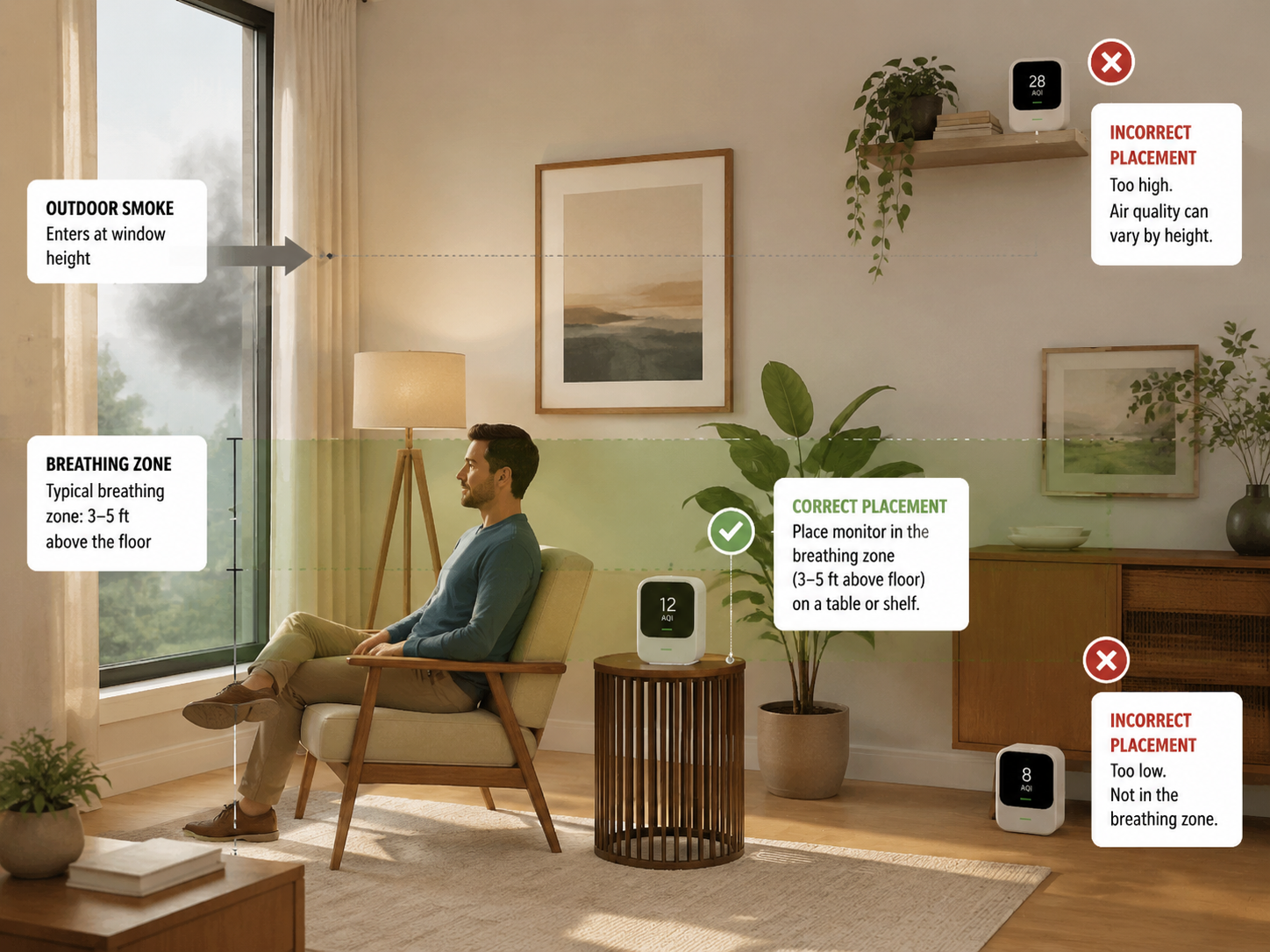
For smoke automation, placement is not just a measurement nicety. A monitor sitting decoratively on a high shelf may miss the breathing zone. A monitor on the floor may overreact to dust, pet activity, or airflow patterns that do not represent the room. A monitor beside a leaky window may be useful if that window is the infiltration point, but misleading if the purifier is protecting a sleeping area across the room.
Put the monitor where the consequence is real: the bedroom where someone sleeps through a smoke shift, the home office where the door stays closed, the living room where kids and pets spend the afternoon, or the room where an older relative sits near a purifier. If one monitor has to serve a whole apartment, favor the occupied central room over the prettiest shelf.
If the monitor keeps triggering at odd times, solve placement before blaming the sensor. Move it away from a window crack, humidifier, cooking path, candle, or purifier exhaust stream. For false triggers and smoke-event debugging, use our guide to what to do when your smart air quality monitor detects smoke.
Set The Threshold For Action, Not Anxiety
A closed-loop smoke setup should have an action threshold, not just a notification threshold. The difference is simple: an alert asks someone to make a decision; an automation starts the purifier while the person is making breakfast, sleeping, working, or trying to get a child back to bed.
For most homes, the first automation should be conservative and reversible: turn the purifier to a higher mode when PM2.5 rises, then step it back down only after the room has stayed better for a while. Avoid rules that switch a purifier on and off rapidly around one number. Smoke season is already irritating enough without adding relay chatter or fan cycling to the house.
The cleaner system is usually layered. The monitor turns on the purifier. A notification tells the household what happened. A separate broader plan may close windows, keep HVAC recirculation in mind, or move sensitive people to the cleanest room. For that whole-house view, see our companion guide to a four-layer smoke-ready smart home defense.
Which Monitor Should You Buy?
If you already use Alexa and want the cheapest practical closed-loop smoke response, start with the Amazon Smart Air Quality Monitor and an Alexa-compatible purifier or smart plug. Its limitations are real, but its integration is exactly what many renters and non-hobbyist households need.
If you run Home Assistant or Homey, prioritize AirGradient ONE. It is the better fit when you want visible data, flexible automations, and the ability to choose purifier hardware without staying inside one consumer brand’s app.
If you want the simplest low-budget same-brand loop, GoveeLife plus a Govee purifier is the practical route. If your home is centered on Google Home, investigate Qingping Pro Gen 2 only after confirming the current integration can expose PM2.5 in a useful way.
Choose PurpleAir Zen if sensor redundancy, map contribution, and smoke visibility matter more than native purifier control. It is a strong monitoring choice, but it should not be mistaken for the easiest automation choice.
If you only need a straight monitor ranking without building the full response loop, use our separate guide to which smart air quality monitor detects wildfire smoke best. For this job, though, the device name is only half the answer. The better smoke-season system is the one that sees PM2.5 in the room people occupy, sends that signal through a platform you actually use, and starts cleaning the air without waiting for another app check.
References
- Amazon Smart Air Quality Monitor Review, BreatheSafeAir
- The Best Home Air Quality Monitor, Wirecutter, September 2025 update
- GoveeLife Smart Air Quality Monitor review, HouseFresh
- Qingping Pro Gen 2 product information, Qingping
- AirGradient vs PurpleAir comparison, AirGradient
- Air Quality Monitor Ratings, Consumer Reports, 2026
- Kidde Smoke + Carbon Monoxide Alarm with Indoor Air Quality Monitor specifications, Kidde
- Kidde Smoke + CO Alarm with Indoor Air Quality Monitor review, TechHive
- Air Sensor Guidebook, U.S. Environmental Protection Agency
Reader Feedback
Share your purchase experience, flag outdated picks, or ask clarifying questions about the checklist items.
Comments
Join the discussion with an anonymous comment.