A useful smart home flood alarm starts before there is water on the floor. During a flash flood, the first signal may be a public warning on a phone, the second may be a sensor touching water at a door or basement wall, and the third has to be an automatic response that wakes people up and tells the house what to do next. If those pieces are treated as separate gadgets, they leave gaps. If they are built as one timeline, they can turn vague danger into earlier decisions.
That distinction matters because flash flooding is not just a property claim problem. The U.S. recorded 145 flood-related deaths in 2024, above the 25-year average of 85, and 2025 reporting on billion-dollar disasters counted at least 276 fatalities; the July 2025 Texas Hill Country flood, with more than 100 deaths reported at the time, is the kind of event that makes single-channel warning feel fragile rather than merely inconvenient.[1][2]
No leak detector in a laundry room can outrun a creek that rises fast enough to cut off a road. The job of smart home flood alarms is narrower and more realistic: add warning channels, detect local water entry within seconds, and reduce the delay between alarm and action.
The Timeline Your System Has to Cover
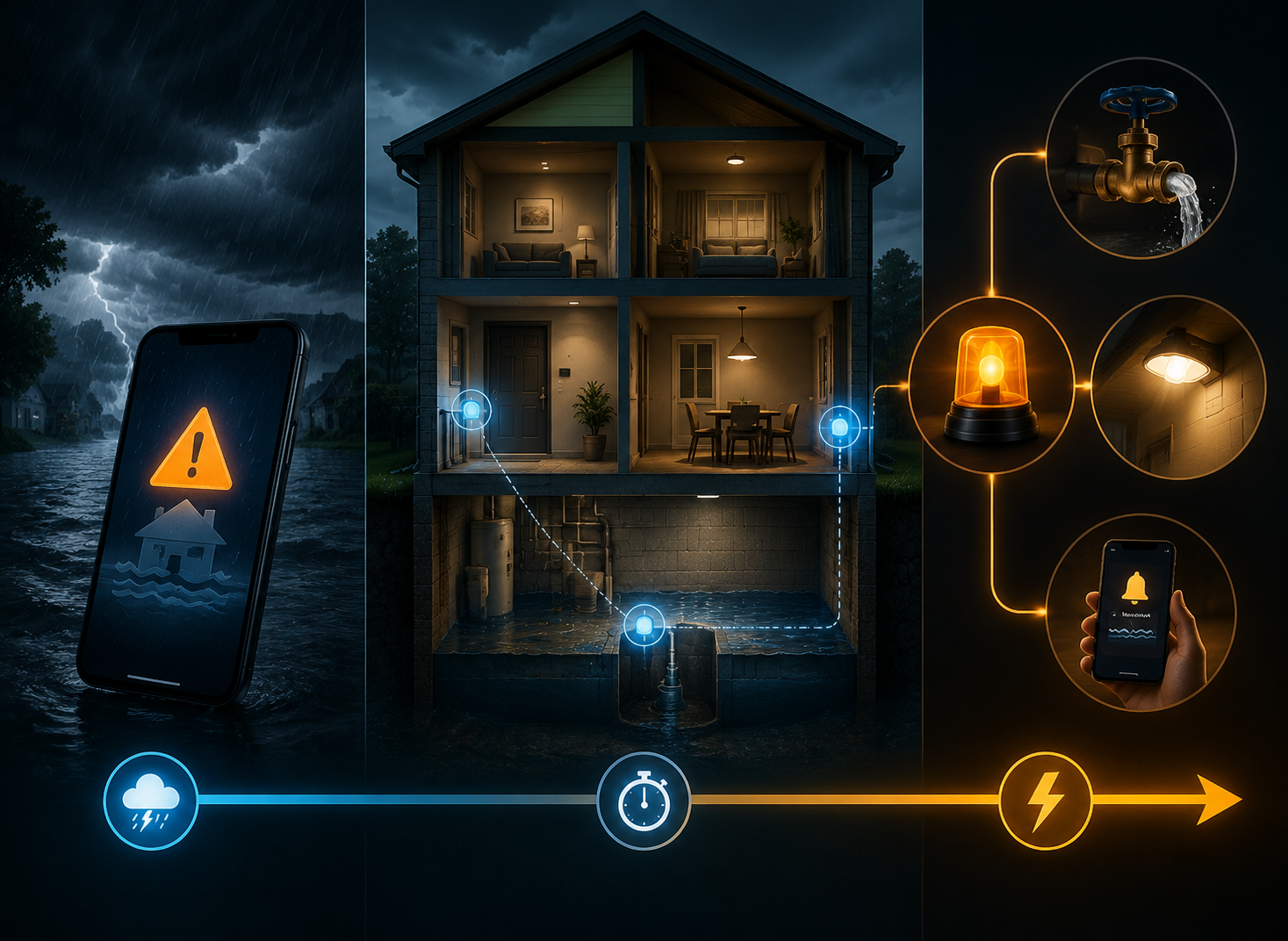
Think in three time windows, because each one asks the household to do something different.
| Layer | When It Helps | What It Should Trigger |
|---|---|---|
| NWS/NOAA warning integration | Hours to about an hour before local impact, depending on the event | Wake-up alerts, household check-in, evacuation review, car and utility decisions |
| In-room flood sensors | Seconds after water reaches a threshold, door, floor edge, sump area, or utility zone | Sirens, phone alerts, voice announcements, lighting, and escalation to neighbors |
| Automated response | Immediately after a warning or sensor event | Water shutoff where appropriate, pump checks, lights on, gates open, repeated notifications |
AEM’s early warning framework cites findings that 12 hours of flash flood notice can reduce damage by up to 60%, while even 1 hour can reduce damage by 20%; the same source says only 80% of North Americans who experienced a disaster in the previous 5 years received any warning, and it reports average benefit-to-cost ratios for flood early warning systems of 4.6:1, with some regions reaching 73:1.[3]
Those numbers do not prove a smart speaker announcement saves a life. They do show why the first layer should not be skipped just because it is not a shiny puck under the sink. Hours are for hard choices: whether to leave, whether to move a car, whether to wake children, whether to call the neighbor whose bedroom is downstairs. Seconds are for confirmation that water is no longer theoretical.
Layer 1: Put NWS and NOAA Alerts Into the House
Start with official alerts. Wireless Emergency Alerts on phones, NOAA weather radios, and National Weather Service alert feeds are the earliest layer most households can access without buying flood-specific hardware. In a smart home, the point is not to replace those channels. It is to make sure the warning is harder to miss at 2:13 a.m.
In Home Assistant, that may mean using an NWS integration or weather-alert feed to trigger a night mode response: turn on selected lights, announce the warning on speakers, send high-priority phone notifications, and display the alert on a dashboard. The same pattern appears in wildfire automation, where a National Weather Service red flag warning can trigger household readiness actions; the mechanics are different, but the design idea is similar: a public warning should move from “someone’s phone might buzz” to “the house changes state.” For a parallel setup pattern, see this red-flag warning smart home checklist.
This layer should be deliberately annoying only when the alert is severe enough to justify it. A flash flood watch might send a household notification and turn on an entryway lamp. A flash flood warning at night might announce through speakers, turn bedroom lights to a low but visible level, and send repeated alerts until someone acknowledges them. The setup should match the consequence, not the novelty of the automation.
- Keep Wireless Emergency Alerts enabled on every household phone, including phones normally kept on silent overnight.
- Add a NOAA weather radio with battery backup if your area has poor cell coverage or frequent power outages.
- Use smart home alerts as a supplement: speaker announcements, lights, push notifications, and dashboard warnings.
- Test the difference between watch, warning, and emergency behavior so the house does not panic everyone for low-priority rain.
Layer 2: Place Sensors Where Floodwater Enters, Not Just Where Plumbing Leaks
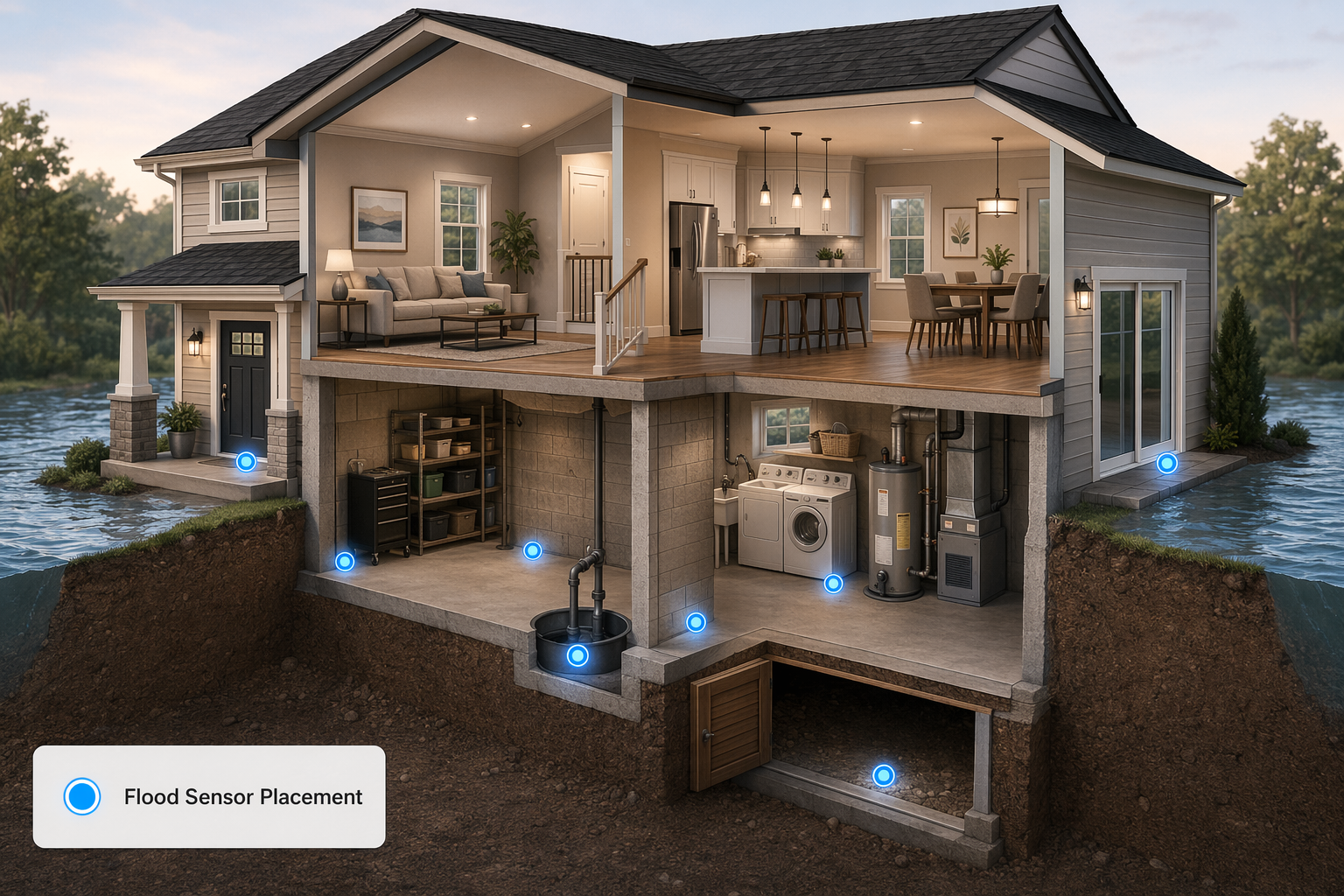
Most smart leak detector advice begins under a sink, beside a water heater, or behind a washing machine. Those are good spots for ordinary water damage. Flash flood placement is different. You are watching thresholds, low edges, floor drains, sump areas, and the first places outside water would cross into living space.
Product testing gives this layer its urgency. Current smart water leak detectors are commonly evaluated on whether they detect water within 1 to 5 seconds, and tested models from PCMag, Wirecutter, Reviewed, and CNET are framed around rapid local detection rather than long-range flood forecasting.[4][5][6][7]
A few device details matter because they change where the sensor can realistically go. PCMag names the First Alert L1, priced at $69.99, as a top pick and notes support for up to 500 feet of extension cable, which is useful when the puck can sit safely above the floor while the probe reaches a perimeter or sump area.[4] PCMag also identifies the Shelly Flood Gen4, priced at $39.99, as an affordable Matter-compatible option that works across major smart home platforms.[4] Flo by Moen is a different class of device: at $549, it monitors whole-home water use and supports automatic shutoff, which is more relevant to plumbing leaks and utility control than to stopping stormwater at a doorway.[4] Wirecutter’s tested D-Link SW-A11KT detected water in under 1 second and produced a 73 dB siren, a useful reminder that the alarm needs to be heard outside the room where water first appears.[5]
Do not buy five identical sensors first and decide later where they go. Walk the house in the order water would likely arrive.
- Ground-level doors: place probes or low-profile sensors just inside exterior doors, walkout basement doors, garage-to-house transitions, and patio entries.
- Basement perimeter: cover the lowest wall edges, especially near known seepage points, window wells, and stairwell drains.
- Sump pit and floor drain areas: monitor overflow risk, pump failure clues, and water that appears before it reaches finished space.
- Utility zones: keep conventional leak coverage near the water heater, softener, boiler, washer, and supply lines, because a storm is not the only way water arrives.
- Crawlspace access points: use extension probes where the sensor body needs to remain reachable for batteries, pairing, and alarm testing.
What the Sensor Has to Do at 2:13 a.m.
A basement sensor that sends one quiet push notification is not enough if everyone sleeps upstairs. For flash flood use, the local alarm should have at least two routes out of the room: an audible siren or speaker announcement inside the home, and a mobile notification that can reach someone away from home. If a sensor depends on a hub, confirm what happens when the internet is down but the local network still runs. If it depends on cloud service, assume the message may be slower or unavailable during a regional outage.
This is where the cheaper sensor is not always the cheaper system. A device with a loud local siren may cover an unfinished basement better than a quiet sensor with beautiful app screens. A probe with a long extension cable may solve a placement problem that three ordinary pucks cannot. Matter support may simplify mixed-platform homes, but only if the automation you need is actually exposed to your hub.
Layer 3: Automate the Response, Not the Judgment
The automation layer is where a flood alarm stops being a notification and becomes a drill. It should not decide whether it is safe to stay. It should reduce the number of manual steps between detection and the person who has to act.
FLASH, the Federal Alliance for Safe Homes, recommends smart flood sensors, automated shutoff valves, and weather-alert systems as part of a broader flood protection strategy.[8] That combination is useful, but only when each automation has a defined purpose. A water shutoff valve can limit damage from a burst pipe or failed appliance. It will not stop creek water from entering a walkout basement. Smart lights can expose a safe path through the house. They do not make a flooded road passable.
Build the first automation around human attention:
- If an NWS flash flood warning is issued overnight, turn on bedroom lamps at a low brightness, announce the warning on speakers, and send critical phone notifications.
- If a ground-level door sensor detects water, turn on exit-path lighting, sound an indoor siren, and notify every adult in the household.
- If a basement perimeter sensor detects water, announce the exact zone, because “basement water” is too vague when someone is half-awake.
- If a utility-zone sensor detects water, close the smart water shutoff valve if one is installed and safe to use for that plumbing setup.
- If no one acknowledges the alert, escalate to a second channel such as SMS, email, or a trusted neighbor notification.
For specific cross-platform recipes, including leak detector actions that chain alerts to shutoffs, power cuts, and voice announcements, use these smart leak detector automation ideas as the build sheet after placement is finished.
Use Different Responses for Outside Water and Plumbing Water
A shutoff valve is one of the best smart home water-damage devices, but it is often misunderstood in flood planning. If the washing machine hose bursts, shutting off the main supply can stop the source. If stormwater crosses the threshold, the house water main is not the source. The automation should still alert, light the route, and log the sensor location, but the shutoff is not the hero of that scene.
This distinction also helps avoid nuisance logic. A sump pit sensor might mean the pump is overwhelmed, the discharge is blocked, or groundwater is rising. A door-threshold sensor during an active warning means water is already entering at an occupied boundary. Both deserve attention; they do not deserve identical automations.
| Trigger | Likely Meaning | Best First Automation |
|---|---|---|
| NWS flash flood warning | Regional danger is active or imminent | Wake household, show alert, review evacuation plan |
| Exterior door or walkout threshold detects water | Water has reached an entry point | Sound siren, turn on exit lights, send urgent location-specific alerts |
| Basement perimeter sensor detects water | Seepage or rising interior water has begun | Announce zone, turn on basement lights, escalate if multiple sensors trip |
| Sump pit or floor drain sensor detects water | Pump, drainage, or groundwater issue may be developing | Notify, check pump status, avoid assuming the event is contained |
| Water heater, washer, or supply-line sensor detects water | Plumbing leak is possible | Close smart shutoff valve and notify household |
Room-by-Room Placement Beats a Bigger Dashboard
A dashboard that says every sensor is online is satisfying until the first alarm names a room too broadly. Labels matter. “Basement north door” is better than “Leak Sensor 3.” “Sump pit probe” is better than “Utility.” During a flash flood, the label is part of the instruction.
For a two-story home with a basement, the practical starting layout is usually one sensor or probe at each water-entry boundary, one at the sump or lowest drain point, and one in each high-risk utility area. Homes on slabs may need more attention at exterior doors, garage transitions, and low mechanical closets. Homes with crawlspaces need reachable sensors, because a battery alert from a device nobody wants to crawl to replace will be ignored eventually.
Renters can still build a useful version without shutoff valves or permanent mounting. Use battery-powered sensors, adhesive placement where appropriate, hub-free devices if the lease or network setup makes hubs impractical, and automations that focus on alerts and lights rather than plumbing modifications. For broader no-drill automation constraints, a renter-friendly smart home automation guide can help keep the setup reversible.
Escalate Only When the Pattern Gets Worse
One sensor at a sump pit during heavy rain may be a maintenance alert. Two perimeter sensors plus an active flash flood warning is a different pattern. If your platform supports conditions, use them. A single low-priority alert can become a household-wide siren when the weather warning is active, when multiple sensors trip, or when a sensor at an exterior threshold detects water.
Keep the rules legible. The person responding should not need to understand your entire automation graph. A good alert says where, what changed, and what to do next: “Water detected at basement walkout door. Flash flood warning active. Check evacuation route now.”
Power, Wi-Fi, and Alarm Paths Need Their Own Test
Flood weather is exactly when power, broadband, and cell networks become less trustworthy. A sensor that depends on cloud service may still be fine for everyday plumbing leaks. For flash flood use, you should know which parts keep working if the internet drops, which devices have local sirens, which hubs run automations locally, and which alerts need outside connectivity.
Battery-powered sensors help at the edge of the system, but the hub, router, modem, siren, and smart speakers may still need backup power if they are part of the alarm path. If your area also plans for hurricanes, the same resilience questions apply: which devices keep working when power and Wi-Fi are degraded, and which automations are only nice when the grid is calm. This hurricane-preparedness smart home device guide is useful for thinking through backup power and offline-capable categories.
Test the system in an inconvenient but safe way. Put a damp cloth on the probe, stand in the bedroom with the door closed, and see what happens. Does the siren carry? Does the phone alert bypass sleep mode? Does the speaker say the room name? Does the light scene help or blind someone? Does the shutoff valve close only for the plumbing sensors that should trigger it?
What Smart Home Flood Alarms Can and Cannot Promise
A 2022 Frontiers in Climate study on flash flood early warning systems examined effectiveness in a domain where warning lead time, communication, and response capacity all matter; that is the right frame for home automation too.[9] The alert is only useful if someone receives it, understands it, and has a safer action available.
So keep the promise disciplined. NWS and NOAA alerts can buy hours when warnings arrive early enough and reach the household. In-room sensors can confirm water entry in seconds. Automations can wake people, light paths, close valves for plumbing events, and escalate notifications. They cannot guarantee evacuation time, make a flooded basement safe to inspect, or substitute for official orders.
Before calling the system done, verify five things: official warning coverage, sensor placement at actual water-entry points, notification paths that wake the right people, power and network assumptions, and a household rule that evacuation judgment outranks the dashboard. That is the standard that matters when the first inch of water is no longer hypothetical.
References
- Flood deaths are rising in the U.S., Washington Post, 2025-07-08,
- U.S. number of flood deaths 2024, Statista,
- A Framework for Developing Effective Flood Early Warning Systems, AEM,
- The Best Smart Water Leak Detectors for 2026, PCMag,
- The 3 Best Smart Water-Leak Detectors of 2026, Wirecutter/NYT,
- 7 Best Smart Water Leak Detectors of 2026, Reviewed,
- The Best Leak Detectors of 2026, CNET,
- Protect Your Home from Flood, FLASH,
- Assessing Flood Early Warning Systems for Flash Floods, Frontiers in Climate, 2022,
Community Tips
Share platform-specific variations, steps that have changed after app updates, or tips that helped your installation succeed.
Comments
Join the discussion with an anonymous comment.