
Automate Your Blinds to Keep Your Home Cool Without AC
Learn how to automate your motorized blinds to track the sun and block solar heat gain per façade, keeping your home up to 7°C cooler during a heat wave without running the air conditioner.
At 10 a.m., the east rooms are the problem. By 2 p.m., they are comfortable again, but the south-facing glass is carrying the load. At 5 p.m., the west side is doing its usual late-day performance: bright, pretty, and absolutely determined to turn the room into a storage heater.
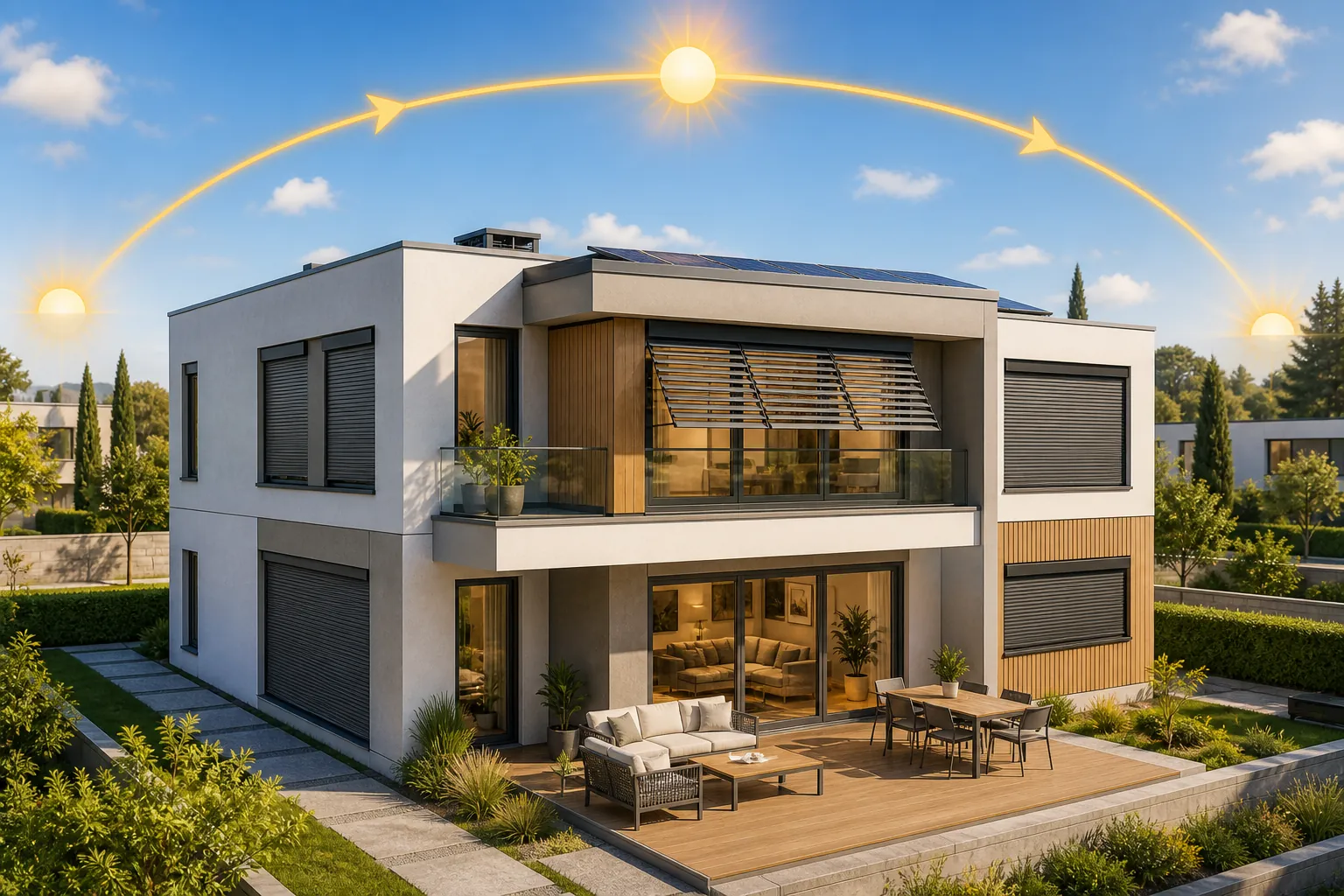
A fixed blind schedule handles that badly. Closing every shade from breakfast to dinner keeps heat out, but it also turns the house into a cave and blocks daylight from windows that are no longer in direct sun. The better version is narrower: during heat-wave conditions, close or tilt only the blinds on the façade currently receiving direct solar load, then reopen them after the sun has moved on.
That makes sun-tracking blinds one of the more useful smart-home ways to stay cool without AC during a heat wave. The automation does not cool the air directly. It reduces the heat entering through the glass before fans, thermostats, or air conditioners have to deal with it.
The Automation In One Pass
The recipe has four moving parts:
- Create a heat-wave binary sensor so the blinds do not run this routine on mild or cold days.
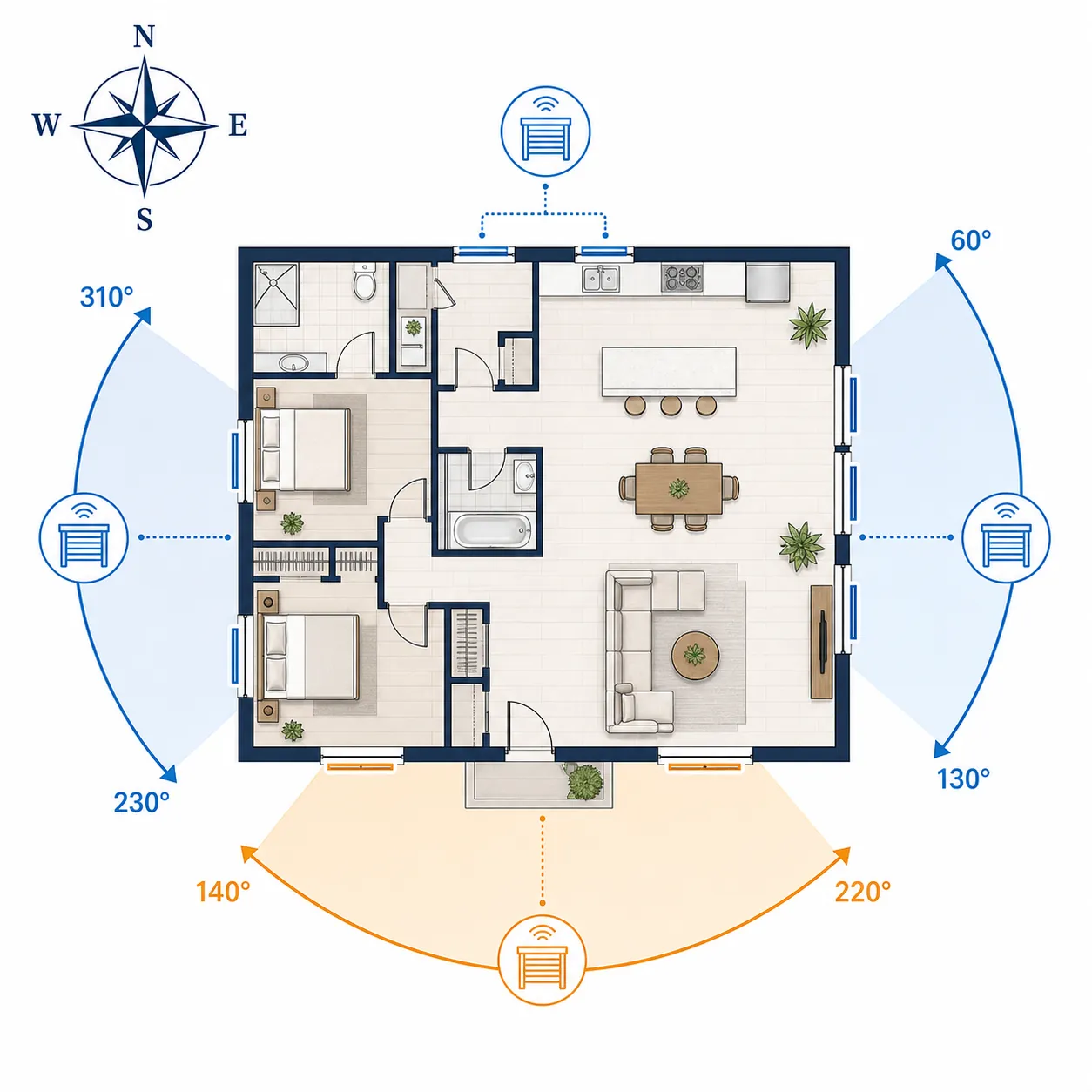
- Group your motorized blinds by façade: east, south, and west for a typical Northern Hemisphere home.
- Use Home Assistant’s built-in
sun.sunentity to read the sun’s azimuth. - Close or tilt each blind group only while the sun is in that façade’s azimuth range.
The useful ranges for a Northern Hemisphere setup are east at 60–130 degrees, south at 140–220 degrees, and west at 230–310 degrees, matching a published Home Assistant shutter automation pattern that uses azimuth thresholds for each façade.[1]
| Façade | Approximate sun position | Azimuth range | Typical behavior |
|---|---|---|---|
| East | Morning sun | 60–130° | Close or tilt after sunrise once the east glass starts receiving direct sun. |
| South | Late morning to afternoon sun | 140–220° | Shade the highest-load midday windows without closing the whole house. |
| West | Afternoon and evening sun | 230–310° | Block the late-day heat that often lingers into bedtime. |
If you are in the Southern Hemisphere, do not copy the south-facing assumption blindly. The sun’s midday path favors the north side instead, so the same idea applies but the façade mapping needs to be mirrored.
Why Use Azimuth Instead Of Outdoor Light Sensors
Outdoor light sensors look tempting until a cloudy day, a shaded sensor, or a bad mounting position makes them lie. For this job, Home Assistant already knows the important thing: where the sun is in the sky. The sun.sun entity exposes azimuth as an angle around the horizon. That angle tells you which side of the house is taking direct sun, even before the room temperature starts climbing.
This is the difference between reacting to a hot room and preventing some of the heat from entering. The automation does not need to know whether the living room is already uncomfortable. It only needs to know that the west windows are about to be hit for the next few hours and that the day is hot enough for shading to be worth the daylight tradeoff.
Create A Heat-Wave Mode First
The gate matters. Without it, the automation becomes annoying in spring, counterproductive in winter, and hard to trust. A heat-wave binary sensor lets the same azimuth logic run only when indoor or outdoor conditions justify blocking passive solar gain.
One published pattern uses a Home Assistant template binary sensor that turns on when indoor temperature is at least 26°C or outdoor temperature is at least 30°C.[1] Treat those as starting thresholds, not universal comfort law. A well-insulated house may need different numbers from a drafty rental with west-facing glass.
template:
  - binary_sensor:
      - name: Heatwave Mode
        unique_id: heatwave_mode
        state: >
          {{ states('sensor.indoor_temperature') | float(0) >= 26
             or states('sensor.outdoor_temperature') | float(0) >= 30 }}
        device_class: heat
Use whatever temperature entities are reliable in your setup. If your outdoor sensor sits in direct sun, it may exaggerate the condition. If your indoor sensor is in a cool hallway, it may miss the room you are actually trying to protect. The gate should represent the home’s cooling problem, not just whichever sensor was easiest to install.
Map Your Blinds By Façade
Before writing automations, name the windows by orientation. “Kitchen blind” is useful for daily control, but “east blinds” is what the sun-tracking recipe needs. A room with two exposed sides may belong to two groups, or it may need separate automations for each covering.
This recipe works with most Home Assistant-controlled motorized coverings: retrofit tilt motors such as SwitchBot Blind Tilt, roller shades such as IKEA FYRTUR, custom shades from SmartWings or Serena, Somfy systems, or similar covers. The price spread is wide. CNET’s 2026 smart blind buying guide lists examples from roughly $70 for a SwitchBot Blind Tilt retrofit to around $150 for IKEA FYRTUR, about $370 for SmartWings custom options, and $500-plus for Serena products.[2] The automation logic does not care which brand moves the slats, as long as Home Assistant can call a cover service.
group:
  east_blinds:
    name: East Blinds
    entities:
      - cover.office_blind
      - cover.kitchen_blind

  south_blinds:
    name: South Blinds
    entities:
      - cover.living_room_left_shade
      - cover.living_room_right_shade

  west_blinds:
    name: West Blinds
    entities:
      - cover.bedroom_blind
      - cover.den_blind
You can also skip Home Assistant groups and target a list of cover entities directly in each automation. Groups are just easier to maintain when you replace a blind, add a second shade, or split a room into separate zones.
Automate The East Side For Morning Sun
East-facing glass is the first to heat up. It usually does not need to stay shaded all day; once the sun has moved past, those blinds can reopen and give the room back its daylight. That is the point of using 60–130 degrees instead of a fixed “close until noon” schedule.
automation:
  - alias: Heatwave - Shade East Blinds By Sun Azimuth
    id: heatwave_shade_east_blinds_by_sun_azimuth
    mode: single
    trigger:
      - platform: numeric_state
        entity_id: sun.sun
        attribute: azimuth
        above: 60
        below: 130
    condition:
      - condition: state
        entity_id: binary_sensor.heatwave_mode
        state: "on"
    action:
      - service: cover.set_cover_position
        target:
          entity_id:
            - cover.office_blind
            - cover.kitchen_blind
        data:
          position: 20
For roller shades, position: 20 usually means mostly closed. For tilt-only blinds, your integration may use a different service or tilt position. The target is not darkness; it is interrupting direct beam sun while leaving enough daylight to make the room usable.
  - alias: Heatwave - Reopen East Blinds After Morning Sun
    id: heatwave_reopen_east_blinds_after_morning_sun
    mode: single
    trigger:
      - platform: numeric_state
        entity_id: sun.sun
        attribute: azimuth
        above: 130
    condition:
      - condition: state
        entity_id: binary_sensor.heatwave_mode
        state: "on"
    action:
      - service: cover.set_cover_position
        target:
          entity_id:
            - cover.office_blind
            - cover.kitchen_blind
        data:
          position: 80
Give The South Side Its Own Midday Window
In a Northern Hemisphere home, the south façade gets the strongest midday exposure. The 140–220 degree range is deliberately broad because the problem is not a single instant at solar noon. It is the long stretch where the sun is high enough and aligned enough to pour heat through large windows, patio doors, and skylight-adjacent rooms.
  - alias: Heatwave - Shade South Blinds By Sun Azimuth
    id: heatwave_shade_south_blinds_by_sun_azimuth
    mode: single
    trigger:
      - platform: numeric_state
        entity_id: sun.sun
        attribute: azimuth
        above: 140
        below: 220
    condition:
      - condition: state
        entity_id: binary_sensor.heatwave_mode
        state: "on"
    action:
      - service: cover.set_cover_position
        target:
          entity_id:
            - cover.living_room_left_shade
            - cover.living_room_right_shade
        data:
          position: 25
South shading is where partial positions often make sense. A full blackout may be unnecessary if an overhang, balcony, or exterior tree already blocks the highest summer sun. Start conservative, then watch the actual floor and wall. If the sun patch still lands deep in the room, lower the shade further or widen the azimuth range.
  - alias: Heatwave - Reopen South Blinds After Midday Sun
    id: heatwave_reopen_south_blinds_after_midday_sun
    mode: single
    trigger:
      - platform: numeric_state
        entity_id: sun.sun
        attribute: azimuth
        above: 220
    condition:
      - condition: state
        entity_id: binary_sensor.heatwave_mode
        state: "on"
    action:
      - service: cover.set_cover_position
        target:
          entity_id:
            - cover.living_room_left_shade
            - cover.living_room_right_shade
        data:
          position: 80
Treat West Windows As The Late-Day Priority
West-facing windows are where a lot of otherwise sensible cooling plans fail. The room may be fine at lunch, so nothing happens. Then the low afternoon sun arrives, the glass keeps admitting heat, and the bedroom or den is still warm hours later.
The 230–310 degree range catches that late-day arc. It is also the range most likely to need adjustment in real homes, because west façades are often affected by fences, neighboring buildings, trees, or a garage wing that blocks part of the evening sun.
  - alias: Heatwave - Shade West Blinds By Sun Azimuth
    id: heatwave_shade_west_blinds_by_sun_azimuth
    mode: single
    trigger:
      - platform: numeric_state
        entity_id: sun.sun
        attribute: azimuth
        above: 230
        below: 310
    condition:
      - condition: state
        entity_id: binary_sensor.heatwave_mode
        state: "on"
    action:
      - service: cover.set_cover_position
        target:
          entity_id:
            - cover.bedroom_blind
            - cover.den_blind
        data:
          position: 10
For west windows, I would rather start too shaded and back off later than discover at bedtime that the automation politely preserved the view while storing heat in the room. This is especially true for bedrooms, where the consequence shows up when the outdoor air is finally pleasant but the room is still radiating the afternoon.
  - alias: Heatwave - Reopen West Blinds After Evening Sun
    id: heatwave_reopen_west_blinds_after_evening_sun
    mode: single
    trigger:
      - platform: numeric_state
        entity_id: sun.sun
        attribute: azimuth
        above: 310
    condition:
      - condition: state
        entity_id: binary_sensor.heatwave_mode
        state: "on"
    action:
      - service: cover.set_cover_position
        target:
          entity_id:
            - cover.bedroom_blind
            - cover.den_blind
        data:
          position: 80
Make The Automations Less Brittle
Numeric-state triggers fire when the azimuth crosses into or past a range. That is enough for many homes, but it can miss the desired state if Home Assistant restarts after the crossing has already happened. A simple time-pattern trigger makes the automation re-check the sun position throughout the day.
  - alias: Heatwave - Maintain West Blind Position
    id: heatwave_maintain_west_blind_position
    mode: single
    trigger:
      - platform: time_pattern
        minutes: "/15"
    condition:
      - condition: state
        entity_id: binary_sensor.heatwave_mode
        state: "on"
      - condition: template
        value_template: >
          {{ 230 <= state_attr('sun.sun', 'azimuth') | float(0) <= 310 }}
    action:
      - service: cover.set_cover_position
        target:
          entity_id:
            - cover.bedroom_blind
            - cover.den_blind
        data:
          position: 10
You do not have to use both styles everywhere. For a first build, the crossing automations are easier to read. For a room that really matters during a heat wave, a periodic “maintain” automation is more forgiving.
Why This Can Make A Noticeable Difference
Windows are a large cooling liability because sunlight that passes through glass becomes indoor heat. A typical solar heat gain coefficient for standard clear double-pane glass is about 0.76, meaning roughly 76% of incident solar radiation is admitted as heat.[3] Low-E, tinted, shaded, or exterior-protected glass can be much better than that, so do not treat 76% as your exact window performance.
Somfy’s 2024 article gives an order-of-magnitude figure of 500W of heat per square meter of window directly exposed to sun, and reports automated shading reductions of 4°C to 7°C indoors, along with up to 70% lower air-conditioning energy use in the cited scenarios.[4] Those are manufacturer-commissioned figures, including older building-federation work and Somfy/Carbone 4 simulations, so they are best read as directional estimates rather than guaranteed results for your house.
Still, the physics behind the automation is not exotic. If a west window is admitting heat at 4 p.m., blocking the sun before it reaches the room is easier than removing that heat later. Even a modest internal blind can reduce the direct solar hit on floors, furniture, and occupants. Exterior shutters, awnings, and reflective exterior shading usually do better because they stop more of the energy before it crosses the glass.
Where Results Change
This automation is high leverage, but it is not magic cooling. It changes the solar load; it does not change outdoor temperature, humidity, insulation, air leakage, or the thermal mass already inside the home.
- Low-E or tinted windows may already admit less solar heat, so the blind automation may feel less dramatic.
- Internal blinds help comfort, but exterior shutters, awnings, and exterior shades usually block heat earlier.
- Dark blind materials can absorb heat; reflective or light-colored materials usually behave better in direct sun.
- Trees, balconies, nearby buildings, and roof overhangs can shift the useful azimuth range for a specific window.
- If the outdoor temperature stays above the indoor temperature all night, shading alone will not flush the stored heat back out.
When nights cool down enough, pair shading with a nighttime fan routine such as Smart Fan Automation to Cool a Bedroom Without AC. Shading reduces the heat you take on during the day; ventilation or fan-assisted free cooling helps remove heat once outdoor air is useful again.
Calibrate It On One Sunny Day
After the YAML is in place, do not judge it from the dashboard. Walk the rooms on a sunny day and look at where the sun actually lands. The best calibration tool is still a patch of sunlight moving across the floor.
- Start with the east group and confirm the blinds close after direct morning sun reaches the glass.
- Check the south group near midday and decide whether partial closure is enough.
- Watch the west group late in the day; this is where small threshold changes often matter most.
- Adjust each façade by 10–20 degrees if shading, trees, or neighboring buildings shift the real exposure.
- Change the heat-wave sensor thresholds if the blinds are either too eager or too reluctant to enter summer mode.
For households with elderly people, infants, pets, or anyone who may not notice heat stress early, shading should be only one layer. Add alerting and fail-safe checks with Set Up Heat Safety Automations for Elderly, Infants, and Pets. The blinds can reduce the load, but people still need warning when rooms become unsafe.
References
- Heatwave and home automation: turn Home Assistant into a heat shield, Maison et Domotique.
- Best Smart Blinds for 2026, CNET.
- Smart Home Tricks to Keep Your Home Cooler, Evapolar.
- Automated sun protection: how to keep your home cooler during heatwaves, Somfy, 2024-05-17.