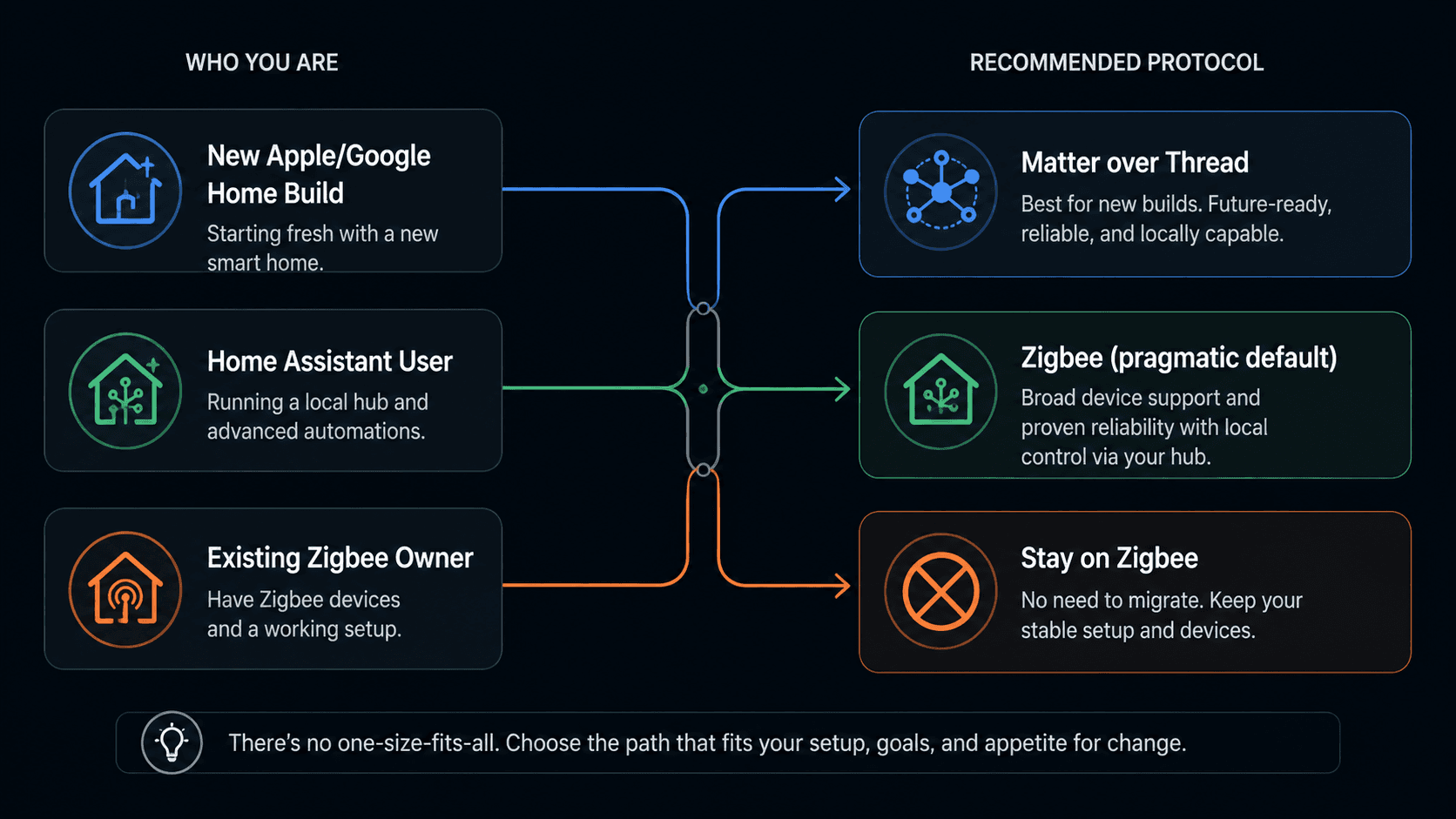
If you are choosing a protocol for a Matter smart home in 2026, the useful answer is not “Matter wins” or “Zigbee is dead.” It depends on what you already own and who has to live with the network after the first exciting weekend of pairing devices.
For a clean Apple Home or Google Home build, start with Matter over Thread where the device category is well supported. For a Home Assistant-heavy house, Zigbee is still the pragmatic default. If you already have a healthy Zigbee installation, do not migrate just to feel current. That is the short version, and it saves a lot of unnecessary sensor replacement.
| Your situation | Best default choice in 2026 | Why |
|---|---|---|
| New Apple Home or Google Home build | Matter over Thread | QR pairing, ecosystem portability, and lower Thread latency matter more when you have no legacy mesh to protect. |
| Existing Zigbee home | Stay on Zigbee | The device ecosystem is deeper, many devices are proven, and migration can weaken the network you already made reliable. |
| Home Assistant power user | Zigbee first, Matter selectively | Zigbee still offers broad device choice and mature local behavior; Matter is useful where cross-platform control is the goal. |
| Large property or difficult range problem | Consider Z-Wave or Z-Wave LR | It can be the better reliability tool for specific range and scale needs, even if it is not the default Apple or Google path. |
The fast protocol map, without the ceremony
Matter is not a radio. It is an application-layer standard meant to let devices work across ecosystems such as Apple Home, Google Home, Amazon Alexa, SmartThings, and others. A Matter device may connect over Thread, Wi-Fi, or Ethernet. Thread is the low-power mesh radio most people mean when they talk about battery-powered Matter sensors.
Zigbee is an older low-power mesh protocol with a large installed base, especially in sensors, buttons, plugs, bulbs, and lighting systems. Z-Wave is another mature mesh protocol, usually prized for range, reliability, and lower congestion rather than for broad consumer ecosystem branding. If you are still sorting out what the controller actually does, the hub side is worth separating from the protocol choice; this smart home hub guide is the better place to start.
The mistake is treating Matter as if it automatically replaces Zigbee. In practice, Matter changes setup, ecosystem portability, and controller expectations before it changes the ownership math for every sensor, switch, and light in the house.
Why new Apple Home and Google Home builds should lean Matter over Thread
Starting from zero is the one case where Matter over Thread has the cleanest argument. You are not protecting an existing Zigbee mesh. You are not trying to preserve a drawer full of paired buttons. You mostly want devices that can be added by QR code, shared across platforms, and moved between ecosystems without rebuilding the house around one vendor’s hub.
That portability is not imaginary. It is the real reason Matter exists, and for ordinary Apple Home or Google Home households it can be more valuable than having the absolute deepest catalog on day one. A door sensor that can be commissioned into the preferred phone ecosystem without hunting for a brand-specific bridge solves a problem Zigbee never tried to solve for mainstream users. For readers who want the standard itself unpacked before buying hardware, the Matter protocol explainer covers the layers in more detail.
Thread also has a responsiveness case. For supported device types, lower latency over Thread can make a fresh Matter build feel clean and modern, particularly when the controller, border router, and device firmware are all behaving. That last condition matters. A Matter badge does not guarantee that every platform exposes every feature the same way, and version support is still uneven in mid-2026.
The platform gap is not small print. As of mid-2026, SmartThings was at Matter 1.5, while Apple, Google, and Amazon were still listed at Matter 1.2, with Apple carrying selected 1.4 features. That means buying a device because “Matter supports it” can still leave you waiting for your chosen ecosystem to expose the feature you expected.
So the clean-build recommendation is conditional: choose Matter over Thread when your main controller ecosystem already supports the device class and feature set you plan to use. If you are building around Apple Home or Google Home and buying common categories such as plugs, switches, sensors, and compatible lighting, Matter is the better long-term starting lane. If you are buying niche sensors or advanced lighting behavior, check the exact platform support first.
Existing Zigbee owners should not migrate for its own sake
A working Zigbee network is not technical debt just because a newer logo exists. It is infrastructure. It has routers, routes, known weak spots, known strong spots, and usually a few devices that took too long to pair the first time. Replacing it should require a practical gain, not a mood.
The product catalog alone makes migration hard to justify. Zigbee had more than 3,500 certified products compared with roughly 1,000 Matter-certified products in mid-2026, with the Matter count drawn from certification databases and maintained lists rather than a guarantee that every product is easily available at retail.[1]
That gap shows up most painfully in the boring categories: tiny sensors, odd switches, remotes, leak detectors, contact sensors, and devices people buy in multiples. A protocol decision is not only about whether the best device exists. It is about whether the tenth device exists at the right price, with sane battery behavior, and without needing a firmware update ritual before it becomes dependable.
Battery life is one of the places where the new path can still cost more than it saves. The Aqara FP300 presence sensor is cited at about two years of battery life on Thread versus about three years on Zigbee, with the important caveat that these are manufacturer-stated figures and real homes vary with network quality, firmware, and polling behavior.[1]
That is not a reason to reject every Thread sensor. It is a reason to stop pretending the newer stack automatically improves ownership. A one-year difference on a device mounted high in a hallway or tucked into a room corner is not an abstract spec; it is the difference between ignoring the system and getting the ladder out sooner.
Lighting is another place where mature Zigbee systems still earn their keep. Matter group lighting can show a visible stagger—the familiar “popcorn effect”—while native Zigbee lighting systems such as Philips Hue can activate groups simultaneously.[1] If your hallway lights fire one after another, everyone in the house sees the protocol decision, even if nobody knows what protocol means.
The hidden migration cost is mesh density. Zigbee and Thread are both low-power mesh networks, but they do not strengthen each other. If half your always-powered plugs and bulbs remain Zigbee routers while the new half become Thread routers, you may have created two thinner meshes instead of one stronger one. A split network can be fine if both meshes are intentionally built, but accidental half-migration is where good houses become annoying houses.
If your Zigbee system is unstable, fix the Zigbee system before calling it obsolete. Router placement, channel interference, weak repeaters, and coordinator issues are more likely than a philosophical failure of the protocol. The practical next stop is a Zigbee hub troubleshooting workflow, not a cart full of replacement sensors.
Home Assistant users should be selective, not sentimental
Home Assistant changes the recommendation because it changes who is responsible for the last five percent. Apple Home and Google Home users can reasonably value a smoother cross-platform setup more than maximum device depth. A Home Assistant user is often choosing the coordinator, watching routes, reading logs, and deciding whether a sleepy sensor is misbehaving or merely conserving power.
In that environment, Zigbee’s age is an advantage. There are many devices, many known quirks, and many community-tested combinations. A cheap contact sensor being boring is the point. A button that keeps working through controller changes is the point. A lighting group that behaves the same way next month is the point.
Matter still belongs in a Home Assistant build, but it should enter where it solves a specific problem: sharing devices with another ecosystem, standardizing a new category, or avoiding a proprietary bridge. It should not be the reason to replace a reliable Zigbee motion sensor with a Thread version that offers worse battery expectations or weaker mesh placement in your actual rooms.
Controller planning matters more with Matter than the marketing copy implies. You need to know where the Matter controller lives, where Thread border routers live, whether Multi-Admin is part of the plan, and how your chosen platform handles updates. If you are mapping that around Home Assistant, start with the Matter hubs and hardware guide for Home Assistant before buying devices in bulk.
What the 2026 updates actually change
The 2026 protocol landscape is genuinely more interesting than it was a few years ago, but not every update changes what you should buy this week.
Matter 1.5 expands the promise, unevenly
The addition of cameras in Matter 1.5 is important because cameras have long been one of the messier smart home categories. It does not mean every Apple, Google, Amazon, or Home Assistant user should immediately expect full camera support through Matter. The safer buying rule is to check the controller platform version, the device’s implemented Matter features, and whether the features you care about are actually exposed in your app.
Thread 1.4 fixes a real mesh problem, once platforms catch up
Thread 1.4’s credential sharing is aimed at a real annoyance: multiple Thread border routers creating parallel meshes instead of one shared network. That matters in houses with a mix of Apple, Google, Amazon, SmartThings, and other border-router hardware. As of April 2026, though, those harmonization benefits were still not fully deployed across all platforms, so some households will not see the clean version immediately.[2]
This is one of those upgrades that deserves patience. It can make Thread feel less fragile over time, but it does not retroactively make a half-built Thread mesh strong today, and it does not make Zigbee devices worse.
Zigbee 4.0 is encouraging, but SUZI is not a buying feature yet
Zigbee 4.0 was released in November 2025 and is fully backward compatible with Zigbee 3.0. Its sub-GHz SUZI path is expected to bring certification for long-range applications in late 2026, but that should be treated as near-term direction rather than something already sitting in shipping products on the shelf.[3]
Backward compatibility is the more useful fact for current owners. It means Zigbee’s future work does not require treating the installed base as disposable. That is exactly how a mature home protocol should behave.
Z-Wave LR deserves a specific job
Z-Wave should not be reduced to a footnote. Z-Wave LR’s announced 4,000-node capacity is a serious scale claim, and Z-Wave remains attractive for installations where range, low congestion, and predictable device behavior matter more than Apple Home or Google Home branding.[4]
That does not make it the default answer for most new Matter-curious households. It makes it the right tool when the problem is specific: outbuildings, long runs, difficult RF environments, large sensor counts, or a reliability-first build where the controller ecosystem supports the plan. If you need that tool, use it deliberately. If you do not, do not add a third protocol just because it sounds more professional.
The ownership test before you buy more devices
Before choosing a protocol, walk the decision through the house instead of through the spec sheet.
- If the device will be controlled mainly through Apple Home or Google Home, Matter support carries real value.
- If the device is one of many battery sensors in a Home Assistant build, Zigbee still deserves first look.
- If the device is part of a lighting group where staggered activation would be visible, test behavior before replacing a native Zigbee setup.
- If adding the device splits your routers between Zigbee and Thread, make sure both meshes will still have enough always-powered nodes.
- If the problem is range rather than ecosystem portability, evaluate Z-Wave instead of forcing Matter or Zigbee to solve the wrong problem.
A hypothetical example makes the mesh problem clear. Suppose a house has Zigbee plugs acting as routers throughout the downstairs rooms, then the owner replaces only the visible smart plugs with Thread versions while leaving distant Zigbee sensors in place. The result may be two networks that both look modern on paper and both have worse relay coverage than the original. No protocol failed there; the migration plan did.
The cleanest 2026 commitment rule is simple enough to survive a trip to the hardware store: build new Apple Home or Google Home systems around Matter over Thread where platform support is confirmed; keep and strengthen Zigbee if you already rely on it or use Home Assistant heavily; consider Z-Wave for specific range and reliability jobs; avoid migration unless the replacement devices make daily ownership materially better.
References
- Should You Switch from Zigbee to Matter in 2026? What to Really Choose for Your Smart Home, Howmation
- Thread 1.4: What the New Specification Brings, matter-smarthome.de, April 2026
- Matter vs Zigbee: Do You Need to Replace Anything?, Homey
- Matter vs Z-Wave: What You Need to Know, Silicon Labs
Updates & Corrections
Protocol specifications and platform features change rapidly — especially with Matter version evolution. Report version changes, certification count updates, or platform policy changes that have occurred since the last editorial review.
Comments
Join the discussion with an anonymous comment.