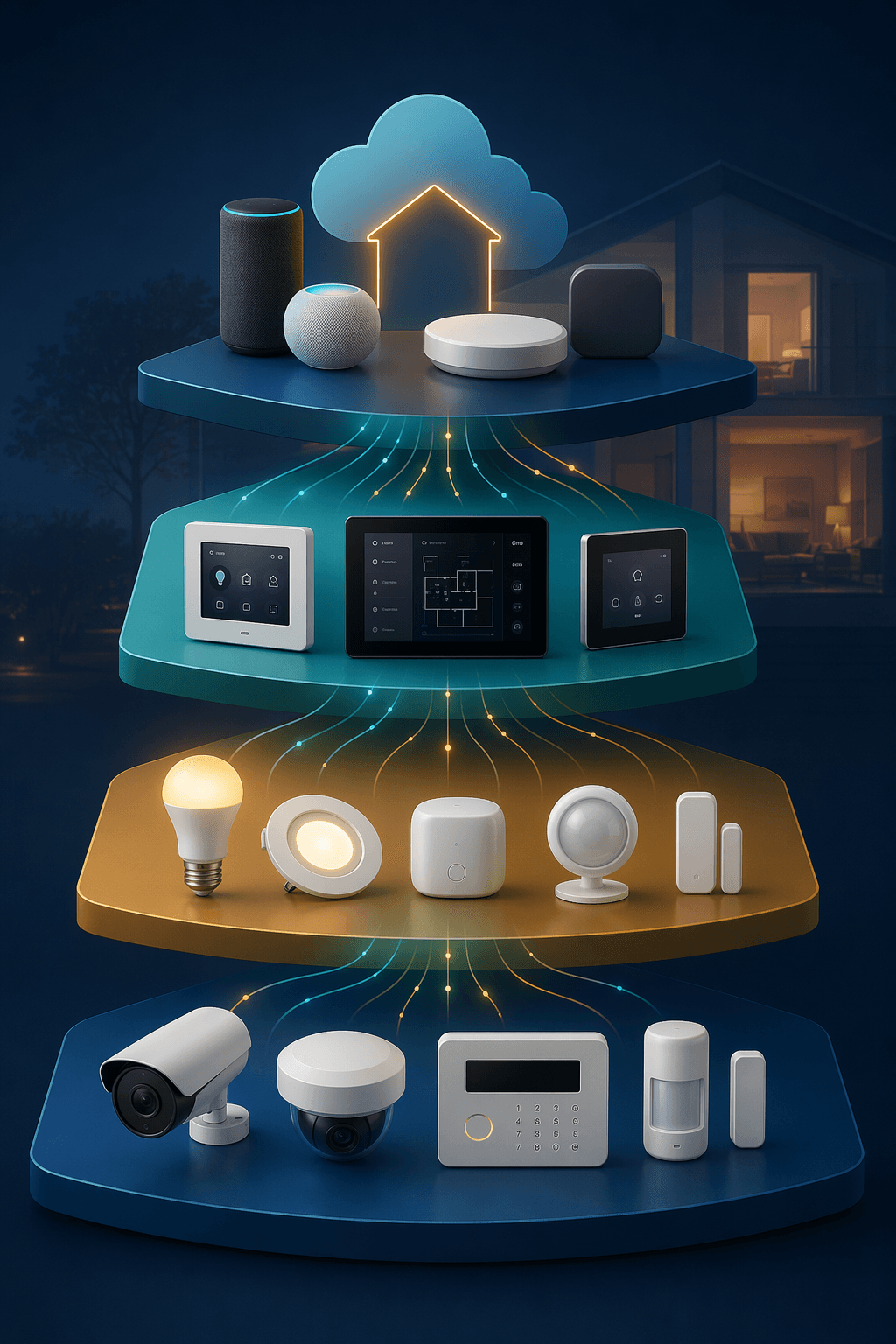
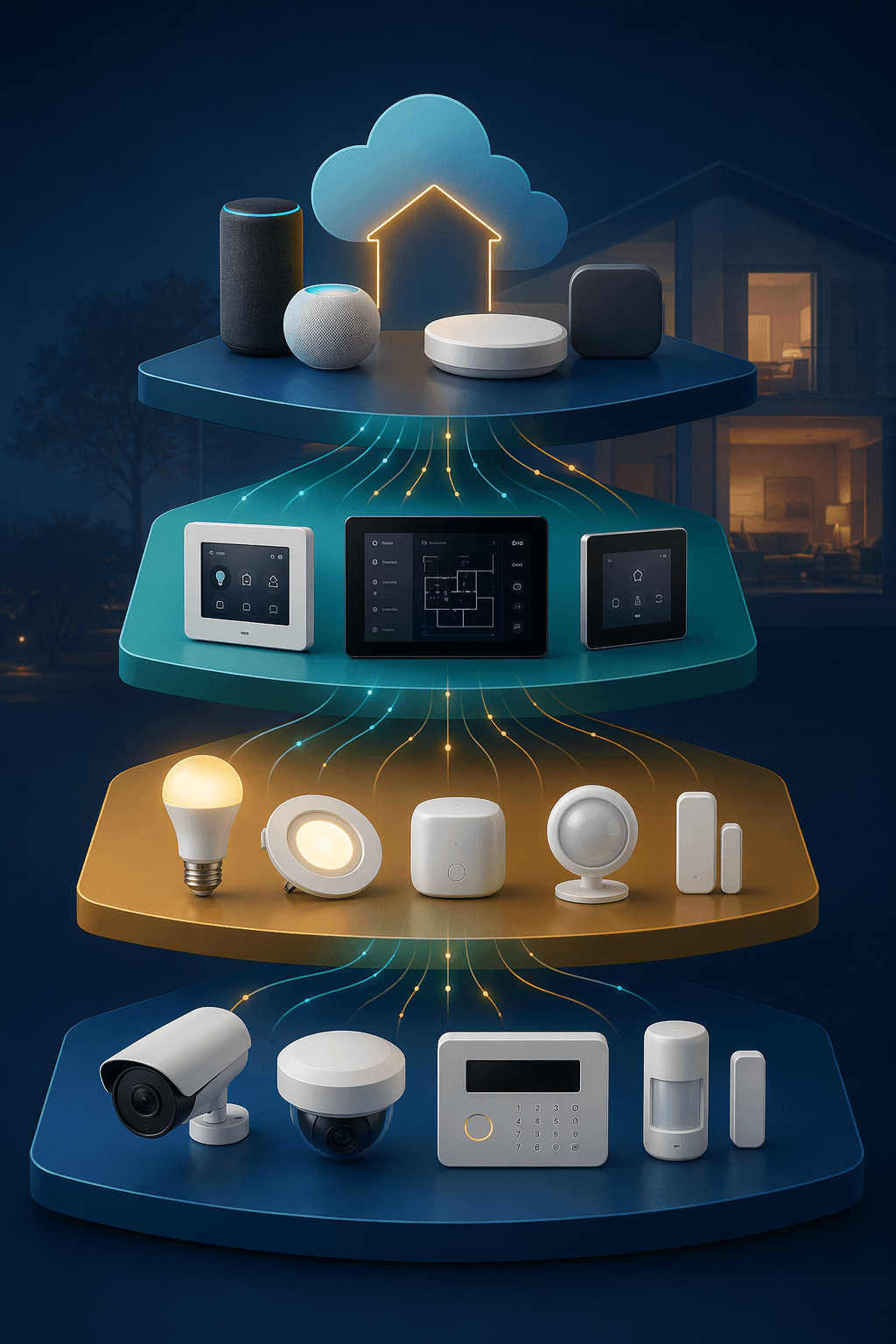
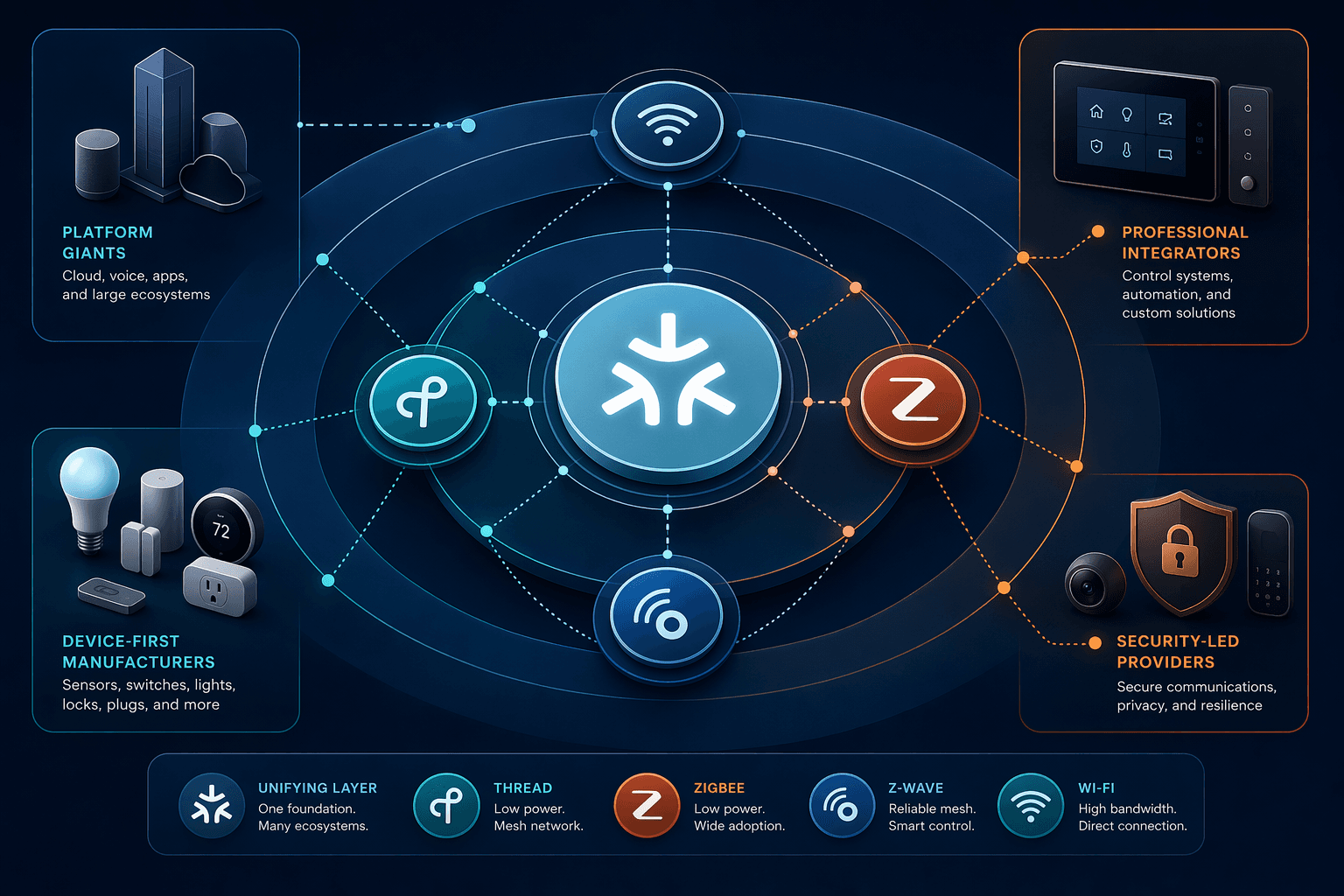
Home automation companies are easier to compare once you stop treating them as one market. In 2026, the useful map has four tiers: platform ecosystem giants, professional integrators, device-first manufacturers, and security-led providers. They may all sell something called a smart home, but they are selling very different relationships with your house.
| Tier | Typical companies | What they optimize for | Main lock-in pattern |
|---|---|---|---|
| Platform ecosystem giants | Amazon, Apple, Google, Samsung | Voice control, broad compatibility, app ecosystems, household convenience | Your automations, routines, speakers, displays, cloud accounts, and family habits start orbiting one platform |
| Professional integrators | Crestron, Control4, Savant, Lutron | Whole-home reliability, custom scenes, high-end lighting, AV, shades, climate, and installer support | Installer dependence, proprietary configuration, high switching cost, and a home designed around a control system |
| Device-first manufacturers | Philips Hue, Ecobee, Aqara, SwitchBot | Strong individual products that can plug into larger ecosystems | Product-specific hubs, apps, feature gaps outside the native app, and gradual brand accumulation |
| Security-led providers | Vivint, ADT, SimpliSafe, Ring | Cameras, alarms, sensors, monitoring, and simple bundled packages | Subscription dependence, monitoring contracts, cloud video storage, and security hardware tied to service plans |
The categories overlap. Amazon is a platform company, a device maker, and, through Ring, a security player. Google is both a platform and the company behind Nest devices. Samsung sells appliances and runs SmartThings. That overlap is exactly why the tier map matters: the question is not only which logo is on the box, but which business model you are letting become the operating layer of your home.
The stakes are no longer niche. One June 2026 market report valued the global smart home market at about $133.3 billion in 2025 and projected it to exceed $1 trillion by 2035, while also listing Apple, Amazon, Samsung, Honeywell, Schneider Electric, Google/Nest, Johnson Controls, GE, Sony, and Emerson among the top companies by revenue in the category.[1] Market-size estimates vary because analysts define “smart home” differently, but the direction is clear enough: more of the home is becoming software-addressable, and more companies want to own the layer that coordinates it.
The platform giants: broad reach, easy voice control, and ecosystem gravity
Amazon Alexa, Google Home, Apple Home, and Samsung SmartThings are the names most people encounter first because they sit where the household already is: phones, speakers, displays, TVs, tablets, watches, and cloud accounts. Their promise is not that every device is best-in-class. Their promise is that the light switch, thermostat, doorbell, speaker, and vacuum can be made visible from one familiar interface.
Breadth is the most obvious advantage. In Security.org’s platform testing, Alexa supported more than 140,000 compatible devices, Google Home more than 50,000, Apple HomeKit more than 1,000, and Home Assistant more than 2,500 integrations.[2] Those numbers should not be read as a guarantee that every device works equally well, but they do show why platform companies pull buyers in: if you are standing in a store or scrolling through a product page, the odds are high that the box says it works with at least one of these systems.
That breadth is useful. It is also how lock-in becomes ordinary. A household may start with one smart speaker, add a few voice-controlled lights, build morning and bedtime routines, share app permissions with family members, and then choose future devices based on the ecosystem that already has the least friction. Nothing dramatic happened. No one signed a luxury installation contract. Still, the cost of leaving has gone up because the system now lives in habits, rooms, labels, routines, and family expectations.
Amazon’s version of this tradeoff is scale. Alexa’s compatibility count makes it the broadest consumer platform in Security.org’s testing, and that makes it attractive for buyers who want to add devices opportunistically without checking a narrow compatibility list every time.[2] The price is that the home becomes increasingly tied to Amazon’s account system, voice assistant, routines, and device assumptions. If the home already has Echo speakers in several rooms, switching platforms is not just a matter of replacing a hub; it means retraining the household’s default way of interacting with the home.
Google Home follows a similar convenience logic, especially for homes already using Android phones, Nest thermostats, Nest cameras, Chromecast, or Google services. Its compatible-device count is lower than Alexa’s in Security.org’s testing but still broad at more than 50,000 devices.[2] The lock-in is less about one device category and more about the gravitational pull of Google accounts, Nest hardware, voice control, and household presence features.
Apple Home is the more controlled version of the platform tier. Its compatible-device count is much smaller in Security.org’s testing, but the same source gave Apple HomeKit a 7.9 out of 10 privacy score, the highest among the major platforms it evaluated, citing end-to-end encryption and local processing.[2] That posture matters for buyers who would rather accept a narrower device universe than make the most intimate parts of the home feel like another data exhaust channel. It also means Apple buyers should be honest about the trade: the walls may be more carefully built, but they are still walls. For a deeper device-level view, see the site’s Apple HomeKit buyers guide.
Samsung SmartThings occupies a slightly different position because it has long appealed to people who care about device interoperability and automation logic, not only voice assistants. It also benefits from Samsung’s appliance footprint. A smart home built around SmartThings can feel less like choosing a speaker brand and more like choosing a coordination layer for sensors, appliances, lights, and routines. That can be a strength, particularly for homes with mixed brands, but it is still a platform decision. Automations built in SmartThings, device handlers, account integrations, and app habits can become their own switching cost.
The best reason to choose a platform giant is that the home needs to be usable by ordinary people every day. Guests, children, partners, and less technical relatives are more likely to understand “turn off the kitchen lights” than a carefully labeled dashboard on a wall tablet. Voice control is not the whole smart home, but it is one of the few interfaces that can survive real household chaos.
The reason to be cautious is that platform breadth can masquerade as future-proofing. “Works with Alexa” or “Works with Google Home” tells you today’s command path. It does not tell you whether the device exposes every feature outside its native app, whether automations run locally, whether a manufacturer will maintain an integration, or whether a future platform policy will change what works. The site’s smart home platforms comparison is the better next stop if the decision is already narrowed to Alexa, Google Home, Apple Home, SmartThings, or Home Assistant.
Professional integrators: expensive, deliberate, and hard to casually replace
Crestron, Control4, Savant, and Lutron belong in a different conversation from a basket of smart plugs and a voice assistant. These systems are usually chosen for large homes, renovations, new builds, high-end lighting plans, multiroom audio, home theaters, motorized shades, climate, access control, and scenes that need to work without asking the homeowner to become the support department.
The cost structure makes the difference visible. A 2026 UK guide from Custom Controls lists Crestron whole-home systems as starting around £15,000–£20,000, Control4 from £10,000–£15,000, and Lutron RadioRA 3 from about £8,000 for a four-bedroom home.[3] Those figures come from a UK integrator and should not be treated as universal U.S. pricing, but they describe the right tier: professionally designed, installed, and supported whole-home systems, not entry-level partial automation.
Control4 illustrates why this tier still exists despite cheaper consumer hardware. The same Custom Controls guide describes Control4 as the most widely installed professional platform in the UK and cites more than 12,000 third-party device integrations.[3] That is not the same kind of breadth as Alexa’s compatibility count. It is a professional ecosystem meant to let an installer coordinate lighting, AV, heating, security, and interfaces in a way that feels finished rather than assembled.
Crestron sits even more clearly in the bespoke-control tradition. Architechne reported in February 2026 that Crestron Home OS 4.4 added sustainability insights and weather-based automation, features aimed at homes where automation is part of the building’s operating logic rather than a collection of gadgets.[4] This is where professional systems can justify themselves: not because they are exciting in a demo, but because the lights, shades, rooms, schedules, and control panels are designed as infrastructure.
The lock-in is correspondingly concrete. If a platform giant locks you in through daily habits and device compatibility, a professional integrator can lock you in through wiring decisions, programmed scenes, dealer relationships, proprietary configuration tools, and expensive hardware. That does not make the choice irrational. A large home with demanding lighting and AV needs may rationally prefer one accountable installer over a patchwork of consumer products. It does mean “can I leave later?” should be asked before the first keypad is chosen, not after the rack is full.
Device-first manufacturers: the most tempting middle ground
Device-first companies are where many careful buyers end up lingering. Philips Hue is known for lighting. Ecobee is known for thermostats. Aqara is known for sensors, hubs, cameras, and compact smart home devices. SwitchBot is known for retrofit devices that automate things a home already has. These companies do not need to own the entire home to win; they need to make a device good enough that you want it inside whatever ecosystem you already use.
This tier has benefited from Matter because Matter gives device makers a way to tell buyers, plausibly, that choosing their product does not mean choosing one platform forever. A Matter-certified device can be set up across major ecosystems more easily than older single-platform products, and it can reduce the fear that a light, plug, sensor, or lock is a dead-end purchase. The important word is reduce. Matter does not automatically make every advanced feature portable, and real-world behavior can still differ by platform; the site’s Matter Platform Face-Off 2026 covers those implementation gaps in more detail.
Philips Hue shows both sides of the device-first bargain. Hue’s lighting products have long been attractive because the core product experience is strong: bulbs, light strips, lamps, scenes, switches, and a mature app. But Hue also demonstrates how a device brand can build its own center of gravity. A buyer may start with a few bulbs, then add a Hue Bridge, then Hue switches, then outdoor lighting, then scenes that work best in Hue’s own app. Matter compatibility can make Hue easier to expose to outside platforms, but it does not erase the reasons Signify wants Hue to remain a distinct lighting ecosystem.
Ecobee is a different version of the same middle ground. A thermostat is not just another accessory; it touches comfort, schedules, energy use, sensors, and sometimes occupancy assumptions. PCMag listed the Ecobee Smart Thermostat Premium among its best smart home devices for 2026, which reflects the way a single high-quality device can earn a place even in homes that have not committed to a single brand universe.[5] The lock-in question is not whether Ecobee is a platform giant. It is whether the thermostat, sensors, app, voice integrations, and routines become important enough that replacing them would disturb the home’s daily rhythm.
Aqara and SwitchBot are especially interesting because they speak to buyers who want capability without hiring an integrator. Aqara’s lineup often appeals to people building sensor-rich homes, while SwitchBot’s appeal is retrofit pragmatism: curtains, button pushers, locks, meters, and small devices that automate existing objects rather than replacing them. Forbes described SwitchBot’s evolution in January 2026 as increasingly Matter-compatible, a sign of how device-first brands use Matter to lower adoption anxiety while keeping their own product identity intact.[6]
That is the quiet lock-in of this tier: not one platform decision, but a drawer full of brand-specific logic. The device may appear in Apple Home, Alexa, Google Home, or SmartThings, yet the firmware updates, specialty scenes, calibration settings, sensor options, and edge-case fixes may still live in the manufacturer’s app. A Matter logo helps with basic interoperability. It does not guarantee that the product’s best features travel cleanly.
For many homes, that is a perfectly acceptable trade. Device-first buying lets you choose excellent products category by category instead of surrendering the whole house to one platform. The practical discipline is to avoid accidental brand sprawl. If you use Hue for lighting, Ecobee for climate, Aqara for sensors, and SwitchBot for retrofits, decide which platform or local controller is actually coordinating them. Otherwise the “open” smart home becomes four apps, four automation engines, and four places to troubleshoot.
Security-led providers: ownership changes when monitoring is part of the product
Vivint, ADT, SimpliSafe, and Ring start from a different household anxiety: intrusion, packages, doors, windows, alarms, cameras, and emergency response. Their smart home features often ride alongside security. Lights may turn on when an alarm triggers. A camera may appear in the same app as a door sensor. A lock may become part of an arming routine. The bundle is convenient because security is one of the few smart home categories where people already expect a service relationship.
That service relationship is also the lock-in. With security-led companies, the question is rarely just “Does this sensor work?” It is “What happens to monitoring, video history, professional response, cellular backup, warranty support, and app features if I stop paying?” A camera or alarm panel can be physically in your home while the most valuable parts of the system remain attached to a subscription.
This does not make security-led providers a bad category. A household that wants one company to install, monitor, and support the security layer may reasonably choose that commitment. The mistake is comparing the monthly price of a monitored security system to the one-time price of a smart hub as if both products are selling the same thing. They are not. One is selling automation hardware and platform access; the other is often selling reassurance, escalation, cloud storage, and response workflows.
The no-subscription countertrend matters here because it shows that buyers are pushing back. Camera and security alternatives from companies such as Eufy, Reolink, and Arlo are often considered by people who want local storage options or fewer recurring fees. The right comparison is not simply subscription versus no subscription. It is whether the household wants monitored service and cloud convenience badly enough to accept that “ownership” may be conditional on an active plan.
Protocols are where the lock-in story becomes testable
Brand claims are easy to overread. Protocol support is harder to fake. A company’s approach to Matter, Thread, Zigbee, Z-Wave, Wi-Fi, and local control tells you whether it is trying to make devices broadly portable, cheaply connected, installer-stable, cloud-dependent, or native-app-centered.
| Protocol or control layer | What it usually signals | Where it commonly appears in the tier map |
|---|---|---|
| Matter | A cross-platform application standard meant to reduce ecosystem switching friction for supported device types | Platform giants and device-first manufacturers; increasingly important for buyers who want platform flexibility |
| Thread | A low-power mesh network often associated with newer Matter devices | Newer platform ecosystems and device-first products, especially sensors, plugs, and small devices |
| Zigbee | A mature low-power mesh protocol often used behind hubs and bridges | Lighting, sensors, and device-first ecosystems such as Hue or Aqara-style hub architectures |
| Z-Wave | A long-running smart home protocol historically strong in sensors, locks, switches, and security-adjacent devices | Professional, enthusiast, and security-adjacent installations, depending on the controller |
| Wi-Fi | Direct network connectivity without a dedicated low-power mesh, often simple to install but dependent on router quality and power availability | Cameras, plugs, appliances, thermostats, speakers, displays, and many mass-market devices |
| Local control | Automation can continue without routing every action through a vendor cloud | Professional systems, Home Assistant-style setups, some platform features, and selected device-first products |
Matter deserves its attention, but not its mythology. Its value is that supported devices can work across major platforms more easily, which reduces the old fear that buying one sensor or plug means pledging allegiance to one ecosystem. For device-first manufacturers, Matter lowers the buyer’s hesitation. For platform giants, it helps keep the ecosystem story broad without requiring every accessory maker to build bespoke integrations forever.
Matter does not remove tier differences. A Matter light may still have better color effects in its native app. A Matter sensor may expose only certain capabilities to a given platform. A platform may support the device but not the automation logic you wanted. A security provider may still keep monitoring and video history behind a subscription. A professional integrator may still prefer systems and interfaces that fit its design, support, and service model.
Thread is often paired with the Matter conversation because it gives small devices a modern low-power mesh path, but it is not a magic compatibility badge by itself. Zigbee and Z-Wave still matter because many homes and many mature products use them. Wi-Fi remains unavoidable because it is simple, familiar, and good for bandwidth-hungry devices such as cameras, speakers, and displays. Local control matters because an automation that only works when a vendor cloud is healthy is not the same kind of ownership as one that runs inside the home.
This is where buyers can avoid being distracted by the biggest logo. Ask what the device or system uses when the internet is down. Ask whether the routine runs on a hub, a phone, a speaker, a cloud service, or an installer-programmed controller. Ask whether basic functions and advanced functions travel through the same protocol. The more the answer depends on one company’s app or service plan, the less portable the purchase really is.
Cost comparisons only make sense inside the right tier
A cheap hub and a professionally integrated home are both “home automation,” but comparing them as if they compete directly creates bad expectations. ZDNET’s December 2025 testing listed Home Assistant Green at $159, a price that illustrates how low the entry cost can be for a capable DIY controller.[7] That is a different universe from a whole-home Crestron or Control4 installation starting in the five figures in the UK pricing cited above.[3]
The DIY route shifts cost from hardware and installation into time, troubleshooting, and household tolerance. The professional route shifts cost into design, labor, programming, support, and a system someone else is accountable for. A platform giant may be cheap to enter but expensive to leave once every room has compatible speakers and routines. A device-first setup may spread cost across years, which feels gentle until the app count and bridge count reveal the hidden complexity. A security-led setup may have a reasonable hardware package but a long tail of monitoring or storage fees.
This is why “best home automation company” is usually the wrong search. The better question is which cost you are willing to pay: money upfront, recurring fees, setup time, installer dependence, platform dependence, or future migration pain.
How to choose the tier before choosing the brand
Start with the permanence of the decision. If you are renting, experimenting, or automating a few rooms, a platform giant plus carefully chosen Matter-capable devices may be enough. If you are renovating a large home and want lighting, shades, audio, climate, and control panels to behave like part of the architecture, the professional tier may be more honest than pretending a drawer of DIY devices will feel finished. If you care most about product quality in a few categories, device-first manufacturers let you buy excellence without handing the whole home to one platform. If security and response matter more than tinkering, a monitored security-led provider may be the right kind of commitment.
- Choose a platform ecosystem giant when voice control, family usability, broad device shopping, and low-friction setup matter more than maximum independence.
- Choose a professional integrator when the home is large, the budget is high, the installation should feel architectural, and you want one accountable party for design and support.
- Choose device-first manufacturers when you want the best lighting, thermostat, sensor, or retrofit product in each category and are willing to manage some app and hub complexity.
- Choose a security-led provider when alarms, cameras, monitoring, and response workflows are the center of the system, and you accept that subscriptions may define the product.
Then check protocols before you get attached to a brand. Matter support is a positive sign, especially for basic device portability, but it should not be treated as a full exit plan. Thread can help newer low-power devices behave well. Zigbee and Z-Wave can still be sensible where mature device categories and reliable mesh behavior matter. Wi-Fi is convenient but can become a network-management problem if every small device joins the router directly. Local control is worth more in functions the household depends on every day: lights, locks, climate, and core scenes.
Finally, decide who in the household bears the consequences. The person excited by the demo may not be the person resetting devices, explaining voice commands to guests, paying the subscription, calling the installer, or rebuilding automations after a platform change. A smart home choice is only good if the least enthusiastic household member can live with it.
For a more guided brand-and-platform decision after the tier choice, use How to Choose a Smart Home System. If the next step is practical setup rather than strategy, the home automation setup guide is the more useful path.
Pick the business model you want living in the walls
The safest choice is not always the most open one, and the most open choice is not always the easiest to live with. A busy household may be better served by Alexa or Google Home than by a purist setup no one else understands. A privacy-sensitive Apple household may rationally accept fewer compatible devices. A large custom home may need an integrator. A security-focused household may value monitoring more than device portability.
Matter has reduced some switching pain, especially for device-first purchases and cross-platform setup, but it has not erased the differences between home automation companies. Platform giants still pull devices into ecosystems. Professional integrators still make homes feel designed and expensive to unwind. Device-first manufacturers still protect their best experiences. Security-led providers still tie value to service.
Choose the tier first. Then choose the company. A broad brand name is not the same as future-proof compatibility, and a Matter logo is not the same as a painless exit. The real decision is which kind of company you are comfortable letting become part of the home’s operating structure.
References
- Top 10 Leading Companies in the Global Smart Home Market, Intellectual Market Insights, June 2026.
- Best Smart Home Platforms, Security.org.
- Ultimate Smart Home Automation Guide, Custom Controls UK, 2026.
- The Best High-End Home Automation Systems of 2025: An Overview and Comparison, Architechne, February 2026.
- The Best Smart Home Devices for 2026, PCMag.
- How To Supercharge Your Smart Home In 2026, Forbes, January 2026.
- The best home automation systems of 2025, ZDNET, December 2025.
Updates & Corrections
Protocol specifications and platform features change rapidly — especially with Matter version evolution. Report version changes, certification count updates, or platform policy changes that have occurred since the last editorial review.
Comments
Join the discussion with an anonymous comment.