The practical answer for Home Assistant Matter support in mid-2026 is no longer “wait and see.” Matter Server 9.0, released in June 2026, changes enough of the plumbing that Matter is now a credible daily driver in Home Assistant for lights, plugs, switches, sensors, locks, and thermostats. It is not, however, a reason to replace every working Zigbee, Z-Wave, or platform-native setup on faith.
The useful line is this: buy and commission common Matter devices into Home Assistant when your IPv6 network is healthy, your Thread border router choice is deliberate, your hardware has enough headroom, and you understand which ecosystem is actually responsible for commissioning and updates. If you need a protocol refresher before that sentence feels fair, start with this Matter smart home standard primer. The rest of this piece assumes you already know the promise and want to know whether the implementation has caught up.
Matter Server 9.0 is the first Home Assistant Matter release that feels operational
The June 2026 Matter Server 9.0 release replaced Home Assistant’s previous Python/C++ SDK path with a server built on matter.js, added the first Thread network visualization with a color-coded LQI mesh map, improved recovery behavior, and brought support for Matter 1.5.1 [1]. Those are not cosmetic changes. They move Matter support from “the device paired” toward “the system gives you enough information to maintain it.”
That distinction matters in a Home Assistant house. A platform can look successful when a plug turns on from a dashboard. It becomes a real integration when it survives restarts, exposes enough diagnostics to explain failures, and recovers without turning every network hiccup into a Saturday afternoon project.
Adoption now backs up the sense that this is no longer a niche experiment. Home Assistant’s Matter integration page reports Matter in use on 38% of Home Assistant instances, making it the 12th most-used integration [2]. That figure does not prove every installation is happy, and it will change over time, but it does mean support problems are no longer being discovered by a tiny early-adopter group.
There is also a trust angle here that is easy to understate. Home Assistant and the Open Home Foundation became the first open-source project to receive CSA Matter certification in 2025 [3]. Certification is not a reliability guarantee, but it matters when the platform is asking users to bridge devices across vendors, fabrics, and border routers rather than stay inside one company’s app.
Why the matter.js rebuild matters if you are not a developer
The matter.js rebuild is easy to file away as implementation trivia. For daily Home Assistant use, the point is less the programming language and more the behavior around failure. Matter Server 9.0 was presented by Home Assistant as a rebuild that improves recovery and lays a better base for future Matter support [1]. That is the part users feel when a device comes back after a restart instead of remaining in an ambiguous half-alive state.
Old smart home integrations often fail in ways that are strangely quiet. A sensor is still listed. A light still has an entity. The automation still exists. The only sign that anything is wrong is that the hallway no longer behaves like a hallway. Better recovery does not eliminate all of that, but it reduces the number of times the user has to be the recovery mechanism.
Matter 1.5.1 support also keeps Home Assistant closer to the current protocol baseline, including camera streaming improvements in that Matter generation [1]. That does not mean cameras are suddenly in the same practical bucket as plugs or bulbs. It means the server is no longer obviously lagging behind the standard in a way that blocks the next round of device support.
The Thread map is the feature that changes troubleshooting
The biggest daily-use change is the Thread network visualization. Matter-over-Thread has always had a frustrating failure mode: everything looks conceptually elegant until one sleepy sensor, weak path, or poorly placed router makes the network feel haunted. Matter Server 9.0’s color-coded LQI mesh map gives Home Assistant users a way to inspect the topology instead of guessing from symptoms [1][4].
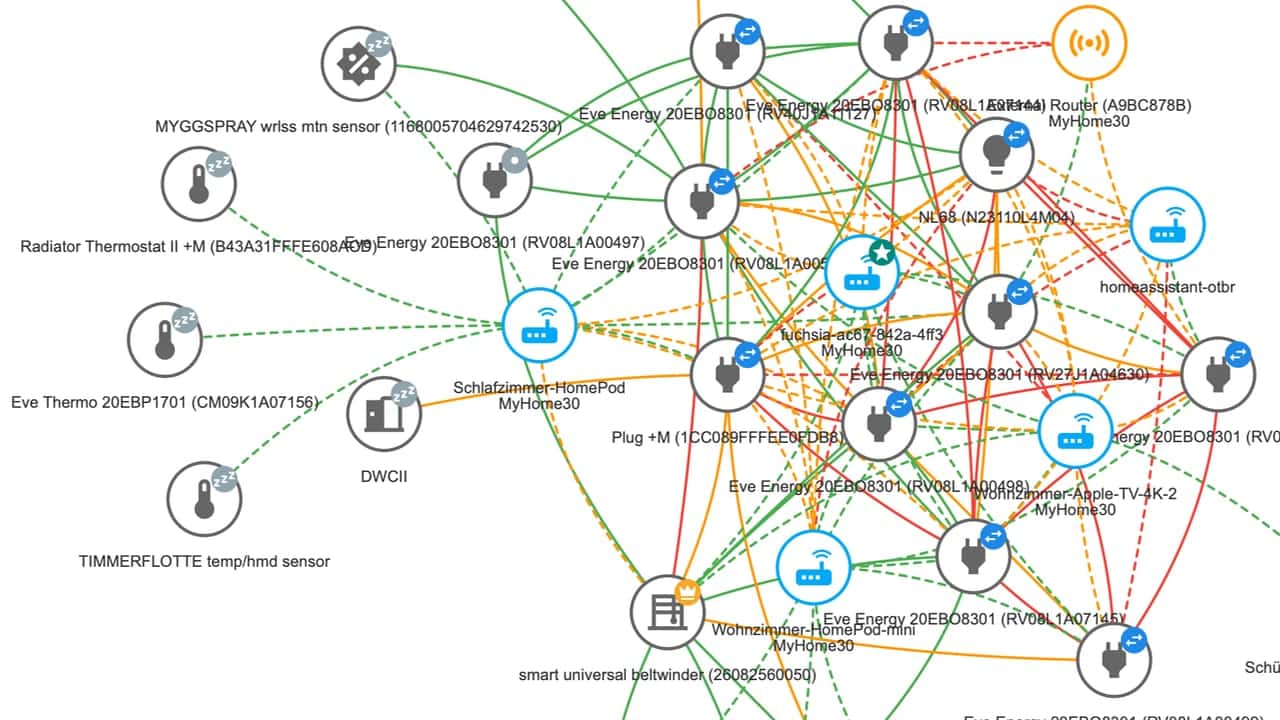
That is a boring feature in exactly the right way. A color-coded LQI view can show whether a device is attached through a weak route, whether a border router is central or marginal, and whether adding a mains-powered Thread device might help the mesh. It turns “my Matter sensor is unreliable” into a narrower investigation: placement, route quality, border router behavior, device firmware, or Home Assistant recovery.
This is where Home Assistant’s rougher, more transparent style earns its keep. Apple, Google, Amazon, and SmartThings can hide a lot of complexity when everything is working. Home Assistant is better when it makes the system legible. For Thread, legibility is not a luxury. It is the difference between replacing devices at random and making a network decision.
If you are still planning the physical side of the network, pair this with a practical Thread border router setup guide rather than treating border routers as interchangeable accessories.
What I would actually run on Matter now
The safe answer is not “Matter is ready” or “Matter is not ready.” The answer depends on device category and how much failure hurts. A plug that needs to recover after a restart is a different risk than a lock on an exterior door. A temperature sensor with lazy reporting is annoying; a thermostat that does not follow schedule expectations affects comfort.
| Device type | 2026 Home Assistant Matter judgment | Planning note |
|---|---|---|
| Lights, plugs, and switches | Ready for normal use | Best starting point, especially for mains-powered devices that can strengthen Thread if they support it |
| Contact, motion, temperature, and basic sensors | Ready with mesh checks | Good candidates, but sleepy Thread devices expose weak routing quickly |
| Locks | Usable, but test recovery and battery behavior before relying on them | Commission carefully and keep a fallback path |
| Thermostats | Usable when the device’s exposed features match your automations | Check supported attributes before replacing a mature integration |
| Cameras | Still cautious | Matter 1.5.1 includes camera streaming improvements, but this is not yet the low-risk category |
| New Matter 1.6 features | Too early to assume | NFC commissioning and Joint Fabric were added in June 2026, but field adoption is still unproven |
Matter 1.6 arrived in June 2026 with features including NFC commissioning and Joint Fabric, while the broader market has more than 750 Matter products listed and IKEA has announced more than 21 Matter-compatible products [5]. Those numbers are encouraging, but they are not the same as saying a specific device in a specific country, firmware branch, and ecosystem path will behave the way your automation expects.
For buying decisions, the most useful filter is still boring: pick categories where Matter already exposes the controls you need, prefer devices with visible firmware support, and do not replace a stable local integration just because a Matter logo exists. For a more granular device list, use a Matter-compatible device buying guide instead of relying on product-count totals.
Ecosystem fragmentation still decides how smooth the experience feels
Matter’s promise is shared control. The reality in 2026 is shared control through platforms moving at different speeds. SmartThings is described as moving fastest on newer Matter versions, Apple remains polished but limited, and Google and Amazon still have device-type gaps [5]. That does not make any one platform unusable. It means the path a device takes into Home Assistant still matters.
A device commissioned first through Apple may not behave like the same model commissioned through another ecosystem and then shared. A border router supplied by one platform may be excellent for everyday routing but awkward for firmware maintenance. A device category that looks complete in one app may expose fewer practical controls elsewhere. Matter reduces proprietary lock-in, but it has not erased platform behavior.
This is where Home Assistant users should resist the fantasy that “multi-admin” means “no planning.” If Home Assistant is the system of record for automations, then commissioning order, fabric membership, and border router placement are part of the design. They are not cleanup details after the device is already stuck to the wall.
The network requirements are not optional
Matter leans on IPv6. That is not trivia for people running consumer routers, VLANs, multiple access points, mDNS reflectors, or carefully segmented IoT networks. A Matter device can be perfectly fine and still feel unreliable if the local network breaks discovery, routing, or multicast behavior in subtle ways.
Hardware headroom also matters more than it used to. One 2026 analysis notes that RAM requirements have roughly doubled and recommends about 4 GB on a Raspberry Pi for Home Assistant Matter setups [4]. That does not mean every smaller system instantly fails, but it should change upgrade planning if the same box is already running add-ons, databases, voice, cameras, or heavy automations.
Thread border routers deserve the same care. Thread 1.4 became mandatory for new border router certifications on January 1, 2026 [5]. That improves the baseline for newly certified hardware, but homes are full of existing border routers, mixed firmware versions, and platform-managed devices. If you are choosing new hardware now, compare the best Matter hardware for Home Assistant and a Home Assistant Matter dongle guide before buying whatever happens to be discounted.
The Apple border router OTA problem is the kind of gotcha that still matters
The most concrete warning is Matter-over-Thread firmware updates through Apple border routers. Community reports around HomePod mini and Apple TV 4K border routers describe OTA update failures tied to mDNS packet forwarding limitations. The practical consequence is simple: a device can work day to day and still become painful when firmware maintenance arrives.
Some community advice suggests power-cycling or removing Apple border routers for a period long enough to force another path, with reports often mentioning 30 minutes or more. That should be treated as community-sourced troubleshooting, not an official fix. If your Thread network has multiple border routers and updates fail unpredictably, use a focused unstable Thread mesh troubleshooting guide rather than repeatedly recommissioning devices.
This is also why “it supports Matter” is not enough information when buying a sensor, lock, or thermostat. Ask how firmware updates happen, which app is required, whether the vendor supports Matter updates outside its own ecosystem, and what happens if the border router doing the routing is not the one the vendor tested most heavily.
Matter-over-Thread is not automatically better than a mature Zigbee mesh
Battery life is the place where the upgrade story needs the most restraint. One comparison cites manufacturer-stated maximums around two years for a Thread version of an Aqara FP300-style device versus around three years for its Zigbee counterpart [6]. That is not a universal law of Thread or Zigbee. It is a useful warning that Matter-over-Thread should not be assumed to improve every battery-powered device.
Real battery life depends on routing, signal quality, reporting frequency, firmware behavior, and whether multiple controllers are polling or subscribing in ways the device handles efficiently. A weak Thread mesh can make a battery device look bad for reasons that have little to do with the sensor itself. A mature Zigbee mesh with good routers in the right places may still be the better home for some low-power sensors.
That is why hybrid setups remain sensible. Zigbee and Z-Wave do not become obsolete because Matter Server 9.0 improved. A 2026 hybrid-mesh analysis still frames the decision as selective migration rather than a whole-home rip-and-replace [7]. If an existing mesh is boring, local, and reliable, boredom is a feature.
A practical decision rule for Home Assistant users
Use Matter in Home Assistant now when the device category is mature, the control surface is enough for your automations, and the network can support it. Lights, plugs, switches, basic sensors, locks, and thermostats are reasonable candidates. Start with non-critical devices if your Thread network is new. Let the LQI map tell you whether the mesh is actually ready before adding the devices people complain about when they fail.
- Prefer Matter for new common devices when you want local control and cross-platform flexibility without another proprietary bridge.
- Keep Zigbee, Z-Wave, or native integrations where they are already stable and expose better device-specific features.
- Treat Thread planning as infrastructure: border router placement, IPv6 behavior, and mesh quality come before bulk device purchases.
- Be cautious with cameras, brand-new Matter 1.6 features, and devices whose firmware update path depends on an ecosystem you do not want to manage.
- Do not judge Matter by pairing success alone; judge it by recovery, diagnostics, OTA behavior, and how it behaves after Home Assistant restarts.
Matter Server 9.0 makes Home Assistant Matter support feel real in a way earlier releases often did not. The matter.js rebuild, recovery improvements, Matter 1.5.1 support, and Thread topology view give users better tools for everyday ownership. That is enough to recommend Matter for planned deployments in common categories. It is not enough to pretend the ecosystem has become uniform, that every border router behaves the same, or that Thread always beats an established mesh.
References
- The Matter upgrade you've been waiting for, Home Assistant, June 23, 2026
- Matter, Home Assistant
- Home Assistant officially Matters, Home Assistant, March 10, 2025
- Home Assistant's New Matter Server Is a Game-Changer, matter-smarthome.de
- The Matter Standard in 2026 – A Status Review, matter-smarthome.de
- Matter and Thread Explained: What Works in 2026, Data Wire Solutions
- Should you switch from Zigbee to Matter in 2026?, Howmation
Updates & Corrections
Protocol specifications and platform features change rapidly — especially with Matter version evolution. Report version changes, certification count updates, or platform policy changes that have occurred since the last editorial review.
Comments
Join the discussion with an anonymous comment.