The best smart home flood sensors for home protection are not one product category. They are a coverage plan. A $20 puck under a sink can be exactly right for a renter, useless for a burst pipe in a locked vacation house, and too expensive if you buy only one beautifully designed sensor when the leak starts behind the washing machine.
Start with the failure you are trying to catch. Spot sensors catch water where you place them. Whole-home flow monitors watch water use from the main line and can flag abnormal flow. Automatic shutoff valves go one step further: when the system decides something is wrong, they can stop the water without waiting for someone to wake up, read a phone notification, find the main valve, and get home.
That distinction matters because the damage bill is not small. Water damage claims commonly land in the $12,000–$15,000 range, and Abode’s 2026 smart water leak guide compares that with an average burglary claim of about $2,661.[1] WIRED, citing Insurance Information Institute data, also notes that about one in 60 insured homes files a water or freezing damage claim each year.[2] A cheap sensor can look almost silly beside those numbers. It is not silly if it is in the right place and someone can act.
The Three Protection Tiers
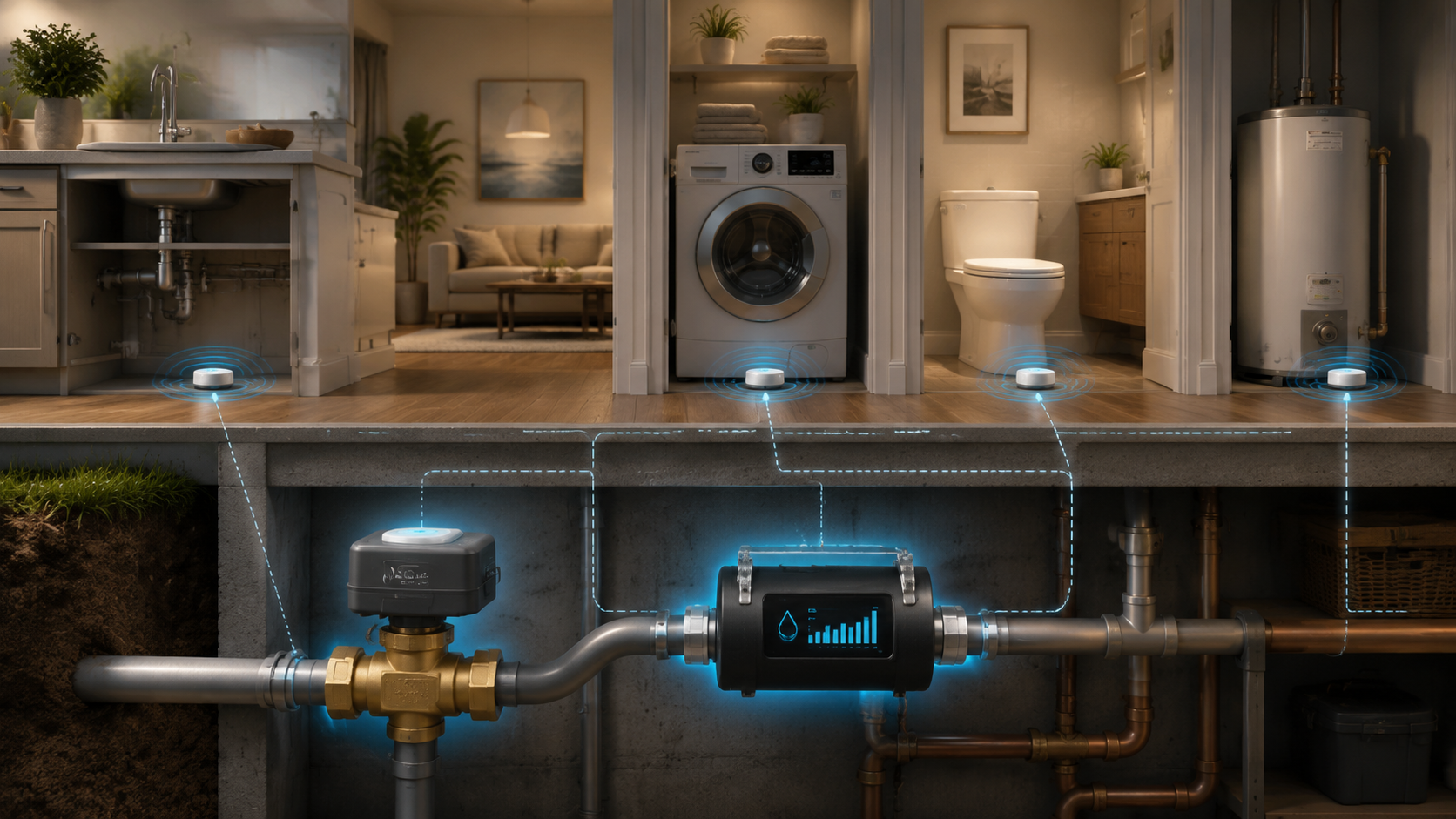
Most homes should think in tiers, not rankings. The first tier is cheap, broad placement. The second tier is whole-home awareness. The third tier is automatic intervention.
| Protection tier | What it catches well | What it misses | Typical fit |
|---|---|---|---|
| Spot sensors | Leaks at known fixtures and appliances | Leaks where no sensor is installed; many burst-pipe events | Renters, apartments, budget homeowners, first layer for almost everyone |
| Whole-home flow monitors | Unusual water use, long-running flow, some burst-pipe situations | Small standing-water leaks that do not create clear flow anomalies | Single-family homes, second homes, owners who want broader visibility |
| Automatic shutoff valves | Leaks where water must be stopped quickly without human response | Homes where installation is not allowed or plumbing is incompatible | Vacation homes, high-risk plumbing, owners who want maximum protection |
If you are buying your first smart home safety devices, this is a better starting point than comparing app screenshots. A sensor’s job is not to be tidy in a dashboard. Its job is to shorten the time between water escaping and water being stopped. For broader first-purchase planning, see what first-time smart home buyers need to know.
Spot Sensors: The Cheap Layer That Only Works Where You Put It
Spot sensors are the little pucks, probes, and cable sensors that sit on the floor or under a fixture. They are the easiest recommendation to make and the easiest to oversell. They are excellent at one thing: detecting water at a known leak point. They do not protect the part of the house where you forgot, declined, or could not afford to place one.
This is why per-sensor cost matters more than polish. A $15–$35 sensor that you can afford to place under several fixtures is often more useful than a single premium sensor guarding one cabinet. GoveeLife’s multi-pack is the clearest budget example: PCMag lists a six-sensor kit with hub around $89, or roughly $15 per sensor, though prices can change.[3] CNET and WIRED also treat Govee-style multi-packs as a practical way to cover more leak points without turning the project into a renovation budget.[4][2]
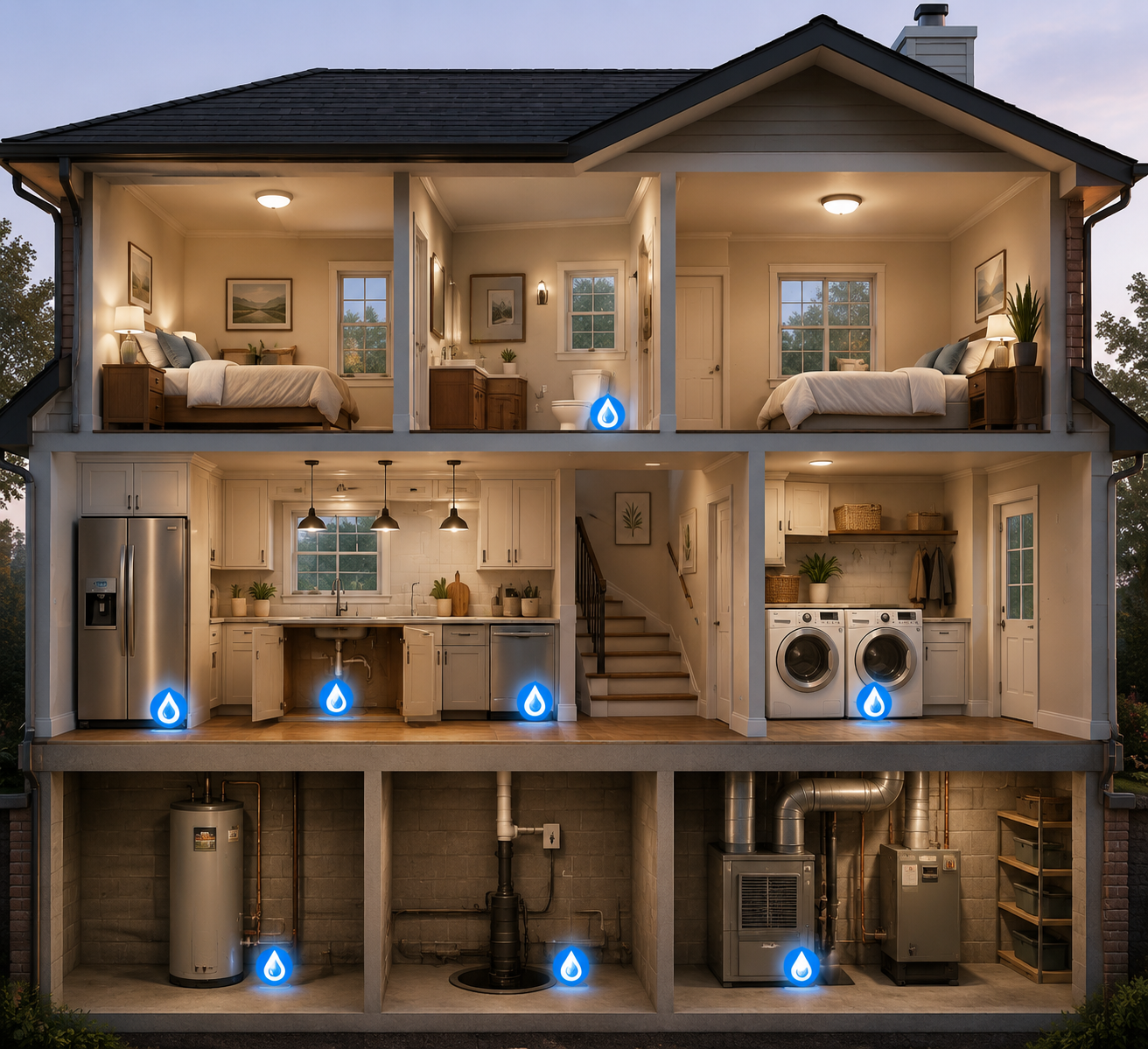
The usual target count is not one or two. A meaningful first pass covers eight high-risk areas: kitchen sink, washing machine, water heater, bathroom sinks, toilets, sump pump, refrigerator ice maker, and HVAC condensate line. Abode calls out washer supply hoses as a leading source of catastrophic flooding, and CNET’s placement guidance overlaps with the same practical map of fixtures and appliances.[1][4]
Not every location needs the same form factor. A puck works under a water heater or beside a sump pump. A probe cable is better when the leak might start behind a cabinet toe-kick, under a dishwasher, or in a tight utility area where the body of the sensor cannot sit at the lowest point. Reviewed and WIRED both highlight the Moen Smart Water Detector’s roughly $50 price and four-foot probe cable, which is the sort of detail that matters more than another generic “works with Alexa” bullet.[5][2]
Battery Life and Protocols Matter, But Only After Placement
Wi-Fi sensors are convenient because many work without a hub, which is why they make sense for renters and small apartments. The tradeoff is battery life: Wi-Fi leak sensors commonly run about one to two years, while Zigbee, Z-Wave, and Thread sensors are typically closer to three to five years.[9] A dead battery under a sink is not protection; it is a plastic reminder that maintenance belongs in the cost calculation.
Hub-based sensors can be cheaper, last longer, or integrate more cleanly once you already own the hub. Aqara’s leak sensors are usually in the $17–$20 range, but they require an Aqara hub that adds about $30 to the first purchase.[9] That can still be a good deal if you are covering several points. It is less attractive if you only need one sensor and do not want another box plugged into the router.
For platform-heavy homes, Shelly Flood Gen4 is the unusually flexible option because it supports Matter, Thread, Zigbee, Bluetooth, and Wi-Fi, with compatibility across Alexa, Google Home, Apple Home, and SmartThings.[9] Eve Water Guard is the cleaner HomeKit-native pick, but at about $110 it is hard to justify as the only strategy unless the cable coverage or HomeKit fit solves a specific placement problem.[9]
Whole-Home Flow Monitors Catch a Different Kind of Trouble
A spot sensor waits for water to reach its contacts. A flow monitor watches the water moving through the house. That difference is important for burst pipes, running toilets, irrigation mistakes, and slow but continuous use that does not immediately puddle under a sensor.
Flume 2 is the simplest example of this tier because it attaches to the existing water meter rather than requiring the pipe to be cut. PCMag and TechHive list it around $199 and describe it as a DIY whole-home flow monitor rather than a point leak detector.[3][6] That does not make it a replacement for pucks under appliances. It means it watches a different signal: flow, not standing water.
This tier starts to make more sense when nobody is home for long stretches. A vacation home with a frozen pipe risk, a single-family house with finished space below plumbing, or a homeowner who travels frequently needs something broader than a sensor waiting under the washing machine. Flow monitoring can warn about abnormal use before anyone steps into the laundry room and hears water running.
There is still a response problem. If the alert arrives while you are on a plane or three hours away, a flow monitor has done its job by warning you, but the water may still be running. That is why this tier is stronger than spot-only detection for awareness, yet still weaker than automatic shutoff for unattended protection.
Automatic Shutoff Valves Are Expensive Because They Change the Outcome
An automatic shutoff valve is the only tier here that can stop water without waiting for a person. That single fact is why it deserves more respect than a nicer app, a louder siren, or another integration badge.
Moen Flo is the common example in this category, with installed costs often discussed in the $500–$700 range.[1] It is not a casual renter purchase. It usually belongs to homeowners who can modify plumbing, have access to the main line, and are willing to pay for installation or a compatible setup. The cost is real. So is the difference between “your phone buzzed” and “the valve closed.”
This is the tier to consider when water damage would be unusually punishing: a second home, a finished basement, a house with aging plumbing, a property that sits empty during winter, or a household where nobody can reliably respond during work hours or overnight. It is also the tier that makes the most sense if the people receiving alerts are not the people who can physically reach the shutoff valve.
Match the Sensor Type to the Home
The right starting point depends less on which product review wins and more on who owns the plumbing, who receives the alert, and how long water could run before someone intervenes.
| Home scenario | Best starting setup | Why |
|---|---|---|
| Renter or apartment | Two to four Wi-Fi spot sensors | No plumbing modification; easy move-out; covers sink, washer, water heater closet, or toilet risk |
| Budget homeowner | Six-pack spot sensor kit, then add probes where needed | Lowest cost per location; better coverage than buying one premium sensor |
| HomeKit-focused home | Eve Water Guard for cable coverage or Aqara sensors with hub for lower per-point cost | Better fit with Apple automations, but cost and hub requirements change the math |
| Single-family home with frequent travel | Spot sensors plus Flume-style flow monitor | Covers fixture leaks and flags abnormal whole-home water use |
| Vacation home or high-risk plumbing | Flow monitor or automatic shutoff valve plus spot sensors | Alerts alone may not be enough when nobody is nearby |
| Maximum protection | Spot sensors at leak points plus automatic shutoff | Detects local water and can stop supply when response time is uncertain |
Renters should keep the system boring. A few Wi-Fi pucks under the sink, near the washer, and beside the water heater closet will usually do more good than a hub-based setup that becomes annoying to move. If you are building a broader renter-friendly system, use this renter smart home automation guide to avoid devices that require permanent installation.
Budget homeowners should resist the temptation to buy one fancy sensor and call the house protected. A multi-pack near the likely leak points is a better first move. If the budget later allows, add a flow monitor for whole-home awareness or a shutoff valve where the consequence of a missed alert is too high.
Vacation-home owners should not rely on alert-only protection unless they also have a neighbor, property manager, or remote shutoff plan. Freeze alerts and abnormal-flow notifications help, but the useful question is still: who can stop the water, and how fast?
Flash flooding is a separate problem from appliance leaks and burst pipes. If your concern is rising outdoor water, basement entry, or evacuation warnings, see smart home flood alarm setup for flash floods. The sensors in this guide are mostly about water that escapes from plumbing, appliances, fixtures, or indoor drainage failures.
Where to Put Smart Flood Sensors First
If you are starting with spot sensors, place them before you optimize automations. Put the first sensors where water is most likely to appear and where a leak can run unnoticed.
- Washing machine: place a sensor near the supply hoses or the lowest point where water would collect.
- Water heater: use a puck or probe at the pan edge or floor low point.
- Kitchen sink: place the sensor under the cabinet, especially near supply lines and disposal plumbing.
- Bathroom sinks and toilets: prioritize upper-floor bathrooms or fixtures over finished ceilings.
- Sump pump: put the sensor where backup water would appear, not where normal dampness will trigger constant alerts.
- Refrigerator ice maker: use a slim probe or cable if the appliance sits too tight to the wall for a puck.
- HVAC condensate line: place the sensor near the drain pan or overflow path.
- Dishwasher or adjacent cabinet: use a cable sensor if the leak path is hidden behind the toe-kick.
The important placement rule is simple: water follows gravity, not your cabinet layout. A sensor tucked neatly against the back wall may miss the first puddle if the floor slopes forward. Before sticking anything down, put the sensor where water would actually pool.
Top Picks by Use Case, Not by Trophy
The useful buying list is shorter than most roundups make it. These are the devices that make sense because they solve different coverage problems.
| Use case | Good fit | Reason to choose it |
|---|---|---|
| Lowest cost per location | GoveeLife multi-pack | Covers more leak points for the money; strongest first buy for budget coverage |
| Tight spaces and probe placement | Moen Smart Water Detector | Four-foot probe cable helps reach awkward leak paths |
| Platform flexibility | Shelly Flood Gen4 | Matter, Thread, Zigbee, Bluetooth, and Wi-Fi support |
| HomeKit-native cable sensor | Eve Water Guard | Clean Apple Home fit, but expensive for broad coverage |
| Budget Zigbee/HomeKit setup | Aqara leak sensors | Low per-sensor cost after hub purchase |
| DIY whole-home flow monitoring | Flume 2 | Attaches to the water meter and watches whole-home flow |
| Automatic water intervention | Moen Flo | Can shut off water instead of only sending an alert |
GoveeLife is the practical first answer when the house has many ordinary leak points and the budget is limited. Moen’s detector becomes more interesting when the leak path is awkward. Shelly is for households that hate ecosystem traps. Eve is for Apple-first homes that value a polished HomeKit path enough to pay for it. Aqara is for people who are already comfortable with a hub and want low per-point cost. Flume and Moen Flo are not direct competitors to pucks; they sit higher in the protection stack.
After purchase, the next layer is routing the alert to the people who can act. That can mean phone notifications, smart speaker announcements, lights turning on, or a message to a neighbor for a second home. For practical setups after the hardware is chosen, see smart leak detector automation ideas.
The ROI Is Real Enough to Matter, But Not Magic
The shock number is hard to ignore: Abode frames a $35 sensor preventing $15,000 in damage as a 428× return.[1] It is a useful way to show the mismatch between sensor cost and claim size. It is not a guarantee. It assumes the sensor is placed where the leak starts, the sensor works, the alert reaches someone, and someone stops the water in time.
A more honest ROI question is not “Can one sensor prevent a huge loss?” Sometimes, yes. The better question is “How much of my realistic leak risk does this setup actually cover?” Six cheap sensors in the right places may beat one expensive sensor in the wrong place. A flow monitor may catch abnormal water use that no puck sees. An automatic shutoff may justify its higher cost precisely because it removes the weakest link: the sleeping, traveling, or unreachable homeowner.
Insurance discounts can help, but they should not be the purchase reason. Abode cites possible 5–15% discounts for homes with monitored leak detection, including examples from major insurers, but availability varies by insurer, policy, and state.[1] Treat a discount as a bonus to verify before buying, not as money already saved.
For most households, the strongest ROI path is staged: cover the obvious leak points first, then decide whether absence, plumbing risk, or finished-space exposure justifies whole-home monitoring or shutoff. That is the same logic behind a broader tiered smart home ROI framework: buy the automation that reduces a real cost or consequence, not the one that merely looks complete.
What to Buy in 2026
If you rent, start with simple Wi-Fi spot sensors under the fixtures you are allowed to monitor without changing plumbing. If you own and have a normal budget, buy enough spot sensors to cover the major leak points before paying for a premium single sensor. If you travel often, own a vacation home, or have finished space below plumbing, add a whole-home flow monitor. If the house needs protection when nobody can respond, budget for an automatic shutoff valve.
The best setup is usually layered: inexpensive spot sensors where leaks begin, whole-home flow monitoring where hidden water use matters, and automatic shutoff where waiting for a person is too risky. Anything less can still be useful. It just should not be mistaken for whole-home protection.
References
- Water Leak Detection Smart Home Guide 2026 — Abode, March 2026.
- Best Water Leak Detectors (2026) — WIRED, May 2026.
- The Best Smart Water Leak Detectors for 2026 — PCMag, June 2026.
- The Best Leak Detectors of 2026 — CNET, February 2026.
- Best Smart Water Leak Detectors of 2026 — Reviewed.
- Best water leak detectors 2026: Reviews and buying advice — TechHive.
- Best Smart Water Leak Sensors in 2026: Comparison — SmartHomeCompared.
Reader Feedback
Share your purchase experience, flag outdated picks, or ask clarifying questions about the checklist items.
Comments
Join the discussion with an anonymous comment.