
Which smart home platforms send native tornado alerts?
Compare how Amazon Alexa, Google Home, Apple HomeKit, SmartThings, Hubitat, Home Assistant, and IFTTT handle tornado warnings. Only two platforms offer native proactive alerts; others require workarounds with varying reliability.
- Symptom
- No native proactive tornado alerts
- Affected ecosystem
- Google Home, Apple HomeKit, Home Assistant, Hubitat, IFTTT
- Status
- Workaround
- Difficulty
- Moderate
- Last verified
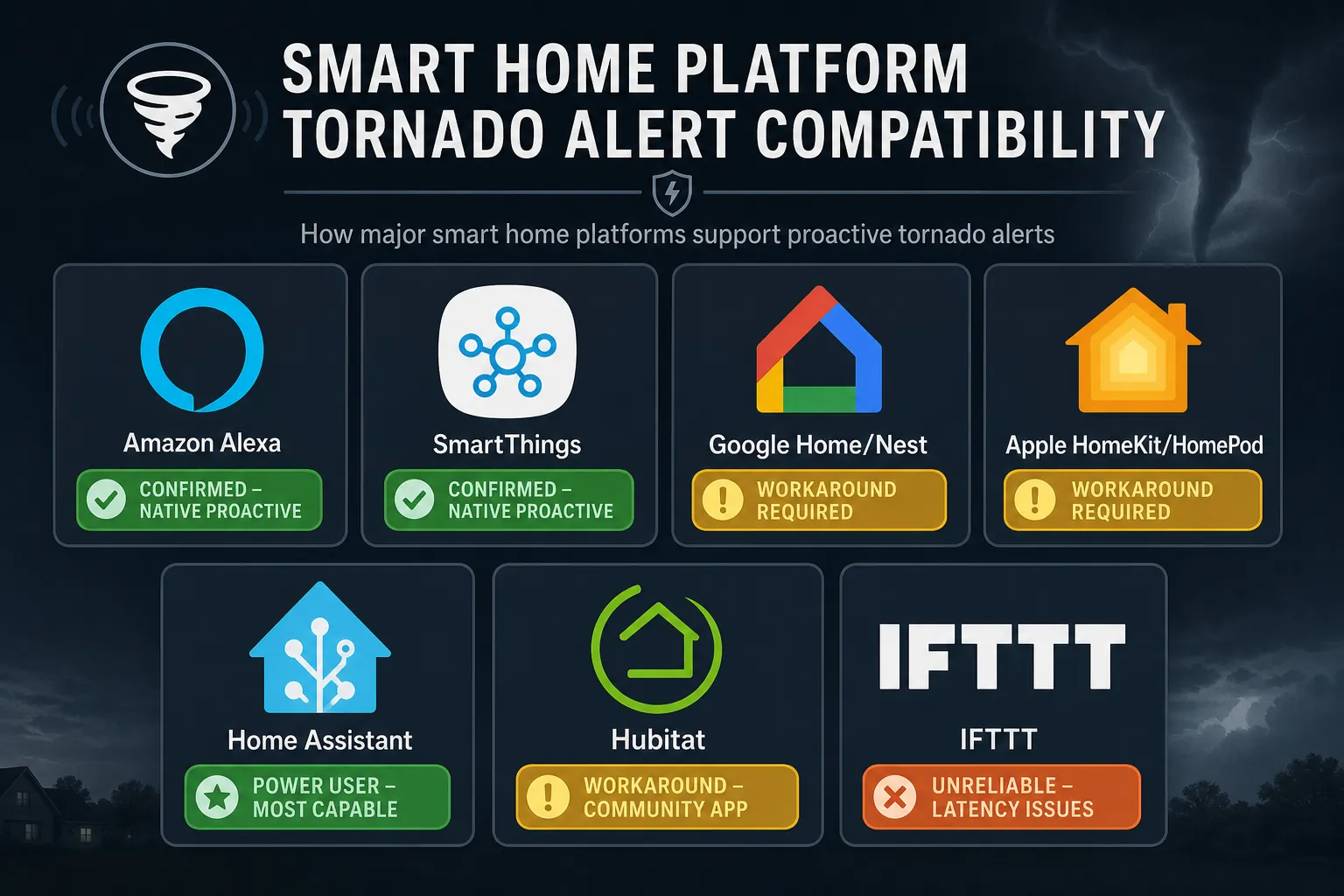
| Platform | Status as of Q3 2026 | What that means for smart home tornado weather alerts |
|---|---|---|
| Amazon Alexa / Echo | Confirmed - native proactive | Echo devices can be enabled for severe weather alerts by voice command, including the documented command: "Alexa, tell me when there's a severe weather alert." The feature is not a tornado-only filter, but it is proactive once enabled. [1] |
| SmartThings | Confirmed - native proactive | SmartThings can use the SmartWeather path with the Severe Weather Alert SmartApp to trigger automations from severe weather alerts. [2] |
| Google Home / Nest | Workaround required | Google's official Home help documents weather as a set of voice queries and spoken responses, not as a native proactive severe-weather alert channel. That is an absence-from-official-docs conclusion, not a direct Google denial. [3] |
| Apple HomeKit / HomePod | Workaround required | HomeKit and HomePod do not have a native path in the reviewed materials that turns iPhone government weather alerts into HomePod announcements. Treat this as an inferred limitation, not an explicit Apple statement. |
| Home Assistant | Power-user - most capable | The NWS Alerts custom integration can poll the NWS API every minute and supports severity-based automations, but it requires HACS and configuration rather than native mainstream setup. [4] |
| Hubitat | Workaround - community app | Hubitat users can use the NOAA Weather Alerts community app, which is useful but not the same as built-in platform support. [5] |
| IFTTT | Unreliable workaround | Weather Underground-triggered automations have been used for storm alerts, but the cited source warns of latency up to one hour; that is too loose for a tornado-warning path. [6] |
The compatibility line is narrower than most smart home marketing makes it sound. For this comparison, “native proactive” means the platform can initiate the alert for the household after setup, without someone first asking a speaker for the weather and without a custom alert stack maintained outside the mainstream app experience.
That definition matters because a smart speaker that answers “Is there a tornado warning?” is not doing the same job as one that wakes the room when the warning is issued. In a severe-weather moment, the missing step is often the dangerous one: nobody asks because everybody assumes the device will speak.
The Two Platforms That Clear The Native Proactive Bar
Amazon Alexa is the cleanest plug-and-play answer in this group. The documented setup is plain enough for a household member to understand: say, “Alexa, tell me when there's a severe weather alert,” and Alexa can provide automatic, proactive severe-weather warnings for the location associated with the device. Gearbrain described the feature in 2020 and documented that exact voice command. [1]
The important limitation is that Alexa's path is a severe-weather alert feature, not a finely tuned tornado-warning-only system in the materials reviewed here. For many households, that is still the right tradeoff: a native alert path that may be broader than desired is safer than a platform that waits for a voice query. The operational claim is simple: once the feature is enabled, the Echo is supposed to initiate the warning behavior instead of waiting for the user.
SmartThings also earns Confirmed status, though the path looks more like a hub automation environment than a speaker feature. The SmartThings Community thread describes using SmartWeather with the Severe Weather Alert SmartApp to trigger automations from severe weather alerts. [2]
That distinction is useful. Alexa is the better fit when the desired output is a simple household-facing spoken warning from an Echo. SmartThings is the better fit when the desired response includes switches, lights, sirens, or other automations tied to an alert condition. Both still belong in the native proactive tier because the platform path can start from the alert rather than from a person asking about conditions.
If you are looking for a setup walkthrough rather than a compatibility verdict, use a dedicated guide such as Set Up Severe Weather Notifications on Any Smart Home Hub or How to Set Up Smart Home Alerts for Local Tornado Warnings. The key point here is simpler: Echo and SmartThings are the only plug-and-play choices in the reviewed material that support proactive smart home tornado weather alerts without building a separate custom infrastructure.
Google Home Answers Weather Questions; That Is Not The Same As Warning You
Google Home and Nest devices are easy to overestimate here because they are good at weather queries. Google's official help page documents what users can ask Google Assistant about weather, including current conditions, forecasts, and related spoken responses. The support material is framed around user-initiated requests, not around a native severe-weather alert subscription that wakes a speaker or display on its own. [3]
That should be read carefully. The research does not include a Google-published sentence saying, “Google Home does not support proactive tornado alerts.” The limitation is inferred from the official support behavior Google documents, plus the absence of a documented native proactive severe-weather alert feature in the reviewed material. For a casual feature comparison, that might sound like hair-splitting. For tornado warnings, it is the difference between a documented alert path and a hope.
There are workaround ideas around Google Home, including third-party weather actions and routines. Those may be worth exploring for non-critical notification experiments, but they do not move Google Home/Nest into the native proactive tier for this article. A routine that depends on an indirect trigger path is not the same compatibility claim as Alexa's severe-weather alert feature or SmartThings' Severe Weather Alert SmartApp route.
HomePod Has The Same Assumption Problem In A Different Shape
Apple's risk is not that HomePod cannot speak. It is that many households reasonably assume the Apple devices around them form one warning surface. In the reviewed materials, the severe-weather and government-alert behavior is tied to the iPhone path, and there is no native HomeKit/HomePod route showing those alerts converted into HomePod announcements.
That is also an inferred limitation rather than a quoted Apple denial. The buyer-facing verdict still has to be firm: HomeKit and HomePod should not be treated as a native proactive tornado-alert platform unless Apple documents a supported path or the user builds a workaround through another system.
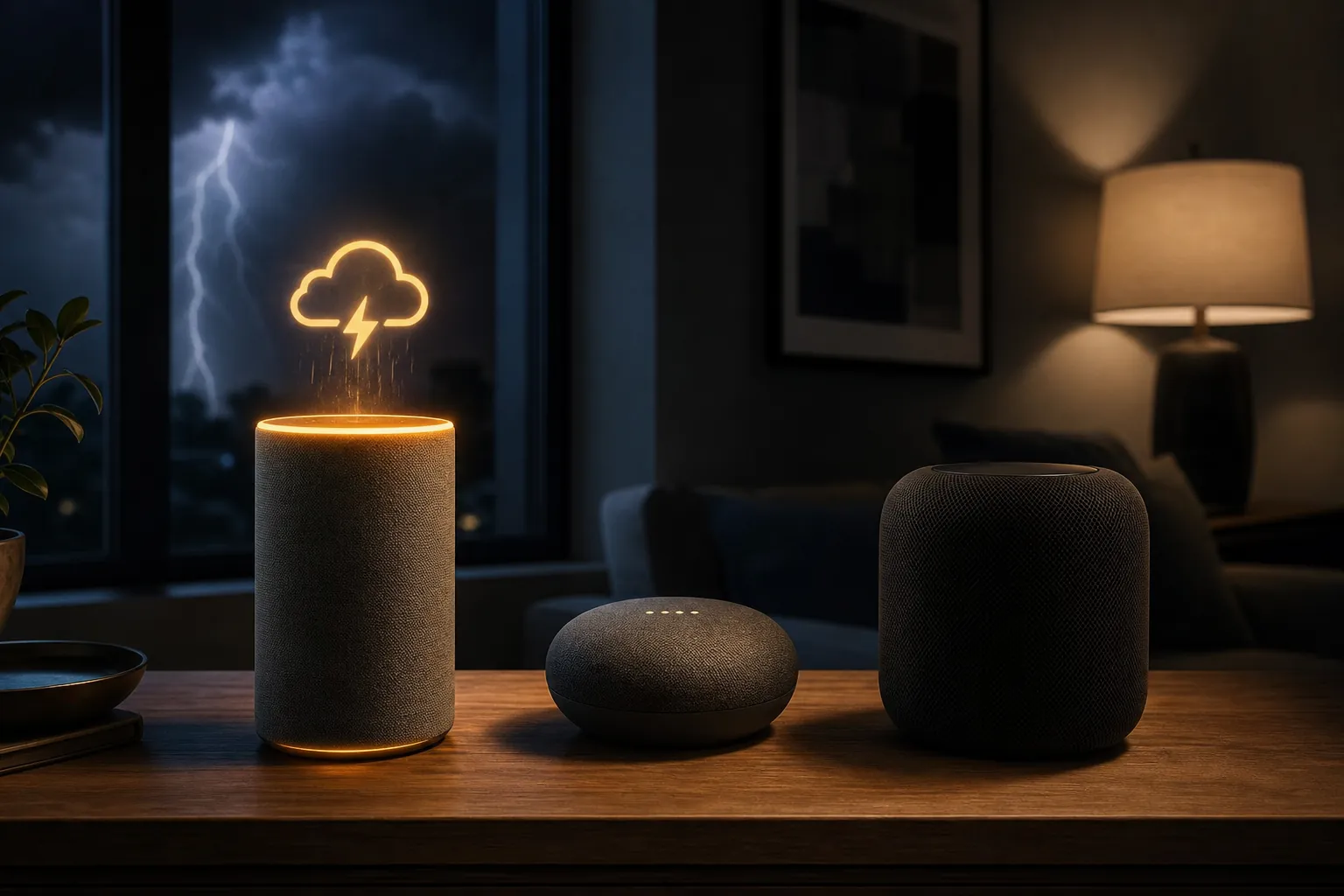
A Home Assistant bridge can make a HomePod part of an audio-announcement plan, but at that point HomePod is the speaker endpoint, not the native warning platform. That distinction is not pedantic. If the alert logic lives in Home Assistant, then Home Assistant is the system that must be installed, configured, monitored, and kept working.
Home Assistant Can Be Stronger Than Native, But It Is Not Plug-And-Play
Home Assistant is the platform in this comparison most likely to satisfy the person who wants control instead of reassurance. The NWS Alerts custom integration described in the reviewed guide supports polling the NWS API every minute and exposes four severity levels: Minor, Moderate, Severe, and Extreme. It can also drive different automation actions by severity. [4]
That is a better technical foundation than many consumer platforms offer. A Home Assistant user can decide that a Severe or Extreme alert should trigger lights, speakers, mobile notifications, wall panels, or other devices. The same alert can branch by severity instead of treating every weather event as the same kind of interruption.
The category problem is setup burden. The NWS Alerts route in the reviewed material requires HACS installation and configuration. [4] That makes it a power-user answer, not a native mainstream answer. It may be the best system for a household with someone willing to maintain Home Assistant, but it is not the same promise as buying an Echo, enabling severe weather alerts, and expecting the speaker to handle the rest.
There is also a version caveat. Custom integrations change, and the guide reviewed here describes a specific NWS Alerts route rather than a guaranteed forever-state of Home Assistant. Anyone choosing this route should verify the current integration behavior before trusting it in a real alert chain.
For implementation detail, a separate Home Assistant guide is the right place: How to Set Up Home Assistant for Tornado Warning Alerts covers the base path, while Build a Smart Home Tornado Safety Automation With Home Assistant belongs to the more advanced workflow. In this comparison, Home Assistant lands in its own lane: most capable, least plug-and-play.
Hubitat And IFTTT Are Workarounds, Not Native Warning Platforms
Hubitat has a plausible community route through the NOAA Weather Alerts app released in the Hubitat community. [5] That matters if you already run Hubitat and are comfortable installing community apps. It does not make Hubitat a native proactive tornado-alert platform in the same sense as Alexa or SmartThings.
IFTTT is weaker. A TidBITS article described using Weather Underground triggers with Philips Hue lights for hurricane and tornado alerts, but it also warned that IFTTT latency could be up to one hour. [6] Even with the caveat that this is a 2017 source and may not describe current performance, the absence of a current IFTTT latency guarantee keeps it out of the reliable tornado-warning category.
IFTTT can still be useful for low-stakes environmental cues: changing a lamp color for a forecast condition, logging weather events, or adding a redundant visual signal. It should not be the primary path for a warning where minutes matter.
What To Buy Or Keep If Tornado Alerts Are The Requirement
If the requirement is a smart home platform that can proactively announce or act on tornado-related severe weather alerts without custom infrastructure, the supported choices in the reviewed material are Amazon Echo and SmartThings. Echo is the simpler spoken-alert answer. SmartThings is the more automation-oriented native path.
If the requirement is maximum control and the household has someone willing to maintain the system, Home Assistant may be stronger than either. It can use NWS Alerts, severity levels, and custom automations in ways the mainstream platforms do not expose. But that is a different category of answer: it is an owned automation system, not a native consumer-platform feature.
Google Home/Nest and HomePod should not be assumed to provide proactive tornado warnings just because they can answer weather questions or participate in a smart home. Hubitat can be made useful through a community app. IFTTT is better treated as supplemental at most.
Smart home tornado weather alerts should supplement official warning channels, not replace them. Keep NWS, FEMA, Wireless Emergency Alerts, weather radio, and local authority guidance in the alert stack, then let the smart home add reach inside the house rather than carry the whole job.
References
- How to get automatic, proactive weather warnings from Alexa — Gearbrain, 2020
- Alexa and Weather Alerts — SmartThings Community
- Ask Google for weather information — Google Home Help
- How to Set Up NWS Alerts in Home Assistant (v6+ Guide) — This Smart House, 2025
- [RELEASE] NOAA Weather Alerts — Hubitat Community
- Using Philips Hue Lights as a Hurricane and Tornado Alert — TidBITS, 2017
Did this fix work for you?
Report whether this fix resolved your case, or flag a correction if firmware or app behavior has since changed.