
Will a Smart Sprinkler Controller Fix Your Brown Lawn?
Brown lawn patches while nearby grass stays green
Last updated
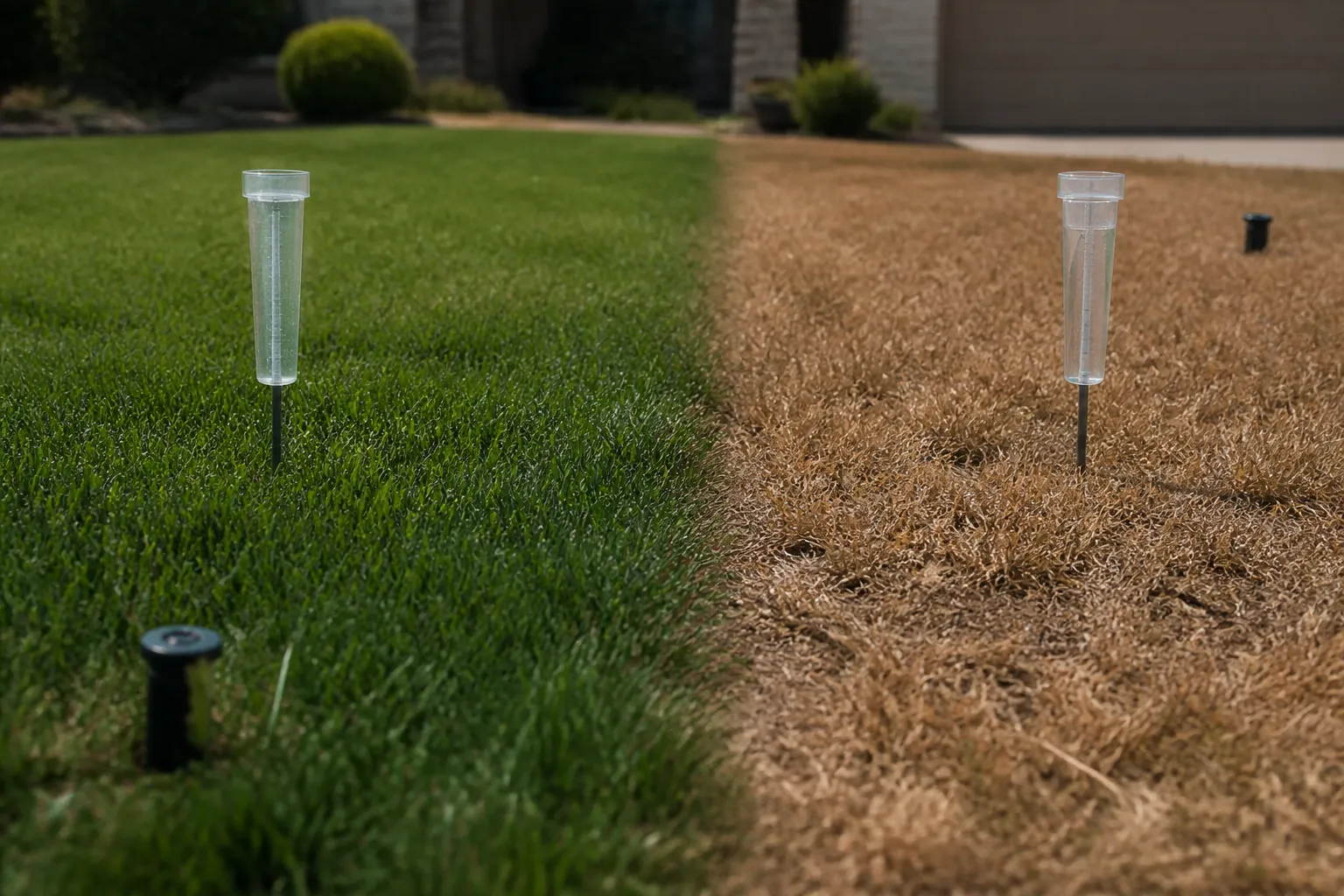
Before you buy a smart sprinkler controller to fix a brown lawn, put two rain gauges in the yard: one in the brown patch, one in a nearby green area served during the same sprinkler cycle. Run one normal watering cycle. Then look at the water depth in both gauges.
That small test is the purchase gate. If the brown area gets less water than the green area during the same cycle, the controller may be relevant because the current schedule is not getting enough water to that part of the lawn. If both gauges catch about the same amount, a new controller is mostly blind to the real failure. At that point, you are looking for a coverage problem, a broken or misaligned head, a leak, compacted soil, fungus, grubs, or another lawn-health issue before you spend $80–$300 on a new box.
The two-gauge test that should come before the controller
Use two matching rain gauges or straight-sided catch cups that will not tip over. Put one in the brown patch that is bothering you. Put the other in a nearby green area that should be receiving comparable irrigation. Do not move heads, change nozzles, add hose watering, or create a special test program first. The point is to measure what your lawn is already getting from the sprinkler system you are thinking about automating.
Run one standard cycle—the same cycle the controller runs now. When it finishes, compare the water depth in the two gauges. You are not trying to calculate a perfect irrigation audit from two cups. You are trying to separate two very different questions: did the brown area actually receive less water, or did it receive similar water and still stay brown?

A meaningful difference does not have to be a laboratory result. If the gauge in the brown patch clearly catches less water than the gauge in the green area, you have evidence that the brown section is being under-watered by the current setup. That could be because the zone runs too briefly, because the schedule is too rigid for the season, because the system skips needed deep watering, or because the controller keeps repeating shallow watering that wets the top and never carries moisture down where roots need it.
If both gauges show similar water depth, the decision changes. The lawn has just told you that the brown patch is not simply being skipped by the schedule. A smarter timer can decide when to run and for how long; it cannot make equally delivered water cure compacted soil, disease, insect damage, or damaged turf roots.
When the brown gauge catches less water
This is the result that keeps a smart controller in the conversation. The brown area is getting less water during a normal cycle, so the next question is why. Start with the current controller settings before you assume the whole system needs replacement. Look at the zone runtime, watering days, start times, seasonal adjustment, and whether the schedule still reflects spring conditions even though the lawn is now in summer stress.
A smart controller can help when the old setup is creating a bad watering pattern. Weather-based scheduling can reduce the habit of running the same program through changing conditions. Rain skip can stop the system from watering after rainfall. Seasonal adjustment can change runtime as water demand changes. App control can make it easier to correct a bad zone schedule instead of leaving it untouched because the controller is mounted in a garage or basement.
The useful word there is “schedule.” A smart controller is built to improve timing decisions. It can water less often but more appropriately, avoid needless cycles, and respond to weather inputs better than a fixed timer. If the brown patch is brown because the zone is not being given enough useful watering time, that is exactly the kind of failure a smart controller may correct.
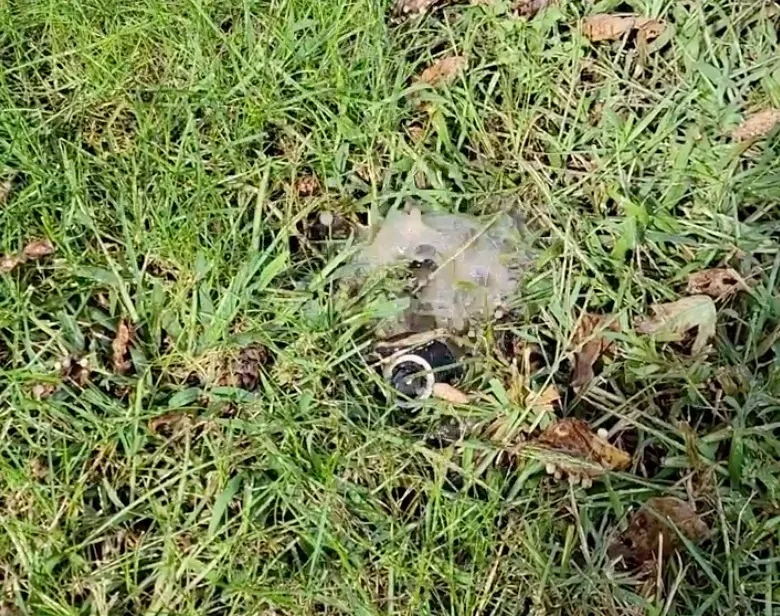
There is still one more check before buying: make sure the low gauge reading is not caused by a physical defect. Watch that zone run. A sunken head may spray into grass blades instead of across the lawn. A clogged nozzle may throw a weak fan. A tilted head may water the sidewalk. A leak may lower pressure before water reaches the far end of the zone. If the water is not physically reaching the brown patch, smarter scheduling just repeats the same bad delivery with better-looking software.
When both gauges catch about the same amount
Equal water in the gauges is the result that saves people from buying the wrong fix. The controller has already done its basic job for that cycle: it opened the valve and ran the zone long enough for both spots to receive similar water. If one area is still brown while the other stays green, the difference is likely happening after water leaves the sprinkler, not inside the timer.
Start with visible hardware anyway, because it is faster to confirm than soil or turf disease. Look for heads that do not pop up fully, nozzles blocked by grass, heads turned away from the patch, water bubbling around a fitting, or one head with a weak spray while the others perform normally. A controller can lengthen a cycle, but it cannot repair a cracked riser or rotate a spray pattern back onto the lawn.
Then look at the ground itself. Compacted soil can shed water or keep roots shallow even when the sprinkler is delivering water. Thatch or hard, dry soil can make a normal cycle look adequate in a gauge while the root zone remains stressed. In that case, aeration, soil improvement, or a change in watering depth may matter more than replacing the controller.
Also keep biological causes on the list. Fungus and grubs can leave brown areas that mimic drought stress from a distance. More automated watering will not treat those problems and can sometimes make diagnosis harder by adding another variable. If the brown patch pulls up loosely, shows irregular disease patterns, or keeps spreading despite even watering, the controller is no longer the main suspect.
What a smart controller can and cannot fix
| What the two-gauge test suggests | Likely next move | Is a smart controller a good fix? |
|---|---|---|
| Brown patch gauge catches clearly less water | Check zone runtime, frequency, seasonal adjustment, rain skip, and shallow repeat watering | Possibly, if no hardware fault is causing the low water |
| Both gauges catch similar water | Inspect heads, nozzles, pressure, leaks, soil compaction, fungus, grubs, and turf condition | Usually no, not as the first fix |
| Brown patch gets less water and a head is visibly blocked, sunken, broken, or misaligned | Repair the irrigation hardware first, then retest | Not yet |
| Water delivery looks even but the brown area continues to decline | Investigate soil and lawn-health causes | No, unless a separate scheduling problem is also found |
This boundary is not just a cautious homeowner rule. A 2024 ASCE review of 80 studies on residential smart irrigation controllers reached the same practical limit: a smart controller “cannot compensate for poor irrigation design, leaks, or lack of maintenance.” [1]
That sentence matters because it stops the feature list from taking over the decision. Weather adjustment, app scheduling, and automatic skips are useful when the failure is timing. They are not substitutes for head spacing, pressure, nozzle condition, valve performance, soil structure, or turf health.
How to make the buy-or-fix decision
Buy or install a smart sprinkler controller when the brown area proves it is receiving less water during a normal cycle and the hardware inspection does not reveal a delivery fault. In that case, the current controller may be watering at the wrong frequency, for the wrong duration, at the wrong season, or in a shallow pattern that never gives the lawn a useful soak.
Do not buy the controller first when the two gauges show similar water depth, or when the test exposes a visibly bad sprinkler head, weak spray, blocked nozzle, leak, or pressure problem. Fix the delivery problem, then run the test again. If the lawn still shows stress after water is delivered evenly, move from irrigation diagnosis to soil and turf diagnosis.
The brown patch is allowed to disappoint your shopping cart. A smart controller is a good fix only after the lawn has proved that timing—not delivery, soil, or turf health—is the thing failing.
References
- Smart Irrigation Controllers in Residential Applications — ASCE, 2024.
Corroborating context
For protocol background on why this failure happens, see Compatibility & Protocols.
Not currently linked to a known regression. Background on the underlying protocol lives in Compatibility & Protocols.