
Can Your Smart Camera Face a Bathroom? Legal Boundaries Explained
Camera placement may violate privacy laws near bathrooms
Last updated
The risky camera is often not the one hidden inside a bathroom. It is the one mounted in the hallway, bought for a perfectly ordinary reason, angled toward a bathroom door because that hallway also leads to the garage, the nursery, or the front entry. Add a 130- to 180-degree lens, a pan-tilt base, a microphone, and cloud recording, and the sentence “it only watches the hallway” starts to need proof.
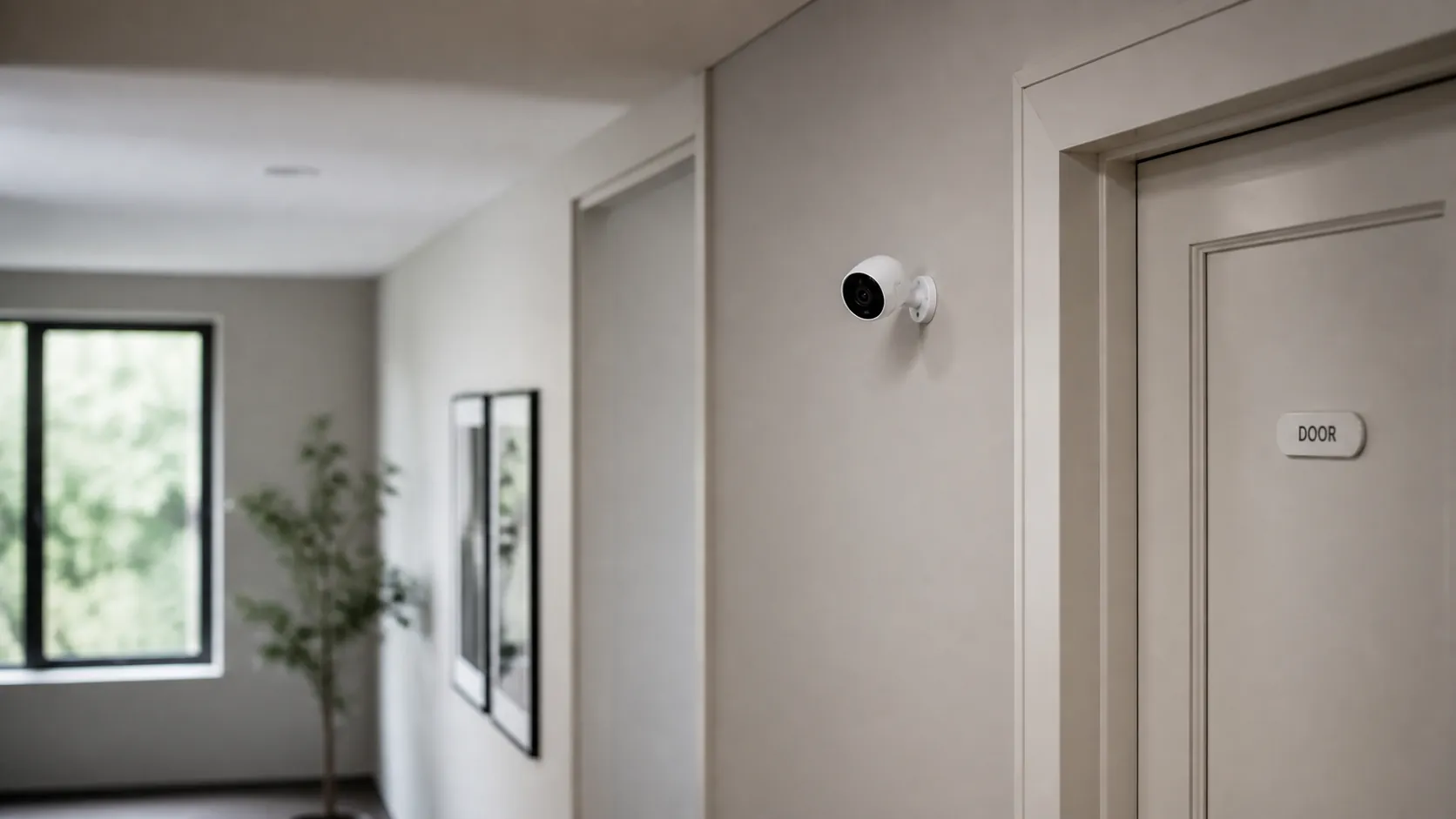
For smart-home owners worried about hidden cameras in bathrooms and related legal issues, the first question should be less about whether the device is disguised and more about what it can actually see or record. A visible smart camera can still create a privacy violation if it captures a bathroom, changing area, guest bedroom, locker-room-like space, or another place where a person reasonably expects privacy.
The practical test is strict: start with the privacy expectation of the space, then trace the camera’s real capture path. Do not stop at the mounting location. Check the lens, the angle, the sweep, the audio range, the app controls, and what gets saved.
The legal line starts with reasonable expectation of privacy
The anchor concept is the “reasonable expectation of privacy” test associated with Katz v. United States, decided in 1967. Smart-home camera guides commonly use that framework to explain why bathrooms sit on the protected side of the line: people expect privacy there, and the law generally treats that expectation as strong regardless of why the camera owner wanted the footage.[1]
That matters because “hidden” is not the whole question. Some state statutes focus on concealed cameras; others use broader privacy, intrusion, or Peeping Tom theories. But the placement problem keeps returning to the same practical issue: can the device view or record a private area? Security-camera legality guides describe bathrooms, changing rooms, locker rooms, and bedrooms used for private activities as places where camera placement can violate privacy even when the device is not secretly installed.[2][3]
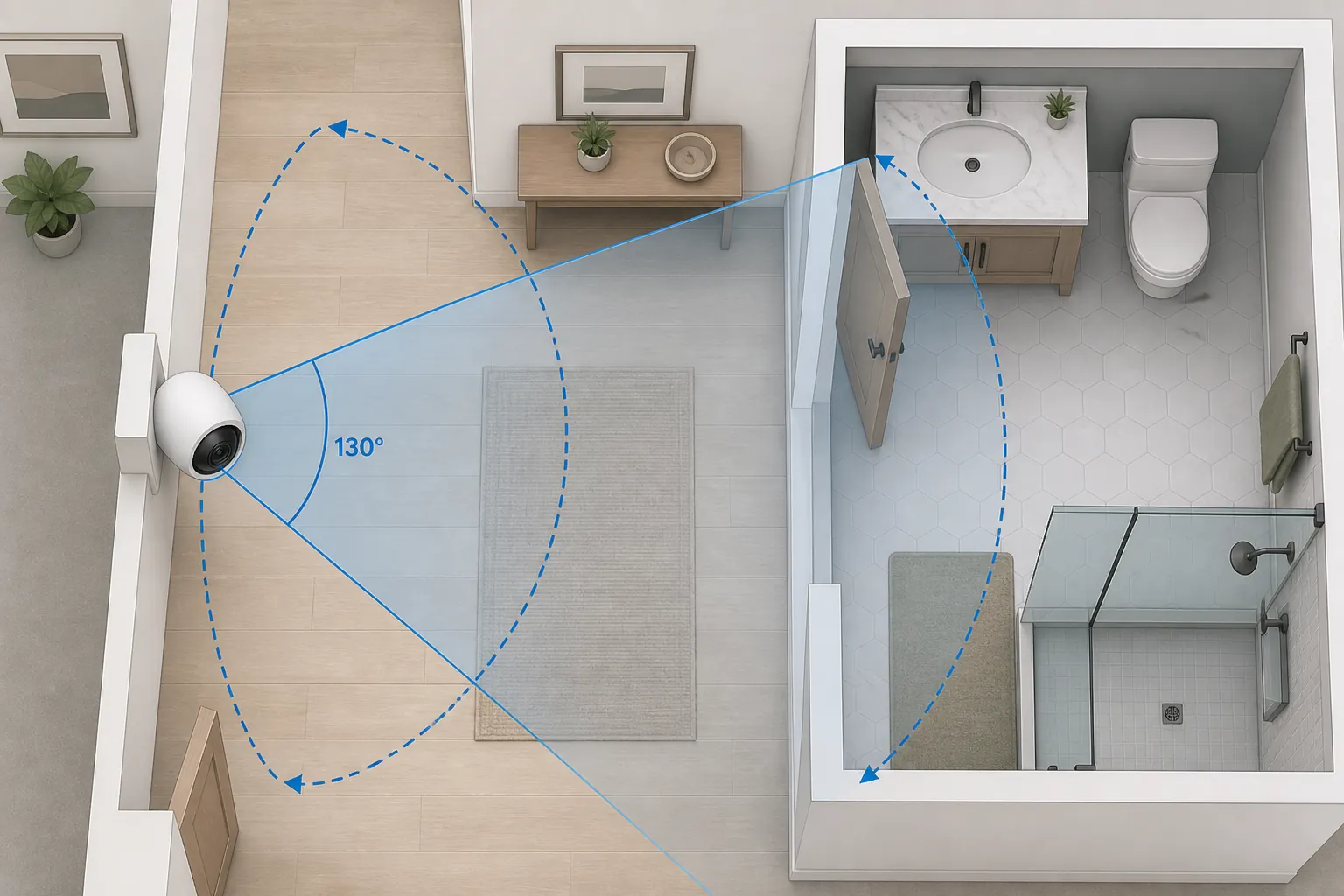
A bathroom is the easiest example because the privacy expectation is not subtle. A camera inside the bathroom is an obvious red line. A camera outside the bathroom can also become a problem if its lens sees through the doorway, captures someone entering or leaving in a state of undress, records a mirror reflection, or can be rotated to look inside.
This is not a nationwide legal opinion for every home, lease, or state statute. State laws vary, and local counsel is the right place to take a specific fact pattern. But for placement decisions, “I bought it for security” is a weak safety check. The better question is whether a guest, tenant, cleaner, child’s friend, or overnight visitor would reasonably believe the area in view was private.
A hallway camera can still cross the bathroom boundary
The cleanest legal setup is a camera that cannot see into the bathroom at all: not through an open door, not through a mirror, not from a low angle, not when the device turns. If the bathroom door is in frame, the camera owner should assume the setup needs closer inspection rather than assuming the door itself solves the problem.
| Camera situation | Why it is risky |
|---|---|
| Lens points directly into a bathroom | The device can capture a space where privacy is strongly expected. |
| Hallway camera faces a bathroom doorway | The camera may record private activity when the door opens, even if it is mounted outside. |
| Pan-tilt camera can rotate toward the bathroom | Remote movement can make the private area viewable after installation. |
| Wide-angle lens includes part of the doorway | The owner may think the view is narrow while the recorded frame is much wider. |
| Camera watches a guest bedroom or changing area | The same privacy logic applies outside bathrooms when people undress or sleep. |
| Microphone remains active nearby | Audio consent laws can create separate exposure even when the video angle is corrected. |
The doorway case is where many smart-home installs go wrong. A homeowner thinks the camera is watching the hallway. The camera is actually watching every bathroom entry and exit, and when the door opens it may catch the interior. Even a few seconds can matter if the recording shows a person where they are entitled to be private.
Guest bedrooms deserve the same sober treatment. A room may be ordinary living space at noon and a private sleeping or changing area at night. If a camera in a hallway or shared room sees into a guest bedroom, the issue is not solved by saying the camera is visible. Visibility may affect notice, but it does not erase the privacy expectation of the area being captured.
Intent is not a reliable defense
A security purpose can explain why a camera was installed. It does not automatically make the capture lawful. The San Luis Obispo gym owner case is the hard reminder: the defendant said cameras were installed to “catch a thief,” but the court rejected that good-intent explanation as a shield against liability.[4]
That is the right lesson for smart homes. The law is not only interested in the story behind the device. It is interested in what the device recorded, where the person was, and whether privacy was reasonably expected there. A camera owner who records a private area has already created the problem before anyone opens the app and explains the motive.
This also cuts against the common “but everyone can see the camera” argument. A visible camera in a living room may be acceptable in some homes when people have notice and the camera does not capture private spaces. A visible camera aimed into a bathroom doorway is a different thing. The person being recorded did not lose the bathroom’s privacy expectation because the device had a status light.
Smart cameras add capture paths owners forget to test
Older fixed cameras made the placement problem easier to see. Many current indoor cameras complicate it. They have wider lenses, remote pan-tilt controls, motion tracking, microphones, app sharing, and cloud clips. Each feature can widen the gap between the camera the owner thinks they installed and the camera a guest is actually living with.
Pan-tilt sweep
A pan-tilt camera should be judged by its full possible sweep, not just its resting position. If the camera normally faces the hallway but can be rotated from the app into a bathroom, the private area is still within the device’s capture path. That risk is sharper when more than one household member has app access or when the camera supports saved viewing positions.
Wide-angle spillover
Wide-angle lenses can catch more than the installer notices while standing under the mount. Smart-camera models with 130- to 180-degree fields of view make this a common gotcha: the center of the frame may be the hallway, while the edge of the frame includes the bathroom doorway. That edge still records.
Do not test the view only with the bathroom door closed. Open the door. Turn on the bathroom light at night. Stand where a guest would stand. Check the live view and the saved clip, because compression, motion-triggered framing, thumbnails, and app previews can expose details the small live-view screen made easy to miss.
Audio pickup
Audio is a separate risk layer. SafeWise identifies all-party-consent rules for audio recording in states including California, Florida, Illinois, Maryland, Massachusetts, Michigan, Montana, New Hampshire, Pennsylvania, and Washington.[2]
The important point is not that every hallway microphone is illegal. It is that a smart camera can be legally angled for video and still create a problem by recording voices in a place where consent rules apply. Bathroom-adjacent placement makes that more uncomfortable because audio may capture private conversations, calls, or sounds from behind a closed door.
Cloud clips and shared access
Cloud storage does not create the privacy expectation, but it can make the consequence worse. A live view that should never have included a bathroom becomes a retained clip. A retained clip may be downloadable, shareable, synced to another device, or accessible to someone who did not install the camera. Once private footage exists, deleting it later is not the same as never recording it.
This is why placement deserves to be settled before automation is turned on. Motion zones, person detection, and clip retention settings are useful, but they are not substitutes for a lens that physically cannot see the private space.
Privacy zones help, but they should not be the legal foundation
Privacy zones are worth using. A well-configured mask can block a bathroom door, a neighbor’s window, or another sensitive part of the frame. For the brand-by-brand setup work, use this guide to smart camera privacy zones.
For legal risk control, though, treat masking as a supplement. No published court case has settled whether a smart-camera privacy-zone setting is a sufficient legal barrier when the camera’s physical position could theoretically capture a private area. That uncertainty should push the install toward physical prevention: move the camera, narrow the angle, use a fixed mount, or choose a different device.
Software settings can be changed by an app update, reset by a new owner, misdrawn on a small screen, or bypassed by another camera mode. A camera that cannot see the bathroom is safer than a camera that can see it but promises not to show it.
How close is too close?
There is no useful universal inch measurement. Homes are too different, and state law is too varied. The better placement test is functional: if the camera can see, sweep into, or record audio from a bathroom or comparable private space, it is too close for a conservative smart-home setup.
- Stand in the most private area nearby, then check whether the camera can see you directly, through a doorway, through a mirror, or at the edge of the frame.
- Open the bathroom or guest-room door and review both the live view and a saved motion clip.
- Rotate any pan-tilt camera through its full app-controlled range, not just the default position.
- Disable audio if the camera sits near bathrooms, bedrooms, or other spaces where private conversations may be picked up, especially in all-party-consent states.
- Limit cloud retention and shared access so an accidental capture does not become a stored and distributed clip.
- Use privacy zones only after the physical view is already safe.
This is also the point where leases, houseguest arrangements, and local law matter. At least 15 states have specific video-surveillance statutes, while others rely on tort law such as intrusion upon seclusion or on Peeping Tom laws. A landlord, short-term rental host, roommate, or homeowner with regular workers in the house should not treat a consumer-camera setup screen as legal clearance.
Penalties are real, but they vary by jurisdiction
Penalty numbers should not be the main reason to keep cameras out of private spaces, but they are not symbolic. Camera-law summaries describe exposure that can range from misdemeanor treatment, including up to 6 months in jail and a $1,000 fine, to felony charges, multi-year prison sentences, and sex-offender registration depending on the state and the facts.[5][6]
Those ranges are broad because the statutes are broad. A hidden camera in a bathroom, a visible hallway camera that records inside a bathroom, a camera aimed at a changing area, and a device that captures audio without required consent may be treated differently depending on jurisdiction. The safe installation standard should be stricter than the most forgiving legal argument a camera owner hopes to make later.
The conservative smart-home standard
A smart camera can face a hallway near a bathroom only if its actual capture path stays out of the bathroom and comparable private spaces. That means no direct view, no doorway spillover when the door opens, no pan-tilt sweep into the room, no mirror path, and no unnecessary audio pickup.
If the device can see, sweep into, or hear a bathroom, move it. If moving it is impossible, narrow the field, fix the angle, disable audio where needed, reduce retention, and use privacy zones as an added guardrail rather than the foundation of the setup.
References
- Security Camera Laws, Rights, and Rules, Security.org
- Security Camera Laws by State, SafeWise
- Is Security Camera in Bathrooms Legal?, Reolink Blog
- SLO gym owner case, San Luis Obispo Tribune
- Hidden Camera Laws, BrickHouse Security
- Are cameras in bathrooms illegal in California?, Shouse Law
Corroborating context
For protocol background on why this failure happens, see Compatibility & Protocols.
Not currently linked to a known regression. Background on the underlying protocol lives in Compatibility & Protocols.