Does the FCC ban affect your Roomba?
Concern that FCC ban affects existing Roomba or triggers c181/c182 errors
Last updated
As of July 31, 2026, the practical answer is simple: if your Roomba is already in your home, the FCC action does not make it illegal, does not order it offline, and does not tell iRobot to stop your app syncs or firmware updates. The FCC’s own FAQ says the Covered List addition “does not restrict the continued use by consumers of previously-purchased devices,” and it also says there are no restrictions on consumers’ ability to use previously purchased covered equipment or covered services.[1]
Status board, verified July 31, 2026
| Claim status | What is true today | What that means for a Roomba owner |
|---|---|---|
| Confirmed | The FCC action does not restrict consumers’ continued use of previously purchased devices.[1] | Do not factory-reset, unplug, return, or replace a working Roomba because of the FCC action. |
| Confirmed | Adding a device category to the Covered List does not prohibit import, sale, or use of existing device models that were previously authorized.[1] | A Roomba model that was already FCC-authorized is not suddenly unsellable or unusable just because the category was added. |
| Confirmed, with limits | The FCC Office of Engineering and Technology issued a blanket waiver allowing certain software and firmware permissive changes for already-authorized covered equipment at least until January 1, 2029; PCMag reported the waiver as applying to already-authorized robot vacuums.[2][3] | January 1, 2029 is a minimum waiver window for certain software/firmware changes, not an iRobot support promise and not a hardware-change permission slip. |
| Confirmed as a vendor statement | iRobot says existing products continue to be supported, app functionality and data security are unchanged, software updates continue where applicable, and warranties continue.[4] | Useful, but secondary: the FCC FAQ and OET waiver are the stronger sources for what the government action does and does not do. |
| Derived | Future Roomba models are plausibly affected because the new category covers foreign-produced advanced robotic devices, and the definition is broad enough to fit many networked, sensor-equipped, self-navigating robot vacuums.[5][6][7] | The uncertain zone is future imports and new-model authorization, not the Roomba currently parked under your console table. |
| Investigating | Current c181/c182 error-code rumors are not confirmed as FCC-related failures. iRobot’s own support material treats c181/c182 as connectivity error codes, not as a regulatory lockout.[8] | Troubleshoot the robot as a device problem unless confirmed evidence ties a failure to the FCC action. |
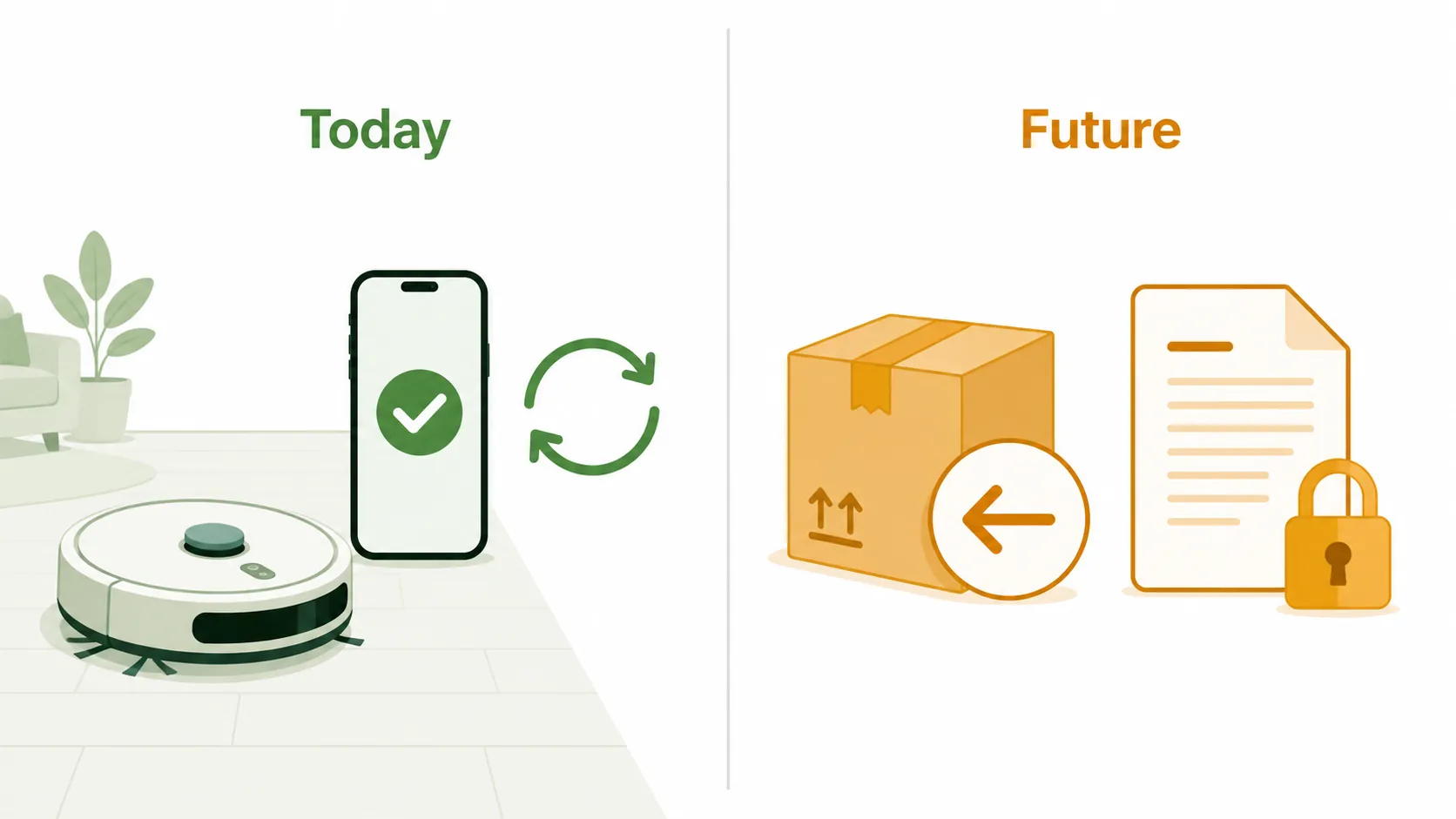
That middle row is where a lot of panic starts. “Firmware update” sounds like a living connection between your robot and a banned product category. The FCC did not cut that connection for already-authorized devices. The OET waiver is specifically about allowing certain software and firmware changes to continue for equipment that already had authorization, with the stated window running at least until January 1, 2029.[2]
The same waiver does not mean every future feature, part revision, dock redesign, or hardware change gets a free pass. Wiley’s client alert on the order notes that hardware changes to previously authorized products remain prohibited absent a separate waiver, and that Conditional Approvals for advanced robotic devices can only be granted by the Department of War.[5]
Use the decision tree, not the headline
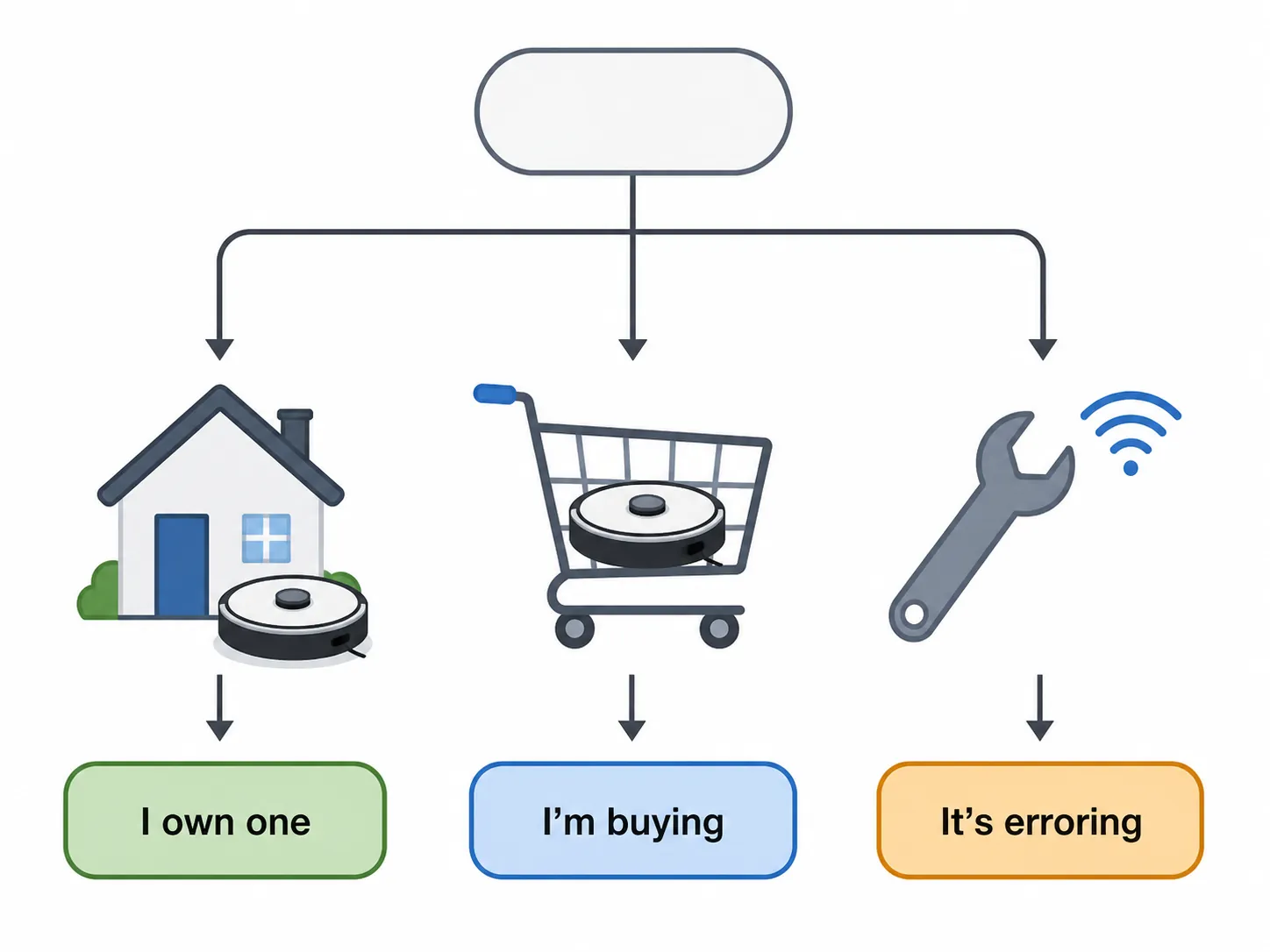
- I already own a Roomba: keep using it. Do not treat the FCC action as a reason to reset, disconnect, block updates, or replace a working robot.
- I want to buy one: separate already-authorized, currently sellable models from future models that may need new equipment authorization.
- My Roomba just started erroring: troubleshoot Wi-Fi, docking, app, and update mechanics first. Do not label c181/c182 or sync failures as ban-related without evidence.
If you already own a Roomba
Leave it alone if it is cleaning, docking, syncing, and updating normally. The FCC FAQ is direct on the consumer-use point: the Covered List addition does not restrict continued use of previously purchased devices.[1]
That means the FCC action is not a reason to:
- factory-reset a working Roomba;
- remove it from Wi-Fi;
- turn off app access;
- block firmware updates;
- return a robot that was working yesterday;
- assume your warranty or app account has been voided by Washington.
The distinction is dull, but it matters: consumer use is not the same thing as equipment authorization. A device can be restricted for future authorization while existing owners remain allowed to keep using previously purchased units. That is exactly the distinction the FCC FAQ makes.[1]
The app and update question
iRobot says existing products continue to be supported, app functionality and data security are unchanged, software updates continue where applicable, and warranties continue.[4] That statement is reassuring for normal ownership, but it should not be inflated into something it is not. A vendor support page cannot override an FCC rule; it can only describe what iRobot says it is doing.
The stronger update answer comes from the OET waiver. For already-authorized devices, certain software and firmware permissive changes are allowed to continue at least until January 1, 2029.[2] Read that date carefully. It is not a promise that every Roomba will receive updates until that day. It is also not a cutoff date saying support ends on January 1, 2029. It is the minimum window stated in the waiver for the covered software/firmware authorization pathway.
If you are shopping for a Roomba
For a buyer, the question is not “Are Roombas illegal?” It is “Is this particular model already authorized and currently sellable, or am I looking at a future model that may run into new authorization barriers?”
The FCC FAQ says the Covered List addition does not prohibit import, sale, or use of existing device models that were previously authorized.[1] So a current, already-authorized model on a retailer shelf sits in a different bucket from a future Roomba design that still needs equipment authorization.
| Shopping situation | Risk level | Sensible move |
|---|---|---|
| You are buying a current model from a normal retailer | Lower, if the model was already FCC-authorized | Keep the receipt, verify warranty terms, and do not assume the model is banned merely because it is a robot vacuum. |
| You are waiting for a future Roomba generation | Higher regulatory uncertainty | Watch whether the model receives authorization, whether iRobot changes launch timing, or whether the company explains the implementation path. |
| You are buying used | Mostly ordinary used-device risk | Check battery health, dock, app pairing, account transfer, and parts availability. The FCC action does not make a previously purchased unit illegal to use. |
If a seller is using the FCC story to pressure you into a rushed purchase or a panic return, slow down. The category change matters most where a product needs a new approval, not where an existing owner is simply running a robot that was already in the market.
If your Roomba just started throwing an error
Treat this as an ordinary troubleshooting problem first. A Roomba can lose Wi-Fi, fail to sync, miss an update, get confused on its dock, or throw an error code for reasons that have nothing to do with the FCC.
For c181/c182 specifically, the current safe status label is Investigating, not Confirmed. iRobot’s support material identifies “Connectivity Error Codes c181/c182” as a support topic, which points toward network or app communication troubleshooting rather than a regulatory shutdown.[8] Separately, iRobot’s software-update guidance says the robot needs Wi-Fi and its dock, and that updates can take up to 24 hours.[9]
Do this before blaming the ban:
- Check that your home Wi-Fi is working for other devices near the robot’s dock.
- Make sure the robot is properly seated on the dock and charging.
- Open the iRobot app and see whether the robot is offline, pending an update, or asking for a normal setup step.
- If an update is pending, give the normal update process time before escalating.
- If the same code repeats, use iRobot support channels and document the exact model, app version, firmware version if visible, router changes, and time the error began.
The important thing is sequence. Resetting a robot, deleting maps, changing router settings, or unlinking an account can create a second problem on top of the first one. Nothing in the FCC FAQ says a consumer needs to take those steps because of the July 28 action.[1]
What actually changed
On July 28, 2026, the FCC added categories for foreign-produced power inverters and advanced robotic devices to the Covered List.[7] The agency did not name iRobot in that action, and the Covered List page does not show an iRobot entity entry as the basis for a company-specific ban.[7]
That is why the “future Roombas may be covered” conclusion needs a label. It is Derived, not Confirmed as an iRobot-specific FCC declaration. iRobot has said it is aware of the FCC’s recent action and is working with the agency to better understand implementation and potential impact.[6]
The reason future robot vacuums are plausibly swept in is the definition. The FCC’s National Security Division definition describes an advanced robotic device as a ground-mobile device over 4.4 pounds including the dock, with sensors, network connectivity of at least 200 kbps, and navigation software including AI/ML weights.[10] A modern mapping robot vacuum commonly has the basic ingredients that make this category relevant: it moves on the ground, docks, senses its environment, connects to a network, and navigates with onboard software.
| Regulatory bucket | Existing Roomba in your home | Current already-authorized model | Future model or hardware revision |
|---|---|---|---|
| Consumer use | Allowed to continue; FCC says continued consumer use is not restricted.[1] | Not the main issue once purchased and used by the consumer.[1] | Depends first on whether the product can lawfully reach authorization and sale. |
| Sale/import of existing models | Not relevant to the unit already in your home | FCC FAQ says adding a category does not prohibit import or sale of existing device models that were previously authorized.[1] | Not the safe bucket if the product needs new authorization. |
| Software/firmware changes | Certain permissive software/firmware changes can continue under the OET waiver at least until January 1, 2029.[2] | Same, if the model is already authorized and the change fits the waiver.[2] | Not a substitute for approval of a new model. |
| Hardware changes | No reason for the owner to act | Hardware changes remain prohibited absent a separate waiver, according to Wiley’s analysis.[5] | This is where redesigns and new hardware can run into the new restriction. |
| New equipment authorization | Not needed for your existing unit | Already completed if the model was previously authorized | Potentially blocked unless the required Conditional Approval path is satisfied.[5] |
The compressed timeline
- October 28–29, 2025: the FCC adopted safeguards that set up the equipment-authorization consequences now being applied to new Covered List categories.[5]
- December 15, 2025: Reuters reported that iRobot entered Chapter 11, with its lender set to acquire the Roomba maker.[11]
- January 2026: coverage of the acquisition placed iRobot under Picea’s ownership, which is part of why future foreign-produced Roombas entered the regulatory conversation.[12]
- July 28, 2026: the FCC added foreign-produced advanced robotic devices to the Covered List category structure.[7]
Your next move
| Your situation | What to do now |
|---|---|
| Your Roomba is cleaning and syncing | Leave it alone. Keep normal app and firmware behavior enabled. |
| You own a Roomba but are worried about legality | No owner-side fix is needed. The FCC says continued consumer use of previously purchased devices is not restricted.[1] |
| You are buying now | Prefer clearly identified current models from normal retail channels, keep documentation, and understand that future models are the uncertain zone. |
| You are waiting for the next generation | Watch for model-specific authorization and iRobot implementation updates rather than assuming every future product will launch on the old schedule. |
| Your robot just errored | Troubleshoot Wi-Fi, docking, app state, and update timing as an ordinary device issue before tying it to the FCC action. |
If the robot in front of you is working, the correct fix is no fix. If you are shopping, verify the model rather than the rumor. If you are troubleshooting, follow the device trail first: network, dock, app, update process, then iRobot support.
References
- Covered List FAQs: Robots and Inverters — FCC, July 28, 2026.
- DA-26-789A1 — FCC.
- FCC Ban on Foreign-Made Robots Includes Robot Vacuums — PCMag, July 29, 2026.
- iRobot is Here to Stay — iRobot.
- FCC Adds Foreign-Produced Power Inverters and Advanced Robotic Devices to the Covered List — Wiley, July 30, 2026.
- Robotic vacuums swept up in new US crackdown over national security risks — Fox Business.
- Covered List — FCC, July 28, 2026.
- Connectivity Error Codes c181/c182 — iRobot.
- Software update mechanics — iRobot.
- Robots NSD — FCC.
- iRobot enters Chapter 11; lender to acquire Roomba maker — Reuters, December 15, 2025.
- FCC Rule Banning Foreign Robots Could Sweep Up New Home Robot Vacuums — CNET.
Corroborating context
For protocol background on why this failure happens, see Compatibility & Protocols.
Not currently linked to a known regression. Background on the underlying protocol lives in Compatibility & Protocols.