
Don't Wait for an iPhone 18 Pro Max Price Drop to Build Your Smart Home
iPhone 18 Pro Max alone does not provide always-on Apple Home hub functionality
Last updated
The confusing part of the “iPhone 18 Pro Max HomeKit smart home controller price drop” story is that there are two prices being discussed, and only one of them belongs to a customer. The reported 20% reduction is Apple’s OLED panel procurement target. Apple is reportedly pushing Samsung Display and LG Display toward about $66.50 per iPhone 18 Pro Max OLED panel, down from roughly $83 for the iPhone 17 Pro Max panel cost.[1] That is a supplier negotiation, not a retail sale.
The consumer-side price story points the other way. The iPhone 18 Pro Max is projected to start around $1,349–$1,399, which would be a $200-plus increase over the iPhone 17 Pro Max.[2] 9to5Mac has also floated a higher possible ceiling of up to $1,499, tying the pressure to the global memory crisis, 12GB RAM, and Apple’s expected 2nm A20 Pro chip.[3] None of that is Apple-confirmed pricing, because the iPhone 18 Pro Max has not shipped yet. But it is enough to kill the idea that a panel-cost cut is a smart-home buyer discount.
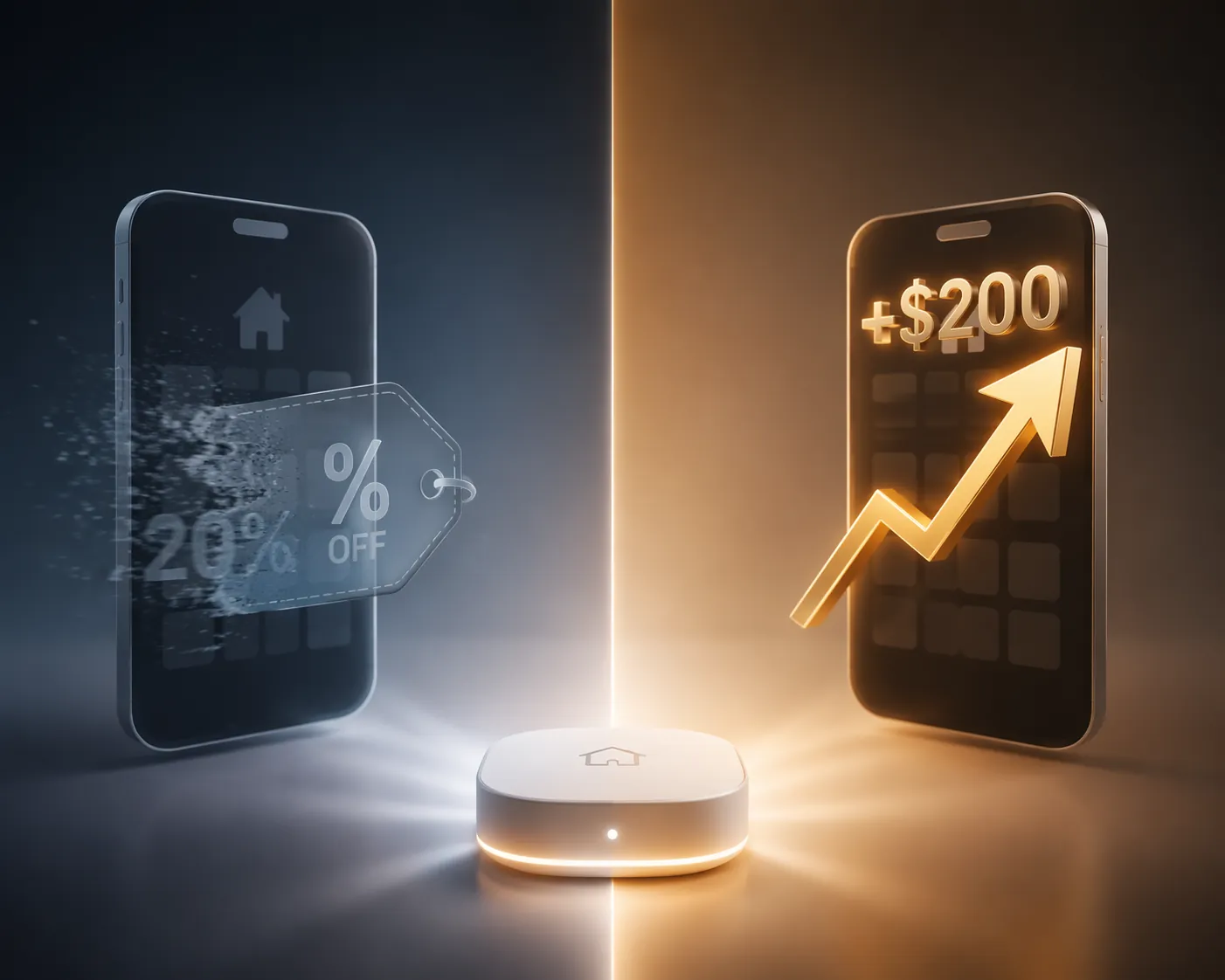
The OLED savings do not solve a HomeKit problem
A lower OLED bill can matter to Apple’s margins, supply chain, or product planning. It does not make your door lock reachable when you are across town. It does not make a camera record when your phone leaves the house. It does not give your Thread devices a border router. Those are home-infrastructure jobs, and a phone is the wrong place to anchor them.
That distinction matters because the iPhone 18 Pro Max may be an excellent phone if Apple’s usual Pro Max pattern holds: better display hardware, a faster chip, more memory, and high-end camera work are all plausible reasons to want it. Those upgrades may make the phone nicer to use as a Home app screen. They do not turn it into an always-on Apple Home hub.
The 9to5Mac pricing context also cuts against waiting for relief: the same report says the memory-cost pressure could last “for a couple more years.”[3] So even if Apple wins a cheaper OLED panel, other component costs can still push the retail price up. A smart-home purchase plan that depends on Apple passing panel savings to buyers is building on the least useful part of the rumor.
The better comparison is phone-only versus phone-plus-hub
For smart-home use, the dollar-for-dollar comparison is blunt. A current iPhone 17 Pro Max is listed around $1,199 in the July 2026 pricing context, and an Apple TV 4K hub is $129.[3][4] Together, that is $1,328. The projected iPhone 18 Pro Max alone would start above that, at $1,349–$1,399, before getting into the higher $1,499 possibility.[2][3]
| Choice | Out-of-pocket price | What it does for Apple Home | What it still does not do |
|---|---|---|---|
| Wait for the projected iPhone 18 Pro Max | $1,349–$1,399 projected starting price; one analysis suggests up to $1,499.[2][3] | Gives you the next premium iPhone and a strong Home app controller screen. | Still does not function as a full Apple Home hub, Thread border router, automation executor, or HomeKit Secure Video recorder. |
| Buy a current iPhone 17 Pro Max plus Apple TV 4K | $1,199 plus $129, totaling $1,328.[3][4] | Gives you a premium iPhone and an always-on home hub with Thread border-router support, HomeKit Secure Video NVR role, and local automation execution.[4] | Does not give you the rumored next-generation phone hardware. |
That table is the part most phone-upgrade discussions skip. The cheaper smart-home setup is not the older phone by itself. It is the older phone plus the box that stays home, stays powered, and does the boring work your automations need.
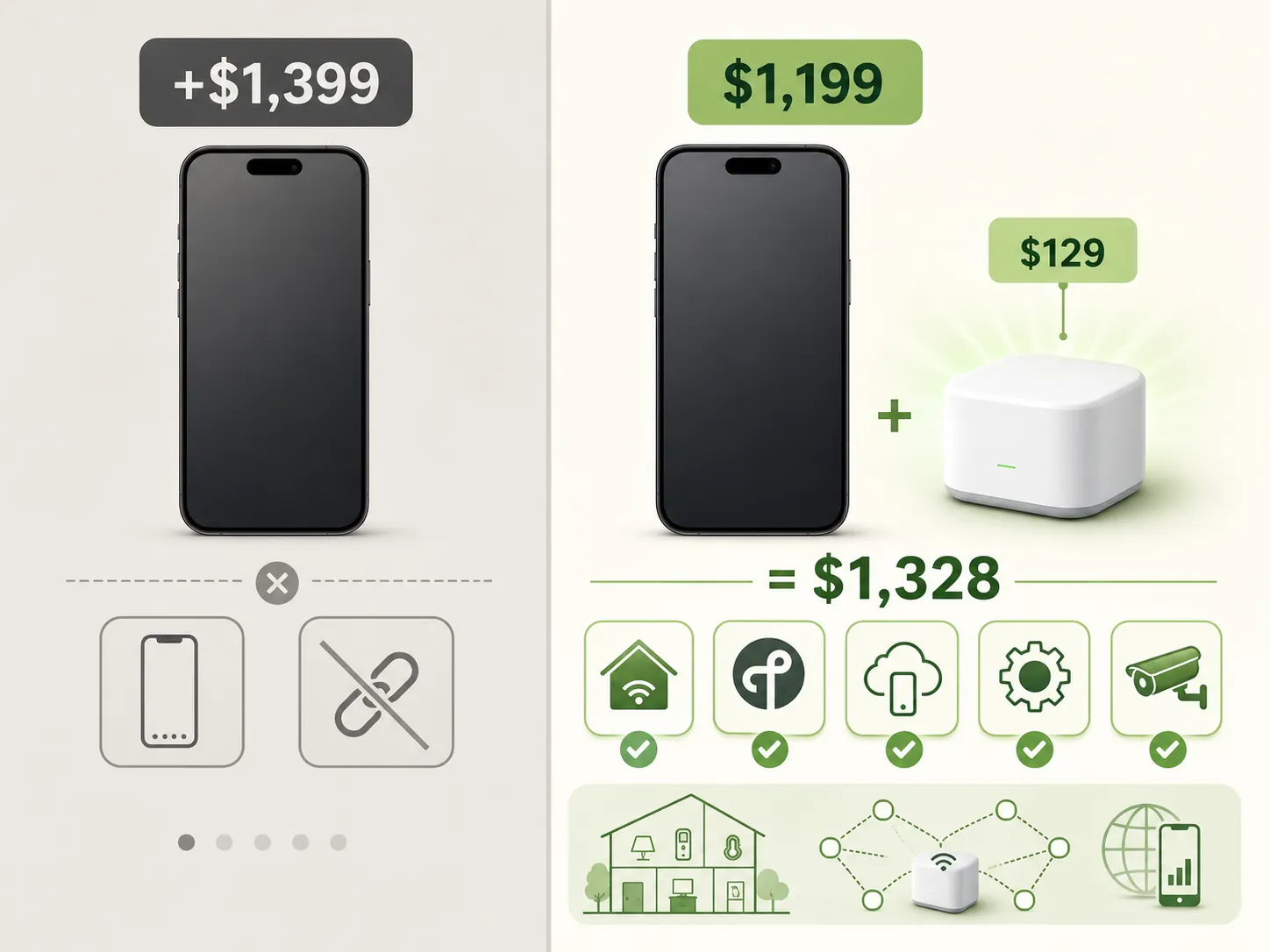
What the Apple TV 4K adds that an iPhone does not
A HomeKit controller is the thing you tap. A home hub is the thing that keeps the house running when nobody is tapping anything. The Apple TV 4K matters because it sits on power, remains on the home network, and can take over jobs that should not depend on whether your iPhone is nearby, charged, unlocked, or even in the building.
The $129 Apple TV 4K cited in the 2026 HomeKit guide is positioned as the cheapest Apple home hub with Thread border-router support, HomeKit Secure Video NVR functionality, and A15-based local automation execution.[4] If you are choosing a specific box, check the exact generation and model details in our Apple TV 4K smart-home hub guide, because Apple TV 4K model differences matter more for Thread than they do for basic streaming.
Those hub functions change the shape of everyday HomeKit use. Remote access means you can lock a door or check device status when you are away. Local automation execution means a motion sensor can trigger lights without waiting for your phone to be present. HomeKit Secure Video support means compatible cameras have a home-side Apple device coordinating recording and analysis. Thread border-router support gives Thread accessories a route into the rest of the network instead of making each accessory depend on a nearby phone session.
That is why a new iPhone often fails to fix the complaint people actually have. If the complaint is “my Home app feels slow,” a faster phone may help the interface feel better. If the complaint is “my lock, camera, or automation does not work reliably when I am away,” the missing piece is usually hub behavior, network design, accessory compatibility, or Thread coverage. We covered that narrower phone-versus-hub limit in Can the iPhone 18 Pro Max Replace Your Smart Home Hub? and in our hands-on troubleshooting piece, Tested: iPhone 18 Pro Won't Fix Your HomeKit Hub Problem.
The iPhone’s direct Thread control is real, but narrow
There is one phone-side improvement worth separating from the hype. Since iOS 18, iPhone 15 Pro and newer models can directly control Matter-over-Thread devices locally without a separate hub in some situations.[5] That is useful. It means the phone’s Thread radio is not decorative, and it can make setup or nearby control cleaner for supported accessories.
But local direct control is not the same as a home having an always-on Thread border router. It does not give you full remote access while the phone is away. It does not run your HomeKit automations from the house. It does not take over HomeKit Secure Video duties. It also does not remove the battery-powered Thread caveat: Apple’s support guidance notes that battery-powered Thread accessories may still require a Thread border router.[6]
That last point is easy to miss because phone-first control feels modern. Standing in the hallway, close to a Thread accessory, the phone may look like it has solved the hub problem. Later, when you are away from home and the automation needs to run without you, the difference shows up. A hub is not glamorous hardware. It is the resident adult in the room.
When the iPhone 18 Pro Max still makes sense
None of this is an argument against buying the iPhone 18 Pro Max as a phone. If you want the biggest Apple display, the newest camera system, the fastest Pro chip, or the longest useful life you can get from an iPhone, waiting for the next Pro Max may be reasonable. The display, RAM, and chip rumors matter for photography, gaming, video, and everyday phone longevity.
They matter much less to HomeKit control. The Home app does not become a home hub because it runs on a more expensive screen. A faster phone can open controls quickly, show camera feeds more smoothly, and make setup feel better. It still leaves the home without an always-on Apple device if there is no Apple TV or HomePod doing hub work.
So the clean way to separate the decisions is this: buy the iPhone 18 Pro Max if you want the next iPhone. Do not buy it because a supplier-side OLED price cut made it sound like a discounted HomeKit controller.
The smart-home spend is the hub
If you already have a compatible iPhone, the best Apple Home upgrade is probably not another phone. It is the $129 class of always-on hub hardware that adds the missing home-side capabilities. If you are building around Apple Home from scratch, the broader ecosystem choice still matters; our 2026 guide to the best smart-home ecosystem for iPhone owners is the more useful next read than another Pro Max rumor roundup.
Do not wait for a nonexistent consumer price drop to build your smart home. The reported 20% cut is an OLED procurement target, while the projected iPhone 18 Pro Max retail price is rising. If the goal is a better Apple Home setup, a current iPhone plus Apple TV 4K is the more useful smart-home spend than waiting for the iPhone 18 Pro Max alone.
References
- Apple Seeking 20% OLED Panel Price Cut for iPhone 18 Pro Max — MacRumors, Jul 24, 2026.
- iPhone 18 Pro and Pro Max May See $200 Price Increase — MacRumors, Jun 26, 2026.
- iPhone 18 Pro is just two months away, but you probably shouldn't wait for it — 9to5Mac, Jul 18, 2026.
- Best Apple HomeKit Devices 2026: 6 Picks, $129 Hub — SmartHomeExplorer.
- Apple enables direct Thread control for smart home devices with iOS 18 — AppleInsider, Sep 18, 2024.
- Apple Support article 102078 — Apple Support.
Corroborating context
For protocol background on why this failure happens, see Compatibility & Protocols.
Not currently linked to a known regression. Background on the underlying protocol lives in Compatibility & Protocols.