
Flock Cameras vs Home Security — Privacy Explained
Understand the structural privacy differences between Flock Safety's nationwide ALPR network and your home security camera — from shared databases and warrantless queries to documented abuse cases that change the risk calculus.
Last updated
The privacy question usually starts in a very ordinary way: you notice a black, solar-paneled camera on a pole near the neighborhood entrance, then remember the camera on your own porch. Both point at public space. Both can see cars. Both may capture people who never consented. So the tempting answer is: they are basically the same.
They are not. The important difference is not the lens, the pole, or whether a license plate is visible from the street. A home security camera is usually an individually owned recording device. Flock Safety’s core product is an automated license plate reader system feeding a shared, searchable ALPR database used by law enforcement agencies. That changes the privacy problem from “who can see my front walk?” to “who can query my vehicle’s movements across places I never knew were connected?”
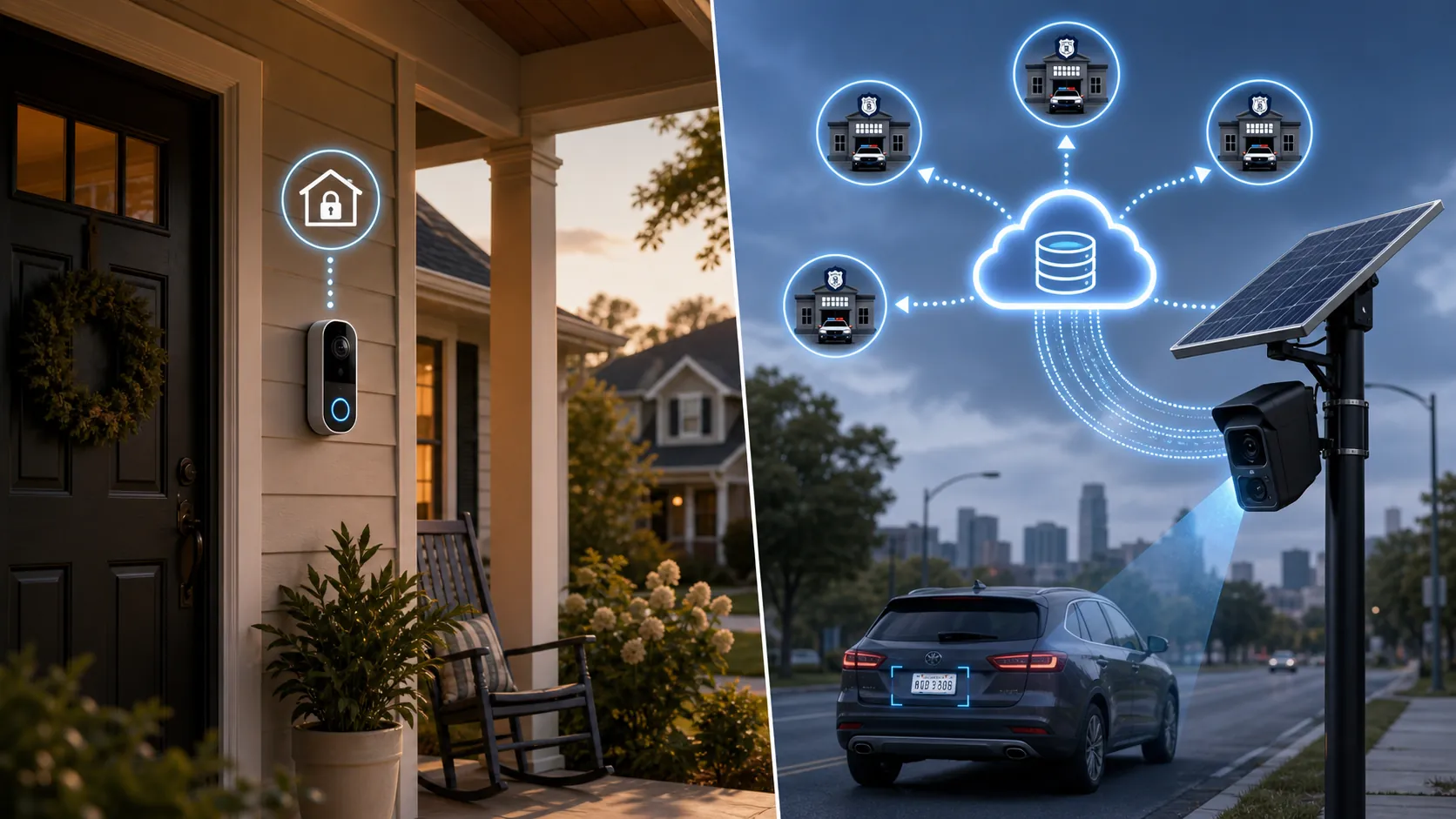
The camera is not the main privacy boundary
A porch camera can absolutely create privacy issues. Ring’s history with police requests and neighborhood-watch style sharing is not imaginary. Cloud storage can be compromised, subpoenaed, or accessed under policies many owners barely read. A camera aimed too broadly can turn one homeowner’s security setup into a nuisance for everyone else on the block.
But a doorbell camera and a Flock ALPR camera are built around different assumptions. The doorbell camera waits for a person, package, or motion event at a specific property. The Flock camera is designed to scan passing vehicles, extract identifying and descriptive information, and place that record into a system that can be searched later. The difference is architectural before it is political.
| Privacy question | Typical home security camera | Flock ALPR network |
|---|---|---|
| Who owns or controls it? | A homeowner, landlord, business, or property manager | A police department, city, HOA, business district, or other customer using Flock’s platform |
| What triggers recording? | Usually motion, doorbell press, person detection, or continuous recording chosen by the owner | Vehicle passage through the camera’s field of view |
| What is indexed? | Video clips, events, sometimes people or packages depending on the brand | License plate and vehicle characteristics that can be searched later |
| Where does the data go? | Local storage, cloud storage, or both, depending on brand and settings | Flock’s cloud-based ALPR system, with default 30-day retention described in public summaries of the platform [1] |
| Who can search it? | Usually the owner and account users; police access typically depends on a request, consent, legal process, or platform policy | Participating agencies and approved users can run ALPR searches through the network; public summaries describe thousands of agencies using Flock [1] |
| Can a passerby opt out? | Rarely in a meaningful way, but the data is normally tied to one owner’s camera | No practical opt-out for drivers passing through a covered road |
That table is why “my Ring also records the street” is a weak stopping point. It identifies a real concern, then flattens the part that matters most: whether the recording becomes part of a searchable movement database.
What happens after a vehicle passes a Flock camera
The basic process is simple enough to explain without pretending the hardware is magic. A vehicle passes a camera. The system reads the plate and records vehicle details such as make, model, color, and other visible characteristics. That record is stored in the cloud for later lookup. A user with access can search by plate or by vehicle description, and the results may include sightings from cameras outside the original neighborhood or city, depending on sharing and lookup settings.
- Capture: a roadside camera observes a passing vehicle.
- Extraction: ALPR software turns the plate and vehicle attributes into searchable data.
- Retention: the record enters Flock’s cloud system; public platform summaries describe a 30-day default retention period [1].
- Query: authorized users search the system for plates, partial descriptions, or related vehicle characteristics.
- Network effect: a local scan can become useful to agencies that did not install the camera that captured it.
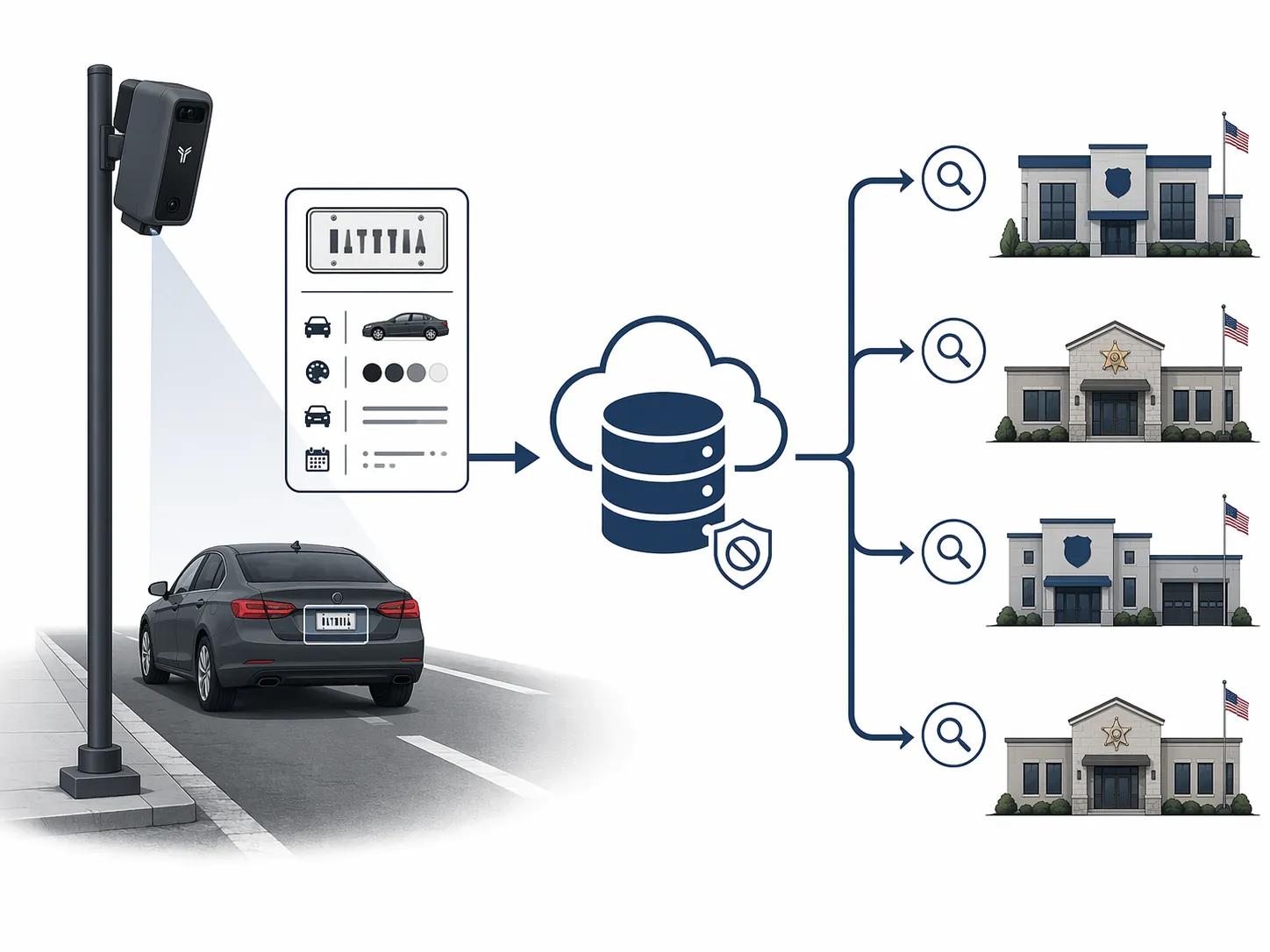
A home camera can be too nosy. A cloud camera can be poorly governed. A neighbor can share footage irresponsibly. Still, those risks usually begin with one camera owner and one account. Flock’s value proposition depends on the opposite: many cameras, many locations, many agencies, and later search.
Scale turns ordinary sightings into a movement record
As of July 2026, the DeFlock crowdsourced map counted 95,923 Flock cameras in the United States, representing more than 82% of all mapped ALPRs of any brand in that dataset. The same analysis notes that the count is likely an undercount because it depends on discovered and submitted camera locations, while Flock has claimed more than 100,000 deployed units [2].
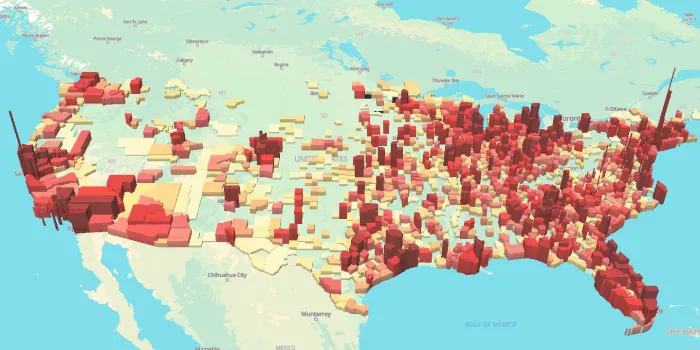
Public summaries of the company describe more than 20 billion vehicle scans per month across the network [1]. That number does not mean 20 billion crimes, suspects, or investigations. It means routine vehicle passages are being turned into structured records at a scale where later search becomes the point.
This is where the privacy math changes. A single sighting near a school, clinic, church, courthouse, protest, ex-partner’s home, union meeting, or crime scene may say very little. Repeated sightings across locations can invite a story. The story may be accurate. It may also be lazy, biased, or simply wrong. The person in the database usually does not get to correct the inference before it is treated as a lead.
Local installation does not guarantee local control
A homeowner choosing a camera for the porch understands the basic boundary: this device belongs to me, on my property, under my account, with whatever compromises the brand’s storage model imposes. With Flock, the political sale is often local — a city council vote, a police department contract, an HOA safety pitch — but the technical usefulness comes from a larger lookup network.
That gap has already surprised public officials. Reporting in 2026 described Mountain View, California, and Dayton, Ohio, discovering that national lookup or sharing features were active in ways local officials said they had not knowingly approved [3][4]. The point is not that every city misunderstands every setting. The point is that the system’s default direction is outward: more sharing, more searchable history, more agencies able to benefit from cameras they did not place.
That is a very different consent model from a homeowner camera. Your doorbell footage might be requested by police. It might be shared through an app. It might sit in a cloud account you should distrust more than the marketing copy suggests. But it does not automatically become a national license-plate lookup tool for agencies that never knocked on your door.
The abuse cases are not hypotheticals
The strongest privacy argument against Flock is not that ALPR technology could theoretically be misused. It is that documented uses have already pushed far beyond the tidy “stolen car recovery” pitch.
The Electronic Frontier Foundation reported that its investigations found more than 12 million searches across more than 3,900 agencies from December 2024 to October 2025. The same review described searches related to “No Kings” demonstrations, searches involving proximity to abortion clinics, including 83,345 camera accesses connected to Johnson County, Texas, and searches targeting Romani people with racial slurs across more than 80 agencies [5].
Separate investigative reporting from 404 Media documented more than 4,000 ICE-related searches on Flock’s platform [6]. That matters because the privacy risk is not limited to the department that installed a camera at a neighborhood entrance. Immigration enforcement, protest monitoring, abortion-related inquiries, and racially targeted searches are not the same use case as finding a stolen pickup.
This is also where “public roads are public” stops doing much work. Yes, a car on a public street is visible. A person standing on a corner could write down a plate. But a person on a corner is not a persistent, multi-jurisdictional query system with retention, search tools, and institutional users who can ask where else that car has appeared.
Chrisanna Elser and the burden of unwinding a bad inference
The Chrisanna Elser case is the kind of story that should make smart-home people pause, because it shows the asymmetry cleanly. PBS NewsHour reported in July 2026 that Elser was falsely accused after Flock data showed her driving near a crime scene 20 times; she used her own dashcam footage to prove she was not responsible [7].
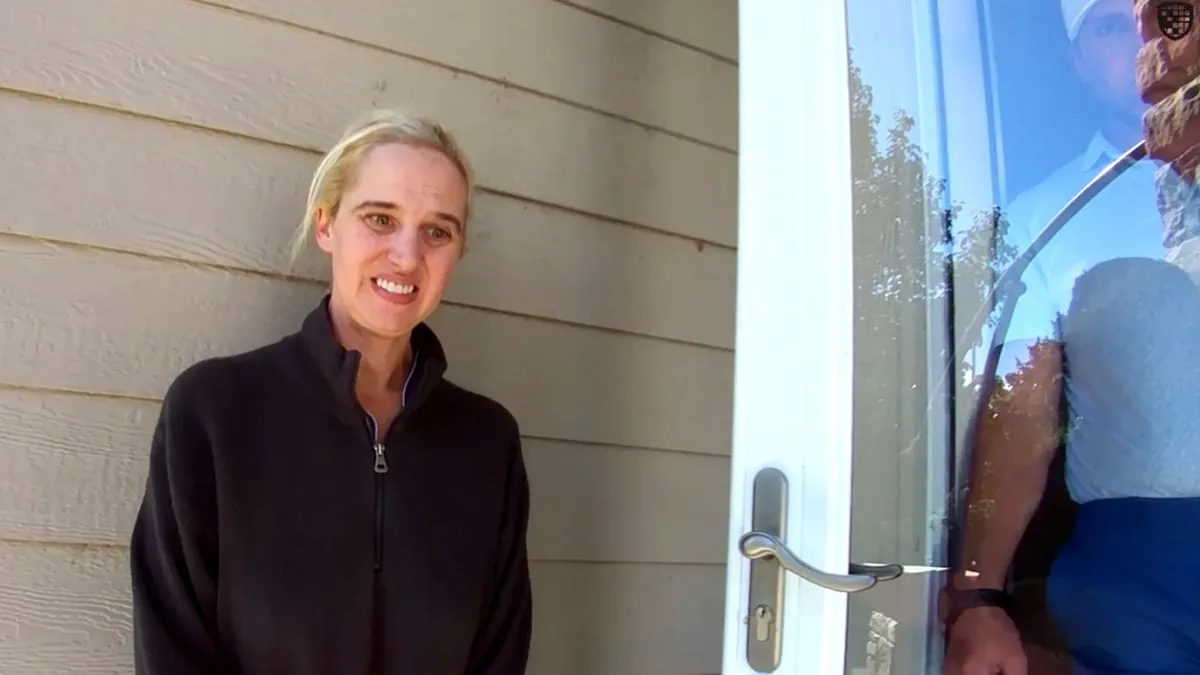
That is not a broad claim that Flock always produces false accusations. It is a narrow, important example of how “near a place, repeatedly” can become suspicion, and how the person caught in that inference may need their own recording system to claw back the truth. In that moment, the home camera or dashcam is not the surveillance state’s twin. It is the person’s receipt.
The Condor vulnerability reinforces the governance problem
Security flaws are not the main reason Flock differs from a home camera, but they matter because systems this large need unusually boring, disciplined governance. In December 2025, 404 Media reported on a Benn Jordan investigation finding more than 60 Flock Condor PTZ cameras exposed to the open internet with no authentication required, along with hardcoded credentials and root access through Android debug tools [8].
A vulnerability can be patched. A bad default can be changed. But the episode belongs in the privacy discussion because Flock is not storing one homeowner’s driveway clips. A failure in a networked public surveillance system has a wider blast radius than a single misconfigured camera under an eave.
Home security cameras are not one clean category
It is still too easy to overcorrect and describe home cameras as harmless. They are not. Ring has had a particularly visible police-sharing history, including integrations and law-enforcement workflows that deserve scrutiny. Other cloud-first brands also ask owners to trust remote storage, account security, employee access controls, and policy language that can change over time.
Brand variance matters, though. A Ring doorbell connected to a cloud account and neighborhood app is not the same privacy architecture as a local-storage setup from Eufy, Reolink, or UniFi configured to keep footage on equipment the owner controls. Local storage is not a force field; the camera can still be aimed badly, accessed by someone with credentials, or handed over under legal pressure. But storage and access design change the risk.
The canceled Ring-Flock integration is worth treating as a warning, not as proof that every home camera is already part of Flock. CNBC reported in October 2025 that Amazon’s Ring cameras were moving deeper into policing through Flock Safety and Axon deals; the Ring-Flock plan was later canceled after backlash around a February 2026 Super Bowl ad, and public reporting leaves uncertainty about whether any technical deployment occurred before cancellation [9].
That episode matters because boundaries erode through integrations. A privately chosen home camera becomes more troubling when its footage is made easier for police systems to request, route, or operationalize. Still, even that concern is not identical to a purpose-built ALPR network that starts from shared search.
For the broader trust gap around smart-home cameras, NestGrid’s Smart Home Security in 2026: The Privacy Paradox is the better baseline. The Flock question starts where that baseline stops: what happens when the camera is not yours, the database is shared, and the subject is every passing driver.
Flock’s public-view argument answers only one part of the question
Flock’s own public materials argue that ALPR systems capture information visible in public and that access is for crime-solving purposes. The company’s trust materials also frame warrantless ALPR searches as permitted because license plates are exposed on public roads [10]. That position should be stated fairly, because it is the legal and practical premise many police departments rely on.
But public visibility is not the end of the privacy analysis. A license plate being visible to a passerby does not answer who retains the scan, how long it persists, how widely it is shared, who can query it, whether the query requires a warrant, whether the driver is ever notified, and whether local officials understood the full reach of the system they approved.
The legal picture is also not settled in a way that should make homeowners complacent. Lower-court rulings and pending challenges may treat limited deployments differently from dense, long-running networks. As camera density grows, the constitutional question becomes less about one plate read and more about whether accumulated sightings reveal a person’s movements over time.
The privacy line to draw
If you are deciding whether to install a porch camera, the hard questions are about placement, recording zones, local versus cloud storage, police-request settings, account security, and whether your neighbors are being swept into your convenience. Those are real questions. They deserve more than a shrug.
If your neighborhood installs Flock, the questions are different: who approved the deployment, whether national lookup is enabled, what agencies can search the data, whether a warrant is required, how audit logs are reviewed, whether immigration or out-of-state agencies have access, how long records persist, and whether residents can see the policy before the cameras go up.
That is the decisive distinction. Flock cameras may look like security cameras, and home security cameras have their own privacy failures. But Flock’s risk comes from the database and access model: a neighborhood image stream can become part of a warrantless, shared ALPR network that lets agencies search vehicle movements far beyond the pole where the scan happened.
References
- Flock Safety — Wikipedia
- How Many Flock Cameras Are in the U.S.? 2026 Data — Roadsigns.com
- Why some cities are ditching their Flock license plate readers — NPR, Feb. 17, 2026
- Flock Safety Crosses 100,000 Cameras as 53 Cities Cancel — TechTimes, June 29, 2026
- EFF's Investigations Expose Flock Safety's Surveillance Abuses: 2025 in Review — Electronic Frontier Foundation, Dec. 2025
- ICE Has Searched Flock’s AI License Plate Reader Network Thousands of Times — 404 Media
- PBS NewsHour segment on AI-powered license plate readers and privacy concerns — PBS NewsHour, July 2026
- Flock Condor Cameras Were Exposed to the Open Internet With No Password — 404 Media, Dec. 2025
- Amazon Ring cameras deeper into policing with Flock Safety, Axon deals — CNBC, Oct. 16, 2025
- Myths vs Facts — Flock Safety
Corroborating context
For protocol background on why this failure happens, see Compatibility & Protocols.
Not currently linked to a known regression. Background on the underlying protocol lives in Compatibility & Protocols.