
Flock Camera Misuse and Your Home Security Privacy
Police misuse of license plate data
Last updated
If you own a Ring, Arlo, Eufy, or Nest-style camera and have started noticing Flock cameras on poles near your subdivision entrance, the first answer is simple: your doorbell camera is not automatically part of Flock’s license-plate network. Flock Safety cameras are automatic license plate reader, or ALPR, cameras built to capture vehicle plates and related vehicle details from public-facing roadways. They are different from consumer home security cameras watching your porch, driveway, or side gate.
The second answer is the one home security users should not ignore. Ring and Flock did announce a partnership in October 2025, and Amazon’s Ring cancelled it in February 2026 after backlash around a Super Bowl ad. CNBC reported that the partnership never launched and that no Ring footage was shared through it.[1] So there is no active Ring-to-Flock footage pipeline to panic about. But the fact that the bridge was built far enough to be announced tells us something important: consumer camera footage and law-enforcement search systems are no longer separate privacy conversations.
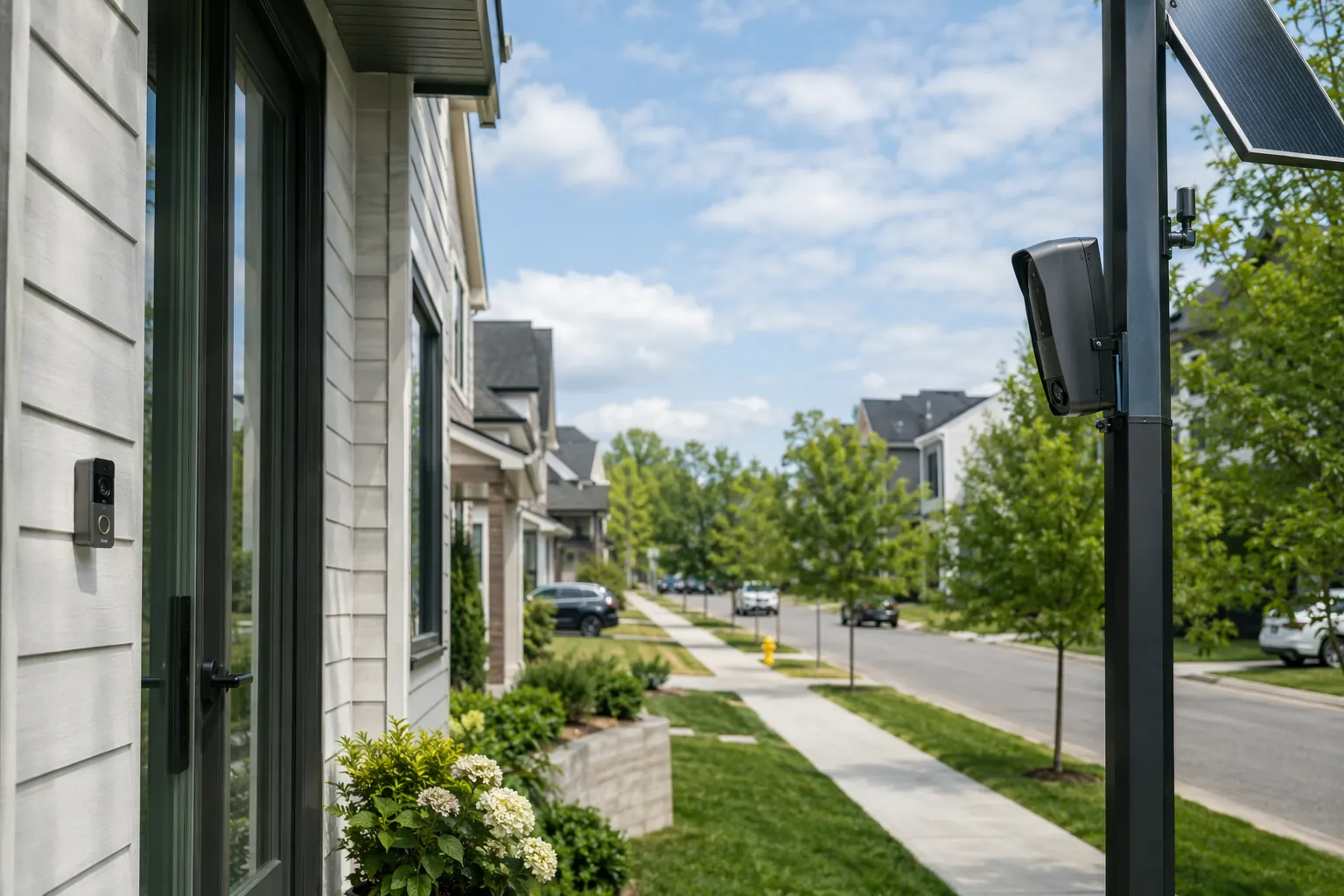
A porch camera and a plate reader collect different things
A home camera usually starts with a specific property owner and a specific purpose: watch the package drop, catch the person checking car doors, see whether the garage closed. Even when the camera has messy cloud settings or optional police-sharing features, the camera is still attached to a household account that someone chose to buy, install, and configure.
A Flock camera works from the other direction. It watches traffic moving through a road, neighborhood entrance, business district, or municipal area. If your plate passes through the camera’s view, you can become a row in a searchable database even though you never bought the device, agreed to a subscription, or received a privacy prompt. That is the real privacy concern for home security users: the affected person is often not the customer.
| System | What it usually captures | Who opted in | Privacy question that matters |
|---|---|---|---|
| Consumer home security camera | Video or images around a home, driveway, yard, or entryway | The device owner, though visitors and neighbors may be recorded too | Who can see, store, share, or request footage? |
| Flock ALPR camera | License plates and vehicle movement data from passing traffic | The agency, HOA, business district, or other buyer — not each driver | Who can search movement history, how long it is retained, and who else can access it? |
The overlap is not technical sameness. It is the way both systems turn ordinary residential space into searchable evidence. A doorbell camera can make a porch searchable after a theft. A plate reader can make a morning commute searchable after an officer types in a plate number. The Ring–Flock cancellation removed one direct consumer-camera bridge, but it did not remove the institutional appetite for searchable neighborhood footage.
Why the cancelled Ring partnership still matters
It would be sloppy to write as if Ring footage is currently flowing into Flock. It is not, based on the reported timeline. The partnership was announced, criticized, and cancelled before launch, with no footage shared.[1]
Still, the cancelled partnership matters because it showed a plausible direction for home security platforms: take cameras installed for household reasons and connect them more tightly to law-enforcement discovery tools. For someone who has spent years telling relatives to turn on two-factor authentication, reduce cloud sharing, and check camera permissions, that is a different class of risk. Encryption and account security matter, but they do not answer who gets invited into the search interface in the first place.
That is also why the story should not end with “the partnership was cancelled.” A cancelled product integration can still reveal a business and policing model. The model is not just “record video.” It is “make everyday footage easier for authorized institutions to query.” When that same logic is applied to license plates, the privacy exposure reaches people who never installed anything.
You can be in the Flock database without owning a Flock camera
Flock’s scale is the reason this is not just a neighborhood hardware question. The Guardian reported in April 2026 that Flock had more than 80,000 cameras in the United States, with police and other customers using the system across a rapidly expanding network.[2] The same reporting described a default 30-day retention period for plate data.[2]
For a homeowner, that retention detail is the part to slow down on. Your doorbell camera may keep clips for a plan-dependent period, and you can usually delete clips or change settings for your own account. With an ALPR scan, the person most affected by the record is the driver, not the account holder. The driver may not know which entity owns the camera, which agencies can search it, whether the scan was shared outside town, or whether a later policy change widens access.
Flock has promoted its systems as tools for finding stolen cars, suspects, and vehicles connected to serious crimes. Police departments have publicly defended the cameras on those grounds. The privacy problem is not that a plate reader can never produce useful evidence. It is that usefulness does not tell you whether access is narrow, audited, warrant-bound, or meaningfully punished when abused.
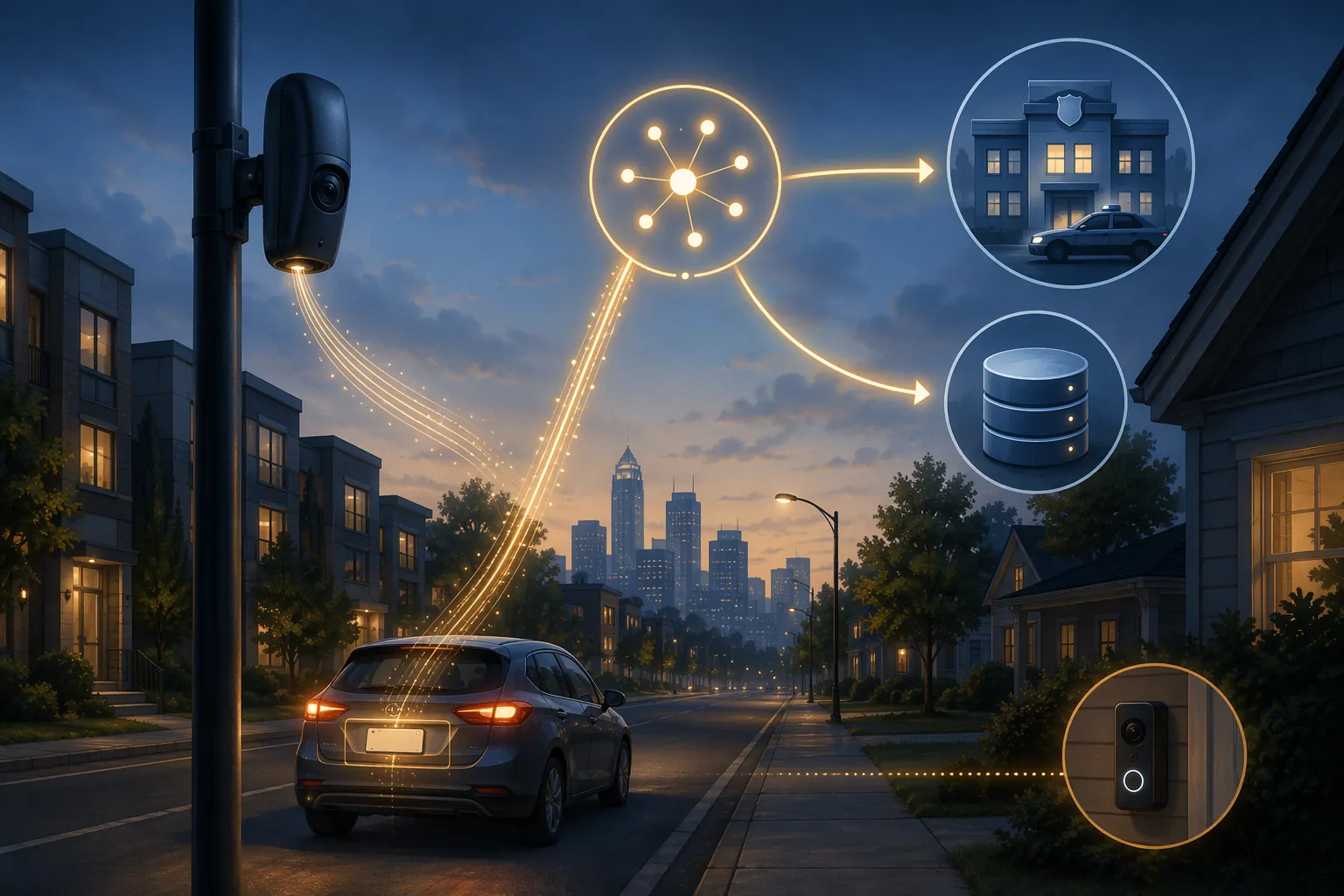
The misuse record is not hypothetical
The strongest argument for taking Flock privacy seriously is not a general fear of smart cities. It is the pattern of documented access failures: authorized users searching for personal reasons, local access becoming a route for federal immigration queries, and technical exposure that let an outsider view live camera feeds.
Authorized users can still be creepy users
The Marshall Project reported that Milwaukee police officer Josue Ayala ran more than 170 searches on a woman he had dated, using license plate reader data to track her movements; he resigned in March 2026.[3] The same report discussed other cases involving officers accused of using plate-reader systems to track romantic interests, including a Costa Mesa, California officer who tracked a mistress, and it cited an Institute for Justice tally of at least 14 reported cases in which police used license plate readers to stalk romantic interests.[3]
Georgia then supplied the sort of case that makes “just trust authorized users” sound less like a safeguard and more like a hope. Fox 5 Atlanta reported that more than 10 Georgia law-enforcement officers were arrested in a wave of cases alleging misuse of Flock license plate tracking data, including deputies, sergeants, lieutenants, and a police chief.[4]
Those cases do not prove that most Flock searches are abusive. They prove something narrower and more useful: when plate-location data is searchable by individual officers, personal misuse is a foreseeable failure mode. The affected person may never know unless an audit, complaint, investigation, or prosecution brings it out.
Local promises can be weakened by sharing paths
NPR reported in February 2026 that Border Patrol and Homeland Security Investigations accessed local Flock data through pilot programs that Flock’s CEO initially denied existed, and that the federal pilots had since ended.[5] NPR also reported that records showed officers listing “ICE” or “immigration” as search reasons.[5]
This is the interagency version of the same privacy problem. A city council may tell residents the cameras are for stolen vehicles or violent crime. An HOA may pitch them as a burglary deterrent. But if the practical access path lets other agencies search through local intermediaries, the resident’s real privacy exposure is broader than the sales pitch.
Technical exposure is a separate failure mode
Misuse does not always require a malicious officer with valid credentials. Security researcher Benn Jordan demonstrated live-feed access to more than 60 Flock Condor cameras in December 2025 and described the result as “Netflix for stalkers,” including cameras aimed at sensitive everyday places such as schools and playgrounds.[6]
That example belongs in the same conversation, but not because it is identical to police misuse. It shows a different weakness: the system can expose people through technical implementation, not just policy abuse. A privacy program that only asks whether officers are allowed to run a search is incomplete if camera feeds or administrative tools can be reached in ways residents never expected.
What Flock says, and what those claims do not settle
Flock’s public trust materials state that the company does not use facial recognition, does not sell data, and gives customers local control over sharing settings.[7] Those claims matter. A plate reader that also identified faces would be a more invasive system, and selling raw movement data would raise a different set of risks.
But those statements do not answer the hard questions by themselves. “No facial recognition” does not change the fact that a license plate can identify a vehicle’s movements. “No data sold” does not limit law-enforcement access. “Local control” depends on what local officials choose, what contracts allow, how defaults are configured, how sharing is audited, and what happens after an improper search.
For home security users, this should feel familiar. A camera company can promise encryption and still leave you with confusing sharing settings. A smart speaker can offer privacy toggles and still require you to understand which layer of account data they affect. If you want the same kind of practical audit for your own devices, NestGrid’s guides to the smart home security privacy paradox and a smart home assistant privacy audit are the right follow-up work. Flock is different hardware, but the discipline is the same: do not stop at the marketing claim; inspect the access path.
What to ask before your neighborhood adds Flock cameras
A neighborhood camera proposal often arrives as a crime-prevention purchase: a few cameras near entrances, a monthly subscription, maybe a claim that police can use hits to find stolen cars. That is too narrow a review. Treat the proposal as a data-governance decision.
- Ask who owns the account: the police department, city, HOA, business district, property manager, or a private association.
- Ask the retention period in the contract, not just in the sales deck. If the answer is “default,” ask what the default is and who can shorten it.
- Ask which agencies can search the data directly and which agencies can receive it indirectly through local users.
- Ask whether a warrant, case number, supervisor approval, or written reason is required before a search.
- Ask whether audit logs are reviewed routinely or only after someone complains.
- Ask what penalty applies to unauthorized access. Training reminders are not the same as enforceable consequences.
- Ask whether residents can see aggregate use reports: number of searches, outside-agency requests, rejected requests, hot-list hits, and misuse investigations.
The important word is “ask,” because many residents only learn the answers after deployment. If a board or council cannot explain retention, sharing, audit logs, and penalties before approving cameras, it is not ready to approve cameras.
What to do with your own home cameras
The Flock system may sit outside your account, but your own cameras are still part of the same residential evidence environment. Start with the settings you actually control.
- Review police-sharing or neighborhood-sharing options in your camera app. Do not join voluntary sharing programs unless you understand who can request footage, how requests appear, and whether shared clips can be retained outside your account.
- Reduce unnecessary recording zones. A camera pointed at your porch is easier to justify than one that continuously captures the sidewalk, a neighbor’s window, or every passing car.
- Shorten cloud retention where your plan and device allow it. Keeping months of clips because the default allows it is not a security strategy.
- Use separate accounts for household members instead of sharing one password. If footage is accessed or exported, you want accountability.
- Turn on two-factor authentication and remove old authorized devices. This will not solve institutional access problems, but it closes the ordinary account-takeover path.
- If your camera platform adds a new public-safety integration, read the change before accepting prompts. The Ring–Flock episode is a reminder that product partnerships can change the privacy meaning of hardware you already own.
This is also where smart-home privacy needs to be boring on purpose. The useful work is reviewing settings, account access, retention, and sharing defaults, not buying another gadget because the last one made you uneasy.
Some places are starting to put rules around ALPR access
Washington State’s SB 6002 took effect on March 30, 2026, and MRSC described it as the first state law to impose new restrictions on these systems. The law includes a 21-day default retention limit, agency registration requirements, sharing restrictions, and bans on ALPR use near schools, places of worship, health care facilities, and food banks.[8]
Local governments are also experimenting with harder contract terms. The ACLU reported that more than 55 localities had terminated Flock contracts in the previous year, and that Arlington Heights, Illinois became the first city to include financial penalties ranging from $22,000 to $70,000 per incident of unauthorized access.[6]
Those responses are not proof that the problem is solved. They are proof that communities are discovering the weak points: long retention, broad sharing, unclear approval standards, and audits that may not bite until after someone is already tracked.
Skip the stunt responses
There is now a small vigilante movement aimed at blocking or disabling Flock cameras. The Guardian reported on non-destructive countermeasures such as 3D-printed lens blockers and infrared emitters, while also reporting that physical vandalism has led to felony charges.[9]
That is not a practical privacy plan for a homeowner, renter, or neighborhood resident who wants durable limits. Legal pressure leaves records: public comments, contract requests, retention amendments, audit demands, local ordinances, and board votes. Those records are less dramatic than a disabled camera, but they are the things that can change who gets access next month.
The line home security users should hold
A camera watching a porch and a camera reading plates at the neighborhood entrance are not the same device. They do not collect the same data, and they are not governed through the same account settings. But they are now close enough in purpose that home security users should evaluate them together: both can convert ordinary residential life into searchable evidence, and both depend on access rules that most residents never read.
The Ring–Flock cancellation removed one direct consumer-camera pipeline before it launched. It did not remove the larger privacy risk created by searchable, widely shared ALPR infrastructure that records drivers who never opted in.
References
- Amazon's Ring cancels Flock partnership amid Super Bowl ad backlash, CNBC, February 12, 2026
- Creepy surveillance: why some cities are shutting down Flock cameras, The Guardian, April 6, 2026
- The Troubling Personal Side of Public Surveillance, The Marshall Project, March 7, 2026
- Georgia cops' alleged misuse of Flock license plate tracking data fuels privacy concerns, Fox5 Atlanta
- Why some cities are ditching their Flock license plate readers, NPR, February 17, 2026
- Flock's Aggressive Expansions Go Far Beyond Simple Driver Surveillance, ACLU, June 2026
- Trust Center, Flock Safety
- Restrictions on Flock Cameras, MRSC, April 2026
- Inside the growing vigilante movement to knock out Flock surveillance cameras, The Guardian, July 25, 2026
Corroborating context
For protocol background on why this failure happens, see Compatibility & Protocols.
Not currently linked to a known regression. Background on the underlying protocol lives in Compatibility & Protocols.