
Setup
Smart Thermostat Savings Reality Check: What You Actually Save and Which Claims to Ignore (2026 Data)
Independent data debunks manufacturer savings claims: smart thermostats really save 8–10% of HVAC costs ($155–$237 per year) — enough to pay for themselves in under a year. This article separates marketing hype from verified savings, helping homeowners and renters make an informed buying decision.
How Much Do Smart Thermostats Actually Save?
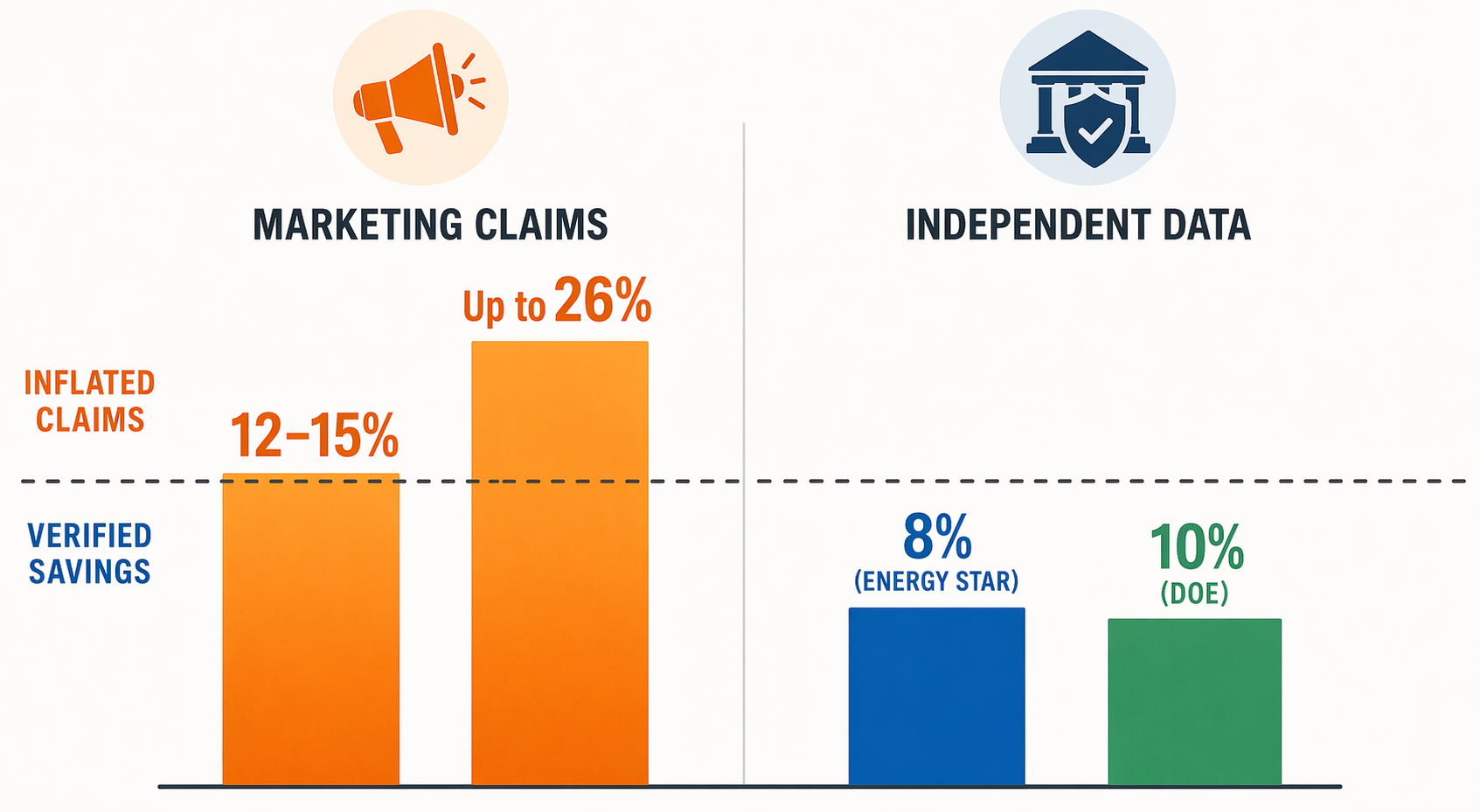
Google Nest says its Learning Thermostat saves 12–15% per year — about $131 to $145. Ecobee claims up to 26%, roughly $250 a year. Those numbers come from the companies that sell the thermostats. I don't dismiss them entirely, but they're manufacturer-commissioned research, not independently verified.
ENERGY STAR, the government-backed certifier, sets a minimum 8% heating runtime reduction and 10% cooling runtime reduction to earn its label. That's verified by third‑party field data across hundreds of homes. The ENERGY STAR FAQ states: "On average, ENERGY STAR certified smart thermostats save approximately 8% of heating and cooling bills, or about $50 per year (based on older energy cost baselines)." That 8% is a floor, not a ceiling. The 12–15% and 26% figures might be real for some homes in ideal conditions, but the average is lower. I'd trust the number that was audited.
Your Baseline: What You Spend on Heating and Cooling
Percentages are useless without a baseline. Heating and cooling account for nearly half of the average household's annual energy bill — more than $900 a year at older rates, according to ENERGY STAR. But utility costs have risen 41% over five years. A more recent analysis from CliQforHome puts the average combined non‑water utility bill around $4,300 per year. Heating and cooling make up 45% to 55%: $1,935 to $2,365. That's the pool a thermostat can draw from.
The old $50‑per‑year figure from ENERGY STAR sounds trivial now because it was calculated against much lower energy prices. At today's rates, the same 8% adds up differently.
8–10%: The Only Number Backed by Independent Data
ENERGY STAR's certification requires a weighted national average annual heating runtime reduction of at least 8% (lower 95% confidence limit) and cooling runtime reduction of at least 10%. That means the thermostat must deliver those reductions in real homes, not in a lab. The Department of Energy adds: you can save as much as 10% by setting the thermostat back 7°–10°F for 8 hours a day. Wirecutter confirms: "All Wirecutter picks are Energy Star–certified, meaning they will save at least 8% of your annual heating and cooling bill." No manufacturer asterisk — just a floor that applies across models and climates.
| Source | Claimed Savings | Verification |
|---|---|---|
| Google Nest (manufacturer study) | 12–15% ($131–$145/yr) | Internal, not independently audited |
| Ecobee (manufacturer claim) | Up to 26% (~$250/yr) | Internal, not independently audited |
| ENERGY STAR (certification criteria) | ≥8% heating, ≥10% cooling | Third‑party field data, auditable |
| DOE (setback recommendation) | Up to 10% | General guidance, not thermostat‑specific |
| Wirecutter (editorial recommendation) | At least 8% | Relies on ENERGY STAR certification |
A note: the ACEEE/Cadmus field study reported smart thermostats saving 12.5–16.1% compared to programmable models saving about 5%. That data appears only in the CliQforHome article — I haven't found the original report. I'd treat those higher numbers as supporting context, not primary evidence. The main takeaway is that even the conservative 8–10% range produces real dollar savings.
What That Means in Dollars Today: $155–$237 per Year
Apply 8% to the $1,935–$2,365 HVAC spend: $155–$189 per year. Apply 10%: $194–$237 per year. That gives a defensible range of $155 to $237 annually from an ENERGY STAR certified smart thermostat. The old $50‑per‑year figure is still cited, but it's based on older, lower energy costs. At today's prices, 8% is worth roughly three to four times that.
Even at 8%, It Pays for Itself in Under a Year
The payback math is straightforward and compelling even with the lower savings estimate. A $70 device saving $155 per year pays back in about 5 months. A $250 device saving $237 per year pays back in about 13 months. Over 7–10 years, a $70 thermostat returning $155–$237 per year accumulates roughly $1,085–$1,660 — a 15‑to‑24 times return on the purchase price. CNET says "Almost every smart thermostat purchase will pay for itself within a year or two." That matches the numbers above.
Utility rebates make the math even better. Many U.S. utilities offer $50 to $200 rebates on ENERGY STAR certified smart thermostats, which can bring a $200 device down to $0–$150 before you start saving. Some also pay $20–$50 per year in bill credits for participating in demand‑response programs.
Why Smart Beats Programmable (Quickly)
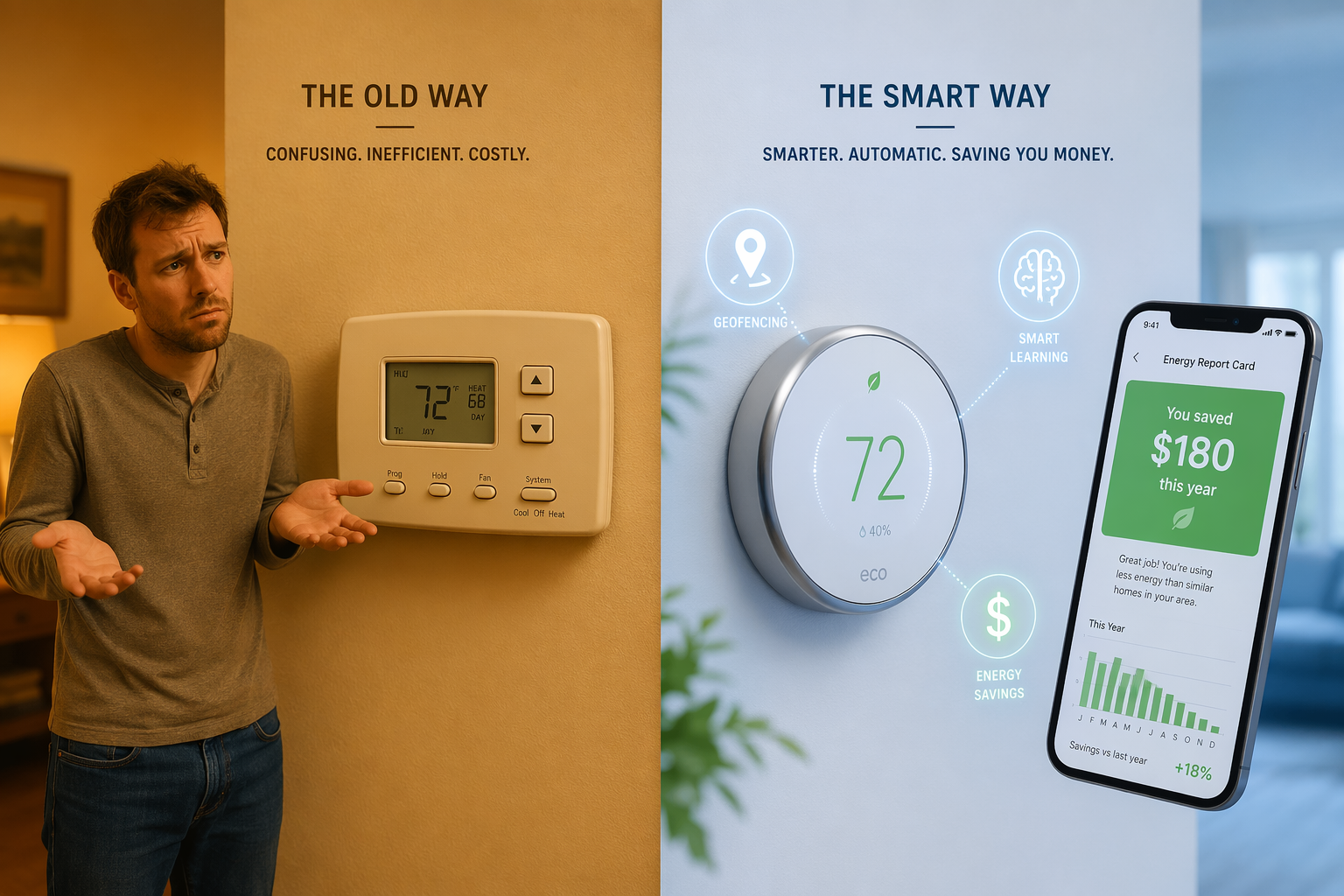
A cheap programmable thermostat can theoretically do the same job. In practice, people don't use them. A Consumer Reports survey found that 29% of programmable thermostat owners never set the schedule. ACEEE/Cadmus data shows that 51–78% of programmable users override their programmed schedules regularly. ENERGY STAR suspended its programmable thermostat certification in 2009 — the program effectively admitted that the devices weren't delivering the savings, because people weren't programming them. Smart thermostats solve that by learning automatically or using geofencing.
For a deeper comparison, see our full breakdown.
When the Savings Shrink: Who Should Adjust Expectations
The 8–10% range is a weighted national average. Some homes will see less, and that's not a product failure. The following conditions reduce the savings you can expect: always‑occupied homes (less opportunity to set back), already efficient HVAC (less waste to trim), temperate climates (lower total HVAC spend), and variable‑speed heat pumps (gentler cycles). None of these mean a smart thermostat is useless. They mean the savings will be at the lower end of the range — still positive, still paying back the device.
The Verdict: Trust 8–10%, But Don't Ignore the Opportunity
Ignore the 12–26% hype. The independently verified data says 8–10% is the real range. That translates to $155–$237 per year at 2026 energy prices — enough to pay back a $70–$250 device in less than a year and deliver a 15–24× return over its lifespan. Smart thermostats are a low‑risk investment for most households. Pick any ENERGY STAR certified model from a major brand, install it, and the savings will follow. The brands' inflated claims don't change that — they just make the case even stronger than the marketing suggests.
Report a step that didn't work
Tell us which step failed and on what firmware or app version — we re-verify before changing the recipe.