If you choose a mmWave presence sensor instead of a camera, you have solved one important privacy problem: the device is not recording recognizable video of the room. It captures no face, no clothing, no visible background, and no audio track. For bedrooms, bathrooms, elder-care spaces, and camera-free automations, that difference is not cosmetic. It is the reason the category exists.
But mmWave presence sensor privacy is not the same thing as privacy absence. These sensors can produce radar-derived data about where a body is, how it moves, and sometimes how it breathes or gestures. With machine learning, abstract movement data can become more revealing than buyers expect. The better answer is therefore split: mmWave is usually more private than a camera, but it should be treated as a low-exposure sensor, not a zero-risk sensor.
A UCLA user study makes the trust problem unusually clear. In a study of 162 US-based Prolific participants, comfort with RF sensing dropped from 2.67, roughly neutral, to 1.99, uncomfortable, on a 5-point scale after participants learned what machine-learning inferences could be drawn from the data; the reported result was statistically significant at p < 4.86×10⁻¹¹.[1] The study population also matters: 58% self-described as technically savvy, so this is not a simple story of uninformed users panicking at unfamiliar technology.[1]
That shift is the privacy paradox in plain form. People may feel comfortable with “not a camera” until they understand that the sensor is still watching in a different data language. The issue is not whether mmWave is secretly equivalent to video. It is not. The issue is whether a buyer can give meaningful consent when the marketing phrase “presence detection” hides the richer data layer underneath.
What a Camera Gives Away Quickly
The camera comparison does not need much stretching. A camera produces images that humans immediately understand. A single frame can show identity, posture, visitors, health equipment, children, religious objects, work documents, or the state of a room. If audio is included, the sensitivity jumps again. Even when a camera offers local processing, the raw material is recognizably intimate.
That is why mmWave often wins the first privacy round. A radar presence sensor can turn on lights when someone is still at a desk, keep a bathroom fan running while someone is showering, or detect possible activity in an elder-care space without putting a lens in the room. For many households, that is the right trade-off. The mistake is stopping the privacy analysis there.
The Less Obvious Data Layer
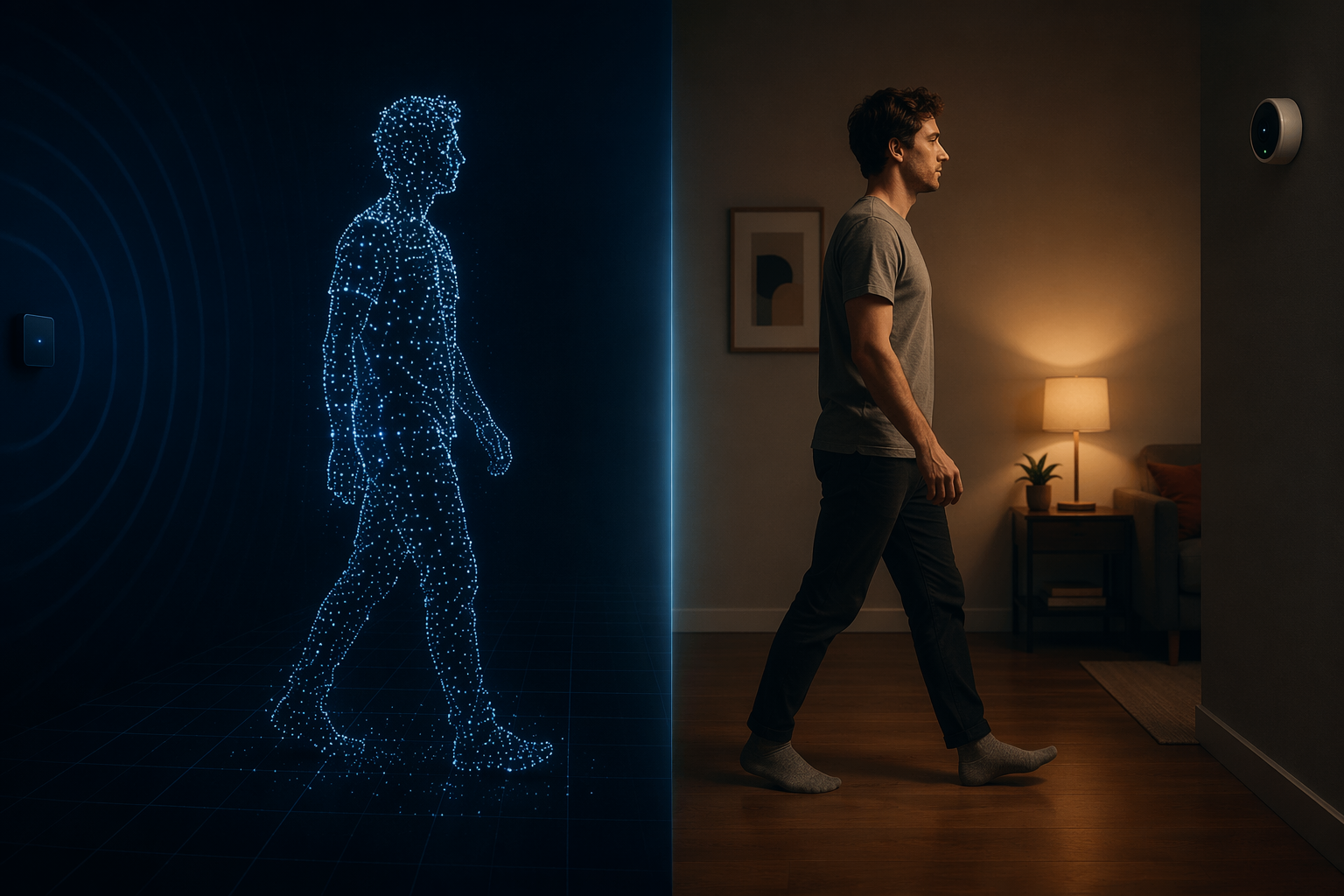
A typical smart-home buyer sees the result of a mmWave sensor as a simple state: occupied, unoccupied, maybe distance or zone. Underneath, the device may be working from radar reflections that can be represented as point clouds or other motion features. Those points are not a photograph, but they are still observations of a body in space over time.
That difference matters because privacy risk often depends less on what the data looks like to a person and more on what a model can infer from it. Repeated observations can reveal routines: when someone wakes up, how long they spend in the bathroom, whether a room is occupied at night, or whether movement patterns have changed. In some settings, those inferences are the feature. In others, they are the part no one mentioned during setup.
The research ceiling is higher than the average product brochure suggests. ImmCOGNITO, a 2026 preprint on identity obfuscation in millimeter-wave radar-based gesture recognition, reports re-identification benchmarks using architectures including PointNet++, Tesla, and Pantomime, with published accuracy up to 89.1% for PointNet++ on mmWave data.[2] That figure should not be read as proof that an ordinary ceiling-mounted presence sensor in a hallway is identifying every family member. It does show that identity leakage from mmWave-derived data is real enough for researchers to design obfuscation methods around it.
The same caution applies to attack research. The mmSpyVR paper examined mmWave radar privacy vulnerabilities around VR systems and reported 98.5% application recognition accuracy and 92.6% keystroke recognition accuracy in that context.[3] That is not a direct description of consumer presence sensors. It is a boundary marker: mmWave sensing can support surprisingly detailed inference when hardware, placement, signal access, and target activity line up.
A More Useful Ranking Than “Private” or “Not Private”
For buying decisions, the better comparison is not camera versus mmWave as moral opposites. It is exposure versus function. A 2026 TechRxiv survey ranked privacy exposure across consumer sensing types as PIR “Very Low,” mmWave “Low,” and vision “High,” while also identifying PIR + mmWave hybrid fusion as an emerging way to balance functionality and privacy.[4]
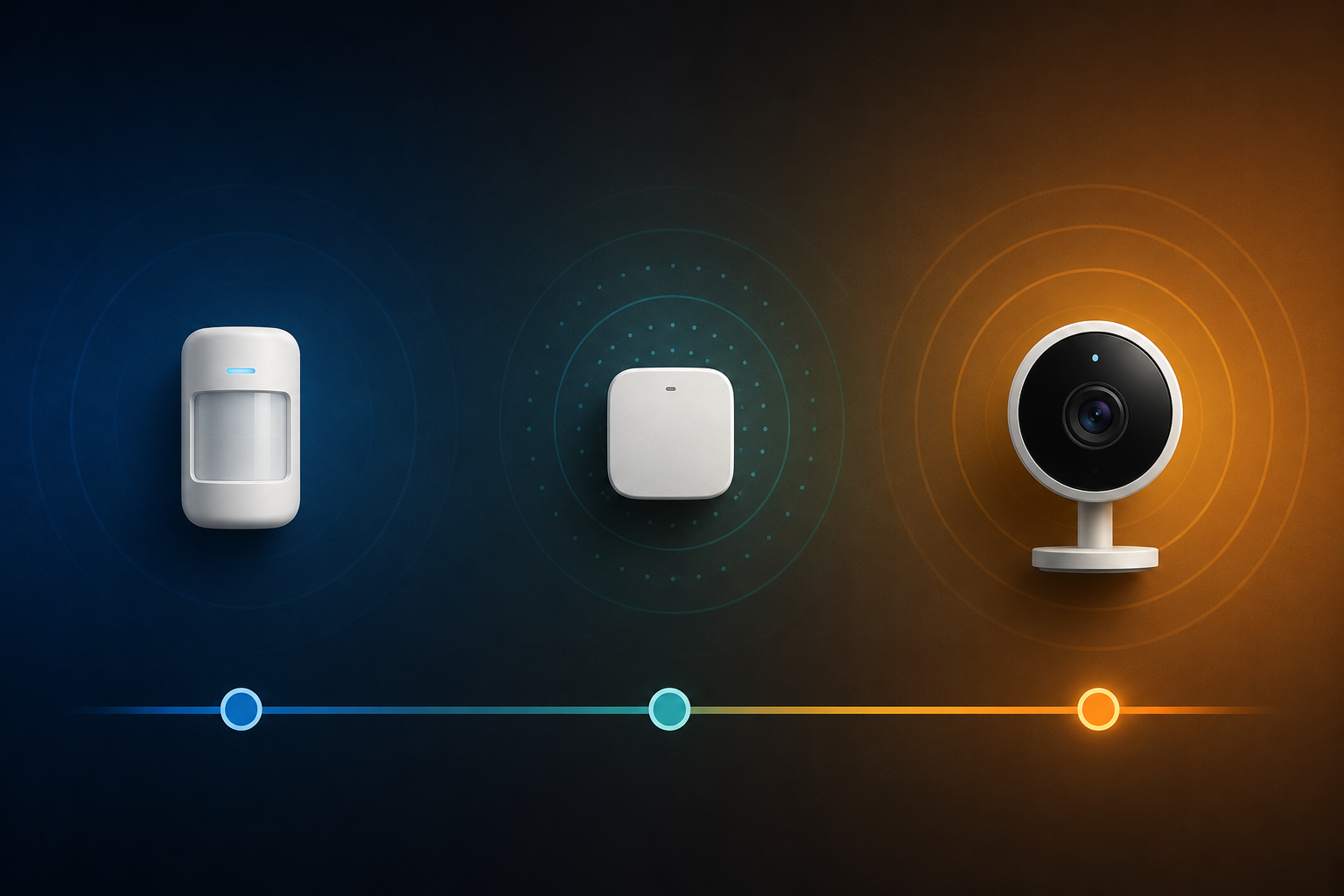
| Sensor type | What it is good at | Privacy exposure to assume |
|---|---|---|
| PIR motion sensor | Detecting larger heat-motion changes, such as someone walking through a room | Very low; it usually cannot see still presence or produce rich body data |
| mmWave presence sensor | Detecting still presence, zones, subtle movement, and camera-free occupancy | Low; less recognizable than video, but capable of richer inference than simple motion |
| Camera or vision sensor | Recognizing people, objects, events, and visual context | High; raw data is immediately identifiable and context-rich |
| PIR + mmWave hybrid | Reducing false states while avoiding full vision sensing | Potentially balanced, depending on whether processing stays local and what data is exposed |
The power profile also points to why these sensors appear in smart-home products. The same TechRxiv survey describes mmWave as drawing under 100mW, compared with vision at roughly 500mW or more.[4] Lower power is not a privacy guarantee, but it makes mmWave attractive for always-on sensing. That always-on quality is exactly where the privacy judgment becomes more subtle: a less identifiable sensor can still be sensitive if it observes continuously.
The Questions That Matter Before You Buy
The label “mmWave” tells you the sensing method. It does not tell you the privacy architecture. Two products can use similar radar hardware while making very different choices about processing, storage, cloud dependence, app permissions, and developer access.
Start with processing location. If a device can detect presence locally and expose only simple states such as occupied, unoccupied, zone occupied, or distance band, the privacy surface is smaller. If basic presence detection depends on cloud analytics, the buyer is no longer just trusting the sensor. They are trusting the account system, network path, cloud retention rules, vendor security, and any future product-policy changes.
Then ask what leaves the device. A local automation hub receiving a binary occupancy event is different from an app or API receiving richer point-cloud, gesture, breathing, or activity-classification data. The more detailed the output, the more the system begins to resemble behavior monitoring rather than simple presence automation.
- Prefer devices that perform presence detection on-device for ordinary automations.
- Check whether the sensor exposes raw radar data, derived features, or only occupancy events.
- Avoid products that require cloud analytics for basic room presence when a local alternative can do the same job.
- Treat vendor claims such as “privacy-safe” or “no camera” as starting points, not conclusions.
- Match the sensor to the room: a bedroom or bathroom deserves a stricter standard than a garage or entryway.
This is also where local-control smart homes have a practical advantage. A sensor integrated into a local hub can often trigger lighting, HVAC, fan, or security automations without sending every presence event through a vendor cloud. Local does not magically erase risk; household members can still object to being monitored, and local logs can still reveal routines. But it narrows who needs to be trusted.
For room-by-room planning, camera-free automation is often the right direction. A mmWave sensor can solve the classic “lights turn off while I’m sitting still” problem that PIR sensors miss. It can support safer elder-care automations where a camera would be socially or emotionally unacceptable. If you are building those use cases, the relevant comparison is not perfection. It is whether mmWave gives enough function while avoiding the more intrusive data captured by vision. Internal guides such as camera-free presence automation recipes and smart-home fall detection for elderly parents are the kinds of places where that trade-off becomes concrete.
Consent Is a Household Feature, Not Just an App Permission
The person installing a presence sensor may understand that “radar” does not mean video. The person sharing the home may only hear that there is no camera and assume nothing sensitive is being collected. That gap is where privacy friction starts.
A fair explanation does not need to sound alarming. It can be as simple as: this device detects whether someone is in the room and may track movement zones; it does not record images or sound; the automation runs locally; and it is being used to keep the lights or fan working correctly. If the product does more than that, the explanation should say so. People are more likely to accept sensing when the function, data, and limits match what they were told.
This is especially important in bedrooms, bathrooms, nurseries, guest rooms, and elder-care spaces. Those are exactly the rooms where mmWave can be most useful because cameras are inappropriate. They are also the rooms where undisclosed passive monitoring feels most invasive once someone understands what the system might infer.
So, Are mmWave Presence Sensors Really More Private?
Yes, compared with cameras, mmWave presence sensors are usually the more private choice for occupancy automation. They avoid the most obvious privacy failure mode: placing identifiable video or audio in rooms where people reasonably do not want to be recorded. For many smart-home tasks, that is enough to make them the better sensor.
No, they are not privacy-free. Radar-derived point clouds, motion patterns, gestures, breathing-related signals, and repeated room observations can become sensitive when stored, shared, or interpreted by machine learning. The risk is not that every consumer sensor behaves like a research system. The risk is that buyers may approve continuous passive sensing under the comforting but incomplete phrase “not a camera.”
The practical verdict is conditional: use mmWave where its function is genuinely better than PIR and its privacy profile is genuinely better than vision. Prefer local processing, avoid devices that need cloud analytics for basic presence detection, read privacy policies skeptically, and reserve richer sensing for rooms where the benefit is worth continuous observation.
References
- Understanding factors behind IoT privacy - A user's perspective on RF sensors, arXiv, 2024.
- ImmCOGNITO: Identity Obfuscation in Millimeter-Wave Radar-Based Gesture Recognition for IoT Environments, arXiv, 2026.
- mmSpyVR: Exploiting mmWave Radar for Penetrating Obstacles to Uncover Privacy Vulnerability of Virtual Reality, ACM, 2024.
- Privacy-Preserving Sensing in Consumer Security Cameras: A Survey of mmWave Radar, PIR, Vision, and Hybrid Sensor Fusion, TechRxiv, 2026.
Policy Updates & Reader Notes
Privacy policies, monitoring plan prices, and security disclosures change frequently. Report new data retention terms, updated plan pricing, or new vulnerability disclosures below. For formal editorial corrections, use the contact page.
Comments
Join the discussion with an anonymous comment.