
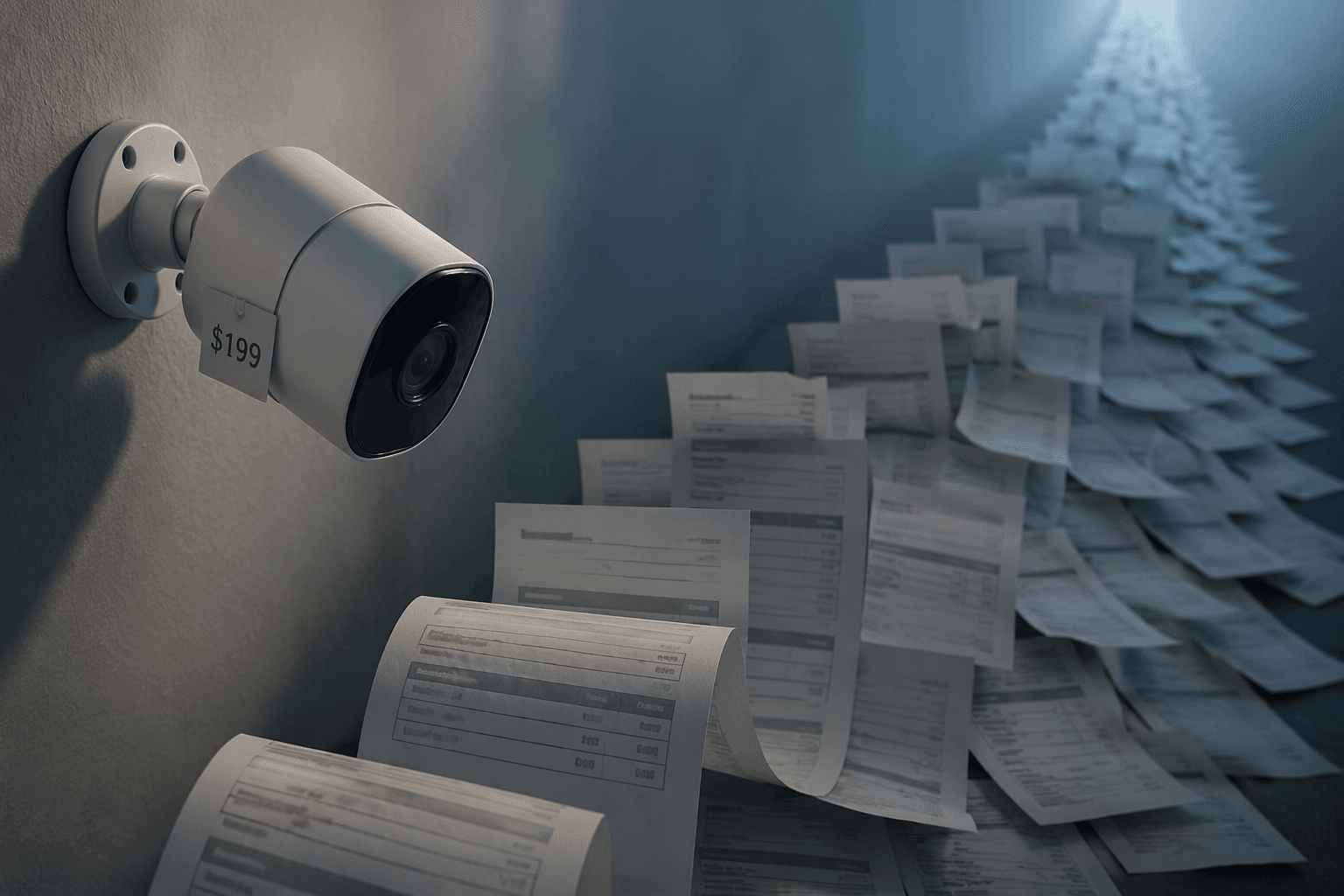
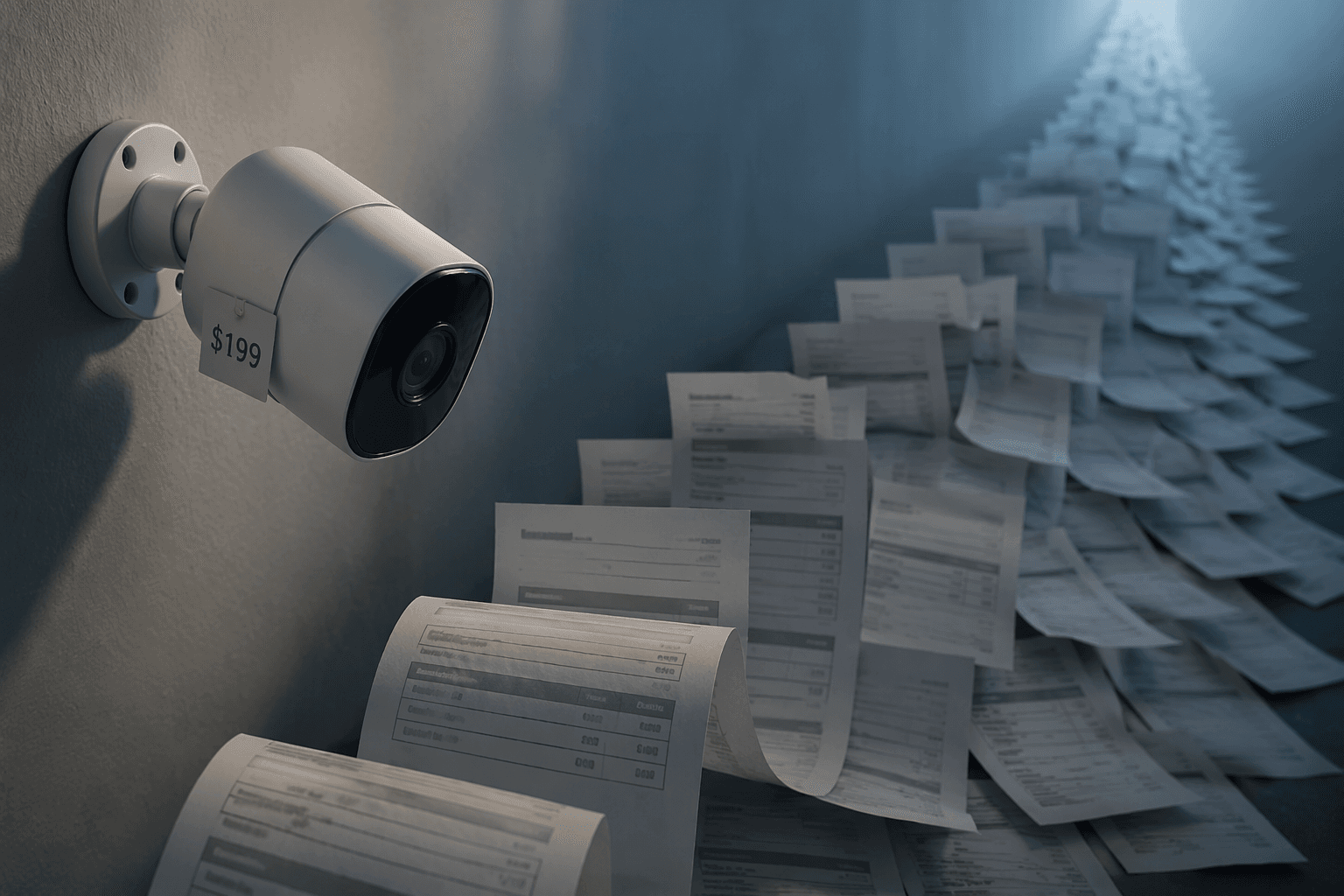
The cheapest-looking box is not always the cheapest system. With smart home security systems, the first receipt usually buys sensors, a hub, a keypad, or a camera. The next 36 receipts decide whether the system stays affordable.
That matters in 2026 because the spread is wide enough to change the buying decision. A capable no-fee DIY path can land around $354 over three years, while a professionally monitored ADT Pro-style setup with $500 in equipment and $49.99 monthly monitoring reaches at least $1,620 before any extra installation, activation, taxes, add-ons, or cancellation costs are counted.[1] At the higher end of professionally installed systems, Vivint-style packages can push the three-year bill beyond $1,800 once equipment and premium monitoring are combined.[1]
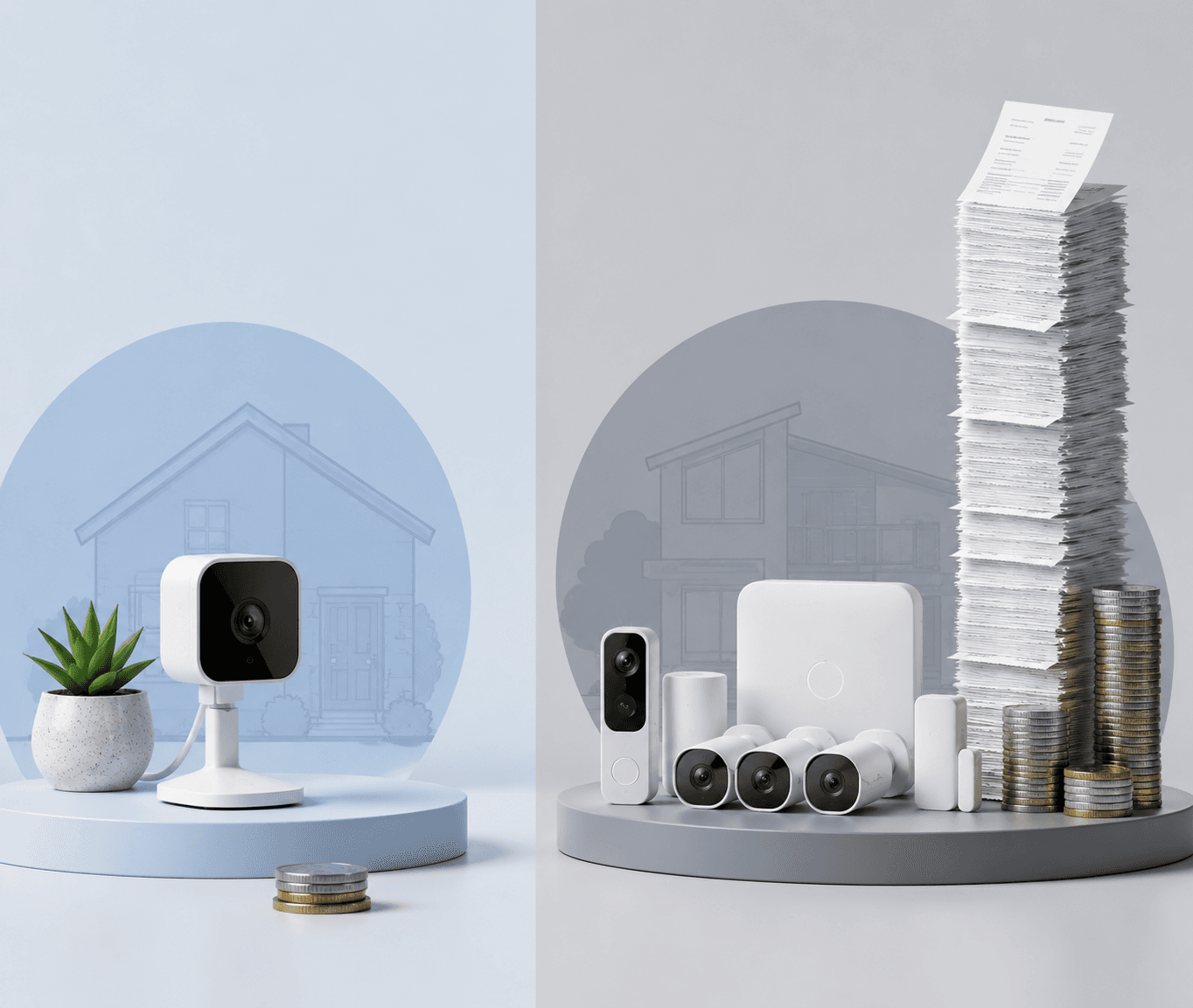
That is the comparison worth making before choosing a brand. Starter-kit prices still matter, but they are only one line in the household budget. Equipment kits range from about $99 for Wyze to more than $900 for Vivint, while many DIY systems sit between $199 and $400.[2] A buyer who stops there is comparing boxes, not ownership.
Price the System Like a Three-Year Bill
A cleaner way to compare smart home security systems is to treat every required and likely charge as part of one three-year total. The basic math is simple: equipment, installation, activation, monitoring, camera storage, and cancellation exposure all belong in the same column.
| Cost component | Why it changes the real price |
|---|---|
| Equipment | The visible purchase price; useful for comparison, but not enough by itself. |
| Installation | Professional installation averages $100–$199, while DIY setup can eliminate that line item.[3] |
| Monitoring | Professional monitoring commonly runs $20–$60 per month; self-monitoring can be free.[4] |
| Cloud storage | Camera recording may require a separate or bundled subscription, even when motion alerts still work. |
| Activation and contract terms | Promotions can hide setup charges or early termination risk until checkout or cancellation. |
This is where a low monthly price stops looking harmless. A $20 monitoring plan becomes $720 over three years. A $60 plan becomes $2,160 before equipment. That does not make monitoring a bad deal; for some households, dispatch support, cellular backup, and professional response are exactly what they are paying for. It does mean the monthly fee deserves the same attention as the door sensor bundle.
June 2026 prices should also be treated as a snapshot, not a permanent quote. Promotions, regional availability, taxes, installation offers, and contract terms can move the final number. The mistake is not being off by a few dollars. The mistake is choosing a system from a $199 kit price and later discovering that the realistic three-year cost is closer to a rent payment than a gadget purchase.
The Low-Cost Path Is Real, but It Has Tradeoffs
The no-fee DIY route is not imaginary. Abode’s free-tier setup is a useful anchor because it shows how low the three-year bill can stay when the buyer avoids recurring monitoring and accepts self-monitoring limits. The cited three-year total is about $354 with a $199 starter kit.[1]
That lower bill usually means the household is taking on more responsibility. Someone has to notice the alert. Someone has to decide whether to call for help. If Wi-Fi fails, power goes out, or a phone is on silent, the system may still be technically working while the response chain is weaker. For renters, younger buyers, or families trying to keep fixed monthly costs down, that may still be a rational exchange. The point is to make the exchange visible before buying.
Professional monitoring earns its fee when it reduces that human bottleneck. The better question is not whether monitoring is “worth it” in the abstract. It is whether the specific fee buys functions the household would actually miss: emergency dispatch, cellular backup, warranty coverage, video verification, or app features that would otherwise disappear.
The Subscription Gap
The most uncomfortable cost is not always the one on the invoice. It is the function that vanishes when the invoice stops.
SafeHome.org’s 2026 survey found that 6% of users had canceled or downgraded monitoring subscriptions because of cost pressure, with renters and 18–29-year-olds disproportionately represented.[5] The same survey found that 32% of users rely solely on cloud storage, meaning that if the subscription is canceled, cameras may still detect motion but cannot record or preserve usable footage.[5]
Those are not the same finding. One measures cancellation or downgrading behavior. The other measures dependence on cloud-only storage. Together, they point to a practical risk: the people most likely to cut the monthly bill may also be the people least able to absorb the loss of evidence if recording was rented rather than owned.
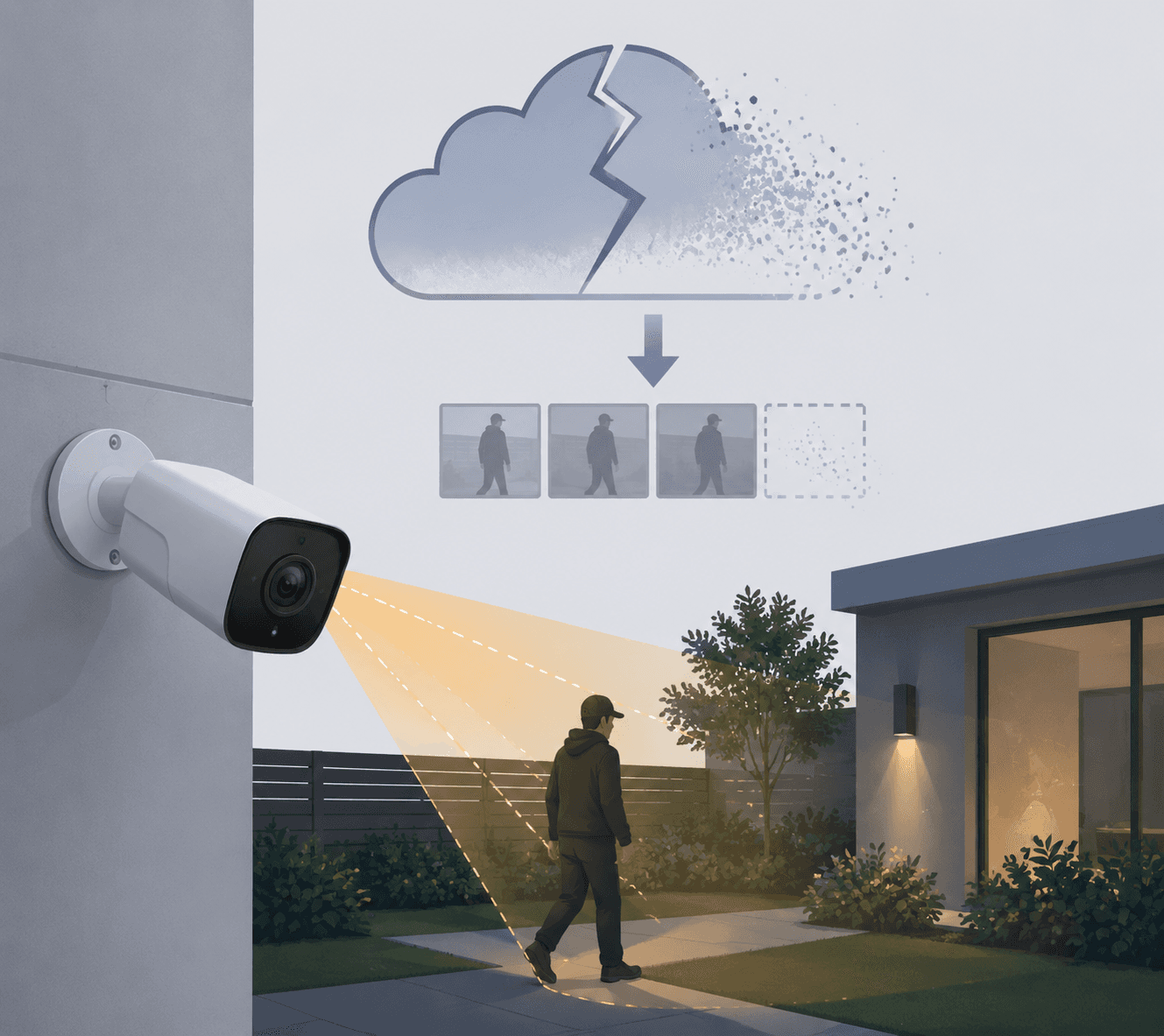
Ring is the easy policy example because its current free tier no longer stores video without a subscription, following changes reflected in 2026 comparisons.[6] A camera can still be present on the wall. It can still send alerts. But if the plan does not include recording, the household may have no clip to review after the fact.
That distinction is easy to miss in normal shopping language. “Motion detection” sounds close to “security footage” until something happens. Detection tells you an event may be occurring. Recording gives you something to inspect, share, or preserve. For a doorbell camera, driveway camera, or indoor camera pointed at an entry, that difference can be the difference between a useful record and a notification that expired into nothing.
A reported Arizona missing-person case is often cited as a warning about this exact kind of dependency: when a subscription had lapsed, potentially important prior footage was no longer accessible during an emergency investigation.[7] A single case does not prove that every canceled plan creates danger. It does show why the fine print on recording access is not a minor feature note.
What Still Works If You Stop Paying?
This is the cancellation test every buyer should run before checkout. Not “What do I get if I subscribe?” but “What remains if I downgrade?”
- Will the alarm still arm and disarm locally?
- Will sensors still trigger a siren?
- Will the app still send push alerts?
- Will cameras still record, or only detect motion?
- Can footage be stored locally, or is cloud storage the only archive?
- Are cellular backup, emergency dispatch, and video history bundled into one plan or split across tiers?
The answer may make a higher-priced system easier to justify. A plan that preserves video history, adds cellular backup, and supports professional response is not the same as a plan that mainly unlocks clips from a camera the buyer already paid for. The first is a service. The second can feel like a toll booth if the free version no longer preserves evidence.
Local storage is not automatically better. It can be stolen with the device, damaged, or misconfigured. Cloud storage is not automatically wasteful either. It can protect footage when a camera is destroyed and make retrieval easier. The practical question is whether the record continues if the household pauses service for a month, or whether it disappears.
Professional Installation Is a Cost, Not the Whole Story
Installation deserves a line in the budget, but it should not dominate the comparison. Professional installation averages $100–$199, and DIY setup can remove that cost.[3] That is meaningful, especially for a renter or a household trying to stay under a fixed upfront budget.
Over three years, though, monitoring usually moves the total more than installation does. A one-time $150 install fee is visible and finite. A $49.99 monthly plan is quiet, automatic, and more than $1,799 across 36 months before equipment or other fees. That is why a professionally installed system can be reasonable for one household and too expensive for another even when the equipment package looks similar.
A Reusable Comparison Standard
Before comparing brand names, build the same three-year line item for every option. Use list price first, then rerun the math with any promotion. If the deal requires a contract, include the risk of leaving early. If a camera plan is optional, price the system both with and without it, then note which recording functions vanish in the cheaper version.
| Question | Why it matters |
|---|---|
| What is the 36-month total? | It catches the gap between a cheap kit and an expensive service path. |
| Which features require a subscription? | It separates owned hardware from rented functionality. |
| Does video recording survive cancellation? | It reveals whether the camera remains useful as evidence. |
| Is installation required or optional? | It prevents a one-time labor charge from being hidden in the quote. |
| What happens at downgrade? | It shows the household’s fallback position during a tighter budget month. |
For a broader brand-by-brand feature comparison, a buyer can still use a head-to-head guide to smart home security systems. For this decision, though, glossy app screenshots matter less than the bill and the downgrade path. The affordable system is the one whose three-year cost fits the household budget and whose core security record does not quietly depend on a subscription the household may later need to cancel.
References
- Abode 2026 cost analysis
- SafeHome.org / Security.org 2026 smart home security system equipment pricing
- CNET 2026 professional installation cost data
- Consumer Reports / Security.org 2026 monitoring cost data
- SafeHome.org 2026 survey of 2,435 U.S. adults, January–February 2026
- Security.org and Abode 2026 comparison of Ring free-tier video storage policy
- Arizona missing-person case cited in privacy paradox coverage
Policy Updates & Reader Notes
Privacy policies, monitoring plan prices, and security disclosures change frequently. Report new data retention terms, updated plan pricing, or new vulnerability disclosures below. For formal editorial corrections, use the contact page.
Comments
Join the discussion with an anonymous comment.