If a Flock Safety Raven sensor is mounted near your home, the practical question is not only “is it recording me?” It is also “what is it listening for before it decides to record?” Flock’s own July 2026 explanation says Raven analyzes ambient sound in rolling 5-second windows, processes that audio on the device, and saves an audio clip only when the system detects a qualifying acoustic event.[1]
That distinction matters. Raven is not described by Flock as a microphone that continuously stores neighborhood audio. But it is described as a system that continuously analyzes neighborhood audio. For homeowners, that is the line worth watching: “not always storing” is not the same as “not always listening.”
What Raven Does Before Anything Is Saved
Flock’s explanation of Raven begins with a narrow claim: the system uses rolling buffers, and those buffers are not stored unless an acoustic event is detected. When Raven detects a qualifying event, Flock says the system captures a 10-second audio clip, with processing happening on the device rather than by streaming raw audio to the cloud for analysis.[1]
In plain terms, the workflow looks like this: sound near the device enters a short buffer; software analyzes that sound for certain patterns; if the sound matches a qualifying event, a clip is saved; if it does not, Flock says the buffer is not stored. That is a real privacy difference from a device that records every minute of street audio. It also means the sensor must be continuously sampling and classifying the acoustic environment in order to know whether a trigger happened.
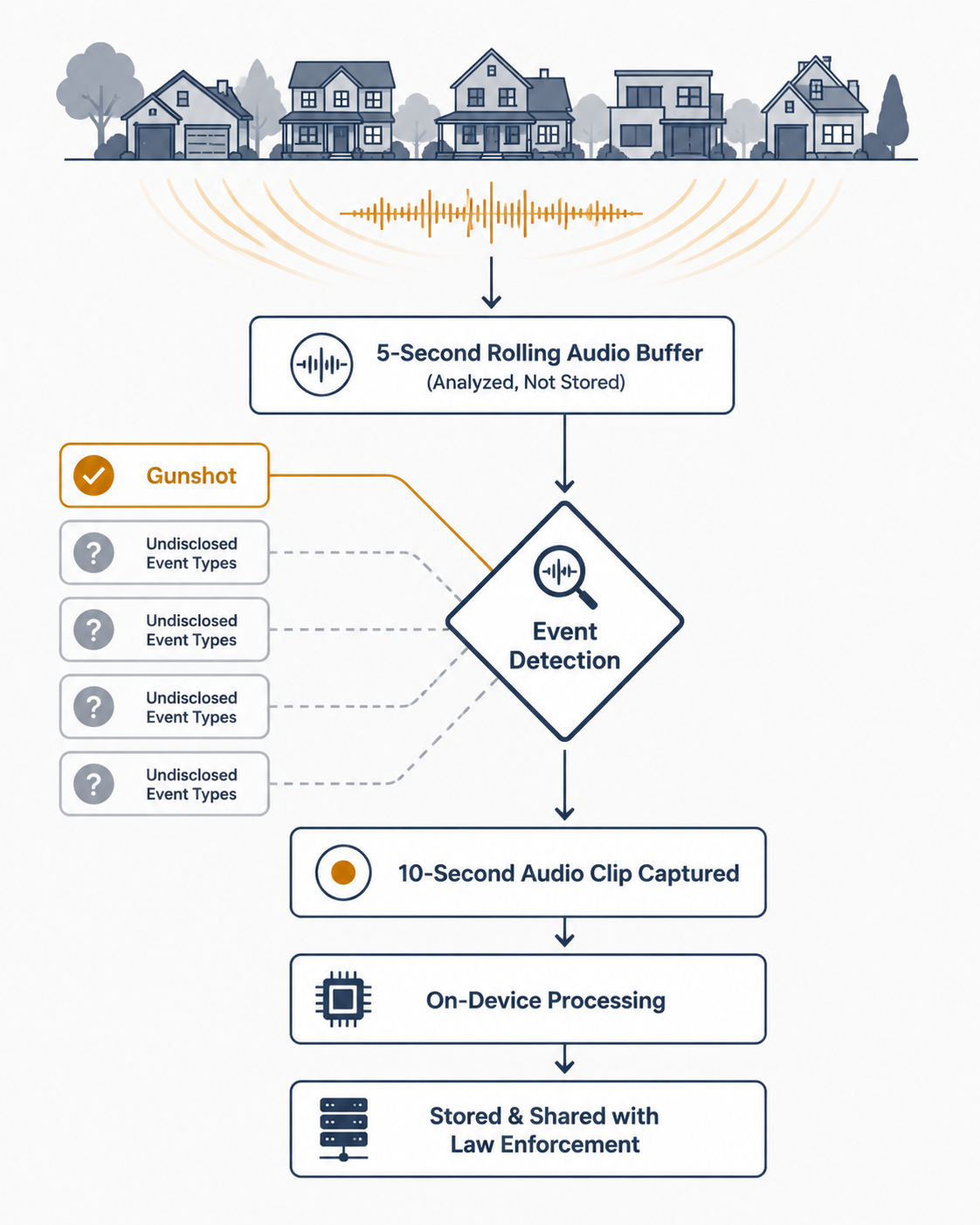
The most important gap is the trigger list. Flock says Raven detects five types of acoustic events. One is gunshot detection. The other four are not publicly disclosed in the July 2026 explanation.[1] That is not a minor footnote for residents. If a sensor is analyzing sound outside bedrooms, porches, driveways, sidewalks, and shared streets, homeowners should be able to know what kinds of neighborhood noise can cause a clip to be captured.
| Part of Raven workflow | What Flock says | Why homeowners should care |
|---|---|---|
| Ambient sound analysis | Rolling 5-second windows are analyzed. | The device is not idle between incidents; it is evaluating nearby sound. |
| Storage | Buffers are not stored unless a qualifying event is detected. | This reduces the risk of blanket recording but does not remove classification risk. |
| Event types | Five event types exist; gunshot is disclosed and four are not. | Residents cannot fully know what sounds can trigger capture. |
| Clip length | A 10-second audio clip is captured after detection. | Short clips can still include bystanders, homes, voices, pets, cars, or context unrelated to the event. |
| Processing location | Flock says processing happens on-device. | On-device processing may limit exposure, but oversight still depends on trigger rules, retention, access, and auditability. |
This is where smart home privacy language can get slippery. A company can accurately say it does not continuously record, while residents can accurately say the device is continuously listening in the sense that it is analyzing sound. Both statements can be true. The policy question is which one governs consent, disclosure, and oversight.
Flock also says its gunshot detection has false positive and false negative rates below 1%, but the research record available here does not include independent external validation of that claim. That does not make the claim false. It does mean a city council, police department, or HOA should not treat the vendor’s performance statement as a substitute for independent testing, deployment logs, and local audit rights.[1]
The Four Undisclosed Event Types Are the Privacy Problem
Gunshot detection is the use case most residents will understand immediately. A shooting happens, a sensor detects the sound, police receive faster location information, and investigators may get a short clip. Whether that system works well enough is a separate question, but at least the trigger is visible.
The undisclosed categories are different. They ask residents to accept a neighborhood microphone system without knowing the full rule set. A homeowner cannot evaluate whether a clip might be triggered by fireworks, a car backfire, breaking glass, shouted words, machinery, alarms, or some other sound category unless the operator discloses the enabled classifications. The issue is not that every possible category is equally invasive. The issue is that residents are being asked to trust a classification system they cannot inspect.
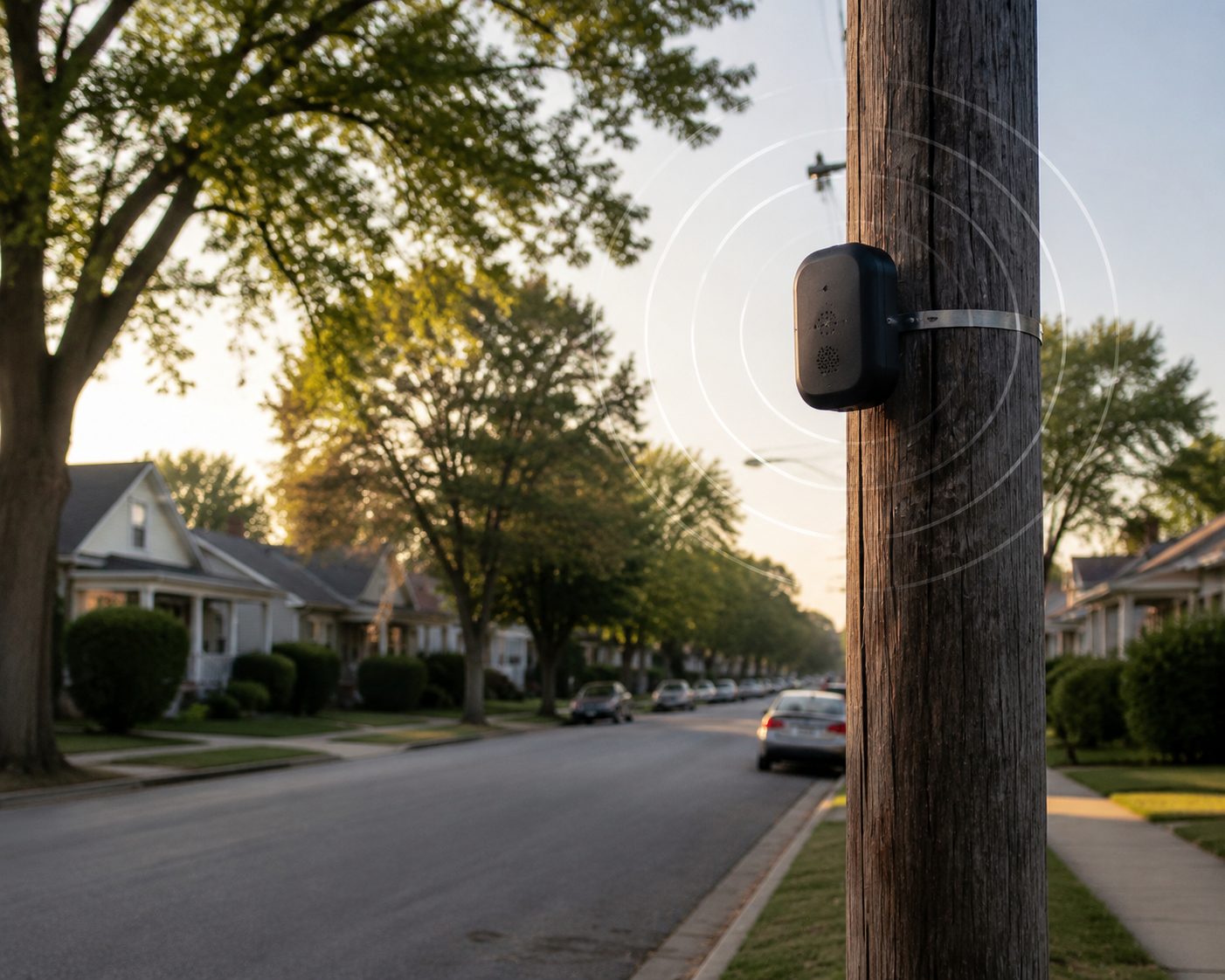
That matters more in shared space than it does inside a home. If you buy a smart speaker, you at least chose the device, the room, the account, and the settings. If a Raven sensor appears on a pole serving a subdivision, the acoustic boundary can reach people who did not sign a contract, download an app, or agree to a privacy policy. Consent becomes collective, indirect, and often buried in a city procurement file or an HOA meeting packet.
The Human-Distress Feature Shows Why “Current Settings” Are Not Enough
The strongest reason to ask about future capabilities is not speculative. In October 2025, the Electronic Frontier Foundation reported that Flock’s gunshot detection microphones would start listening for human voices through a pilot feature designed to detect screams and shouts.[2] Flock’s July 2026 blog post says the company removed that human-distress detection feature.[1]
That sequence is the part homeowners should remember: the feature existed as an offered pilot, an advocacy group exposed it, and Flock later said it removed it. The removal matters. So does the fact that the acoustic infrastructure remained. The microphones did not vanish from poles because one classifier was taken out of the product.
A sensor network built to classify gunshots can be repurposed to classify other sounds if the hardware, software pipeline, customer demand, and company policy allow it. The human-distress episode does not prove that Raven currently detects screams or shouts after Flock’s removal announcement. It does prove that the question “what does it detect today?” is too narrow unless residents also ask who can approve new classifications tomorrow.
That is why the four undisclosed event types are so difficult to dismiss. A city or HOA might believe it has approved gunshot detection, while the actual system contains additional event categories residents cannot evaluate. If the answer is “trust the vendor,” that is not a privacy control. It is a procurement posture.
Why the Ring Deal Made This a Smart Home Privacy Issue
Flock’s Raven sensors are not smart speakers, doorbells, or indoor cameras. They sit in the public and semi-public fabric around homes. But the attempted connection to Amazon’s Ring ecosystem made the boundary harder to ignore. BBC reported that Amazon’s Ring ended its integration deal with Flock after backlash tied to a Super Bowl advertising push in early 2026.[3]
That cancellation is not the whole story, and it should not be treated as if it solved the problem. It does show that the consumer smart home market can still resist a public-surveillance integration when it becomes visible enough. The more important point is that Flock’s systems already operate outside the consumer device relationship. A homeowner can decline a Ring camera at the front door and still live under a neighborhood camera and audio network maintained by an HOA, city, or police department.
For a broader comparison between consumer-platform privacy promises and public-space security networks, see this guide to smart home platform privacy. The important difference here is control. A household can change a setting or unplug a device. A resident usually cannot unplug a pole-mounted sensor watching and listening over a shared street.
Scale Changes the Risk
Flock is not a one-neighborhood experiment. EFF’s 2025 review described Flock as operating in more than 5,000 communities across 49 states and connected that reach to a much broader network of automated license plate readers and law-enforcement access.[4] Malwarebytes reported in July 2026 that Flock performs more than 20 billion vehicle scans per month and that 75% of its law-enforcement customers use the National Lookup Tool.[5]
Those numbers are about Flock’s broader surveillance network, not specifically Raven audio deployments. They still matter because audio sensors do not arrive in a vacuum. They can be attached to the same institutional habits: vendor dashboards, police access, regional sharing, retention settings, and procurement decisions that residents often see only after installation.
Automated license plate readers already raised the question of whether a neighborhood security tool becomes a regional tracking system. Raven adds a second layer: not only “which vehicle passed?” but “what did the neighborhood sound like, and did software classify it as important?” That is an escalation even if the audio clips are short and even if the stated purpose is public safety.
The public pushback is no longer theoretical. The Guardian reported in April 2026 that more than 30 localities had canceled Flock contracts since early 2025.[6] NPR reported in February 2026 that 82 Flock contracts had been terminated across 28 states between August 2021 and May 2026.[7] Those cancellations do not prove every deployment is unlawful or harmful. They show that governance concerns are serious enough for cities to walk away after adoption.
False Alerts Are a Separate Warning, Not Proof About Raven
The clearest audit figure in the available materials concerns Flock alerts in Los Angeles, not Raven audio. Malwarebytes reported that a Los Angeles Police Department inspector general audit found 32.3% of Flock alerts inaccurate over a 2-month period, including 161 vehicles falsely flagged as stolen.[5]
That number should not be copied and pasted onto every Flock product or every city. It does not establish Raven’s gunshot detection accuracy, and it does not prove that 32.3% of audio alerts would be wrong. What it does show is more modest and still important: automated public-safety systems can generate confident-looking alerts that require human review, audit trails, and consequences when they are wrong.
For the person on the street, a false alert is not an abstract data-quality issue. It can mean a police stop, a search, a report, a neighborhood suspicion, or a record that takes time to correct. Audio alerts could carry different consequences, but they deserve the same oversight question: who verifies the machine before anyone acts on it?
What to Ask Before an HOA or City Approves Raven
The worst time to ask privacy questions is after the pole is installed and the contract has renewed automatically. If your HOA, neighborhood association, city council, or police department is considering Flock equipment, ask for the documents before the vote: the contract, product schedule, data-retention terms, access policy, sharing policy, audit rights, and any attachments that describe Raven or audio detection.
- Is Raven audio detection deployed, proposed, or merely available as an add-on?
- Which of the five acoustic event types are enabled locally, including the four categories Flock has not publicly disclosed?
- Can the customer enable new audio classifications without a public vote, resident notice, or contract amendment?
- How long are 10-second audio clips retained, and who can delete, export, or share them?
- Who can access audio clips: local police, neighboring agencies, Flock personnel, prosecutors, private security, or HOA board members?
- What independent validation exists for detection accuracy, and will local false positives and false negatives be published?
- Does the contract allow the National Lookup Tool, regional sharing, or other cross-jurisdiction access for related Flock data?
- What happens when a resident, tenant, guest, delivery driver, or passerby is captured in an audio clip unrelated to a crime?
If the answer to any of those questions is “we do not know,” the deployment is not ready. A neighborhood cannot give meaningful consent to an audio surveillance system when the event types, access rules, and retention settings are unclear.
For household-level privacy work, the steps are different: review your own cameras, speakers, doorbells, app permissions, and cloud retention. This smart home privacy settings checklist is useful for devices you personally control. But do not confuse account settings with community governance. You can harden your own home and still need a public answer about the sensor on the pole.
How to Push for Real Limits
Start with disclosure. A city or HOA should publish whether Raven is deployed, where sensors are placed, which event types are active, how long clips are kept, and which agencies or private parties can access them. If officials will not publish the enabled event categories, residents should treat that as a reason to delay or reject the deployment.
Then ask for change control. The human-distress controversy is a reminder that capabilities can shift after installation. A contract should require public approval before any new audio classification is enabled. It should also bar silent expansion from gunshot detection into broader acoustic monitoring.
Retention deserves its own vote. A 10-second clip is still a record. It can contain a voice, a child, a domestic argument in the background, a medical incident, or nothing relevant at all. If your community already debates camera retention, apply the same pressure to audio. This camera data retention and privacy guide covers the same basic question for video: who keeps the recording, for how long, and under what access rules?
Finally, demand auditability. Vendor dashboards and police assurances are not enough. Residents should ask for local alert counts, false positive reviews, access logs, deletion logs, sharing logs, and an annual public report. If law enforcement says the data is too sensitive to disclose in detail, it can still publish aggregate numbers and policy changes without exposing investigations.
The narrow answer is that Raven is not proven, on the materials available here, to be an always-recording microphone in the simple consumer-fear sense. The broader answer is less reassuring. A system that continuously analyzes neighborhood audio, saves clips on undisclosed triggers, sits inside a scalable public-private surveillance network, and has already tested the boundary of human-voice classification is a real smart home privacy risk even when each individual clip is short.
References
- How Flock's Audio Detection Works, and the Concerns We Hear Most, Flock Safety, 2026-07-10.
- Flock's Gunshot Detection Microphones Will Start Listening for Human Voices, Electronic Frontier Foundation, 2025-10.
- Amazon's Ring ends deal with surveillance firm after backlash, BBC.
- EFF's Investigations Expose Flock Safety's Surveillance Abuses: 2025 in Review, Electronic Frontier Foundation, 2025-12.
- The backlash against Flock cameras is spreading, Malwarebytes, 2026-07.
- 'Creepy surveillance': why some cities are shutting down Flock cameras amid privacy concerns, The Guardian, 2026-04.
- Why some cities are ditching their Flock license plate readers, NPR, 2026-02.
Policy Updates & Reader Notes
Privacy policies, monitoring plan prices, and security disclosures change frequently. Report new data retention terms, updated plan pricing, or new vulnerability disclosures below. For formal editorial corrections, use the contact page.
Comments
Join the discussion with an anonymous comment.