The first question is not whether the board is frustrated with Flock Safety. The first question is whether the contract has already rolled over.
For an HOA, neighborhood association, or gated community, canceling a Flock Safety contract usually comes down to one small administrative window: the written notice period before renewal. Flock’s terms provide for annual auto-renewal unless written notice is given, and cancellation guidance commonly points boards to a 30- to 60-day notice window that depends on the contract language in front of them.[1][2] Miss that window, and the discussion can turn from “Do we still want these cameras?” into “Why are we paying for another year?”

That is why the cancellation file should start with dates, not opinions. Privacy concerns, resident pressure, budget fatigue, and doubts about effectiveness may all be legitimate reasons to end the service. None of them substitutes for timely written notice in the form the contract requires.
Start With The Renewal Date
Find the signed agreement, the order form, any amendments, and the latest renewal invoice. Do not rely on a board member’s memory of when the cameras went up. The date that matters is the contract renewal date, and the exact notice requirement may be in the main agreement, an incorporated terms page, or a later addendum.
The board secretary or community manager should pull out four items before anyone drafts a cancellation email:
- The current contract term and renewal date.
- The number of days of written notice required before renewal.
- The address, portal, account contact, or delivery method required for notice.
- Any language on early termination, remaining balances, equipment return, data retention, or incorporated terms.
If the contract says notice must be written, treat a phone call with a sales representative as useful only for clarification. It is not the cancellation record. If the contract requires notice to a specific legal address or account channel, send it there, even if a familiar representative has been helpful. The cancellation packet should be understandable two years from now by a different board looking through old records.
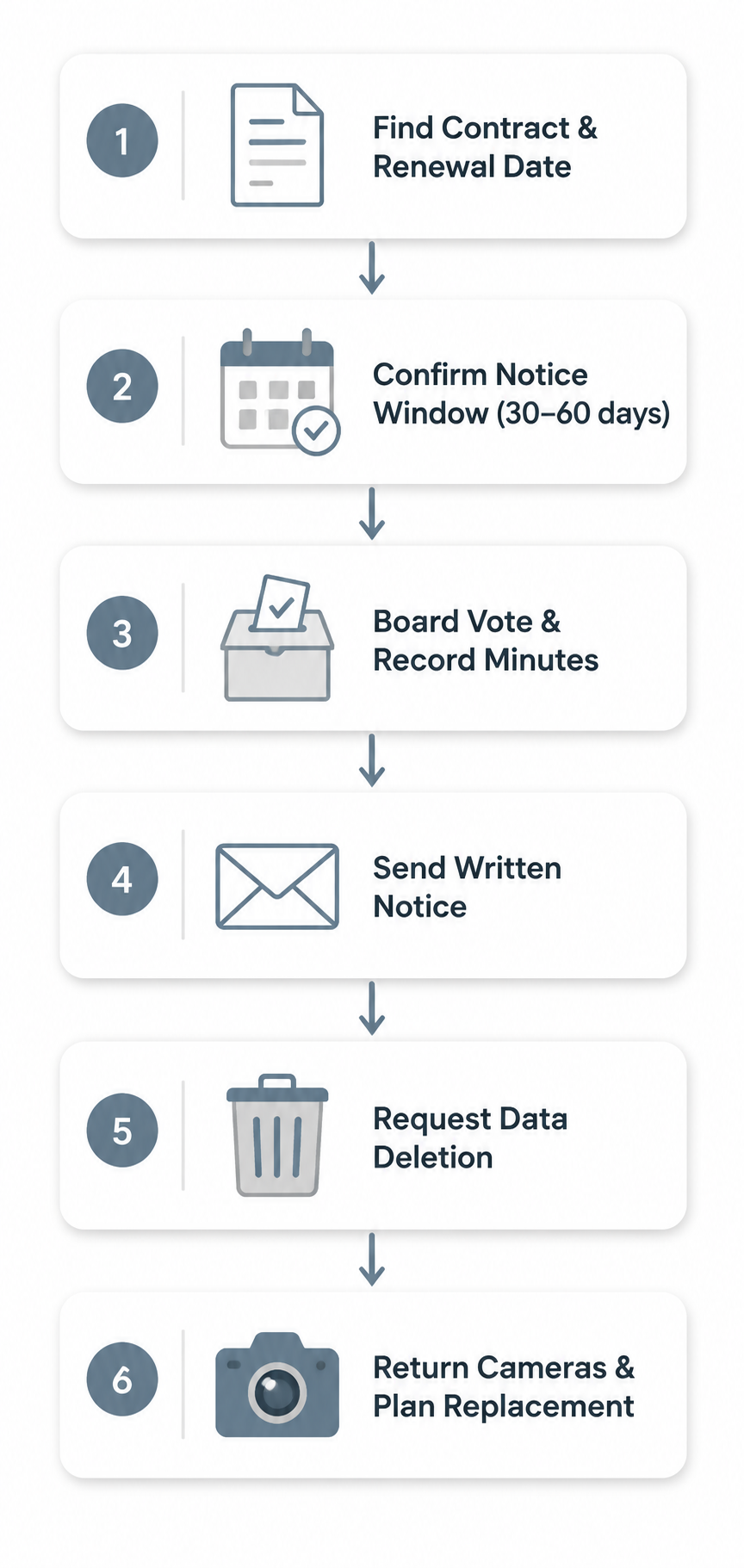
| Task | Why it matters |
|---|---|
| Find contract and renewal date | Determines whether cancellation is still available before the next term |
| Confirm written notice window | Prevents an avoidable auto-renewal |
| Authorize cancellation by board vote | Shows the manager or officer had authority to act |
| Send formal written notice | Creates the record that the contract required |
| Request deletion and access records | Addresses plate data and downstream uncertainty |
| Coordinate camera removal or return | Prevents confusion over leased equipment |
| Document replacement or coverage gap | Tells residents what changes after cancellation |
Do Not Let A Mood Vote Stand In For Authority
Resident comments can explain why the board is revisiting the service. They do not, by themselves, cancel the contract. The board should vote in a properly noticed meeting under the association’s governing documents, then record the decision in the minutes.
The motion does not need theater. It needs authority. A clean motion might authorize a named officer, manager, or attorney to issue non-renewal or termination notice for the Flock Safety agreement, request confirmation of the cancellation effective date, request data deletion and access records, and coordinate removal or return of equipment. If the community is still inside the contract term, the motion should also authorize review of any remaining balance or early termination obligation.
Early exit is a different problem from non-renewal. Flock’s terms address termination and payment obligations, and cancellation guidance warns that leaving mid-contract may require paying the remaining balance unless there is a provable breach or another contractual basis.[1][2] If the board believes Flock materially breached the agreement, for example through unauthorized sharing or misrepresentations tied to the sale, that is a legal review issue, not a casual email exchange.
The ACLU has published criticism of Flock’s statements to public bodies and the public, including claims that it characterizes as misleading.[3] That material may matter if a board is investigating what was represented before approval. It does not automatically prove that a private HOA has a breach claim under its own signed contract.
Send The Notice Like It Will Be Challenged
The notice should be boring, specific, and traceable. Put the association’s legal name, contract or account number if available, property address, board authorization date, requested cancellation or non-renewal date, and a request for written confirmation. Attach the relevant board action if your counsel or manager recommends it, but do not bury the actual cancellation language in a long complaint letter.
If the contract requires notice 30 days before renewal, do not wait until day 30. If it requires 60 days, do not wait until day 60. Send early enough to correct a wrong address, portal failure, holiday delay, or rejected attachment. Volunteer boards lose money in the dead space between “I thought the manager sent it” and “Flock says it never received proper notice.”
Keep proof of delivery in the association’s permanent records. That may include certified mail receipts, email headers, portal confirmations, sent PDFs, screenshots, and any reply from Flock confirming receipt. If a representative responds with a retention offer, pricing change, or request for a call, answer only if it does not jeopardize the notice record. The notice has one job: stop renewal or begin the contractually allowed exit.
Ask For Data Deletion, Then Assume You Need A Record
Cancellation should include a separate written request covering data. Ask Flock to confirm what license plate reader data the association controls or can request deletion for, what retention period applies, whether data was shared with law enforcement or other users, and whether access logs can be provided for the association’s cameras.
This is where clean privacy promises often get too neat. PLACA.AI, a Flock competitor, warns that once plate data enters a wider law-enforcement network, downstream deletion may be incomplete; the ACLU has also described Flock’s network in terms of broad law-enforcement connectivity and data-sharing concerns.[3][4] PLACA.AI states that Flock’s network includes 3,000-plus connected agencies, a figure that should be treated as a vendor-competitor claim rather than an independent audit.[4]
That uncertainty is not a reason to skip the request. It is the reason to write the request carefully. The association should ask for confirmation of deletion where deletion is available, a description of any data that cannot be deleted, and the names or categories of parties that accessed or received data from the community’s cameras. If Flock cannot or will not provide some of that information, keep the response in the file.
Residents who want broader privacy context can compare this issue with other connected security systems in Smart Home Security and Privacy in 2026 and the broader trade-offs discussed in The Privacy Price Tag. Those debates may matter to the next vote, but the cancellation file still needs its own deletion and access-log paper trail.
Plan For The Cameras To Leave
With Flock, the hardware issue is not sentimental. PLACA.AI states that Flock owns the hardware and removes the cameras after cancellation, leaving the community with no equipment to reuse despite prior payments.[5] Because PLACA.AI competes with Flock, its cost comparisons deserve caution. But the lease-model consequence is still the operational point the board must verify: if the service ends, what physically remains at the entrance, gate, clubhouse, or roadway?
Ask Flock, in writing, for the removal schedule, who will remove equipment, whether the association must provide access, whether poles or mounts remain, whether electrical or network work is affected, and whether any damage repair is included. If the cameras are mounted on property not owned by the association, such as a utility pole or a municipal right-of-way, confirm who has authority to coordinate removal.
The treasurer should also close the billing loop. Request a final invoice or zero-balance statement, confirm whether prepaid amounts are refundable under the contract, and preserve the cancellation confirmation with the financial records. A camera being removed from a pole does not prove the account has stopped renewing.
Decide What Residents Should Expect Afterward
A board can cancel Flock without immediately replacing it, but it should not pretend nothing changes. If residents were told the cameras deter theft, helped police after break-ins, or monitored entrance traffic, then the community needs a plain statement about what happens after removal.
Replacement planning does not have to mean buying a new license-plate reader system. The board may choose more lighting, gate maintenance, patrol changes, conventional cameras, neighborhood communication, or no replacement at all. The important distinction is between a security plan and a cancellation celebration. Someone will ask, after the next car break-in, why the cameras were removed. The minutes should show the board knew the trade-off and made a decision.
If the association is considering other audio or camera products, keep that discussion separate from the Flock exit mechanics. For example, privacy questions around Flock’s Raven audio surveillance belong in a broader review of monitoring tools, not in the sentence that gives notice of non-renewal.
Cancellations Are No Longer Hypothetical
HOAs are not municipalities, and a city council’s procurement process is not an association board meeting. Still, recent public-sector cancellations show that ending a Flock relationship is administratively possible when the decision is documented.
Framingham, Massachusetts, decided in June 2026 that its police department would not renew its Flock Safety contract after months of resident opposition.[6] Staunton, Virginia, reported that its Flock contract was officially terminated in January 2026.[7] Flagstaff, Arizona, canceled its contract in December 2025.[8] Cambridge, Massachusetts, announced termination of its Flock Safety ALPR contract in December 2025.[9]
The larger count depends on who is counting and what qualifies. NPR has reported at least 30 localities since early 2025.[10] TechTimes reported 53 cities total.[11] DeFlock maps 87 cities rejecting license plate readers more broadly, which is not the same as completed Flock contract cancellation.[12] For an HOA reader, the practical takeaway is narrower: cancellation and rejection are now common enough that a board does not have to invent the concept from scratch.
Flock has said that new partnerships “significantly outpace” departures, according to reporting on the company’s response.[10] That may be true and still irrelevant to a community whose own renewal date is 45 days away. The board’s job is not to settle the national debate. It is to preserve the association’s options before the contract renews.
Build The Cancellation Packet
By the end of the process, the association should be able to open one folder and see the whole exit. If that folder does not exist, the cancellation is still too dependent on memory.
- Signed contract, renewal date, and notice requirement.
- Board agenda, motion, vote result, and approved minutes.
- Formal written cancellation or non-renewal notice and proof of delivery.
- Flock’s written confirmation of receipt, effective date, billing status, and equipment removal plan.
- Data deletion request, access-log request, and Flock’s response.
- Resident communication and documented plan for the coverage gap or replacement.
That packet is the difference between a defensible cancellation and a board rumor. Canceling Flock is not a single email, and it is not a mood vote after a tense open forum. It is board authorization, timely written notice, data and access follow-up, equipment removal coordination, retained records, and a clear account of what residents should expect once the cameras are gone.
References
- Flock Safety Terms and Conditions, Flock Safety.
- How to Cancel Flock Safety Contract, PLACA.AI.
- Flock Safety Credibility Lost As It Repeatedly Lies to City Councils, Police Departments, and Public Across the Country, ACLU.
- Flock's Terms and Conditions, ACLU.
- What Happens If HOA Cancels Flock Safety?, PLACA.AI.
- Framingham police will not renew Flock Safety contract after months of resident opposition, Boston.com, June 25, 2026.
- City of Staunton’s contract with Flock Safety officially terminated, WHSV, January 10, 2026.
- Flagstaff cancels contract with Flock Safety cameras, KJZZ, December 17, 2025.
- Statement on the Flock Safety ALPR Contract Termination, City of Cambridge, December 2025.
- NPR report on localities ending Flock Safety contracts, NPR.
- TechTimes report on Flock Safety city cancellations, TechTimes.
- DeFlock map of cities rejecting license plate readers, DeFlock.
Policy Updates & Reader Notes
Privacy policies, monitoring plan prices, and security disclosures change frequently. Report new data retention terms, updated plan pricing, or new vulnerability disclosures below. For formal editorial corrections, use the contact page.
Comments
Join the discussion with an anonymous comment.