A doorbell camera is a choice. You buy it, aim it, set the motion zones, decide whether package alerts are worth the battery drain, and eventually remove it if the tradeoff feels wrong. Flock Safety cameras are not that kind of smart home decision. When an HOA, neighborhood association, apartment community, or city installs them at neighborhood entrances, the people being recorded usually do not get household-level control over the device, the search system, the retention rules, or the agencies that can query the data.
That is why concerns about Flock Safety in smart home security deserve a different conversation than the usual Ring-versus-Nest privacy debate. The issue is not whether cameras can help solve break-ins or identify a stolen car. They can. The issue is what changes when residential security becomes a searchable location network that everyone passes through, including residents who never voted for it, renters who were never asked, visitors who never saw a policy, and neighbors whose daily routines become data points in someone else’s system.

Flock describes its license plate reader cameras as a public-safety tool for communities and law enforcement. The system has also grown into something much larger than a neighborhood gate camera: more than 80,000 cameras nationwide, more than 5,000 law-enforcement customers, and a National Lookup Tool that, according to civil-liberties reporting, enrolled about three-quarters of Flock cameras for cross-jurisdictional searches.[1]
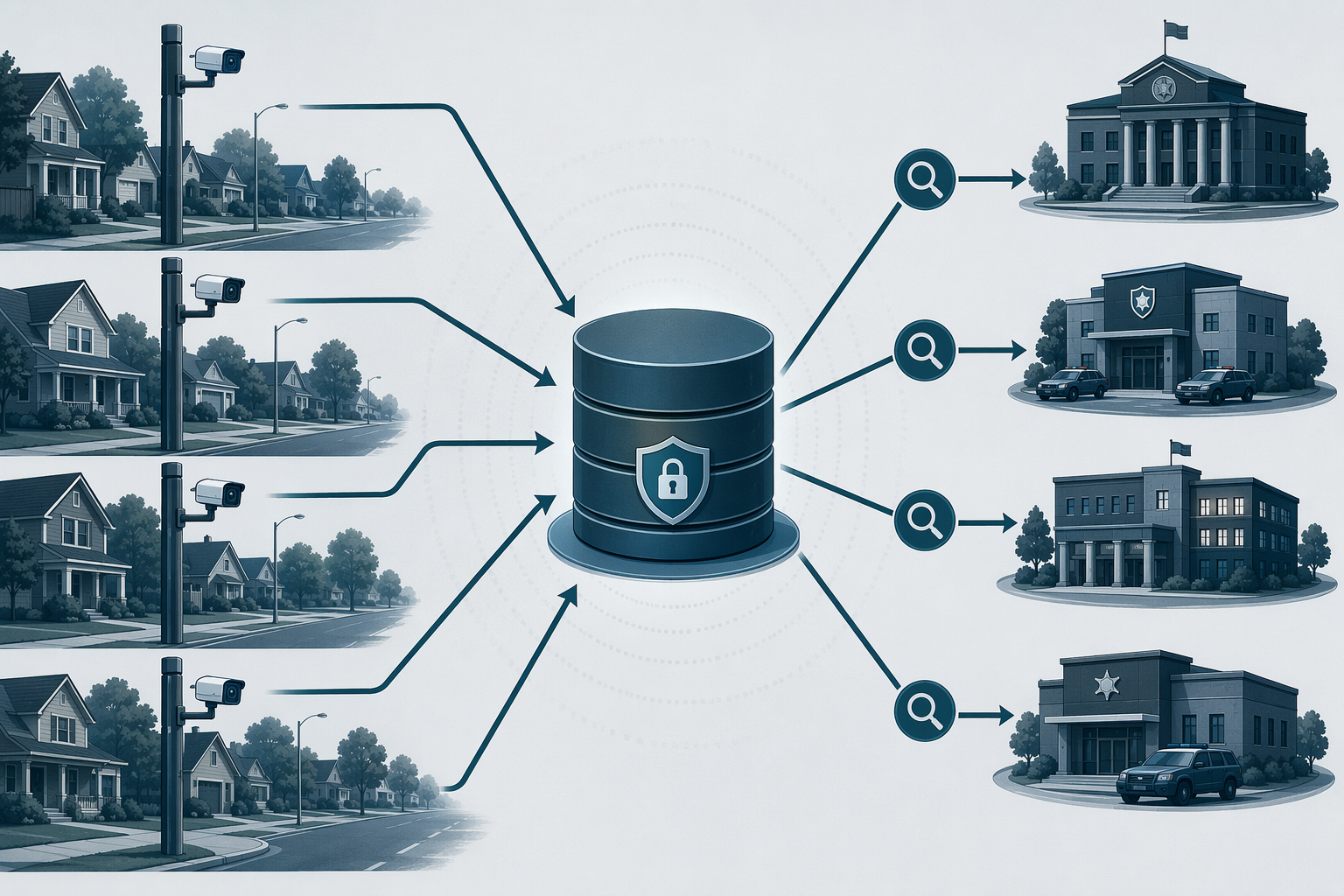
A smart home owner can reasonably understand the appeal and still object to the architecture. A camera at a subdivision entrance feels practical after a string of car burglaries. But once the plate hits a cloud database, the local safety tool becomes part of a broader system: always-on capture, searchable location history, shared law-enforcement access, automated alerts, and audit trails that residents may never see.
This Is Not Just a Bigger Doorbell Camera
The familiar smart home privacy problem starts inside a household. A security camera may record too much of the sidewalk, share clips with a cloud provider, or make police access too easy. Those are real concerns, and they are covered in broader smart-home privacy guides such as Smart Home Security and Privacy in 2026. But the person who bought the camera still has some direct control: settings, placement, subscription status, account access, and removal.
Flock’s neighborhood model reverses that control. The cameras sit in shared space or public-facing residential corridors. They are installed for collective use, often through an HOA board, police department, or local government. The people captured by them are not only the customers. They are delivery drivers, home health aides, teenagers walking home, residents going to medical appointments, house cleaners, relatives, tenants, and anyone else whose route crosses the camera line.
The company’s public framing has emphasized vehicles and license plates. Independent security researcher Jon “GainSec” Gaines, however, reported that Flock camera systems stored images of people and pedestrians in separate folders, a finding later discussed in security-vulnerability reporting. Flock disputes characterizations that its cameras are used to track pedestrians, so this point should not be inflated into a settled claim that every deployment is a pedestrian-tracking system. The narrower, still important point is that independent researchers documented pedestrian images in the system despite “vehicles only” marketing.[2]
That mismatch matters. A resident deciding whether to tolerate an ALPR camera needs to know what is actually captured, not just what the brochure says the product is for. If the system can store more than plates, then retention, access, and search rules need to cover more than plates.
The Data Problem Is the Search Layer
A single image of a car entering a neighborhood is not the main privacy problem. The problem is the indexed pattern: which vehicle appeared where, when, how often, and near which other cameras. Once cameras from thousands of communities feed a shared lookup system, a local residential installation can become one node in a national location-search network.
This is where smart home instincts can mislead people. With a home camera, the obvious question is, “Who can see my clips?” With ALPR networks, the better question is, “Who can search for my movements, under what purpose, with what approval, and who checks later?”
| Consumer smart home camera | Neighborhood Flock-style ALPR network |
|---|---|
| Chosen and installed by a household | Chosen by an HOA, city, police department, landlord, or association |
| Usually records one property edge or entryway | Records shared routes into and through a neighborhood |
| Account owner can change settings or remove the device | Residents generally have no technical opt-out |
| Privacy risk centers on clips, cloud access, and settings | Privacy risk centers on searchable location history and shared queries |
| Access is tied to a consumer account and provider policies | Access may extend through law-enforcement networks and lookup tools |
The National Lookup Tool is the clearest expression of that shift. When a camera is enrolled for broader lookup, a plate captured near a townhouse complex or subdivision can become searchable by agencies far from the neighborhood, depending on permissions and policies. A resident who thought the camera was there for burglaries on the next block may discover that the system has become relevant to immigration, protest, reproductive-health, or out-of-state investigations.
Documented Harms Follow From Who Can Query the System
The strongest case against treating Flock as a normal neighborhood camera is not theoretical. The documented problems have different mechanisms, but they all start with the same design choice: many cameras, many agencies, searchable records, and weak resident-level control.
Immigration Queries Can Move Through Local Police
It is important to be precise here. The concern is not that ICE has been shown to have direct Flock access in the cited reporting. The concern is that local law enforcement can run searches on behalf of ICE or immigration-related investigations, turning a local camera network into an indirect immigration tool.
That distinction is not a comfort. It is the mechanism. Civil-liberties groups and journalists have documented Washington law-enforcement agencies running Flock queries connected to immigration enforcement; University of Washington Center for Human Rights work identified 20 Washington agencies in that state context.[3]
For residents, the practical question is simple: does the neighborhood or city policy prohibit using the cameras for immigration enforcement, and does the audit system actually make violations visible? A sign that says “community safety” does not answer either question.
Protest Searches Show Purpose Creep
EFF analyzed more than 12 million Flock search logs from more than 3,900 agencies and reported that 19 agencies searched for people connected to No Kings protests, while three agencies targeted animal-rights activists.[4]
That does not prove every local Flock installation is used to monitor political activity. It proves something narrower and more useful: once the lookup tool exists, protest-related queries are a documented use case. For anyone living near a camera, that changes the risk calculation. The relevant question is not whether the HOA intended to monitor speech. It is whether the system they bought can be searched for that purpose and whether local rules forbid it.
Reproductive-Health Searches Are Not Hypothetical
EFF also reported a Texas sheriff’s office search for a woman who had a self-managed abortion. The query reached 6,809 networks and 83,345 cameras nationwide.[4]
This is the point where the “it’s just for stolen cars” reassurance collapses. A camera installed at a neighborhood entrance for property crime can become relevant to a health-care investigation far outside the neighborhood. Residents do not need to speculate about every possible abuse; one documented search across tens of thousands of cameras is enough to justify asking whether reproductive-health surveillance is explicitly banned in local policy.
Insider Misuse Turns Access Into Personal Power
Broad access also creates the old surveillance problem in a newer interface: insiders using official tools for personal reasons. Civil-liberties reporting has cited more than 22 ALPR stalking cases tracked by the Institute for Justice, including a Kansas police chief who used Flock 164 times to track an ex-partner.[1]
This is not a claim that most officers misuse the system. It is a reminder that a searchable location database creates a high-value abuse target even when the original purchase was mundane. If a board member or police representative says “only authorized users can access it,” the follow-up is: who authorizes them, are searches logged, who audits the logs, and what happens when a search is abusive?
False Alerts Can Become Dangerous Stops
Errors in a smart home app are annoying. Errors in an ALPR system can put a driver into a police stop they did nothing to cause. A July 2026 Los Angeles Times report on an LAPD Inspector General audit said 32.3% of Flock alerts reviewed were inaccurate, and that 161 vehicles were falsely flagged as stolen over a two-month period.[5]
That number measures more than software quality. It measures how often a database signal may have pushed officers toward the wrong person or vehicle. In a high-risk stolen-vehicle stop, the person bearing the consequence is not the HOA that approved the camera or the vendor that sold it. It is the driver on the roadside, trying to prove that the alert is wrong while police decide how much danger they think they are facing.
A neighborhood evaluating Flock should ask what verification is required before an alert becomes an enforcement action. If the answer is vague, that is not a technical detail. It is the boundary between a database hit and a potentially armed encounter.
The Security Weaknesses Should Bother Smart Home Owners
People who install smart home gear already know the pattern: unsupported firmware, exposed admin panels, weak credentials, sloppy cloud permissions, and devices that stay mounted long after their software support has ended. Those risks are bad enough when the device is above one garage. They are worse when the device is watching the shared entrance to a residential area and feeding a law-enforcement search platform.
Security reporting from GainSec and SimeonOnSecurity described more than 50 critical flaws in Flock camera systems in 2026. The reported issues included Android Things 8.0 and 8.1 foundations, a platform discontinued in 2021; references to more than 900 unpatched vulnerabilities associated with that discontinued stack; a hardcoded universal Wi-Fi password; and unprotected administrative interfaces discoverable through Google searches.[2]
That reporting should be read carefully. It does not prove that every camera in every neighborhood has been exploited. It does mean residents and local governments should not accept “the vendor handles security” as a complete answer. Public-facing infrastructure needs a patch policy, vulnerability disclosure process, hardware inventory, credential-rotation plan, and proof that exposed interfaces have been remediated.
For a household camera, the fallback is unpleasant but clear: replace the device, disable remote access, or remove it. With a neighborhood ALPR camera, the household cannot do that. The person who notices the problem has to push an HOA board, city council, police department, property manager, or procurement office to ask the vendor for answers.
| Security question | Why it matters |
|---|---|
| What operating system and firmware version are the cameras running? | Unsupported software can leave known vulnerabilities exposed for years. |
| Are default or shared credentials used anywhere? | Shared credentials turn one leaked secret into a system-wide problem. |
| Are admin interfaces reachable from the public internet? | Exposed interfaces invite scanning, probing, and unauthorized access attempts. |
| How quickly are vulnerabilities patched after disclosure? | A camera network without a patch timeline is a permanent liability. |
| Who receives security incident notices? | Residents cannot respond to a breach they are never told happened. |
The uncomfortable part is that these are ordinary vendor-management questions. They only sound aggressive because residential surveillance purchases are often presented as simple safety upgrades rather than technology contracts with civil-liberties and cybersecurity consequences.
The Safety Rationale Is Real, But It Is Not the Whole Contract
There is no need to pretend communities buy these systems for no reason. Residents get tired of stolen cars, mailbox break-ins, catalytic converter thefts, and grainy footage that shows everything except the plate. A board member who votes for ALPR cameras may sincerely believe they are buying a practical tool with less privacy impact than a camera pointed at porches.
But the purchase is not only a camera purchase. It is a data-governance decision. It decides whether every vehicle passing through the neighborhood enters a searchable database. It decides whether police can search locally or across jurisdictions. It decides how long location records are retained. It decides whether residents are notified, whether renters have a voice, and whether the community can cancel the system if use expands beyond the original promise.
That is also why the short-lived Ring-Flock-Axon policing partnership drew attention in 2025. CNBC reported that Amazon’s Ring announced deeper law-enforcement integrations involving Flock Safety and Axon in October 2025.[6] The deal’s rapid backlash was predictable: people who already worry about consumer camera access are not going to be reassured when home-camera ecosystems and police-facing ALPR networks start moving closer together.
If you want a narrower brand-by-brand look at ordinary consumer systems, The Privacy Price Tag is the better frame. Flock belongs in a different category because the resident is often not the purchaser and cannot fix the privacy settings from an app.
Pressure Has Already Changed Some Outcomes
Residents are not limited to private anxiety. Public pressure, records requests, audits, and local organizing have already produced cancellations and restrictions in some places. NPR reported in February 2026 that at least 30 localities had canceled Flock contracts, naming communities including Flagstaff, Santa Cruz, Mountain View, South Pasadena, Eugene, and Cambridge.[7]
Los Angeles is a useful example because it is not a small symbolic cancellation. After privacy and civil-liberties concerns, the LAPD suspended use of Flock cameras, and TechCrunch later reported that the department let its contract expire in July 2026.[5][8]
Legislation is moving too. Washington’s SB 6002, effective March 30, 2026, created new restrictions on Flock-style automated license plate reader systems. The law includes a 21-day retention limit and restrictions involving immigration enforcement, health-care surveillance, First Amendment activity, and warrant requirements in covered contexts.[9]
None of this proves the problem is solved. It proves concern is not fringe and that local rules matter. A city contract can expire. A state can limit retention. An HOA can be forced to explain who owns the data. A police department can be asked for logs. Those are not perfect remedies, but they are more useful than treating the camera pole as inevitable.
What Residents Should Ask Before or After Installation
Start with ownership. Is the camera owned by the HOA, a private security contractor, the city, the police department, or Flock under a service agreement? Ownership affects who can approve access, who receives notices, who can cancel, and who must respond to records requests.
Then ask for the documents, not a verbal reassurance. The useful materials are the contract, data-retention policy, access policy, audit policy, user list or role descriptions, sharing settings, National Lookup Tool status, and any vendor security documentation. EFF’s earlier neighborhood ALPR guidance also recommends asking about data access, retention, law-enforcement sharing, and resident consent before a neighborhood installs these systems.[10]
- Who can query the cameras: local police only, neighboring agencies, federal partners through local requests, private security staff, or broader lookup networks?
- What purposes are allowed: stolen vehicles and violent crime only, or also immigration, protest, reproductive-health, debt, code enforcement, or warrant-related searches?
- How long data is retained: days, weeks, or longer, and whether shorter retention can be required locally.
- Whether the cameras are enrolled in the National Lookup Tool: a local installation has a different risk profile if outside agencies can search it.
- How queries are audited: who reviews logs, how often, whether residents or elected officials receive reports, and what penalties apply for misuse.
- Whether security flaws have been remediated: firmware status, credential practices, exposed interfaces, vulnerability-disclosure handling, and breach notice procedures.
If the system is already installed, the work becomes less satisfying but more concrete. Ask the HOA or city for the contract and policy packet. Ask whether renters received notice. Ask whether residents can vote on renewal. Ask the police department for aggregate query logs and sharing settings. If the cameras are public-agency owned or police-accessible, public records laws may apply. If the cameras are HOA-owned, governing documents and meeting rules may still give residents a route to demand disclosure or a renewal vote.
For communities that keep the cameras, the minimum acceptable policy should be narrow: short retention, no National Lookup Tool enrollment unless publicly approved, no immigration enforcement, no health-care surveillance, no First Amendment tracking, no searches for other agencies without documented legal basis, mandatory audits, public transparency reports, and a cancellation clause if the vendor cannot meet security requirements.
There is also a companion issue outside plate readers: Flock’s other sensor products, including audio surveillance. Readers looking at the broader ecosystem should also see Flock Safety’s Raven Audio Surveillance and Your Privacy. A neighborhood that normalizes one shared surveillance layer may be asked to normalize another.
The concern, finally, is not that Flock is a scarier version of a doorbell camera. It is that Flock can convert neighborhood security into a searchable surveillance layer with few resident-level controls. A useful security tool should survive basic questions about consent, access, accuracy, retention, auditing, and cybersecurity. If it cannot, the problem is not resident paranoia. The problem is the system.
References
- “Flock's Aggressive Expansions Go Far Beyond Simple Driver Surveillance,” ACLU, 2026.
- “Flock Safety Camera Security Vulnerabilities: Critical Analysis of 50+ Discovered Flaws in 2026,” SimeonOnSecurity, 2026.
- “'Creepy surveillance': why some cities are shutting down Flock cameras amid privacy concerns,” The Guardian, Apr. 2026.
- “EFF's Investigations Expose Flock Safety's Surveillance Abuses: 2025 in Review,” EFF, Dec. 2025.
- “LAPD suspends use of Flock surveillance cameras over privacy issues,” Los Angeles Times, Jul. 11, 2026.
- “Amazon Ring cameras deeper into policing with Flock Safety, Axon deals,” CNBC, Oct. 16, 2025.
- “Why some cities are ditching their Flock license plate readers,” NPR, Feb. 17, 2026.
- “LAPD lets contract with surveillance giant Flock expire,” TechCrunch, Jul. 13, 2026.
- “What to Know About the New Restrictions on Flock and Similar Camera Systems,” MRSC, Apr. 2026.
- “Things to Know Before Your Neighborhood Installs an Automated License Plate Reader,” EFF, 2020.
Policy Updates & Reader Notes
Privacy policies, monitoring plan prices, and security disclosures change frequently. Report new data retention terms, updated plan pricing, or new vulnerability disclosures below. For formal editorial corrections, use the contact page.
Comments
Join the discussion with an anonymous comment.