If you are shopping for earthquake home safety smart devices, the useful question is not “Which gadget predicts earthquakes?” None of the homeowner products here does that. The practical question is: when shaking is detected or expected, what can your home do with the few seconds before, during, and immediately after it?
The answer is layered. A free phone alert can warn people. A local sensor can detect movement at the house. A shutoff valve can reduce secondary damage. A smart-home routine can turn on lights or close a water line if the trigger path is reliable. Those are different jobs, and they should not be judged as if they are interchangeable.
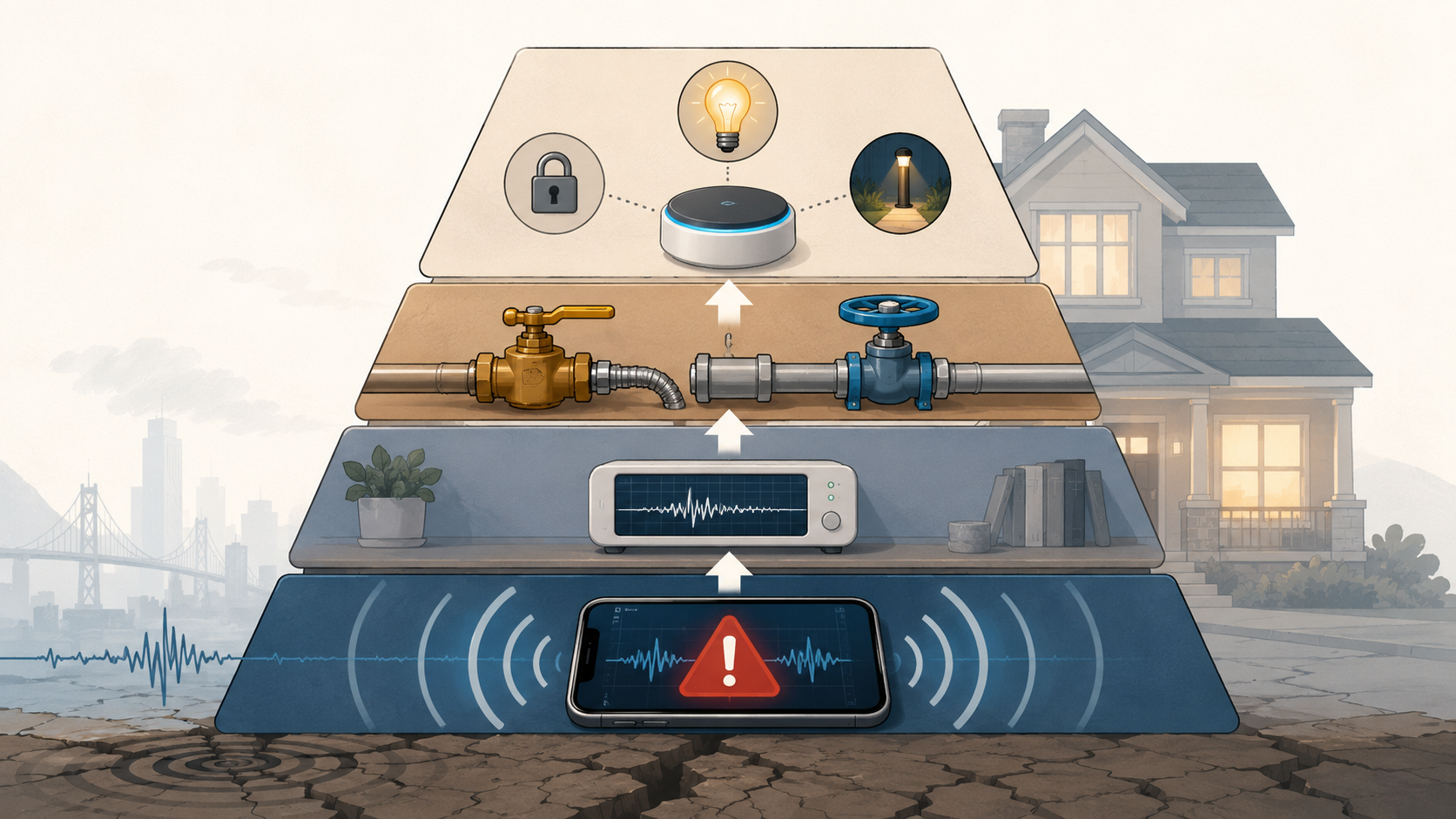
| Layer | What it does | Typical cost and install burden | Trigger source | Smart-home integration | Best use |
|---|---|---|---|---|---|
| Free early-warning apps and phone alerts | Warn people before or as shaking arrives | Free; install, enable alerts, check permissions | Public early-warning systems such as ShakeAlert, MyShake, Android Earthquake Alerts, and Wireless Emergency Alerts | Weak for automation; MyShake and Android Earthquake Alerts do not expose simple native smart-home trigger APIs | Baseline layer for nearly every household in covered regions |
| Standalone or in-home seismic sensors | Detect shaking locally or provide a hardware signal | From simple consumer alarms to more expensive sensor systems; installation varies | A device in or on the property | Possible, but depends heavily on product outputs or community integrations | Households that want local detection, experimentation, or building-system outputs |
| Gas and water shutoff devices | Stop fuel or water flow to reduce secondary damage | Gas valves usually require professional installation; smart water valves require plumbing work | Mechanical seismic trigger for gas valves; app, sensor, or automation trigger for water valves | Gas shutoff is usually not smart; smart water shutoff can integrate if the trigger path is confirmed | Reducing fire, leak, and flood risk after shaking |
| Smart-home routines | Turn on lights, unlock exits, notify family, open garage doors, or activate devices | Low if devices already exist; higher if adding hubs, valves, batteries, or sensors | Usually a workaround, local sensor output, or platform feed | Powerful only when tested end to end | Convenience and immediate response actions, not structural safety |
Start With the Free Alert Layer
For homeowners in California, Oregon, Washington, and eventually broader ShakeAlert expansion areas, free alerts are the first layer because they are available to more people than any installed device. MyShake, Android Earthquake Alerts, and Wireless Emergency Alerts all sit in this category, but they do not behave the same way.
MyShake is a free iOS and Android app that sends alerts for magnitude 4.5 and larger earthquakes. Since its California launch in October 2019, it has delivered 6.8 million alerts for 194 earthquakes, and it is available in English, Spanish, Traditional Chinese, Tagalog, Korean, and Vietnamese.[1]
Android Earthquake Alerts work differently because they are built into Android phones. The system uses phone accelerometers as a crowdsourced detection network and covers the entire United States plus 98 other countries. During the June 2026 Venezuela earthquakes, Android alerts reached 11.4 million users.[1]
Wireless Emergency Alerts are the blunt instrument in the set. They are intended for the most urgent alerts, including expected Modified Mercalli Intensity V or greater shaking, and arrive automatically on compatible phones without requiring a dedicated earthquake app.[1]
The warning window is real but uneven. People closest to the epicenter may feel shaking before an alert arrives, while people farther away may get 20 seconds or more.[1] That difference matters inside a house. Twenty seconds can be enough to move away from glass, stop using a stove, or get under cover. It is usually not enough time for a household to debate what the alert means.
The public system behind many West Coast alerts is ShakeAlert. It has covered California since 2019 and Oregon and Washington since 2021, with expansion to Alaska and Nevada. California had installed more than 95% of its target 1,115 seismic sensors as of October 2025, expected full buildout by December 2026, and state funding had reached more than $127.2 million.[2]
That sensor buildout is not the same thing as buying a device for your hallway. ShakeAlert is a public early-warning infrastructure. A homeowner app receives warnings from that infrastructure; it does not turn the phone into a certified whole-home control panel. That distinction prevents a lot of disappointment later.
How to configure the alert layer
- Install MyShake if you live, work, or travel in a supported region, and allow critical notifications where your phone permits them.
- On Android, check that earthquake alerts are enabled in system safety or location settings; do not assume the feature is active just because the phone is new.
- Leave Wireless Emergency Alerts enabled unless you have a specific accessibility or safety reason to manage them differently.
- Set expectations with the household: the alert means act immediately, not open an app and investigate.
This layer is not satisfying in a tinkerer’s sense because it mostly sends messages to people. It does not shut off the gas, open the garage door, or turn on the hall lights by itself. Still, it is the broadest and cheapest layer, and skipping it because it is “just an app” is hard to justify.
Local Sensors Are for Detection, Outputs, or Experimentation
A dedicated seismic sensor answers a different need: “I want something in my home or building to notice shaking and produce a local signal.” That signal may be an alarm, a dry-contact output, a data feed, or a project for a home-automation enthusiast. The appeal is obvious. The buying decision is less clean.
At the high end, QuakeLogic’s eQUAKE-SMART is an industrial-grade earthquake early-warning and automatic-response system. Its product page lists eight user-configurable seismic threshold levels, dry-contact outputs for building automation, and false-alarm filtering based on synchronized multi-sensor verification.[3] That is the language of building systems, not a plug-in smart speaker accessory.
The practical catch is price and installation clarity. Public pricing for eQUAKE-SMART is not listed, and any $1,000-plus expectation should be treated as an inference from its industrial positioning, not a confirmed retail price. QuakeLogic also lists compact hardware such as the PX-01 Cube, but public consumer pricing is not available from the materials reviewed.[3]
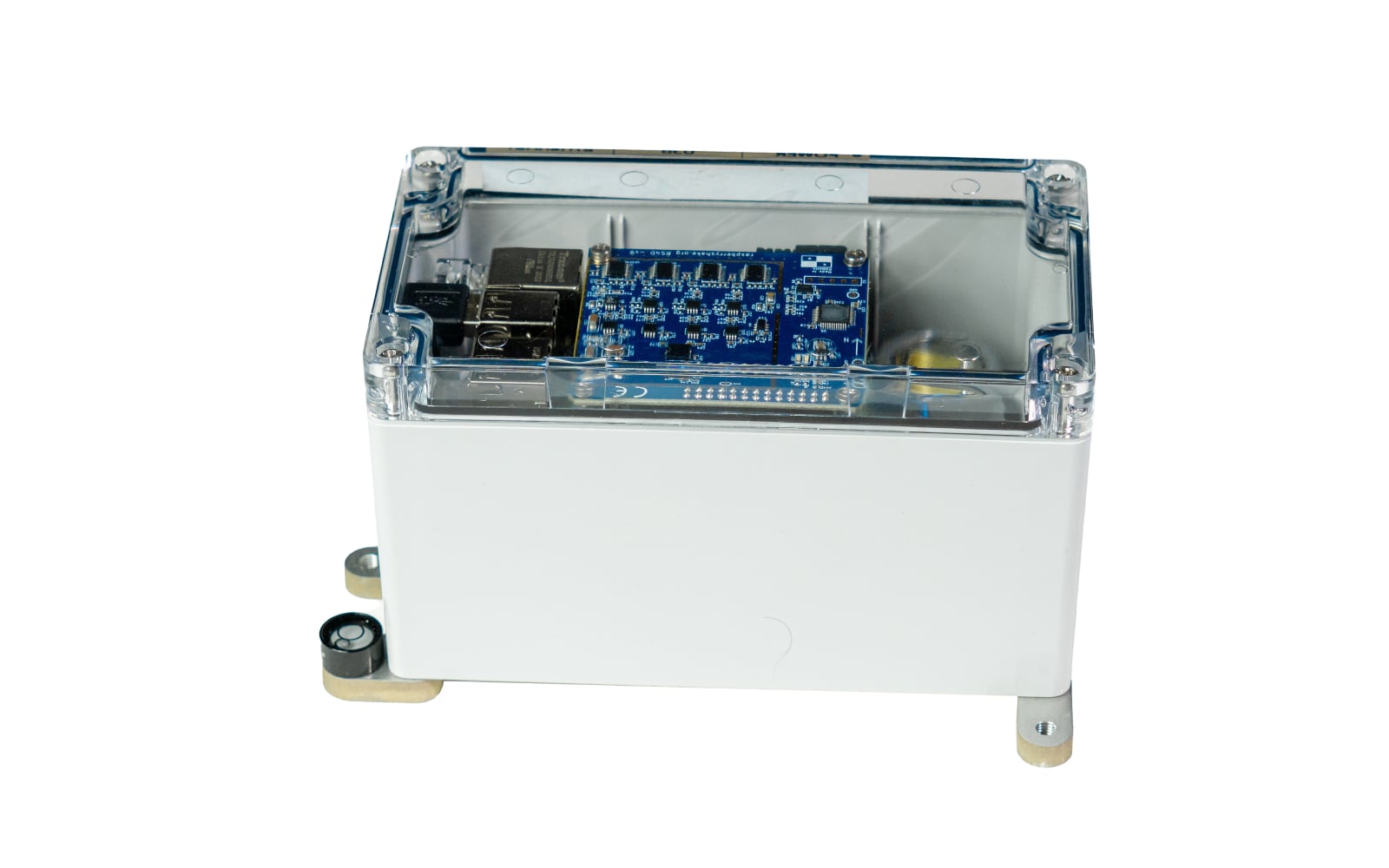
Raspberry Shake-style devices sit in a more approachable but more hobbyist category. They are attractive if you want a real seismograph in the house, local data, and a path toward experimentation. They are less attractive if your requirement is a polished consumer flow that says, “When earthquake alert happens, run this Apple Home, Google Home, or Alexa routine.” Manufacturer-described smart-home integration is still not a finished mainstream pathway, and community-maintained bridges should be treated as projects rather than appliances.
Simple standalone earthquake alarms are the least integrated version of this layer. Consumer earthquake alarms have existed for decades, and some are inexpensive, but their job is usually audible or visual warning rather than home automation.[4] That can still be useful in a basement, garage, workshop, or household where a loud local alarm is more dependable than every person carrying a charged phone.
| Sensor choice | Why it appeals | Where expectations need trimming |
|---|---|---|
| Standalone earthquake alarm | Low complexity; local sound or light | Usually no smart-home integration |
| Raspberry Shake-style seismograph | Local sensing and data; useful for hobbyist automation experiments | Integration is not yet a polished consumer pathway |
| QuakeLogic eQUAKE-SMART | Dry contacts, thresholds, building automation outputs, false-alarm filtering | Industrial-grade positioning, unlisted pricing, likely professional design and installation |
| QuakeLogic PX-01 Cube or similar compact sensors | Dedicated hardware in a smaller package | Pricing and homeowner integration details need direct vendor confirmation |
The buyer’s test is simple: before purchasing a sensor, identify the exact output you will use. A siren is an output. A dry contact is an output. A supported integration is an output. A dashboard that looks impressive after the event may be interesting, but it does not automatically change what the house does while people are reacting.
Gas Shutoff and Water Shutoff Are Not the Same Category
Utility shutoff is where earthquake safety becomes satisfyingly physical. Something moves. A valve closes. A secondary emergency may be prevented. But this is also where product language can blur two very different ideas: a mechanical seismic gas valve and an app-controlled smart water valve.
Seismic gas shutoff valves such as Watts AGV-75 and Little Firefighter are mechanical safety devices. They are designed to trigger around magnitude 5.1 to 5.4 shaking, require professional installation, and cannot be remotely reset. After activation, the gas utility or qualified service provider must restore service and relight pilot lights.[5]
That reset requirement is not a footnote. It is part of the purchase decision. A gas valve that closes when it should may prevent a dangerous condition, but it can also leave the home without gas until the proper person comes out. For many households in seismic regions, that trade-off is still reasonable. It just should not be sold as if it were a smart plug you can toggle from a phone.
Smart water shutoff valves, such as app-connected main-line valves, belong in a different bucket. They are not inherently earthquake detectors. Their value in an earthquake setup comes from being connected to a trigger: a local seismic sensor, a home-automation rule, or a manual action taken after an alert. If that trigger path is shaky, the valve is simply a very useful leak-prevention device waiting for instructions.
Water is worth thinking about because earthquake damage is not only the shaking itself. Broken supply lines, failed fittings, and damaged water heaters can turn one emergency into a cleanup and mold problem. A smart water valve can reduce that risk, but only if it still has power, network access where required, and a tested command path.
| Device | Earthquake trigger | Remote control | Reset consequence | Best fit |
|---|---|---|---|---|
| Mechanical seismic gas shutoff valve | Built-in mechanical shaking trigger | No | Utility or qualified service visit needed after activation | Homes where automatic fuel shutoff is appropriate and professionally installed |
| Smart water shutoff valve | Usually external: automation, sensor, or manual command | Yes, depending on model and connectivity | Usually homeowner-controlled, subject to plumbing and device design | Homes that want water-damage reduction and already maintain smart-home infrastructure |
Automation Recipes Are Useful Only After the Trigger Is Real
The tempting version of this article would say: connect your earthquake app to your smart home, then make the house take care of the rest. The current reality is rougher. MyShake and Android Earthquake Alerts are meant to alert people, and they do not provide a simple native automation API for ordinary homeowners. If you see examples that use phone notifications as triggers, they usually depend on workarounds such as Tasker on Android, Pushover, notification scraping, or a more custom Home Assistant setup.
That does not make automation pointless. It means the trigger deserves more scrutiny than the routine. Turning on lights is easy. Knowing exactly what event turns them on, how fast it happens, whether it runs when the internet is down, and whether it avoids false triggers is the hard part.
- Path lights: turn on hallway, stair, porch, and bedroom lights at night so people can move without searching for switches.
- Exit access: unlock selected doors if that matches the household’s security needs and local risk profile.
- Garage access: open a garage door only if the door, opener, and structure are safe to operate after shaking.
- Water shutoff: close the main water valve when a trusted local sensor or automation rule confirms a seismic event.
- Family alerts: send a short message to household members or nearby relatives that the home automation detected shaking.
- Emergency radio or battery devices: activate or surface devices that help the household get information after the first alert.
Home Assistant is often the most realistic platform for this kind of experimentation because it can combine feeds, local devices, notification services, and custom logic. Community approaches using earthquake feeds, magnitude filters, distance filters, or bridges to specific sensor hardware can be useful. They should be labeled honestly: they are DIY systems that need maintenance, not consumer-ready earthquake safety packages.
A clean automation plan usually starts smaller than expected. For example, a household might decide that the first earthquake routine only turns on interior and exterior path lighting. That action is low regret, easy to test, and useful during other emergencies too. Water shutoff comes later, after the valve is installed and the trigger source has been tested. Door unlocking may never be appropriate for a particular home. Good automation is selective.
A trigger checklist before trusting an automation
- What exact event starts the routine: public alert, local sensor, phone notification, dry contact, or manual button?
- Does it work if Wi-Fi, broadband, or cloud services are unavailable?
- Can the household test the routine without waiting for an earthquake?
- What happens if the trigger is false or delayed?
- Which action could create a new problem, such as unlocking a door or opening a garage?
What to Buy First
A reasonable upgrade path does not start with the most dramatic device. It starts with the layer most likely to reach the people in the house, then adds hardware only where it performs a specific job.
- Enable free alerts first. Install MyShake where appropriate, check Android Earthquake Alerts, and leave Wireless Emergency Alerts available. This costs nothing and covers the widest set of situations.
- Add a low-complexity local alarm if the home has spaces where phone alerts may be missed, such as garages, workshops, accessory dwelling units, or bedrooms where phones are silenced.
- Consider Raspberry Shake-style hardware only if local sensing, data, and experimentation are part of the appeal. Do not buy it assuming it will behave like a finished smart-home earthquake appliance.
- Look at QuakeLogic-style systems when the goal is building automation integration, dry-contact outputs, and professional-grade thresholds rather than casual homeowner alerts.
- Use professionally installed seismic gas shutoff where it fits the property and local guidance, with the reset consequence understood before installation.
- Add smart water shutoff and lighting automations after verifying the trigger path, power assumptions, and failure behavior.
The smart-device niche is growing for a reason. The earthquake early-warning system market was valued at $1.3 billion in 2025 and projected to reach $2.8 billion by 2034, with an 8.7% compound annual growth rate, though market estimates vary depending on what each report counts.[6] Homeowners do not need to follow that market forecast closely. They do need to notice which products are public infrastructure, which are consumer apps, which are industrial systems, and which are DIY bridges.
The best earthquake smart-home setup is not one winner. It is a short stack of dependable actions: phones warn people, local devices add awareness or outputs where they are actually useful, shutoff valves reduce secondary damage, and automations handle simple tasks that should not wait for someone to find a switch. None of that replaces structural safety, human judgment, or a plan for the hours after shaking stops.
References
- What to know about earthquake early warning systems — Anchorage Daily News, June 25, 2026
- California Earthquake Early Warning Program — California Governor’s Office of Emergency Services
- eQUAKE-SMART Earthquake Early Warning & Automatic Response System — QuakeLogic
- Earthquake early warning system — Wikipedia
- Automatic Gas Shutoff Valves — PNNL Building America Solution Center
- Earthquake Early Warning System Market Report — Dataintelo
Policy Updates & Reader Notes
Privacy policies, monitoring plan prices, and security disclosures change frequently. Report new data retention terms, updated plan pricing, or new vulnerability disclosures below. For formal editorial corrections, use the contact page.
Comments
Join the discussion with an anonymous comment.