
Set Up Smart Sensors for Brush Fire Early Warning
Learn how to deploy outdoor PM2.5 sensors, AI-smoke cameras, and local hub automations that detect brush fire smoke 30–60 minutes earlier than indoor alarms, with a backup power chain that keeps working when the grid and internet go down.
A smart sensor system is not a wildfire plan. It will not clear brush, harden vents against embers, choose an evacuation route, or decide whether a county order applies to your road. What it can do, when built carefully, is move the first warning point from the hallway ceiling to the edge of the property, where smoke may arrive before it reaches the house.
That distinction matters for brush fire safety. An indoor smoke alarm is excellent at telling you smoke is already inside or very near the structure. A perimeter system is trying to answer a different question: is something changing upwind before the house is involved? The useful version combines an outdoor PM2.5 sensor, an outdoor camera that can visually confirm smoke or flame, a local hub that can run automations without the cloud, and backup power for the network path that carries the alert.
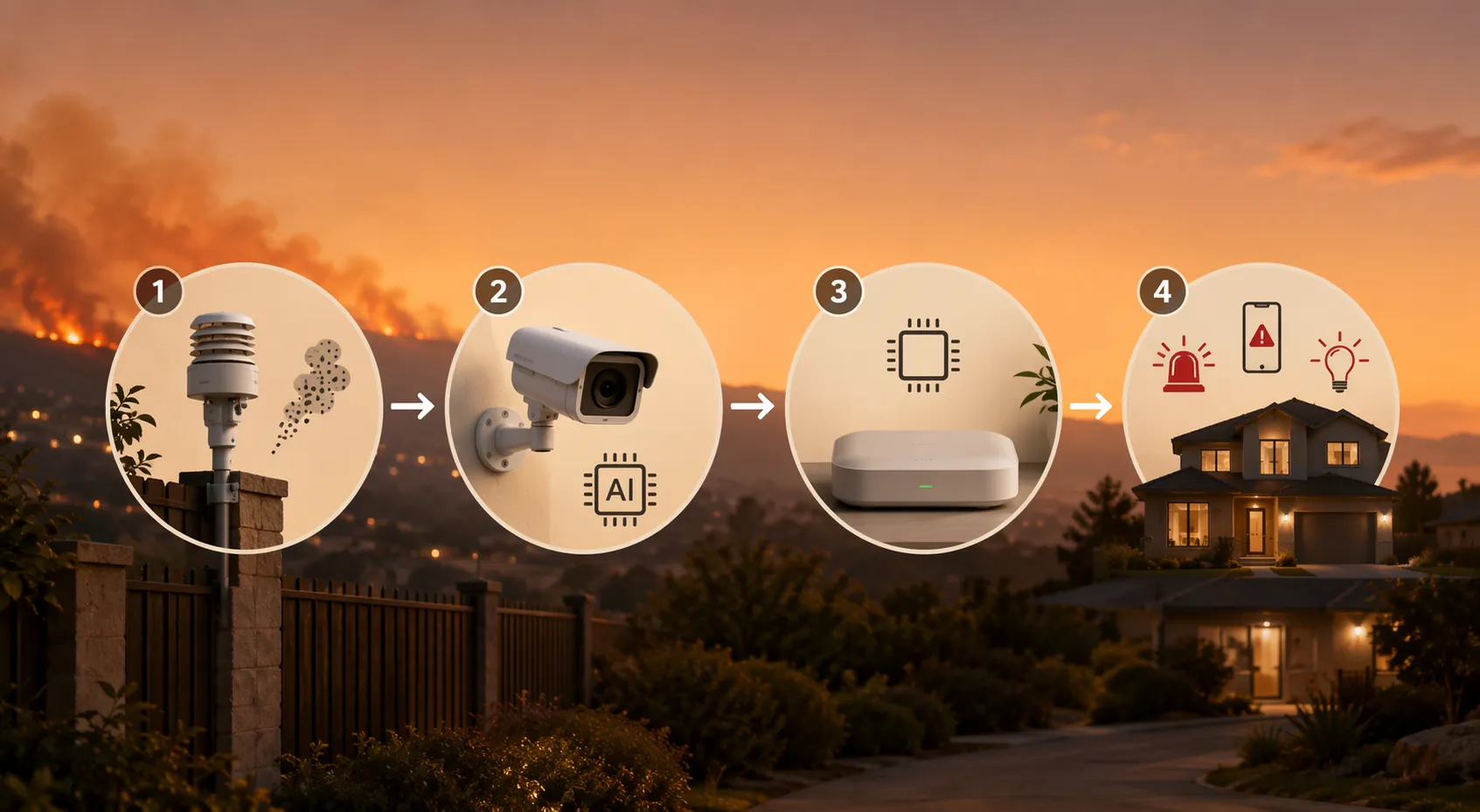
The Build In One Pass
The system is simple on paper and unforgiving in the details. Put the particulate sensor where smoke is likely to arrive first, use the camera to keep dust and fog from turning into panic, let a local hub make the decision, and keep every link in that chain alive when utility power or broadband flickers.
| Layer | Job | What To Avoid |
|---|---|---|
| Outdoor PM2.5 sensor | Detect a sharp change in fine particles at the property edge | Mounting only under the eaves, where smoke may arrive too late |
| Outdoor camera with on-device smoke or flame detection | Confirm that the PM spike looks like smoke, not dust, fog, or a burn pile | Depending on cloud-only image analysis during an outage |
| Local hub automation | Combine sensor and camera signals, then trigger alerts and routines | Routines that need Alexa, Google Home, or cloud SmartThings services to be reachable |
| Backed-up network and power | Keep modem, router, hub, and PoE switch running long enough to alert the household | Backing up only the sensor while the network path dies |
Treat the commonly cited 30–60 minute early-warning target as a planning window, not a guarantee. Wind direction, terrain, tree cover, fire intensity, sensor height, and the side of the property you choose can collapse that window or make it useful. The number is less important than the architecture: perimeter first, local logic second, backup power third.
Start At The Upwind Edge, Not The House Wall
The most common weak build is also the neatest-looking one: a sensor mounted under the eaves, close to power, Wi-Fi, and the rest of the smart-home gear. That placement is convenient, but it turns the outdoor sensor into a slightly earlier version of an indoor alarm. By the time smoke wraps around the house, the perimeter advantage is already partly spent.
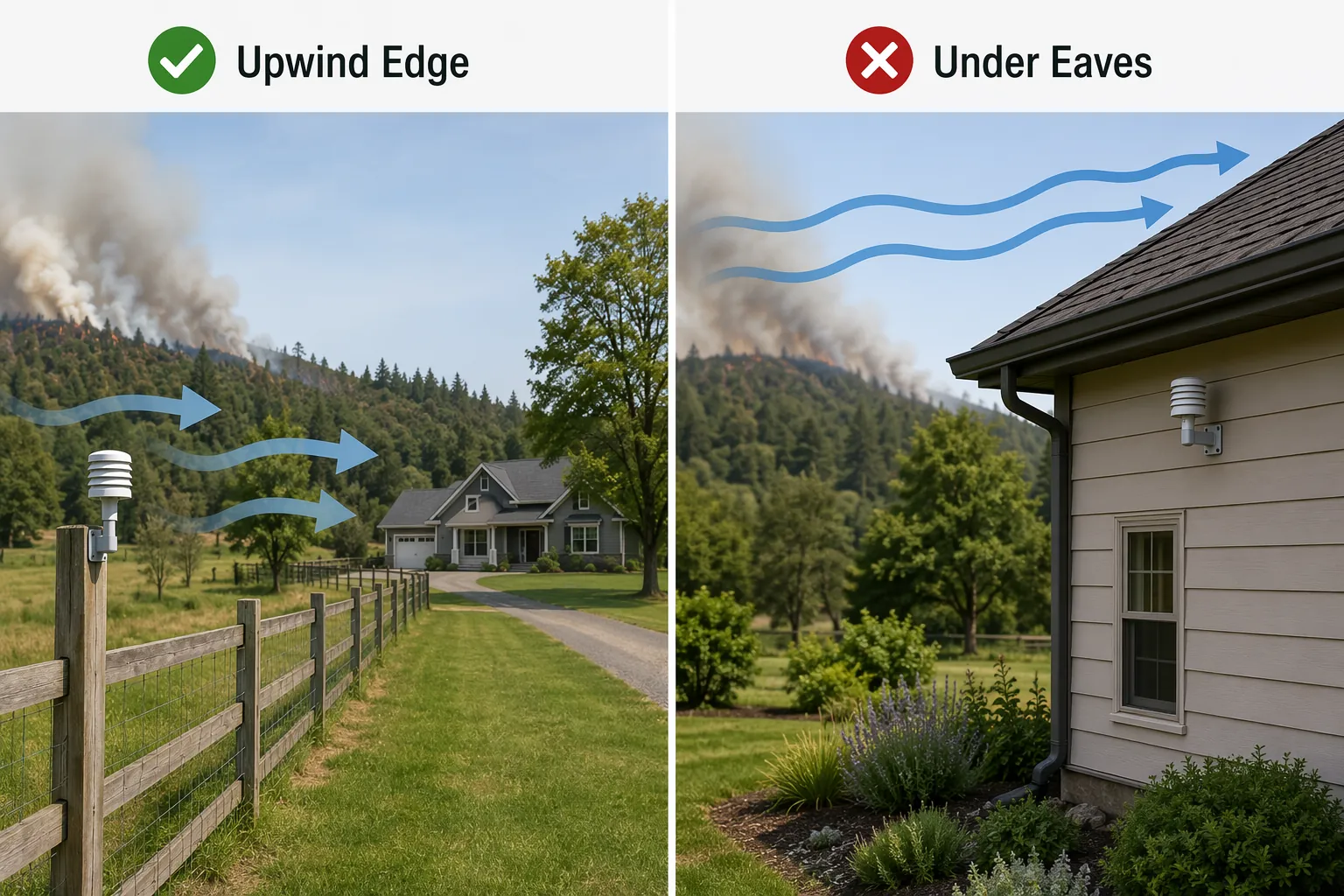
For a brush-fire-prone lot, the first sensor belongs at the likely upwind property edge: the fence line, utility pole, gate post, or detached structure that faces the direction from which dangerous smoke usually approaches. In many places that means the side facing open grass, chaparral, dry woodland, or a canyon draw rather than the side facing the driveway. The exact answer is local. The placement decision should follow prevailing wind during fire weather, not where the sensor looks least awkward.
Height matters less than exposure and survival, but it still matters. A sensor buried behind a privacy fence, tucked under a roofline, or placed beside a dusty driveway will see a distorted sample. A better location has open airflow, some protection from direct rain if the device requires it, and enough distance from barbecue smoke, generators, workshops, gravel roads, and irrigation mist to avoid turning normal property activity into alarms.
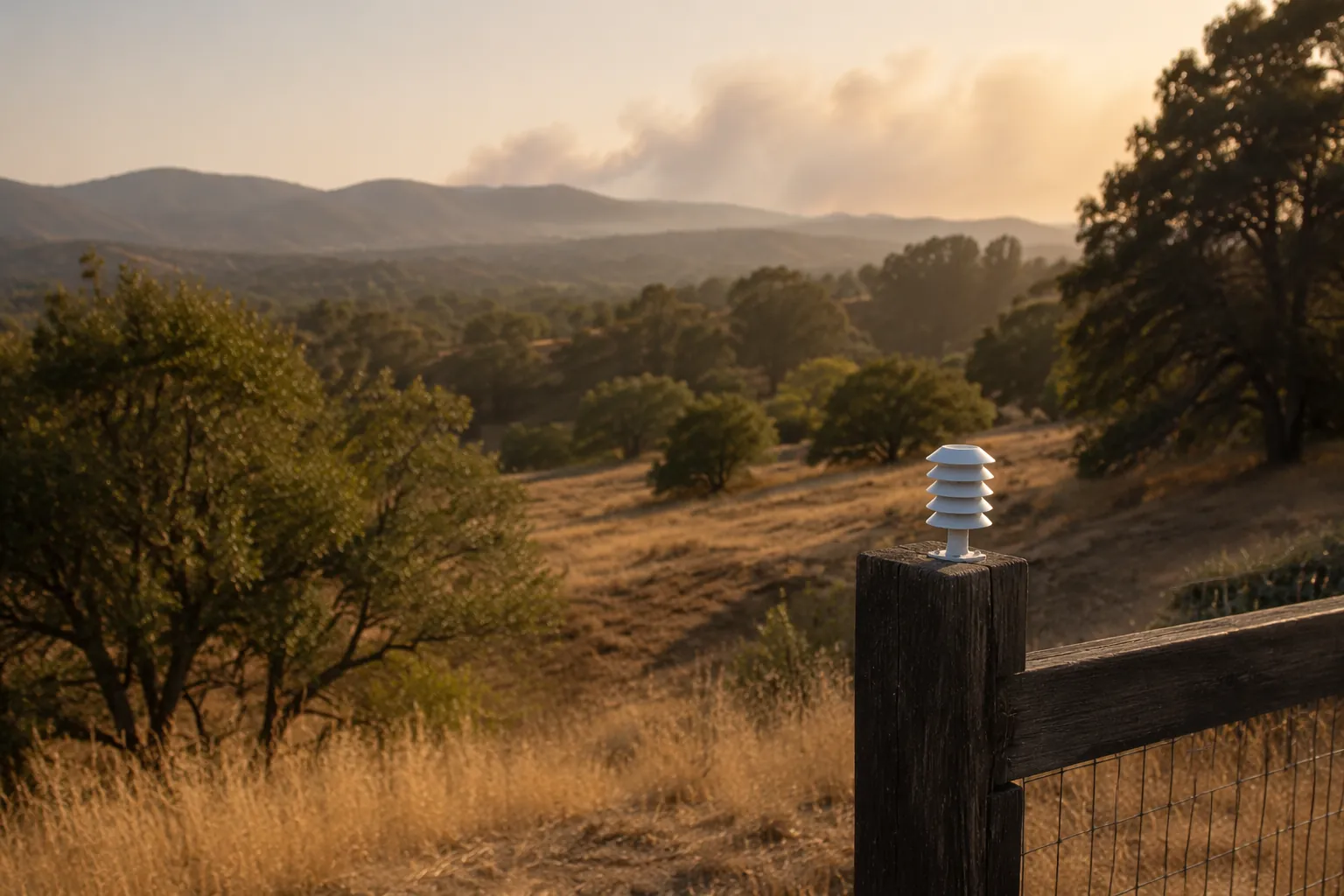
Larger properties need a harder choice. A single sensor at the most likely upwind edge may catch the highest-risk approach well, but it can miss smoke from a fire starting on the opposite side. Multiple sensors give better directional awareness, especially on irregular lots, five-acre parcels, or properties split by slopes and tree cover. The tradeoff is cost, maintenance, radio range, and more false-positive sources to understand.
- Place the first PM2.5 sensor where smoke would arrive before reaching the house, not where Wi-Fi setup is easiest.
- Keep it away from normal particle sources such as grills, dusty roads, wood stoves, workshops, and planned burn areas.
- Walk the property during windy conditions and look for blocked airflow behind fences, shrubs, sheds, and terrain breaks.
- For larger or oddly shaped lots, consider two or more perimeter sensors rather than pretending one point represents the whole property.
Choose Sensors For The Job, Then Verify The Specific Device
The PM2.5 sensor is the early-change detector. It should report frequently enough to catch a fast rise, survive outdoor mounting, expose data to your hub locally or through a reliable integration, and be serviceable without taking down the whole system. PurpleAir and AirGradient are useful category examples for outdoor particulate monitoring, but model-specific claims should be checked against current device documentation and firsthand tests before buying.
The camera has a different role. It is not there to replace the particle sensor. It is there to ask, “does the scene look like smoke or flame?” before the house starts sirens, lights, and evacuation notifications. For this use case, on-device detection is preferable to cloud analysis because broadband may be unreliable during the exact window when the camera matters. Reolink, Dahua, Ubiquiti, and similar outdoor camera ecosystems may have relevant models or integrations, but smoke or flame detection features need dated verification for the exact camera, firmware, and hub path.
Wireless planning deserves more attention than most smart-home recipes give it. Wi-Fi is convenient near the house, but a fence-line sensor at the far edge of a property may not have stable signal, especially through trees, terrain, stucco, foil-backed insulation, or metal outbuildings. Zigbee and Thread can be better fits for low-power perimeter devices when the mesh is planned correctly, but they require the right coordinator, repeaters, and hub support. A sensor that technically pairs from the driveway but drops out during wind, rain, or a router reboot is not part of an evacuation system.
Make The Automation Local And Boring
The automation should be conservative enough that the household keeps it enabled. A single PM2.5 spike should not immediately launch the loudest evacuation routine unless your site has a very specific risk profile and you accept the nuisance alarms. Dust, fog, harvest activity, construction, a neighbor’s burn pile, and smoke from a distant non-threatening source can all produce particle changes that deserve attention but not necessarily a midnight evacuation.
A more survivable pattern is staged. First, the hub notices a sharp PM2.5 rise at the perimeter. Second, it checks whether the change persists for a short period rather than disappearing as a one-sample glitch. Third, it asks for another signal: camera smoke detection, camera flame detection, a second perimeter sensor rising, or a local weather condition that makes the reading more concerning. Only then does it escalate from quiet notification to household alert.
| Condition | Automation Response |
|---|---|
| Moderate PM2.5 rise at one perimeter sensor | Send a low-priority phone notification and log the event |
| Sharp PM2.5 rise that persists | Turn on exterior camera recording and request visual review |
| PM2.5 rise plus camera smoke or flame confirmation | Trigger siren or chime, flash selected lights, and send urgent alerts |
| PM2.5 rise plus multiple sensors affected | Escalate even if one camera view is blocked, depending on site rules |
| Internet unavailable but hub and LAN alive | Run local sirens, lights, and local notifications without waiting for cloud services |
Home Assistant and Hubitat are the obvious starting points because they are designed around local rule execution when configured that way. Home Assistant automations, Node-RED flows, local MQTT, Zigbee, Z-Wave, Thread, and LAN camera integrations can be assembled into a system that keeps working without a vendor cloud, assuming each device path is actually local. Hubitat’s local rule engine serves a similar purpose for many supported devices. The burden is on the builder to verify the full path, not just the hub brand.
Alexa and Google Home routines are fine for convenience lighting. They are not where I would put the first evacuation alert unless the specific routine, device integration, and notification path have been proven to run locally during an internet outage. SmartThings is more complicated because some modern device execution can be local while other automations and integrations still depend on cloud paths. For brush fire warning, “some local support” is not enough. The exact rule must work with the WAN cable unplugged.
Test that failure mode deliberately. Unplug the internet connection while leaving the local network powered. Create a safe simulated trigger. Confirm that the hub still receives the PM2.5 value, still receives the camera or secondary signal if required, still runs the rule, and still activates the siren, lights, or local speakers. If the phone notification disappears but the hallway chime and bedroom lights still fire, that is a known limitation. If nothing happens, the system was a dashboard, not an alert path.
A Practical Trigger Pattern
Use thresholds that reflect your normal air. A rural gravel-road property, a canyon lot, and a suburban edge lot will not have the same baseline. Instead of copying someone else’s exact PM2.5 number, watch your sensor history across normal windy days, foggy mornings, grilling, nearby yard work, and seasonal smoke. Then build around abnormal rate of change, persistence, and confirmation.
- Log perimeter PM2.5 for several normal weeks before enabling loud alerts.
- Create a watch state when PM2.5 rises faster than your normal pattern.
- Escalate only when the rise persists or another sensor agrees.
- Use camera verification to separate smoke-like scenes from dust, fog, and ordinary activity.
- Send different alerts for “check outside” and “wake the household now.”
The last point is not cosmetic. A system that treats every anomaly as evacuation-grade will train people to ignore it. The goal is to make the first alert useful enough that someone looks, and the second alert serious enough that people move.
Back Up The Whole Chain, Not Just The Clever Parts
Power backup is where many otherwise elegant systems get brittle. The sensor may have battery power. The camera may be PoE. The hub may sit on a UPS. None of that matters if the switch between them is dead, or if the router that hands out local network access has gone dark.
Think of the system as a chain: modem, router, hub, PoE switch, wireless coordinators, cameras, sirens, and any network bridge the automation depends on. In a pure local-alert design, the modem may not be required for the siren and lights to work, but the router, hub, switches, and coordinators usually are. If you still want remote push notifications while the internet is available, the modem also needs runtime.
CyberPower and APC UPS units, PoE switches from networking vendors such as Ubiquiti or MikroTik, and DC battery systems are all candidates, but the brand is secondary to the load calculation and topology. Put the network equipment on backup power, label what each UPS supports, and test the system with utility power off. A brush-fire warning build does not need an elaborate server rack. It does need the few devices in the alert path to stay alive together.
For the broader blackout design, use How to Power Your Smart Home Through a Blackout as the companion plan. The wildfire-specific twist is that runtime is not only about comfort. It is about whether the system can warn while the household is deciding whether to leave, while the grid is unstable, and while broadband may already be degraded.
Keep Indoor Smoke Response Separate
Once smoke reaches the house, the problem changes. Air purifiers, HVAC fan rules, filtration, window sensors, and indoor air-quality monitors belong to the smoke-defense layer, not the perimeter-warning layer. They are worth building, but they should not distract from the outdoor detection path.
If you need that indoor plan, pair this setup with Build a Smoke-Ready Smart Home with a Four-Layer Defense. The outdoor system is meant to create earlier awareness. The indoor system is meant to reduce exposure after smoke is already part of the home environment.
False Positives Are A Design Problem, Not An Annoyance
A false alarm is not harmless if it teaches the household to disable the automation before fire season is over. Perimeter particle sensors are exposed to the real world: fog, pollen, dust, smoke from cooking, nearby road traffic, agricultural activity, and prescribed or controlled burns. The system has to distinguish “look now” from “leave now” without pretending the sensor knows intent.
Camera confirmation helps, but it adds its own constraints. The camera needs a useful field of view toward the risky edge, not a beautiful view of the driveway. It should avoid recording more of a neighbor’s property than necessary, and it may be subject to HOA, municipal, or local privacy rules. If the only legal camera angle cannot see the likely smoke approach, do not let the automation pretend it has visual confirmation.
Local rules can also affect where you mount poles, sensors, antennas, and cameras. Some communities restrict exterior equipment, visible wiring, or camera fields of view. Water-based defensive automations, such as irrigation routines, can run into local water restrictions and should not be treated as a universal fire-defense tool. Check the rules before mounting hardware at the property edge.
The Final Readiness Check
- The first PM2.5 sensor is at the likely upwind property edge, not merely under the eaves.
- The camera can actually see the risky approach area and performs any smoke or flame analysis locally, if that feature is part of the trigger.
- The automation runs on a local hub such as a properly configured Home Assistant or Hubitat system.
- The rule has staged alerts, so a particle spike does not automatically become a household evacuation alarm without confirmation.
- The modem, router, hub, PoE switch, wireless coordinator, and alert devices have backup power appropriate to the evacuation window you are planning for.
- The system has been tested with internet disconnected and utility power off.
- Common false-positive sources and local placement or privacy rules have been checked before relying on the alerts.
For brush fire warning, the smart-home layer should start outside, at the edge where smoke first becomes measurable. A credible setup is a perimeter system with local decisions and power-backed networking. Without those conditions, it is just another dashboard that may go quiet when the brush fire gets close.