
The useful answer to “does Matter actually work in smart homes in 2026?” is not yes or no. It is category first, platform second, product third. If you buy a certified Matter bulb, plug, switch, thermostat, basic sensor, or lock from a current brand and add it to a current hub, the odds are finally good that it will behave like an ordinary smart home device across Apple Home, Google Home, Alexa, and SmartThings. If you buy a camera, video doorbell, appliance, robot vacuum, or energy-monitoring device because the word Matter appears somewhere on the page, you still need to slow down.
Here is the mid-2026 buying table I would want in front of me before opening a product listing.
| Category | Mid-2026 Matter Status | What To Expect |
|---|---|---|
| Lights, bulbs, plugs, outlets, switches | Works now | Reliable basic control across major platforms when certified and paired to a current controller. |
| Basic Thread sensors | Works now | Door/window, motion, temperature, and similar sensors are among the safest Matter buys, especially with a healthy Thread network. |
| Thermostats | Works now | Core temperature and mode controls are broadly usable; brand-specific comfort features may stay in the manufacturer app. |
| Locks | Works now for basic lock/unlock | Lock, unlock, and status are the safe expectations; advanced access management can remain platform- or vendor-specific. |
| Robot vacuums | Emerging | Basic controls are improving, but room maps, cleaning modes, and advanced automation are not consistently portable. |
| Energy reporting, EV charging, water management, air purifiers, blinds | Conditional | Support depends heavily on the exact model and platform; do not assume every exposed feature travels with Matter. |
| Washers, dryers, dishwashers, other appliances | Conditional to immature | Matter support exists on paper and in selected products, but retail availability and feature exposure are uneven. |
| Cameras and video doorbells | Still vendor-specific | Live video, AI detection, cloud recording, event history, and rich notifications still mostly depend on the manufacturer or platform ecosystem. |
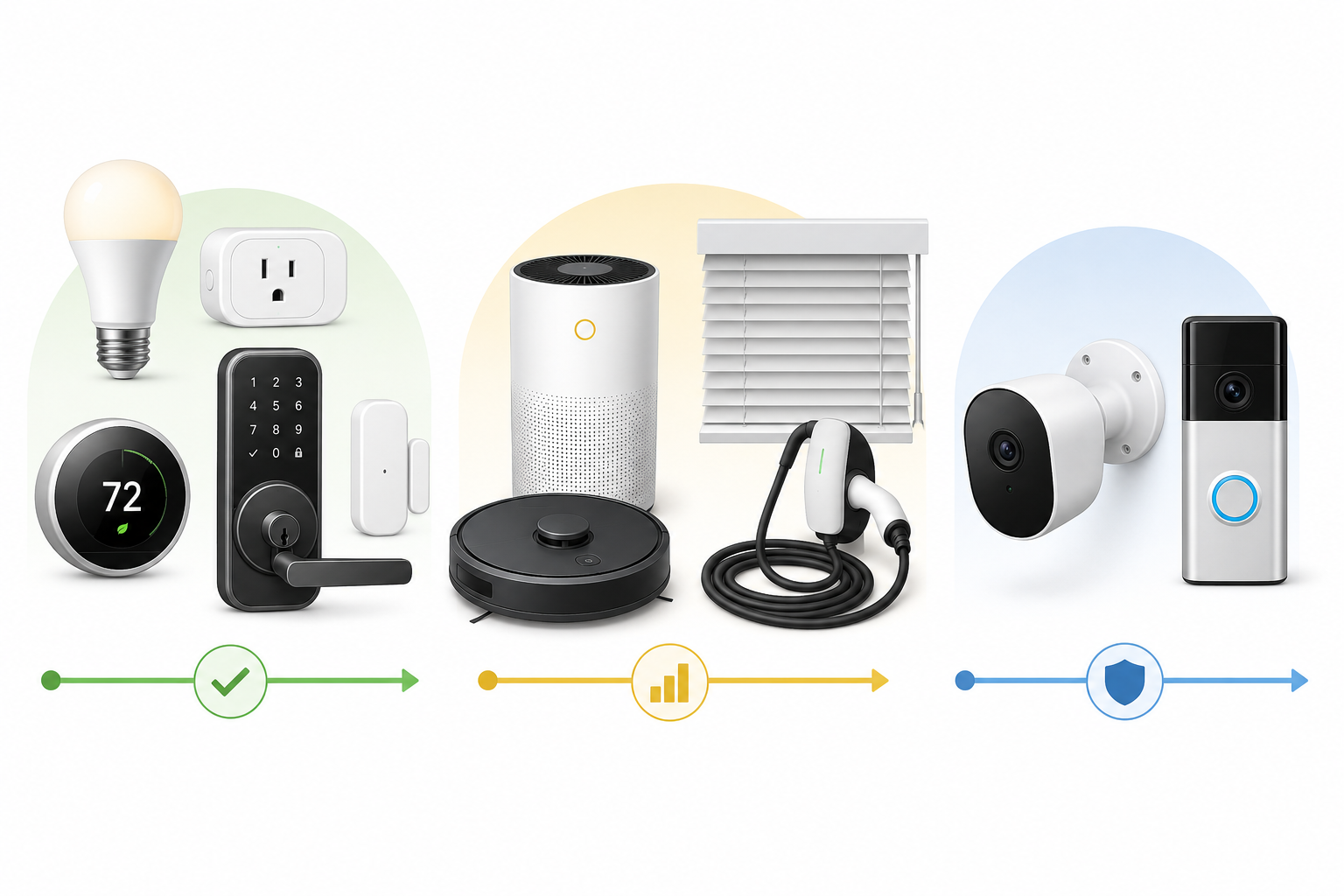
That split matches the practical state described in 2026 Matter status reviews and device lists: mature control for lighting, plugs, switches, basic sensors, thermostats, and locks; more conditional results for vacuums, appliances, energy, EV charging, water, air purifiers, and blinds; and weak real-world freedom for cameras and doorbells despite specification progress.[1][2][3]
The Categories I Would Buy With Confidence
Matter is at its best when the job is boring. Turn a light on. Dim it. Switch an outlet. Read a contact sensor. Change a thermostat mode. Lock a door. These are not glamorous tasks, but they are exactly the tasks that used to collapse into compatibility charts, bridge requirements, and “works with” footnotes.
For lights, plugs, outlets, and switches, the standard has reached the point where the Matter logo usually means something useful. A certified Matter bulb or plug should add to the major platforms and expose the ordinary controls a buyer expects. If you are building from scratch, these are the safest first purchases, and they are also the easiest categories to test before you fill a house. Buy one bulb, one plug, or one switch, add it to your chosen platform, and see whether the household likes the app before buying ten more.
The lowest-cost entry point is no longer theoretical either. IKEA has offered Matter-certified devices such as the PARASOLL door/window sensor at $9.99 and TRÅDFRI bulbs at $7.99 through the Dirigera hub, which matters because a standard becomes more useful when testing it does not require a premium starter kit.[4]
Basic sensors are similarly safe when the network behind them is healthy. Door/window sensors, motion sensors, and temperature sensors are the kind of devices Matter handles well because the exposed state is simple. The trap is not usually the sensor category itself; it is the home’s Thread or Wi-Fi setup. A sensor at the edge of a weak mesh can make Matter look worse than it is.
Thermostats belong in the confident zone, with one plain-language caveat: expect the shared controls, not every comfort feature the manufacturer advertises. Setpoint, mode, and temperature reporting are the point of Matter here. If a thermostat brand has proprietary scheduling logic, occupancy tricks, utility integrations, or energy reports, check the app and platform notes before assuming those travel.
Locks are also ready for normal buyers if the expectation is basic lock and unlock. That is a meaningful win. A front-door lock should not strand a household because someone prefers Apple Home and someone else uses Google Home. But lock categories always carry extra app-level features: PIN management, temporary codes, fingerprints, logs, auto-unlock behavior, and household permissions. Matter can make the lock visible and controllable across platforms; it does not guarantee that every access-control feature leaves the brand’s own app. For a deeper lock-specific caveat list, see Matter smart locks work everywhere — here’s the catch.
The Categories Where “Matter” Still Needs Footnotes
Robot vacuums are the clearest example of a category that can be technically supported without feeling fully portable. Starting, stopping, pausing, and basic status are one thing. Room maps, cleaning zones, mop settings, multi-floor maps, no-go areas, and brand-specific cleaning modes are the real product. Those features are exactly where buyers can still end up back in the manufacturer’s app. Matter support is progress, but it is not a promise that your robot vacuum will become the same product inside every ecosystem.[1][5]
Energy reporting has the same problem from the other direction. A plug may turn on and off perfectly through Matter while its energy graph, history, cost estimate, or automation trigger appears only in one app. If energy data is the reason you are buying the device, shop for that feature specifically. The safer reading is “Matter control plus possible energy support,” not “Matter guarantees energy visibility everywhere.” A category guide such as which Matter smart plugs actually show energy data is more useful than a generic compatibility badge.
Blinds, air purifiers, EV chargers, and water-management products sit in the selective-buying lane. These categories are not fake; they are just not equally mature across stores, brands, and platforms. Before buying, look for the exact Matter certificate, the supported device type, the required hub or bridge, and the platform feature list. If the listing only says “Matter compatible” but never says what appears in Apple Home, Google Home, Alexa, or SmartThings, treat that as unfinished information.
Appliances deserve even more caution. Washers, dryers, dishwashers, and similar products are expensive, slow to replace, and often built around vendor accounts, maintenance alerts, detergent systems, warranty flows, and remote-start safety rules. Matter support may help with status and selected controls, but it is not enough reason to choose a major appliance. Buy the appliance you want first; treat Matter as a bonus until more retail models prove that cross-platform control is consistent.
Cameras and Doorbells Still Aren’t Portable
Cameras and video doorbells are where Matter’s marketing language most easily outruns the buyer’s experience. Matter 1.5 and 1.5.1 specified camera and doorbell device types, but certified retail products remain scarce, and the features people actually care about still live in ecosystems: AI person detection, package alerts, cloud recording, event history, rich push notifications, and familiar timeline views.[1][6]
This is not a small omission. For a light bulb, the core feature is the control. For a camera, the core feature is the event pipeline: what it detects, how fast it notifies you, where the clip is stored, who can see it, and how long the history remains available. A camera that technically participates in a standard but still needs the manufacturer’s cloud for the features that matter is not meaningfully ecosystem-free.
So the buying advice is blunt: do not buy a camera or video doorbell in mid-2026 expecting the same cross-platform freedom you get from a Matter plug. Choose the camera ecosystem you trust, price the subscription if one is required, and assume the manufacturer’s app remains part of the experience.
Your Platform Still Decides Which Features You See
Matter reduces platform lock-in, but it does not erase platform behavior. No major smart home app implements every new Matter feature the moment the specification appears. That is why two people can buy the same certified device and report different levels of satisfaction.
SmartThings deserves credit for moving quickly on newer Matter categories. If you like trying new device types early, Samsung’s ecosystem has often been one of the more responsive places to see them appear. That does not mean every device exposes every advanced feature, but it does make SmartThings a strong practical test bed for Matter’s expanding category list.[1][2]
Apple Home is usually the polished choice when the device category is mature and the home already has the right Apple hardware. Setup tends to feel clean, and controls sit nicely inside the app. The tradeoff is that Apple’s tighter hardware expectations can make older or mixed households feel less forgiving. A Matter accessory may be certified, but the controller, border router, iPhone, HomePod, Apple TV, and software versions still decide how smooth the pairing feels.
Google Home and Amazon Alexa remain easy recommendations for voice-first households and basic device control, but they have lagged in some newer Matter areas such as cameras and energy reporting. That does not hurt a basic plug or bulb much. It matters a lot if the entire purchase depends on seeing energy data or handling a more complex device type inside the main app.[1][2]
Home Assistant is the opposite bargain. It offers the most flexibility, including Matter Server 9.0 and matter.js-based paths noted in 2026 platform coverage, but it asks more of the person setting it up.[1] If you enjoy dashboards, logs, local control, and fixing your own edge cases, that flexibility is a strength. If you are buying devices for a household that just wants the lights to work, it can become unpaid support work. The practical platform comparison starts with which smart home ecosystem to buy into in 2026, not with a protocol chart.
The Logo Does Not Check Your Network
A Matter device can be certified and still disappoint you if the infrastructure around it is stale. The three checks that prevent the most avoidable pain are simple: current hub, current firmware, and the right network path.
- Confirm that your controller supports Matter, not just the brand’s older smart home integration.
- For Thread devices, confirm that you have a Thread border router, not only a Wi-Fi router.
- Update the hub, phone app, and device firmware before judging pairing failures.
- Check whether the feature you care about is exposed in your platform, not merely in the manufacturer’s app.
- Keep one primary platform for daily control, even if you use Multi-Admin for sharing.
Thread is the part that has improved the most for early adopters. Since January 2026, new border routers have been required to use Thread 1.4, which addresses the old problem where multiple border routers could create parallel, fragmented Thread meshes instead of one cooperative network.[2] That is a real fix, not a branding tweak.
The catch is that homes do not replace themselves on January 1. Older pre-2026 border routers may still behave badly unless firmware updates have brought them forward. If your Thread sensors are flaky while your Wi-Fi plugs are fine, the next stop is not another sensor purchase; it is the border router and mesh. The guide to fixing an unstable Thread mesh with multiple border routers is more likely to help than another compatibility list.
Multi-Admin is worth using carefully. It lets one Matter device work across up to five ecosystems at the same time, which is genuinely useful in mixed households.[2] But most homes should still pick one primary platform for automation and daily control. Sharing a device to multiple apps is convenient; building the same automation logic in three places is how a simple smart home turns into a blame game.
Why Product Counts Are Messy
Matter product numbers sound impressive until you ask what is being counted. One 2026 catalog cites about 4,282 products across categories, while a curated matter-smarthome.de list reports more than 860 Matter-compatible entries.[1][3] Those figures can both be useful and still not answer the store-shelf question, because catalogs may mix certified, announced, pre-certified, bridge-enabled, region-specific, and not-yet-shipping products.
For buying decisions, the official CSA Device Certification List is the registry that matters most, followed by the retailer’s exact model number and the platform’s own support notes. A big catalog number tells you the ecosystem is growing. It does not tell you whether the specific dishwasher, doorbell, or energy plug in your cart will expose the feature you care about.
Matter 1.6 Is Coming, Not Buying Advice Yet
Matter 1.6 was released on June 17, 2026, only a few weeks before July 9, 2026.[1] That timing matters. Features such as NFC commissioning, Joint Fabric, and Thermostat Suggestions may improve setup and control later, but a specification release is not the same as retail support, firmware updates, platform adoption, and a good Saturday afternoon setup experience.
This is where the more critical readings of Matter still have a point. The standard has not delivered every promised category at equal speed, and some experiences still look much too much like the old ecosystem problem with a new logo.[5] The mistake is treating that as proof that Matter failed everywhere. It did not. It succeeded first where devices have simple, shared controls, and it is still catching up where the product is really a cloud service, a data model, or a safety-sensitive appliance.
What To Buy Now
Buy Matter lights, plugs, outlets, switches, basic Thread sensors, thermostats, and most locks with confidence if the product is certified, your hub is current, and the platform exposes the normal controls you need. These are the categories where Matter has become boring in the best way.
Be selective with robot vacuums, blinds, air purifiers, EV charging, water management, appliances, and anything involving energy reports. Look up the exact model, not the brand family. Check the feature you care about in the platform you plan to use. If the listing is vague, assume the advanced parts still live elsewhere.
Do not buy cameras or video doorbells expecting full cross-platform freedom yet. Pick them for their video quality, privacy model, subscription terms, detection features, and the app you are willing to live with.
Matter is useful now if you buy in the right categories and verify the parts the logo does not guarantee.
References
- The Matter Standard in 2026: A Status Review, matter-smarthome.de
- Matter & Thread Explained 2026, Data Wire Solutions
- Matter Smart Home Devices List 2026 Complete Guide, YourMatterHome
- How to Set Up a Smart Home with Matter Step by Step, matter-smarthome.de
- Why the Matter Protocol Hasn’t Lived Up to Its Promise, IoT For All
- IKEA smart home failings point to a major problem with Matter, 9to5Mac, March 18, 2026
Updates & Corrections
Protocol specifications and platform features change rapidly — especially with Matter version evolution. Report version changes, certification count updates, or platform policy changes that have occurred since the last editorial review.
Comments
Join the discussion with an anonymous comment.