Matter home automation is ready in 2026 if your shopping list is boring in the best possible way: lights, smart plugs, locks, and basic sensors on a platform that already supports the device type well. It is not ready if you expect every advanced feature from a manufacturer app to survive the move into Matter, or if your happiness depends on ten lights changing state at the exact same instant.
That sounds less dramatic than either side of the Matter argument usually wants. It is also closer to what a real home feels like in Q3 2026. The standard has enough certified products, enough working categories, and enough Thread cleanup to recommend it for simple builds. It still has enough platform gaps, feature stripping, and staggered scene behavior to make “Matter-certified” a starting filter, not a purchase guarantee.
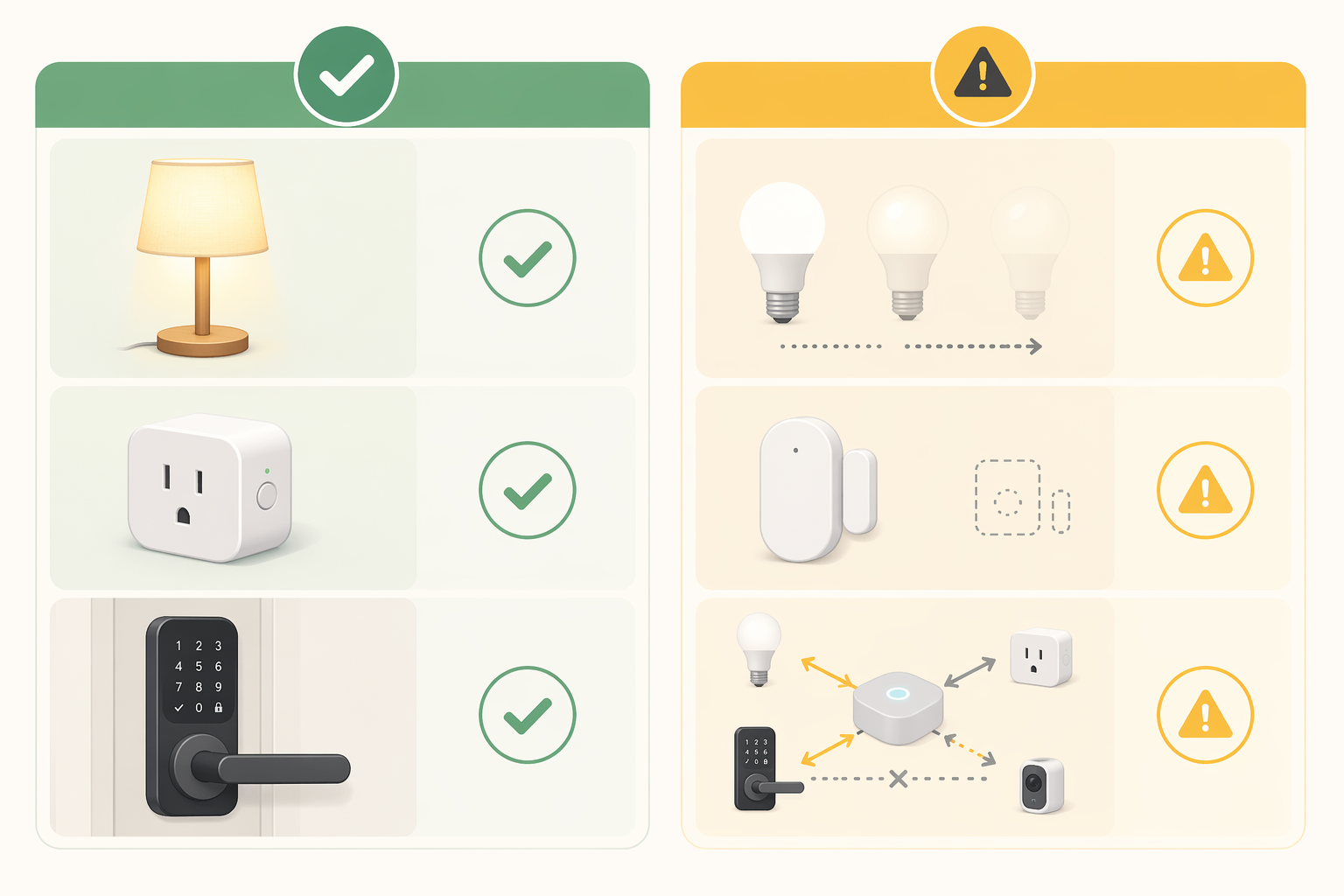
The 2026 Buying Verdict by Device Type
The practical question is not whether Matter has improved. It has. A conservative mid-2026 count puts the market at more than 750 Matter products, which is enough to make comparison shopping real rather than theoretical.[1] The better question is whether the specific category you are buying behaves well after setup, after sharing to another platform, and after the novelty of pairing wears off.
| Category | 2026 Matter Readiness | What to Watch |
|---|---|---|
| Smart bulbs and basic lights | Good for simple on/off, dimming, and color control | Multi-light scenes can still show staggered “popcorn” timing |
| Smart plugs and outlets | One of the safest Matter categories | Energy monitoring or advanced scheduling may remain app-specific |
| Smart locks | Useful enough to consider now | Check which access features your chosen platform exposes |
| Basic contact, motion, temperature, and occupancy sensors | Generally reasonable when the platform supports the sensor type | Some platforms still lag on generic switches and sensor categories |
| Cameras | Still early as a Matter category | Matter 1.5 adds cameras, but platform deployment is not universal |
| Feature-rich devices | Use caution | Manufacturer-only features may disappear in Matter mode |
For a first Matter setup, the safest path is still a small one: a few lights, a plug, a lock, or a basic sensor. If you want a fuller shopping short list, the practical next stop is a Matter-compatible device buying guide, not a spec sheet.
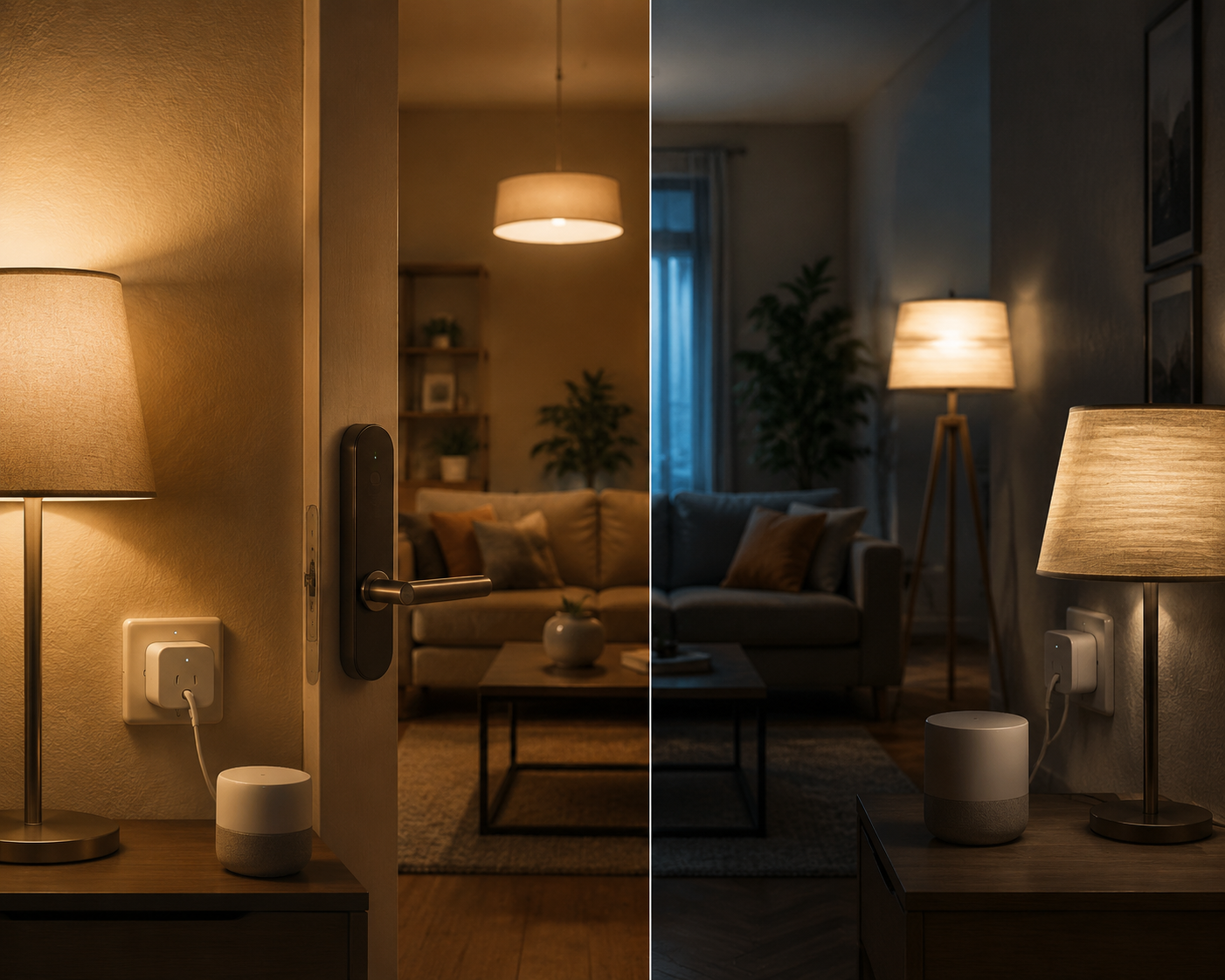
Lights and plugs are where Matter feels closest to its promise. Pairing is usually less fussy than the bad old days of separate bridge islands, and the everyday controls people actually use are covered. A Matter plug that turns a lamp on and off from Apple Home, SmartThings, or another controller is not glamorous, but it removes a real maintenance burden.
The trouble starts when “light” really means “a room scene with seven bulbs, adaptive behavior, dynamic effects, and a spouse who notices when one lamp waits half a beat.” The user-visible complaint has a name: the popcorn effect. Instead of a group changing together, devices fire one after another. Reports and reviews in 2026 still identify it as one of the most visible Matter frustrations, especially for lighting scenes.[1][3]
That does not make Matter lighting unusable. It changes what I would buy it for. A hallway bulb, porch light, bedside lamp, closet plug, or simple evening scene is a reasonable Matter job. A room where synchronized lighting is part of the experience deserves a test with the exact bulbs, controller, and automation platform before you rip out a working Zigbee or native setup.
Matter Mode Can Be the Smaller Version of the Product
The most important fine print in 2026 is that Matter support does not always mean full product support. A manufacturer may expose the common controls through Matter and keep richer controls inside its own app. That can affect energy data, adaptive lighting modes, button behavior, lock settings, sensor detail, or device-specific automations, depending on the product and platform.
This is where the standard’s success can feel irritatingly partial. The device pairs. It appears in your app. It responds. Then you discover that the thing printed on the box is still living behind the manufacturer’s app, while Matter gives you the polite minimum. DataWire’s 2026 analysis flags feature stripping as a continuing issue, and critical user reports make the same point from the other side: the device may be technically compatible while still feeling downgraded outside its native ecosystem.[2][4]
Before buying a Matter device with a special feature you care about, check three things: whether that feature is part of the Matter device type, whether your chosen platform exposes it, and whether the manufacturer documents a difference between Matter mode and its own app. If you only need the common controls, Matter is often the cleaner choice. If the special feature is the reason you are buying the device, native control may still be the less annoying route.
Thread Got a Real Fix, Not Just a Better Explanation
One of the most encouraging 2026 changes is Thread 1.4 credential sharing becoming mandatory for new border-router certifications since January 2026.[2] That matters because early Thread homes could end up with multiple separate Thread meshes instead of one shared network. The result was exactly the kind of invisible failure that makes people hate smart homes: everything looks compatible on paper, but your devices are quietly not cooperating as one network.
Credential sharing directly targets that split-mesh problem. It does not make every old border router magically equal, and it does not fix platform feature gaps. But it does remove a specific early-adopter trap from new certified hardware. If you are buying Thread gear now, pay attention to the border router as much as the end device; the Thread border-router guide is the more useful decision point than another abstract Thread-versus-Wi-Fi argument.
Thread also should not be treated as automatically superior to Zigbee for every small sensor. One published comparison using the same Aqara FP300 sensor class lists about two years of battery life for Thread versus about three years for Zigbee, while noting that newer Nordic nRF54 chips are narrowing the gap.[5] That is useful caution, not a universal law. Battery life depends on device class, network quality, placement, polling, and how many platforms are involved.
The Platform You Choose Still Matters Too Much
The uncomfortable part of Matter in 2026 is that the logo on the device box is less predictive than the app you plan to live in. No major ecosystem covers the full spec evenly. Current reporting points to SmartThings as the fastest on new Matter device-type coverage, Apple Home as the most polished for categories it supports, and Google Home and Amazon Alexa as lagging on generic switches and some sensor categories.[1][2]
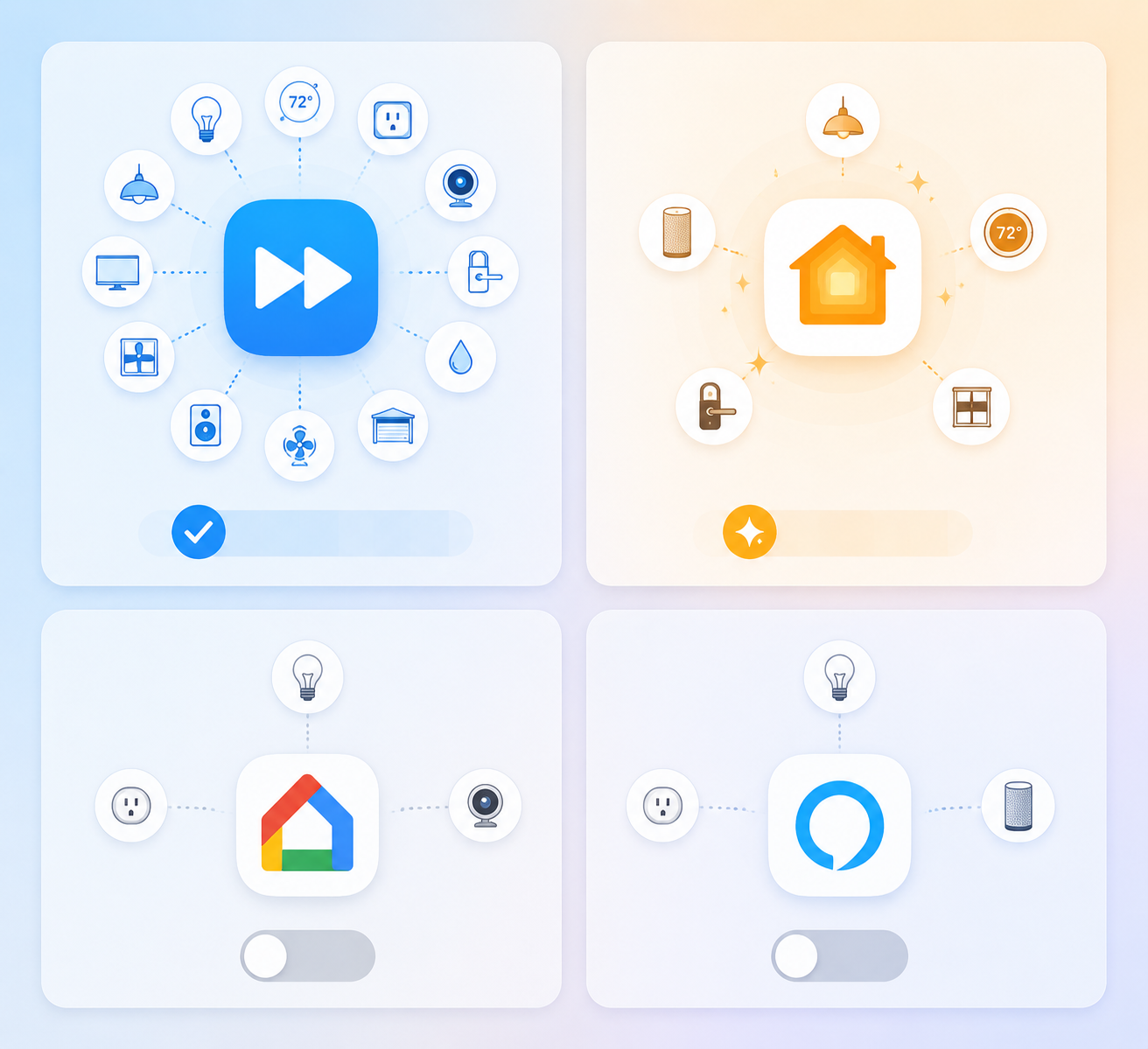
That ranking is qualitative rather than a CSA-published scorecard, so it should not be read as permanent. It is still a useful buying shortcut. If you like trying newer categories as soon as they appear, SmartThings is the platform most likely to feel ahead. If your supported devices fit inside Apple’s current lane, Apple Home often feels more finished. If your home is centered on Google or Alexa, check the exact device type before assuming a Matter product will expose what you expect.
This is also where multi-admin needs a reality check. Matter’s multi-admin model is one of its best ideas: add the same device to more than one ecosystem without buying duplicate hardware or living inside one vendor’s app forever. In practice, most devices support up to five fabrics, and platforms do not always expose the same controls once the device is shared.[4][6]
Five fabrics is enough for many homes. It can also disappear quickly if you have Apple Home, SmartThings, Google Home, Home Assistant, a manufacturer app, and a test controller in the mix. A normal buyer should not need to know the word “fabric” to turn on a lamp, but the person maintaining the home still needs to know that multi-admin is not infinite and not always feature-identical.
If you are choosing a main controller now, use a platform-specific comparison rather than a generic Matter promise. The better question is not “Does this app support Matter?” but “Does this app support the Matter device types I actually plan to use?” A current Matter smart home app comparison is more actionable than a compatibility badge.
The Product Count Is Real Progress, With a Counting Problem
More than 750 Matter products by mid-2026 is meaningful.[1] It means a buyer can compare brands, prices, shapes, and platforms instead of waiting for the first acceptable device to exist. It also means Matter is no longer just a CES talking point.
It is still modest beside older ecosystems. Zigbee is reported at roughly 3,500-plus certified products, depending on the source and counting method.[7][6] That does not automatically make Zigbee the better choice for every new device, but it explains why long-running Zigbee categories can feel deeper, cheaper, and more mature.
There are larger Matter numbers floating around, including device-list projections that count far more certified devices when variants, color or size SKUs, and pre-certification listings are included.[8] For buying advice, the conservative 750-plus figure is more useful. A shopper cannot install a spreadsheet row. The number that matters is the set of products actually available, documented, and supported by the platform in the home.
Matter Is Still Moving, Which Cuts Both Ways
Matter’s timeline explains why the 2026 experience feels both much better and still incomplete. Matter 1.0 arrived in October 2022 with basic device types. By 2026, the standard had advanced through Matter 1.5, which adds cameras, and Matter 1.6, which brings NFC and Joint Fabric work.[1] That is not a stalled standard.
The catch is that a spec version and a living-room experience are not the same thing. A device type can exist in Matter before your preferred platform supports it well, before enough products ship, and before the manufacturer exposes the features you expected. That is why cameras, richer sensors, and more specialized controls deserve caution even when they appear in the standards timeline.
For readers who need the standards-level background, a broader Matter overview for 2026 is useful. For a buying decision, the version number is secondary to the category, platform, and feature list.
When I Would Buy Matter Now
I would buy Matter devices in 2026 when the job is simple and the consequences of partial support are low. A smart plug controlling a lamp. A basic bulb in a hallway. A lock where the supported access features match what the household needs. A contact sensor that only has to report open or closed. These are the places where Matter’s practical value shows up: fewer bridge islands, more controller choice, and less anxiety about being trapped in one app.
- Buy Matter now for basic lights, plugs, locks, and simple sensors when your platform explicitly supports the device type.
- Prefer Thread Matter devices when you have a current Thread 1.4-capable border-router plan, not just because the box says Thread.
- Keep manufacturer apps installed when you rely on advanced settings, firmware updates, or feature-specific configuration.
- Test one device before buying a roomful, especially for grouped lighting or multi-admin homes.
If you are starting from scratch, a first Matter smart home build should stay small at the beginning. The goal is not to prove the standard right in one weekend. It is to find out how your chosen platform behaves with your real automations before the porch, kitchen, hallway, and guest room all depend on it.
When I Would Wait, or Stay Native
I would wait, or keep an existing Zigbee, Z-Wave, or native setup, when the current system is stable and Matter would mainly remove theoretical lock-in. A working home is not a protocol lab. If your Zigbee lighting scenes are synchronized, your hub is reliable, and your automations survive guests and holidays, replacing them only makes sense when Matter solves a real problem you have.
- Wait if you need perfectly synchronized multi-light scenes.
- Stay native if the device’s advanced features are the reason you bought it.
- Be cautious with cameras and newer Matter categories until your platform’s support is proven.
- Do not replace a stable Zigbee or Z-Wave network just to make the protocol stack look newer.
A mixed home is not a failure in 2026. It is often the sane option. Matter can handle the devices where interoperability matters most, while Zigbee, Z-Wave, or native integrations keep doing the jobs where they are still stronger. If subscription avoidance, local control, or long-term maintenance is part of your decision, the broader protocol choice matters as much as the Matter logo.
So the 2026 rule is simple enough to use at a store shelf: invest in Matter home automation when you are buying simple categories on a platform already known to handle them well. Wait, or stay native, when you need advanced features, perfectly timed scenes, or broad parity across every major ecosystem. Matter is no longer something only early adopters should touch. It is also not yet the universal escape hatch its best marketing promised.
References
- The Matter Standard in 2026 – A Status Review, matter-smarthome.de
- Matter and Thread Explained: What Works in 2026, DataWire Solutions
- Why Matter Still Sucks in 2026!, terrywhite.com
- Matter's broken promises, XDA Developers
- Should you switch from Zigbee to Matter in 2026?, howmation.com
- Matter vs Zigbee in 2026, Homey
- Does Thread Matter in 2026?, rAVe Pubs
- Matter Devices List 2026: Complete Guide, Your Matter Home
Updates & Corrections
Protocol specifications and platform features change rapidly — especially with Matter version evolution. Report version changes, certification count updates, or platform policy changes that have occurred since the last editorial review.
Comments
Join the discussion with an anonymous comment.