For garage door Matter compatibility in mid-2026, the plain answer is this: products sold as Matter-compatible garage door controllers do exist, but Matter still does not define a native garage door opener device type. What you can buy today is usually an add-on controller that presses the same circuit as your wall button and reports a simple door sensor state. That can be useful. It is not the same as Matter understanding your garage door as a garage door.
That distinction matters more here than it does for a lamp. If a smart plug turns on a table light, the platform does not need much vocabulary. A garage door is a moving barrier with safety beams, travel limits, obstruction behavior, remote access, household routines, and the occasional person standing in the driveway wondering whether the app is telling the truth. “Compatible” is too small a word for all of that.
The Matter spec still has no garage door opener type
The most important fact is not buried in a product comparison. Matter 1.4, released in November 2024, added device support including Mounted On/Off Load Control and cameras, but it did not add a dedicated garage door opener type.[1] Matter 1.5, released in November 2025, expanded the standard again, and public device-type tracking through v1.5 still does not list a garage door opener endpoint.[2]
This is where some buying guides and local-service blogs get messy. A Royal Garage Door Repairs blog post claims Matter 1.4 added a garage door device type.[3] That is not the version of the story to build a purchase around. The official CSA release and the Matter device-type table are the sturdier evidence here, and they point to the same conclusion: through Matter 1.5, there is no native garage door opener device type.[1][2]
Mounted On/Off Load Control is easy to confuse with a garage control because the words sound close enough for marketing copy. It is still an on/off load category, not a complete garage-door model with open, closed, opening, closing, stopped, obstructed, partially open, vacation lock, or safety reversal semantics. A controller can use Matter to expose a switch-like action. Matter does not yet give that controller a native garage-door identity.
A native device type is not just a prettier icon in an app. It tells Apple Home, Google Home, Alexa, SmartThings, and other Matter controllers what the device is supposed to represent. Without that common garage vocabulary, vendors stitch together the behavior from simpler parts.
What today’s Matter garage controllers actually do
The current pattern is practical and fairly old-fashioned. The add-on box connects two wires to the same wall-button terminals on your existing opener. When you tap the app, the controller closes a relay for a moment. To the opener, that looks like someone pressed the wall button. A separate magnetic contact sensor goes on the door or rail so the system can tell whether the door is open or closed.[4][5]
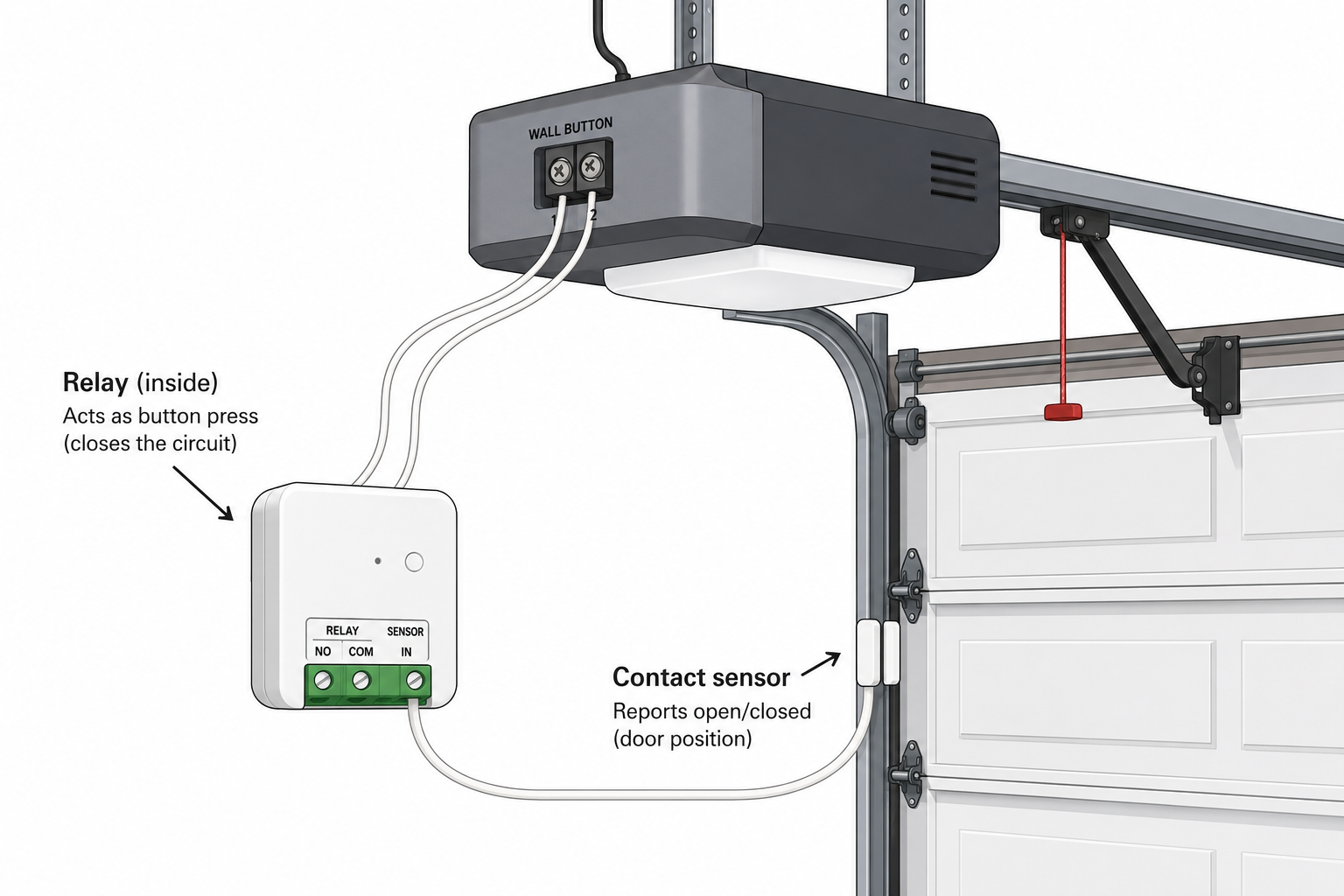
That architecture explains both the appeal and the disappointment. The appeal is that many existing garage openers already have wall-button terminals, so a low-cost controller can make a dumb opener respond to an app. The disappointment is that the smart-home platform may see one generic switch and, separately, a contact sensor. It is not seeing one unified garage door device with a full set of garage-specific states.
| What the hardware does | What the smart-home platform may see |
|---|---|
| Relay briefly closes the wall-button circuit | An on/off switch or Mounted On/Off Load Control-style device |
| Magnetic sensor detects whether the door is open or closed | A contact sensor, if exposed separately |
| Existing opener handles motor movement, travel limits, and safety beam behavior | Usually not a detailed Matter garage-door state model |
In daily use, that means a command can be simple while the interpretation stays fuzzy. If the door is closed, a relay pulse usually opens it. If the door is open, a relay pulse usually closes it. If the door is moving, another pulse may stop or reverse it, depending on the opener. The Matter controller did not necessarily choose “open” or “close” as a semantic command. It may only have triggered the same toggle your wall button would have triggered.
The contact sensor helps, but it is not magic. Open and closed are useful states, especially for remote checks and automations. They still do not guarantee that the platform understands why the door stopped, whether an obstruction occurred, whether the safety beam was interrupted, or whether the door is partly open in a way the sensor does not represent well. Those details remain outside what most relay-and-sensor kits can reliably express through Matter today.
The real benefit: one controller across several ecosystems
The workaround is not pointless. Matter’s Multi-Admin model is the best reason to care about these products. A single controller can be shared across Apple Home, Google Home, Alexa, and SmartThings, instead of forcing the household to pick one platform or maintain parallel integrations.[4]
That is a real quality-of-life improvement for mixed-platform homes. One person can ask Alexa. Another can use Apple Home. A routine in Google Home may coexist with a dashboard in SmartThings. For a garage door, that is often more valuable than another vendor app with its own account, notifications, and cloud dependency.
Still, Multi-Admin does not turn a relay into a native garage endpoint. It solves the ecosystem-sharing problem better than it solves the garage-modeling problem. If the thing you want is “everyone in the house can operate and check the garage from their preferred smart-home app,” today’s products may satisfy you. If the thing you want is “Matter fully understands the garage door as a safety-relevant moving device,” they will feel unfinished.
Product names make the market look more mature than it is
Several mid-2026 products illustrate the same pattern. SwitchBot sells a Garage Door Opener at $35.99, describes it as Matter over Wi-Fi, and says it is compatible with more than 1,600 opener models.[6] Matter Alpha also lists Matter-oriented options from THIRDREALITY, Yepbuds, and Aqara, including a THIRDREALITY Smart Garage Door Opener using a Matter over Wi-Fi bridge, a Yepbuds Smart Wi-Fi Garage Control described as supporting more than 200 brands, and an Aqara Smart Garage Kit that requires a Zigbee hub and is Europe-only.[4]
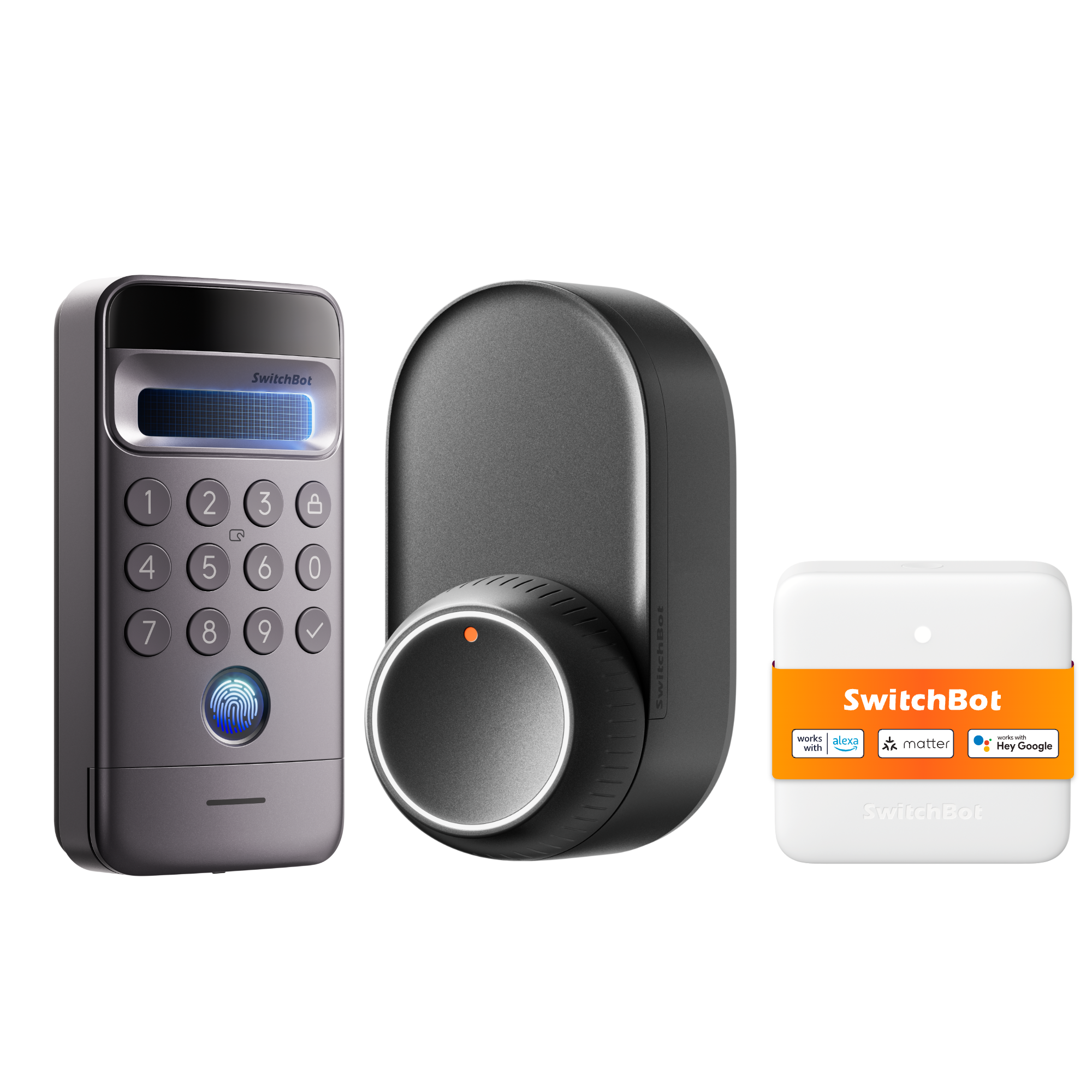
Those examples are useful as a market snapshot, not as proof that Matter now has a garage opener category. They are add-on controllers for existing openers. The word “opener” in a product name can be misleading because the motorized opener is still the ceiling unit you already own. The smart accessory is closing a circuit and reading a sensor.
Certification language needs the same caution. The Gadgeteer’s June 2026 roundup of smart garage door openers explicitly says none of its picks are Matter-certified yet.[5] That does not mean every listed product is useless, nor does it settle the status of every garage accessory on the market. It does sharpen the distinction a buyer should keep in mind: “works with Matter,” “uses a Matter bridge,” “exposes a switch to Matter,” and “is certified as a native Matter garage door opener” are not interchangeable statements.
What to check before buying one
The first compatibility check is not Matter. It is your existing opener. Relay kits generally need access to wall-button terminals that behave predictably when shorted by a momentary contact. Some modern openers use more complicated wall controls, security protocols, or accessory buses, and a simple two-wire relay may not behave like the original button. Vendor compatibility lists are worth reading line by line, especially for Chamberlain, LiftMaster, Genie, and other common opener families.
- Confirm that your opener model is listed by the controller maker, not just the opener brand.
- Check whether the product uses Matter directly over Wi-Fi, a bridge, or another hub.
- Look for how the device appears inside your preferred platform: switch, contact sensor, garage door tile, or a combination.
- Decide whether open/closed sensing is enough for your use, especially if you expect alerts or automations.
- Treat “Matter-compatible” as a starting claim, then verify certification, hub requirements, and regional availability.
Installation also deserves a little respect. The low-voltage wall-button terminals are not the same as the mains power feeding the opener, but the opener is still mounted overhead, the door is heavy, and the safety system belongs to the original opener. If a controller installation asks you to bypass safety features or improvise beyond the vendor instructions, that is no longer a normal smart-home retrofit.
Buy now if the workaround matches your expectation
Buying now can make sense if your goal is cross-ecosystem control for an existing compatible opener. The strongest use case is a household split across Apple Home, Google Home, Alexa, and SmartThings that wants one shared way to trigger the door and check a basic open/closed state. In that situation, a relay-and-sensor kit is not fake value. It removes app fragmentation and can make an older opener easier to live with.
It also makes sense if you are comfortable with the mental model. You are not buying a new native smart garage opener. You are adding a remote button presser with a door sensor. If that description sounds acceptable rather than disappointing, the current products are easier to judge fairly.
Wait if you want the platform to understand the door
Waiting is the better choice if your expectation is a native Matter garage door device with richer state awareness. That means cleaner representation in smart-home apps, more explicit open and close behavior, better handling of stopped or partially open states, and a platform model that does not have to pretend a moving garage door is basically a switch.
It is also reasonable to wait if you care about integrated safety and diagnostic behavior. Current add-on controllers usually leave obstruction detection and safety reversal to the original opener, which is exactly where those functions should remain. The smart-home layer, however, may not get a detailed report of what happened. For some households, a simple “closed” notification is enough. For others, especially those automating around arrivals, pets, deliveries, or detached garages, the missing detail is the point.
There are signs of interest beyond the current workaround. Matter Alpha reports that native Matter garage openers have been announced or discussed but are not shipping as of mid-2026, and the Matter device-type tracking notes garage door openers as a desired future device type rather than a released one.[4][2] CES 2026 coverage also shows the broader Matter product pipeline continuing to expand, including garage-related innovation signals.[7] Signals are not shipping products, and roadmap mentions are not a reason to buy hardware today on faith.
Experimental projects such as RatGDO and Konnected GDO blaQ are interesting for people who already know why they want them, but they should not be treated as the mainstream production answer for a homeowner asking what “Matter garage door opener” means in 2026. The safer general answer remains the boring one: check what the device can actually report and control today.
The mid-2026 bottom line
Matter compatibility for garage doors currently means a useful retrofit path, not a finished native category. The controller closes a relay. The sensor reports open or closed. Matter helps share that setup across major smart-home platforms. The garage-specific intelligence still belongs mostly to the original opener and to whatever the add-on vendor builds around the basic relay-and-sensor design.
So the right buying question is not “Is this a Matter garage door opener?” It is “What does this device expose to Matter, and is that enough for how I use my garage?” If the answer is a shared switch plus open/closed status, the 2026 products can be a good fit. If the answer requires a native garage endpoint with fuller state semantics and cleaner safety-aware representation, Matter has not arrived there yet.
References
- Matter 1.4 Enables More Capable Smart Homes, CSA-IOT, November 2024
- These device types are available in the Matter standard, matter-smarthome.de
- Matter Thread Smart Garage Opener, Royal Garage Door Repairs
- The best Matter-compatible garage door openers, Matter Alpha
- Best smart garage door openers 2026, The Gadgeteer, June 4, 2026
- SwitchBot Garage Door Opener, SwitchBot
- The Matter innovations at CES 2026, matter-smarthome.de
Updates & Corrections
Protocol specifications and platform features change rapidly — especially with Matter version evolution. Report version changes, certification count updates, or platform policy changes that have occurred since the last editorial review.
Comments
Join the discussion with an anonymous comment.