
The most interesting part of the latest Matter smart home news is what Matter 1.6 does not do. Released on June 17, 2026 at the CSA Unify event in Austin, this version adds no new device categories at all; instead, it spends the release on setup, shared administration, thermostats, and a handful of behind-the-scenes fixes that households are more likely to feel than admire on a spec sheet. [1]
That makes Matter 1.6 a quieter update than the releases that brought in new appliances or device types, but probably a more revealing one. The standard is no longer only trying to widen the catalog. It is starting to deal with the awkward moments that make people stop recommending smart home gear to family members: scanning a setup code after a bulb is already in a ceiling fixture, discovering that one home has too many controllers attached, or watching a thermostat receive commands that make sense to an app but not to the person standing in the hallway.
The short version: NFC commissioning, Joint Fabric, and Thermostat Suggestions are meaningful improvements, but they are not instant upgrades for most homes in Q3 2026. NFC needs new or updated hardware with embedded NFC chips. Joint Fabric needs platform-level changes from ecosystems such as Apple, Google, Amazon, SmartThings, and Home Assistant. The thermostat work needs both device makers and platforms to use the new behavior instead of treating every command as a blunt override.
If you need the broader state of the standard before deciding what to buy, the larger Matter trajectory in The Matter Smart Home Standard in Mid-2026 is still the right context. Matter 1.6 is more specific: it is a quality-of-life release, and its best ideas are aimed at places where the earlier Matter experience still felt too brittle.
NFC setup fixes the ladder problem
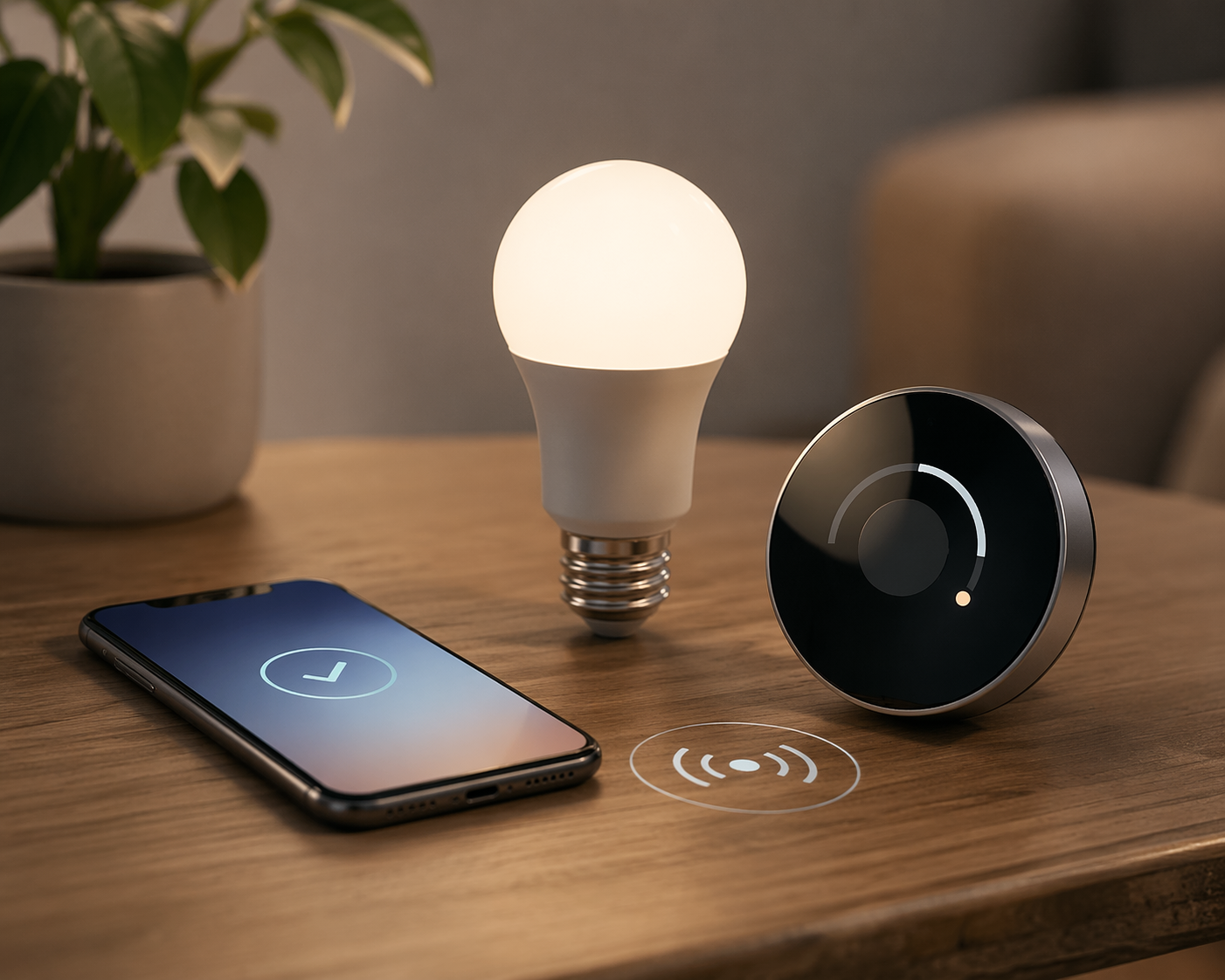
NFC-based commissioning is the easiest Matter 1.6 change to picture. Instead of powering a device, putting it into pairing mode, keeping a Bluetooth LE connection alive, and hoping the app sees it at the right moment, the user can tap a phone to the device and begin setup through NFC. The CSA describes this as a way to make commissioning more intuitive, including for devices that are not yet powered on. [1]
For a light bulb, that matters. A bulb may be sitting in its box, on a table, or in your hand before it is screwed into a fixture. Under the familiar setup flow, the annoying part often starts after installation: the bulb is overhead, the QR code is on a tiny sticker, the app is searching, and the person doing the setup is balancing convenience against gravity. NFC changes the order of operations. You can start with the phone and the accessory within reach, then install the device after the commissioning information is exchanged.
Forbes highlighted the same practical appeal in its June 17, 2026 coverage, using the example of tapping a phone to set up a bulb before putting it into a ceiling fixture. [2] Mashable also framed the update around making setup feel closer to true plug-and-play, with NFC commissioning as the headline change. [3]
The caveat is hardware. NFC setup is not something every existing Matter device receives just because its manufacturer updates firmware. The device needs an embedded NFC chip or tag, such as STMicroelectronics' new ST25DA-C tag cited in coverage of the release. [2] That one requirement is the cleanest way to separate the specification from the retail shelf: Matter 1.6 can define the behavior now, but buyers will need to look for devices built for it.
It also does not erase every setup variable. Matter devices still have to land in an ecosystem app, attach to the right network path, and remain reachable afterward. A Thread accessory still depends on a working Thread border router, while a Wi-Fi accessory still depends on normal Wi-Fi coverage and credentials. If those terms are already blurring together, start with What Is a Matter Border Router and Do You Already Have One? or the transport comparison in Should Your Matter Accessories Use Thread or Wi-Fi in 2026?. NFC can make the first handshake less ridiculous; it cannot compensate for a weak network or a platform that has not adopted the new flow.
Joint Fabric addresses the multi-app home
Matter was sold to many households as a way to stop choosing one brand forever. In practice, multi-ecosystem homes have exposed a less glamorous constraint: fabric limits. A Matter fabric is the trusted administrative domain that lets a controller manage devices. Today, a device can run out of available fabric slots faster than a casual buyer would expect, especially when a household uses several major platforms or when one platform consumes more than one slot.
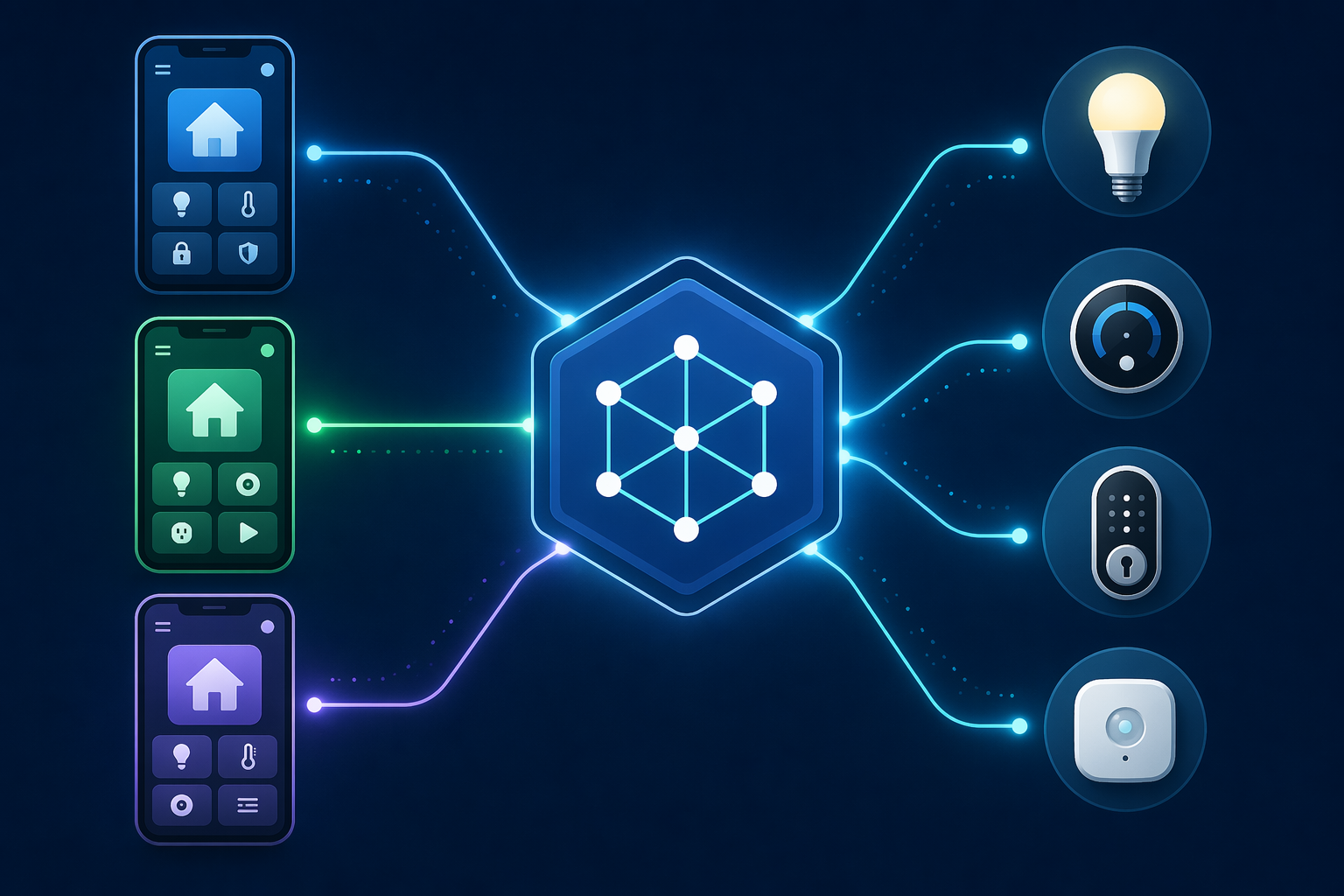
Matter 1.6 introduces Joint Fabric so multiple controllers can co-administer one Matter network instead of each consuming a separate fabric. The practical reason is not theoretical protocol tidiness. Matter devices have a five-fabric limit, and the matter-smarthome.de analysis points out that Apple Home alone can consume two fabric slots because one is used for iCloud Keychain sync. [4]
That Apple example gives the feature its stakes. Imagine a household where one person prefers Apple Home, another uses Google Home, a voice assistant is present, a home server is running Home Assistant, and a device maker app remains installed for firmware or advanced settings. The point is not that every home looks like that. The point is that the supposed freedom to mix ecosystems can become a slot-counting exercise, and most people do not know the counter exists until something fails to add.
Joint Fabric is meant to make that shared home less fragile. If platforms can participate in one jointly administered fabric, the same device does not have to spend a separate fabric slot for every controlling environment. That should make mixed homes easier to maintain and reduce the chance that a new controller bumps into a limit created by earlier setup decisions.
The adoption warning is stronger here than it is for NFC. A device maker can choose to ship an NFC-equipped product, but Joint Fabric requires ecosystem-level architectural support. Platforms have to decide how they will co-administer, synchronize, expose, and troubleshoot shared control. As of Q3 2026, no major ecosystem has announced a Matter 1.6 ship date for this support.
For Apple Home users, the immediate takeaway is not to expect a visible switch labeled “Joint Fabric” tomorrow. It is to understand why future platform updates matter. The fabric issue sits underneath the friendly room-and-tile interface, but it affects whether a device can join all the places a household wants it to appear. The deeper Apple-specific setup picture is covered in Apple Home and Matter 2026: Hardware, Setup, and Gaps, while What Your Matter Hub Actually Does (And What Breaks Without It) is the better primer if controller and border-router roles are still getting mixed together.
Thermostat Suggestions make commands less absolute
Thermostats are where a smart home stops being a toy. A light turning on at the wrong color is irritating. A thermostat ignoring a manual adjustment, fighting an energy program, or chasing an automation from another app changes comfort and sometimes cost. Matter 1.6's Thermostat Suggestions feature is a small but important shift in how control is modeled.
Instead of treating every incoming instruction as a direct command, Thermostat Suggestions allow a controller to send a time-bound recommendation. The thermostat can then evaluate that suggestion against user preferences, demand-response commitments, and recent manual changes before deciding how to respond. [1][4]
That distinction matters because thermostats already live among competing claims. A platform automation may want to lower the temperature at night. A utility-linked demand-response program may ask the thermostat to reduce load during a peak period. Someone may have just walked over and changed the setting because the room felt wrong. A direct command treats those claims as if the newest instruction is automatically the smartest one. A suggestion gives the thermostat room to apply context.
This should not be read as the thermostat becoming magically thoughtful. The specification creates a mechanism for smarter behavior; it does not guarantee that every thermostat will make the same judgment or that every app will send suggestions well. Device makers still have to implement the logic, and platforms still have to choose when a suggestion is more appropriate than a command.
Still, the direction is healthy. A home with more than one controller cannot assume that all automation intent is equal. Matter 1.6 starts giving at least one high-consequence device category a way to say, in effect, that timing and user context matter.
The smaller fixes are still worth noticing
Matter 1.6 also includes changes that will not sell a device box on their own but should reduce ambiguity for platforms and installers. Security sensors gain event history, smoke alarms can report an unmounted state, and partitioned certificate revocation lists are added for better security handling. [1]
The smoke alarm state is a good example of a narrow fix with real meaning. “Unmounted” is not the same condition as “quiet,” “offline,” or “alarming.” If an alarm has been removed from its base, the home should be able to represent that condition directly rather than leaving an app or user to infer it from a vague device status.
Partitioned CRLs belong more to the plumbing side of the release, but they should not be dismissed. Certificate revocation is part of how ecosystems handle trust when credentials should no longer be accepted. Most users will never see this feature as a button or tile. They may only benefit if it helps platforms manage security data more efficiently and reliably.
What you can actually use in Q3 2026
The hard line for buyers is simple: Matter 1.6 is a released specification, not a guarantee that the device in your cart or the app on your phone supports these behaviors today. Coverage from Matter Alpha framed the release as an effort to make Matter less of a headache rather than to expand the device list, which is the right way to read it. [5]
| Matter 1.6 change | What has to happen before users feel it |
|---|---|
| NFC commissioning | Devices need embedded NFC chips or tags, and ecosystem apps need to support the new setup flow. |
| Joint Fabric | Major platforms need architectural changes to co-administer one Matter fabric instead of consuming separate fabric slots. |
| Thermostat Suggestions | Thermostat makers and controller platforms need to implement suggestion-based behavior instead of relying only on direct commands. |
| Sensor and security refinements | Devices and platforms need to expose or use the new states and security improvements in their own software. |
For an existing Matter home, this means patience. A firmware update may help some devices over time, but the most visible NFC benefit depends on hardware that was designed with NFC in it. Joint Fabric is even less likely to arrive as a simple accessory update because it asks the platform layer to change how shared administration works.
For someone shopping now, Matter 1.6 should change the questions more than the purchase decision. Ask whether a new device supports NFC commissioning, not merely whether it is Matter-certified. Ask which Matter version the platform supports. Ask whether your preferred ecosystems have announced support instead of assuming that certification language covers every new feature in the latest release.
For builders and integrators, the update is a reminder to document the controller layout of a home, not just the devices. Fabric limits, app ownership, hub placement, Thread coverage, and recovery procedures all affect whether the system feels dependable after installation. If you are still troubleshooting older setup flows, the practical next stops are Fix a Matter Device That Won't Show in Apple Home and the broader Matter Smart Home Troubleshooting Checklist. Matter 1.6 points toward fewer of those moments, but it does not retire the checklist yet.
No major ecosystem named in the research around this release has announced a Matter 1.6 support date as of Q3 2026. That is the part to keep in mind when the feature list sounds ready. The spec is ready. The household experience is waiting on chips, firmware, controller updates, platform policy, and the usual uneven march from standards language to products people can buy.
Matter 1.6 is still good news. It aims at the boring failures that make smart homes feel fragile: setup that happens in the wrong physical order, homes that quietly run out of shared-control room, and thermostats that receive instructions without enough context. In Q3 2026, it is best treated as a roadmap for better products and platform updates, not as a feature set most users can activate today.
References
- Matter 1.6 Enables More Intuitive Setup, Connectivity Standards Alliance, June 17, 2026.
- Matter 1.6: Smart Home Standard Gets A Major Upgrade, Forbes, June 17, 2026.
- New Matter 1.6 updates make your smart home devices truly plug-and-play, Mashable.
- Matter 1.6: Shared Fabrics and Smarter Thermostats, matter-smarthome.de.
- Instead of new devices, Matter 1.6 focuses on making Matter less of a headache, Matter Alpha.
Updates & Corrections
Protocol specifications and platform features change rapidly — especially with Matter version evolution. Report version changes, certification count updates, or platform policy changes that have occurred since the last editorial review.
Comments
Join the discussion with an anonymous comment.