The effect of AI data center moratoriums on smart home gear is not that a city council vote suddenly makes your hallway light switch smarter. The effect is less theatrical and more useful to understand: cloud capacity is becoming harder to build, power equipment is harder to get, and every device that depends on remote inference, remote automations, or vendor-hosted features sits closer to that bottleneck than its box copy admits.
As of June 2026, 14 U.S. states had considered or enacted data center moratoriums, while more than 100 localities had taken up restrictions or pauses of their own; New York enacted a one-year freeze on facilities of at least 50 MW, and Monterey Park, California became the first U.S. city to permanently ban data centers through a voter ballot measure.[1] That does not mean smart homes are being regulated directly. It means the infrastructure behind many smart home features is entering a more contested, slower-moving phase.
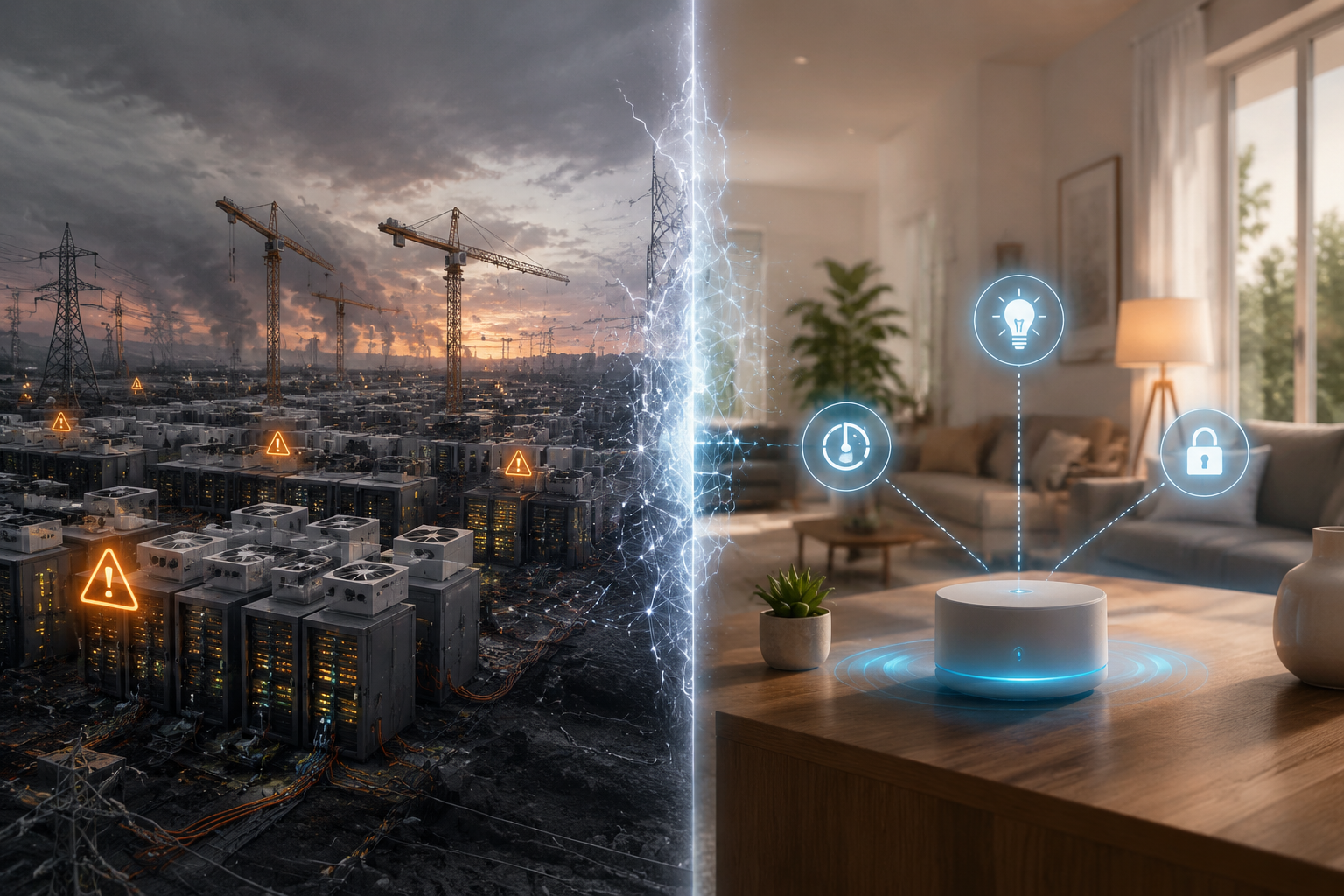
The timing matters. Planned U.S. data center capacity for 2026 has been estimated at roughly 12 GW to 16 GW, but only about 5 GW—around one-third—is under active construction; 30% to 50% of projects are reportedly delayed or canceled because of power-equipment bottlenecks, and transformer lead times have stretched as long as five years.[2] Those are not smart home numbers. They are the numbers behind the cloud services that smart home makers use when they decide whether a doorbell recognizes a person locally, whether a camera clip is processed remotely, or whether a routine runs through a hub in the house or a service outside it.
The cloud is becoming a more expensive place to hide basic behavior
For years, cloud dependence was easy to sell because it hid complexity. A cheap device could ship with modest hardware, send hard work to a remote service, and improve later through server-side updates. That bargain still has value. Cloud setup can be smoother, model updates can arrive without replacing hardware, and some features genuinely need large-scale computation.
But the bargain changes when cloud compute stops looking abundant. AI demand is competing for the same power, land, cooling, networking, memory, and construction capacity that consumer device platforms use. Restrictions are not limited to one U.S. state or one zoning fight: Reuters has tracked authorities restricting data centers internationally amid the AI buildout, including major pressure points in Europe and Asia.[3] Data Center Knowledge has described the policy problem as a balancing act among energy needs, community concerns, and growth risk.[4]
The chain from moratorium to smart home is therefore indirect, but it is not imaginary. It looks like this:
- AI demand raises the value of data center capacity.
- Moratoriums, local restrictions, grid interconnection queues, and transformer shortages slow new capacity.
- Cloud compute, storage, and bandwidth become more contested inputs.
- Device makers that rely on remote processing face more pressure to gate features, raise subscription prices, trim free tiers, or move work onto hardware.
- Homeowners feel the result as latency, missing features during outages, tighter subscriptions, or a device that ages badly when the vendor changes its service.
No single source proves that moratoriums alone are forcing smart homes local. The better reading is that moratoriums are one visible part of a broader supply-side squeeze. They make the old cloud-first design assumption—send the hard part away and let the platform absorb it—less safe for foundational household functions.
Latency is where the infrastructure story reaches the hallway
The cleanest household symptom is delay. Synaptics, writing via the Edge AI and Vision Alliance, describes edge AI response times under 200 ms for voice commands, compared with more than 2 seconds for cloud-dependent devices; the same source notes that human-computer interaction research treats delays beyond 200 ms as enough to break immersion.[5]
That gap is not a benchmark vanity metric. Under 200 ms is the difference between a light feeling wired and a light feeling negotiated. A two-second response is tolerable when asking a speaker for a recipe. It is irritating when standing in a dark laundry room. It is worse when the first command fails, the second command stacks on top of it, and the house starts obeying late.
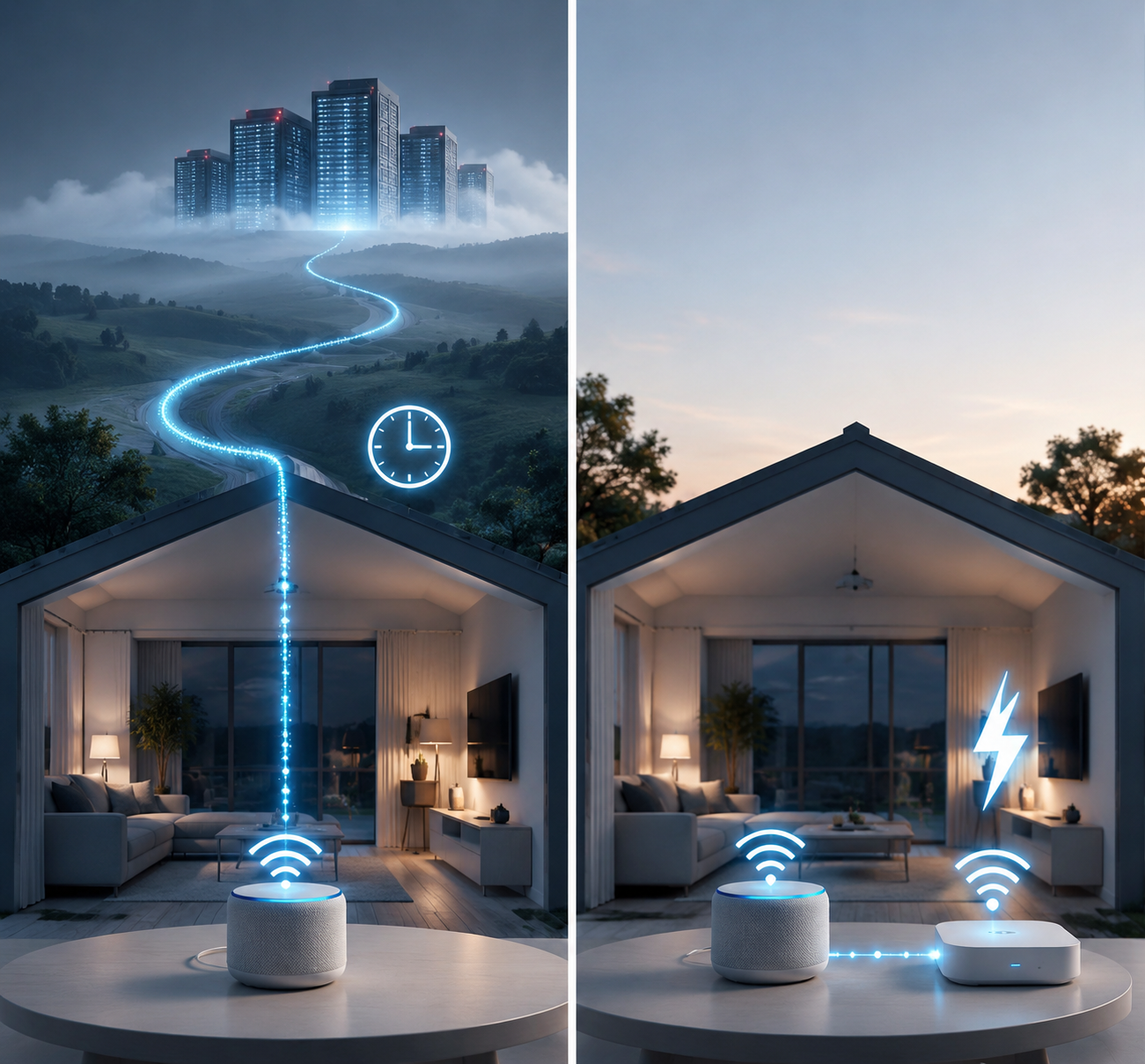
Cloud latency also compounds. A cloud-routed automation can involve the device, home network, vendor cloud, integration partner, another vendor cloud, then a second device. If any one piece is degraded, the whole routine feels flaky. Local processing does not eliminate bad Wi-Fi, weak radios, or buggy firmware, but it removes a long trip that should not be required for basic domestic behavior.
What “local” should mean when you are buying devices in 2026
Local is now a marketing word, so it needs to be broken apart. A product can advertise local AI because one feature runs on-device while its automations, alerts, recordings, or account login still depend on the cloud. That may be fine. It is just not the same as a home that remains usable when the internet connection or vendor service is degraded.
| Buyer question | Cloud-dependent answer | Local-resilient answer |
|---|---|---|
| Will the device perform its core job without internet? | Often no, or only in a reduced manual mode | Yes for the core action, such as switching, locking, sensing, or basic automation |
| Where does recognition or inference happen? | Remote servers process voice, video, occupancy, or events | The device or hub handles at least the routine inference locally |
| What happens when the vendor changes a plan? | Features may move behind a subscription or disappear | Cloud extras may change, but basic behavior remains in the home |
| How do routines execute? | An app or cloud service coordinates device-to-device behavior | A hub, controller, or local protocol coordinates behavior on the LAN or mesh |
| How visible is the failure? | The user sees lag, unavailable automations, or missing alerts | The user may lose remote access, but the house still responds locally |
For a bulb, local resilience may mean that a wall switch, motion sensor, or hub routine still works even if the vendor app is unreachable. For a thermostat, it means schedules and basic climate control continue without a cloud round trip. For a lock, it means local credentials and physical access are not hostage to a service outage. For cameras, it means being very clear about which parts are local: live view, event detection, recording, storage, notifications, and remote viewing are separate functions.
This is also where platform choice matters more than the individual gadget. A local-first hub, Matter controller, Thread border router, Zigbee coordinator, or Home Assistant box can keep device-to-device behavior inside the home. A cloud-first ecosystem can still be pleasant to use, but it should not be treated as equivalent just because the app looks polished. If you are choosing a platform from scratch, the ecosystem lock-in questions in The Smart Home Ecosystem Trap: Which Platform to Buy Into in 2026 belong in the same conversation as voice assistant preference and device availability.
Edge AI is useful when it removes a dependency, not when it adds a badge
The strongest edge-AI smart home features are not the flashy ones. They are the ones that reduce a round trip: wake-word handling, occupancy interpretation, simple voice intent, familiar-face or person detection, energy anomaly detection, acoustic sensing, and routine decisions that do not need to leave the house.
A local model that decides whether motion in the driveway is a person, vehicle, or tree branch can reduce cloud video processing. A hub that notices unusual energy use without uploading every event can keep a useful automation running even when remote analytics are delayed. A voice command interpreted locally can turn on a light before a cloud assistant finishes negotiating with three services.
This does not make the cloud useless. Remote backup, off-site video access, multi-home management, large model updates, and cross-vendor account services can be worth paying for. The buying mistake is letting those extras become prerequisites for ordinary behavior. A camera that needs the cloud for off-site alerts is one thing. A camera that becomes a dumb lens without a subscription is another.
Cost is part of the same architecture question. Tech Insider, citing Omdia, reported memory costs up roughly 5x and storage costs up roughly 3x since Q1 2025 as AI data center demand crowded consumer supply.[2] That pressure can show up in device pricing, subscription pricing, smaller free tiers, or more aggressive upsells. Local processing has its own bill of materials cost, but it can also reduce the amount of ongoing cloud work the vendor has to fund forever.
For cameras and security systems, the long-term math can become especially lopsided because storage, detection, and monitoring plans accumulate year after year. The 5-year subscription angle is handled in more detail in The 5-Year Cost of Cloud vs Local Smart Home Security, but the broader 2026 point is simpler: if a device’s core value depends on rented compute, its cost is exposed to the price and availability of that compute.
The devices where local control matters first
Not every smart plug needs a manifesto. A holiday light timer can be cloud-dependent and still be a perfectly reasonable purchase if it is cheap, easy, and nonessential. Local control matters most where failure is frequent, visible, expensive, or tied to safety and access.
| Category | Local feature to verify | Why it matters |
|---|---|---|
| Hubs and platforms | Local automation execution, local device control, exportable configuration | The hub becomes the household control plane, so cloud-only routines create a single remote point of failure |
| Thermostats | Local schedules, sensor fallback, manual control without service login | Comfort and energy use should not depend on an analytics service being reachable |
| Locks and access | Local credentials, keypad or physical fallback, local hub integration | Access devices need predictable behavior during outages and account problems |
| Cameras and doorbells | Local detection, local recording option, usable live view on the LAN | Video generates recurring cloud cost and becomes frustrating when detection is subscription-gated |
| Lighting and sensors | Thread, Zigbee, Matter-over-LAN, or hub-local routines | These are the commands people notice immediately when lag appears |
| Energy devices | Local monitoring and automation triggers | Power-aware routines are more valuable when utility costs and grid constraints are less predictable |
The useful test is blunt: unplug the internet, not the power. Can the motion sensor still turn on the hall light? Can the thermostat follow its schedule? Can the lock be opened by the people who need access? Can a camera record locally, or does it only keep working as a live sensor until the app gives up? If the answer is buried in support pages, that is also information.
For beginners, this does not mean starting with a rack of equipment. It can mean choosing a hub that runs automations locally, favoring Matter or established local-radio devices when the category supports them, and avoiding products whose best features disappear without a monthly plan. Starter device choices are covered more directly in The Beginner's Guide to Home Automation in 2026; the extra filter now is whether the starter system can keep doing ordinary work locally.
Reliability is not only an internet-outage problem
Most people think of local control during a broadband outage. That is valid, but too narrow. Cloud-dependent homes can also degrade during vendor outages, API changes, account lockouts, discontinued integrations, overloaded services, subscription changes, or regional infrastructure constraints. The cloud does not have to vanish for the house to become annoying. It only has to become slow, expensive, or less generous.
Power resilience adds another layer. If your modem, router, hub, Thread border router, or Zigbee coordinator has backup power, local automations can continue during some outages even when remote access is gone. If every automation requires the internet, a battery-backed router may keep the app online for a while, but it cannot make a dead cloud service execute a routine. For the electrical side of that planning, see How to Power Your Smart Home Through a Blackout.
A practical resilience setup does not require abandoning cloud features. It separates jobs. The home handles time-sensitive and essential actions locally. The cloud handles remote access, long-term analytics, backup, large updates, and optional intelligence. When the cloud is healthy, the system feels richer. When it is not, the house still behaves like a house.
How to read product claims before you buy
The words to look for are not just “AI,” “edge,” or “Matter.” Look for the failure mode. Product pages usually describe what happens on a perfect day. Support pages, forums, and integration docs reveal what happens when the internet is down, the subscription expires, or the vendor cloud is unavailable.
- Ask whether automations run locally or in the vendor cloud.
- Check whether the device supports local APIs, Matter, Thread, Zigbee, Z-Wave, or LAN control where appropriate.
- Separate local live view from local recording and local detection; camera vendors often treat these as different features.
- Verify what stops working when the subscription lapses.
- Look for hub requirements before buying battery sensors, locks, thermostats, and switches.
- Prefer systems that can export settings or integrate with more than one controller.
Matter helps most when it gives devices a shared local control path, not when it is used as a logo that still leaves important functions in an app silo. Thread and Zigbee help when they give small devices a low-power mesh that a local controller can coordinate. Home Assistant-style local-first systems help when the owner is willing to trade some polish for inspectability and control. Mainstream cloud platforms help when ease of setup, remote support, and household familiarity matter more than maximum independence.
That distinction matters because cloud-dependent devices are not obsolete in Q3 2026. Many will remain easier to install, easier to share with family members, and better supported by voice assistants. A rented apartment with a few smart plugs has different needs than a house full of locks, cameras, HVAC controls, leak sensors, and lighting automations. The point is not to punish every cloud feature. It is to stop buying basic household behavior that only works when distant infrastructure is cheap, available, and friendly to your vendor’s margins.
The 2026 buying judgment
Data center moratoriums are not the only reason smart homes are moving local. Better chips, better radios, maturing hubs, Matter’s local ambitions, and user fatigue with subscriptions all matter. The moratorium story adds a harder edge: cloud capacity is now visibly constrained by land-use politics, grid limits, construction delays, and equipment shortages. A smart home architecture that assumes endless cheap remote compute is carrying a risk the homeowner cannot patch later with a firmware update.
For foundational purchases in Q3 2026—platforms, hubs, thermostats, locks, cameras, energy devices, and core automations—treat local control as a resilience and cost-control feature. Verify which functions work without the cloud. Pay for cloud services when they add value, not when they hold the light switch, lock, schedule, or sensor hostage. The best smart home is not the one that rejects the cloud; it is the one that can keep running when the cloud gets slower, pricier, or less predictable.
References
- Updates on the Cloud: More Moratoriums on Data Centers, Rockefeller Institute of Government
- US AI Data Center Delays and Cancellations: 7GW Capacity Crisis in 2026, Tech Insider
- Where authorities are restricting data centres amid AI boom, Reuters, 2026-07-14
- AI Data Center Moratorium: Balancing Energy, Community, and Growth Risks, Data Center Knowledge
- Smart Home Connectivity Trends, Challenges and the Role of Next-Gen IoT Technology, Edge AI and Vision Alliance, 2026-03