Apple has not overtaken Nvidia as of mid-July 2026. That matters, because the phrase “apple smart home strategy after overtaking nvidia” gets the market story slightly ahead of itself. The better version is more interesting: Apple is close enough to Nvidia’s market-cap lead that any believable new platform story now carries extra weight. In early July, Apple was valued at about $4.56 trillion versus Nvidia at roughly $4.77 trillion, leaving Apple about 4% behind after a one-week share surge of about 7%.[1][2]
That gap is small by mega-cap standards, but the businesses underneath it are not similar. Nvidia’s valuation is tied to the AI accelerator cycle, where demand is immediate, expensive, and visible in data-center buildouts. Apple’s case is more layered: iPhone durability, replacement cycles, ecosystem lock-in, and a Services segment that reached a record $30.98 billion in the March quarter.[2] A smart home push will not, by itself, answer Nvidia’s AI-chip growth. It could, however, give Apple another place to turn its installed base into recurring value.
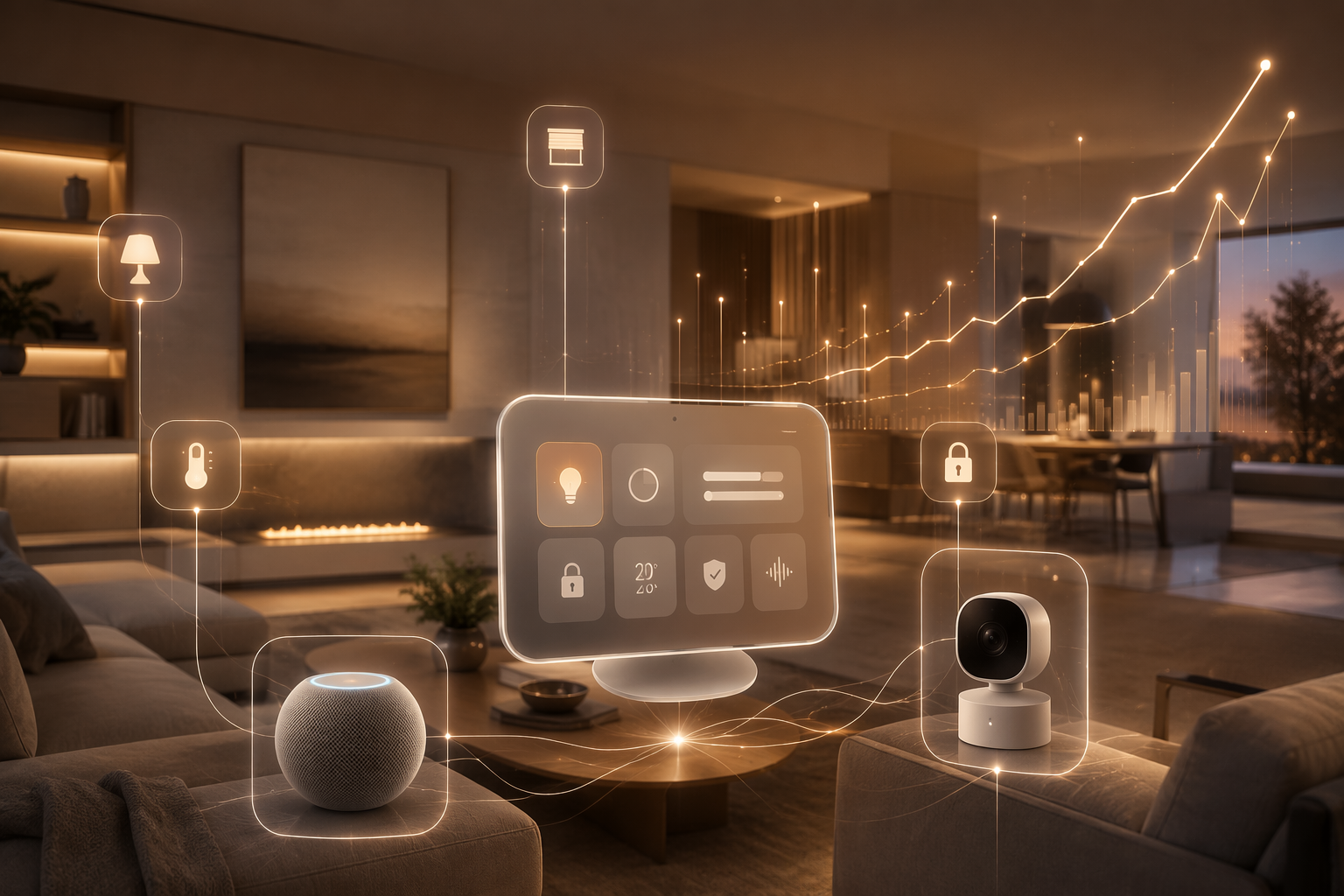
The home is the obvious place where Apple’s ecosystem should have mattered more than it has. Millions of households already carry iPhones, subscribe to iCloud, use Apple TV, share photos, unlock Macs with Apple Watches, and approve purchases with Face ID. Yet the kitchen counter, bedroom nightstand, and hallway speaker have often belonged to Amazon or Google. That disconnect is why Apple’s rumored 2026 home-device wave deserves more attention than the usual accessory-cycle coverage.
Apple’s home push looks less like a device refresh and more like a platform map
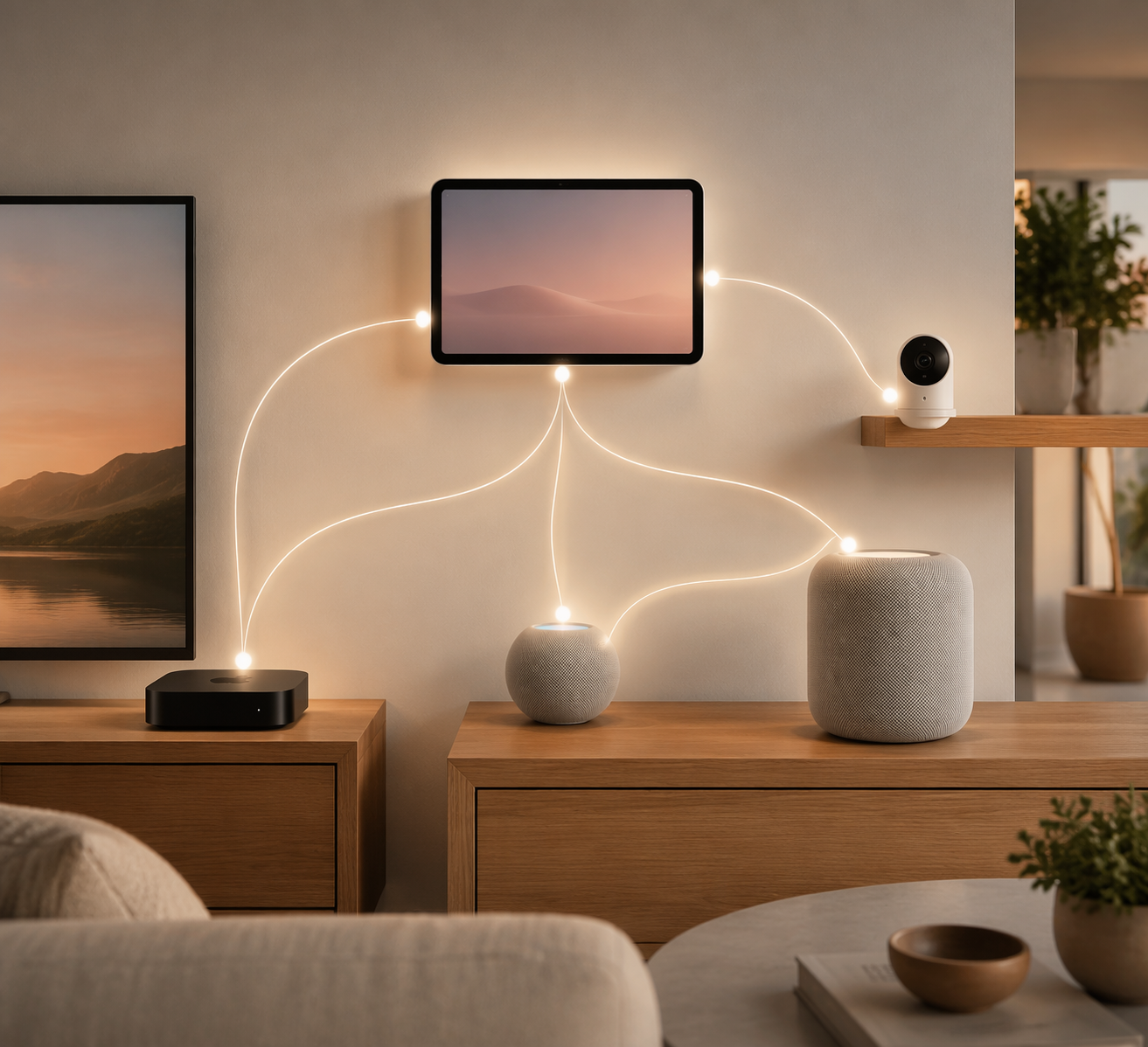
The reported 2026 lineup is unusually dense by Apple home standards. MacRumors’ roundup describes a Home Hub expected around $350 with a 7-inch display, A18 chip, FaceTime support, and a role as a central home interface; a new Apple TV 4K with an A17 Pro and N1 wireless chip supporting Wi-Fi 7, Bluetooth 6, and Thread; a HomePod mini 2 with S9-class or newer silicon; a refreshed full-size HomePod; and an Apple-branded indoor security camera with 4K HomeKit Secure Video and audio monitoring.[3] These are still rumors, not announced products. But as a cluster, they point to a different posture.
The Home Hub would be the visible control surface. The Apple TV would be the always-plugged-in living-room hub, media endpoint, and Thread-capable bridge. The HomePods would become distributed voice and audio nodes. The camera would add a security layer tied to identity, storage, and notifications. Put together, the lineup starts to look less like a shelf of nice Apple objects and more like the missing home layer of Apple’s ecosystem.
| Reported device | Strategic role in the home |
|---|---|
| Home Hub with 7-inch display and A18 chip | Shared household interface for controls, FaceTime, Siri, scenes, and app-like home interactions |
| Apple TV 4K with A17 Pro, Wi-Fi 7, Bluetooth 6, and Thread | Living-room compute, entertainment, and smart home hub layer |
| HomePod mini 2 with S9-class silicon | Affordable voice node for rooms where Apple needs presence |
| Full-size HomePod refresh | Premium audio and Siri endpoint for households already inside Apple Music and AirPlay |
| Indoor security camera with HomeKit Secure Video | Security, storage, notification, and privacy layer attached to iCloud |
The difference is not just quantity. Apple has spent years treating the home as a supporting role: HomePod for audio, Apple TV for entertainment, HomeKit for compatibility, and the Home app for people patient enough to configure it. A display hub changes the interface assumption. A camera changes the data and storage assumption. New wireless support in Apple TV changes the connectivity assumption. More room-level speakers change the voice coverage assumption.
The timeline also makes the hardware feel less casual. Forbes reported that Apple’s smart home display had slipped from an expected March 2025 window to spring 2026 and then fall 2026.[4] A delayed Apple home display is not automatically a strategic breakthrough; Apple delays plenty of products that never become central. But when the delay lines up with a Siri reset and multiple home devices appear to be waiting behind it, the reason for waiting becomes more important than the calendar.
Manufacturing is part of the signal too. Reporting tied to Bloomberg said the first-generation Home Hub would be assembled in Vietnam by BYD rather than in China.[5] That does not prove demand, but it fits Apple’s broader supply-chain diversification and suggests the company is preparing the category with more seriousness than a one-off experiment.
The installed-base problem is not theoretical
The case for Apple in the home usually begins with the iPhone installed base. The problem is that households do not wait for ecosystem logic to become elegant. They buy what works, what is cheap, what answers quickly, and what supports the devices already screwed into the ceiling or plugged into the wall.
CIRP data cited by MacRumors puts Amazon Echo at roughly 65% to 67% share, Google Nest at 17% to 27%, and Apple HomePod at about 6%, while also finding that 40% of Apple device buyers own an Amazon Echo and only 13% own a HomePod.[3] That is the uncomfortable part of the Apple home story. Apple did not merely lose share among Android households or bargain shoppers. It left room for Alexa inside homes that had already chosen Apple everywhere else.
Share estimates vary depending on methodology, and some surveys put Apple higher than CIRP’s figure. The more useful point is narrower: Apple has not made HomePod the default voice-and-control device even among many Apple buyers. A household can love iMessage, AirPods, Apple Watch, and iCloud Photos while still asking an Echo to set timers, play radio, turn on lights, or check the weather.
That is why a smart home strategy cannot be judged by whether Apple finally ships a screen. It has to be judged by whether the screen, speakers, TV box, camera, Home app, and Siri reduce the number of reasons an iPhone household keeps an Echo or Nest device around. For readers comparing ecosystems from that practical angle, the broader trade-offs are closer to a platform decision than a single-device purchase, as in this smart home ecosystem guide for iPhone owners.
Siri is the hinge, not the Home Hub
The most important 2026 Apple home product may not be hardware at all. It is Siri, if the long-promised assistant overhaul finally arrives in a form that changes daily behavior. MacRumors reported that Craig Federighi said Apple’s “end-to-end revamp succeeded” and described the coming version as “a much bigger upgrade than what we envisioned,” with personal context, onscreen awareness, and deeper app integration as central capabilities.[6]
Those three capabilities matter more in the home than a spec bump does. Personal context means the assistant can understand whose calendar, reminders, messages, music, or routines are relevant. Onscreen awareness matters if a Home Hub is supposed to do more than display big buttons. Deep app integration matters because smart home commands rarely live inside one clean Apple-owned lane; they involve lights, locks, thermostats, cameras, media apps, grocery lists, delivery notifications, and family logistics.
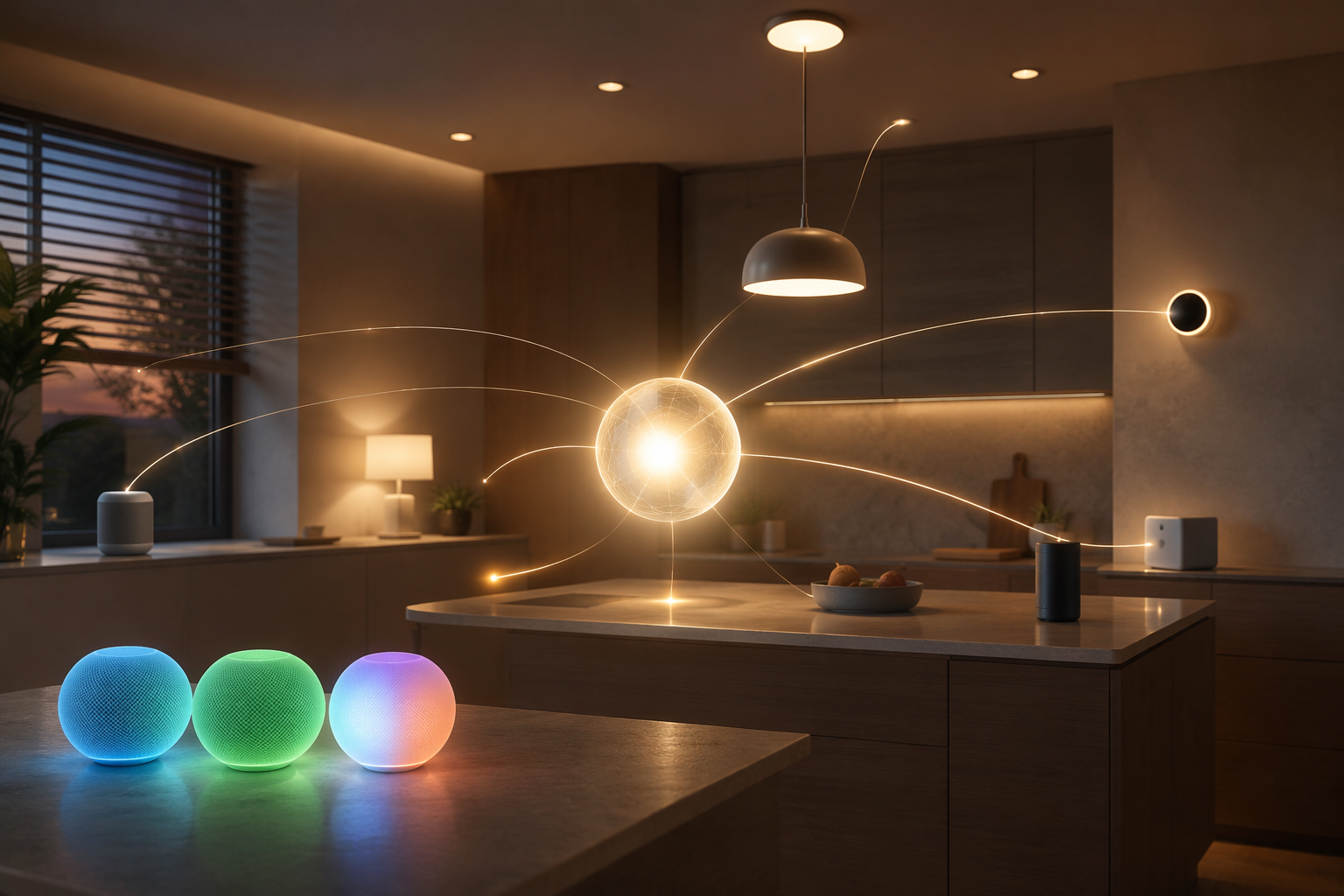
A wall display without that assistant layer risks becoming an attractive control panel that still sends people back to their phones. A better Siri could make the same display feel like the household’s shared interface: show the camera, lower the lights, call a family member, summarize a notification, start a recipe timer, and adjust the thermostat without making the user remember which app owns which device.
The reported Google Gemini piece should be handled carefully. MacRumors reported that Apple’s Siri upgrade would use a Google Gemini model on Apple’s Private Cloud Compute, with no data shared with Google.[6] Apple has not confirmed that arrangement, and one report should not be treated as settled architecture. Still, the idea is strategically revealing if accurate: Apple would be trying to borrow or buy part of the intelligence layer while keeping the privacy boundary that makes its home pitch different from Amazon’s and Google’s.
That would be a very Apple compromise: concede that frontier assistant intelligence is hard to build quickly, but route it through infrastructure designed to preserve the company’s trust story. In the smart home, that trust story is not ornamental. A phone assistant knows a lot; a home assistant may know when children are home, which room has motion, who rang the doorbell, when the lights turn off, and what cameras recorded.
The risk is that Apple’s privacy architecture becomes a reason to forgive mediocrity. It should not. People did not put Echo devices in kitchens because they enjoyed Amazon’s data posture. They did it because Alexa answered quickly, supported common devices, handled simple household commands, and became good enough for low-stakes daily use. Apple does not need Siri to become a charming personality. It needs Siri to stop being the weak link in an otherwise coherent home.
The home devices appear to be waiting for the assistant layer
The sequencing supports that reading. MacRumors reported in May 2026 that a new Apple TV and HomePod mini were nearly ready and already in employee use, but were being held for the Siri AI work tied to iOS 27.[7] If true, that is a useful tell. Apple can ship an Apple TV with better wireless, or a HomePod mini with a newer chip, without changing the strategic shape of the category. Holding them for Siri suggests the company understands that the hardware story and assistant story now have to land together.
The Apple TV refresh is especially important because it is easy to underestimate. A set-top box is not glamorous in 2026, but it is powered, stationary, connected to the largest screen in the house, and often located near the router and living-room devices. If the rumored A17 Pro, Wi-Fi 7, Bluetooth 6, and Thread support arrive, the Apple TV becomes more than a streaming box. It becomes home infrastructure.[3]
The HomePod mini 2 has a different job. Apple needs low-friction voice presence in more rooms. The original HomePod mini was closer to the right price and size than the full-size HomePod, but it never turned Apple into the home assistant default. New silicon could help with responsiveness, local processing, wireless reliability, and future Siri features, but only if Apple also fixes the assistant behaviors that made many households choose Echo in the first place.
The full-size HomePod refresh is likely a narrower play: premium audio, Apple Music, home theater pairing, and a more capable Siri endpoint for people already willing to pay Apple prices. It does not need to carry the whole strategy. In fact, Apple’s past mistake was letting premium speaker logic stand in for home platform logic.
A camera would pull privacy and services into the same room
The rumored Apple indoor security camera may be the most commercially revealing part of the lineup. Cameras are not just accessories. They create recurring storage needs, notification workflows, privacy anxieties, and family-sharing questions. A camera tied to HomeKit Secure Video would give Apple a clearer bridge between home hardware and iCloud subscriptions.[3]
AppleInsider reported that some Apple Home AI features would be locked behind the 2TB iCloud+ tier at $10 per month.[8] That kind of gating will annoy some users, but it follows the Services logic already visible across Apple’s business. The company does not need every home device to be a high-margin blockbuster if the devices increase the value of iCloud, Apple Music, Apple TV+, family sharing, and AI features that make the household more dependent on Apple’s account layer.
The privacy challenge is sharper with cameras than with speakers. A camera subscription is not just cloud storage; it is a promise about who can see footage, how long clips remain available, whether audio is analyzed, and how access is shared among family members. Anyone evaluating that part of Apple’s strategy should look less at the camera spec sheet and more at retention, encryption, and account-control details, the same issues covered in this smart home camera data retention and privacy guide.
This is where Apple has a plausible advantage and a real burden. Amazon and Google normalized voice assistants in the home, but they also trained many users to worry about microphones, recordings, ads, and data use. Apple can differentiate on privacy, but only if its system is compatible enough, responsive enough, and useful enough that privacy is not merely the consolation prize for worse functionality.
Compatibility decides whether this becomes a platform
Apple cannot win the home by making only Apple devices talk beautifully to other Apple devices. The home is too heterogeneous. Lights, locks, sensors, cameras, thermostats, robot vacuums, shades, doorbells, and appliances turn over at different speeds and come from different vendors. Even loyal iPhone households do not replace a working thermostat because a platform story got cleaner.
That makes Thread and broader device support more important than they sound in a product rumor. If the Apple TV 4K becomes a stronger Thread-capable hub, Apple can reduce the friction between HomeKit, Matter-era devices, and the physical reality of the house. A smart home platform is not proven when it controls a demo light in a keynote. It is proven when a spouse, guest, child, or tired homeowner can operate the house without knowing which protocol made it work.
This is also why Apple’s product wave should be judged against the broader device landscape, not just against prior HomePods. The real competition includes cheap Echo speakers, Nest displays, Ring cameras, Eero routers, Samsung SmartThings, Matter-compatible accessories, and dozens of category specialists. The question for buyers is rarely “Which single Apple home device is best?” It is “Which system will make the devices I actually own less irritating?” That broader compatibility lens is central to any category-by-category smart home buying decision.
What would make the strategy matter to Apple’s valuation?
For Apple’s market-cap race with Nvidia, the smart home only matters if it becomes more than hardware revenue. A $350 display hub, refreshed speakers, and a new Apple TV can contribute sales, but the valuation case depends on a larger loop: more Apple-controlled interfaces in the home, more iCloud and media attachment, more daily Siri usage, more family account dependence, and more reasons for iPhone households to stay inside Apple’s ecosystem when they buy their next device.
That loop is believable because it fits Apple’s strengths. The company is good at turning hardware into distribution for software and services. It is good at making fragmented categories feel more coherent once standards, silicon, and user expectations mature. It is also patient enough to enter late without apologizing for being late.
But the loop is not guaranteed. The smart home has punished companies that confused adoption with satisfaction. People can own smart speakers and still dislike their assistants. They can buy connected bulbs and stop using scenes. They can install cameras and then resent subscriptions. They can set up a smart home once and avoid changing it for years because the setup was painful. Apple’s chance is not that the category is easy. It is that the category is still fragmented enough for a better integrated layer to matter.
A useful way to judge Apple’s 2026 push is to ignore the launch-day adjectives and watch for household behavior. Does the Home Hub become the place people actually check cameras and control rooms? Does Siri handle multi-step, context-aware requests without pushing users back to the iPhone? Do Apple TV and HomePod reduce device-compatibility complaints? Does iCloud+ feel like a fair home subscription rather than a toll? Do Echo owners inside Apple households stop replacing old Echoes with new ones?
The crown moves only if the home becomes an interface
Apple is close enough to Nvidia that investors will look for every credible source of incremental growth. Services already gives the company a powerful base. The rumored 2026 home wave gives it a more ambitious story: not a new speaker, not a new display, but a coordinated attempt to make the home another Apple platform.
The conditional is doing real work. Apple’s smart home strategy could help lift the company past Nvidia if it turns existing Apple households into deeper services customers and makes Siri the default way those households control rooms, media, cameras, and routines. It will not happen because Apple ships more attractive hardware than before. The market-cap crown does not move because of new speakers and screens alone. It moves only if Siri finally becomes useful enough to make Apple the home interface people stop working around.
References
- Nvidia Vs. Apple, 24/7 Wall St., July 14, 2026.
- Apple closes in on Nvidia, MacDailyNews, July 8, 2026.
- 2026 Smart Home Lineup, MacRumors, July 15, 2026.
- Apple Smart Home Display Delayed Again, Forbes, March 11, 2026.
- Home hub reportedly marks shift, 9to5Mac, October 2025.
- Siri AI overhaul report, MacRumors, November 2025.
- New Apple TV and HomePod Mini Are Nearly Ready, MacRumors, May 31, 2026.
- Apple Home AI features locked, AppleInsider, July 6, 2026.
Updates & Corrections
Protocol specifications and platform features change rapidly — especially with Matter version evolution. Report version changes, certification count updates, or platform policy changes that have occurred since the last editorial review.
Comments
Join the discussion with an anonymous comment.