Devices
Which Smart Pool Safety Devices Prevent Toddler Drowning?
This article maps the NDPA's Five Layers of Protection to specific smart pool safety devices you can buy today, and explains the compatibility gaps—including the absence of Matter support—so you know what works together with your existing smart home hub.
- Apple HomeNot stated
- Google HomeNot stated
- AlexaNot stated
- SmartThingsNot stated
- Home AssistantNot stated
The honest answer to “which smart pool safety devices prevent toddler drowning” is not a single product. In mid-2026, the defensible setup is a stack: a physical access barrier first, a gate alert that reaches the right adult, at least one water-entry or submersion detector, and a supervision plan that does not depend on everyone vaguely assuming someone else is watching.
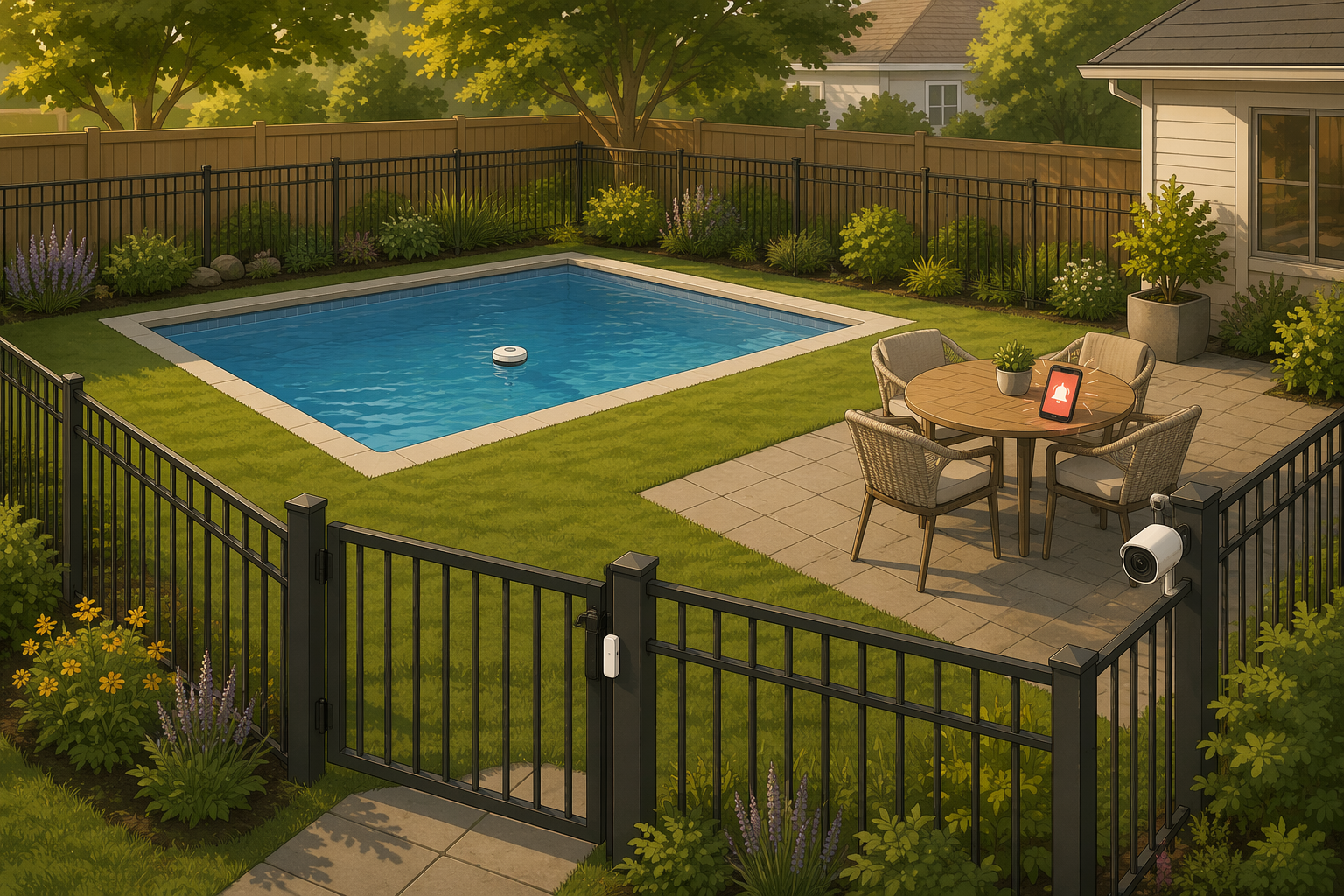
That answer is less tidy than a shopping page, but it fits the risk. The U.S. Consumer Product Safety Commission reported an annual average of 376 fatal child drownings for children younger than 15, with most involving children younger than 5, in its June 2026 drowning report.[1] The National Drowning Prevention Alliance frames prevention around Five Layers of Protection rather than a single alarm or camera.[2] For a toddler in a backyard, that distinction matters: the best device is the one that interrupts access before the child is near the water.
| NDPA layer | Buyable device type | Example products | Alert method | Protocol or app dependency | Verification status |
|---|---|---|---|---|---|
| Barriers and alarms | Four-sided isolation fence, self-closing gate, gate alarm, gate contact sensor | Pool Guard USA-style self-latching fence; Techko S187D gate alarm; Ring Alarm Outdoor Contact Sensor | Physical lockout; audible gate alarm; hub or app notification when gate opens | Fence is not connected; Techko is standalone; Ring sensor uses Zigbee through Ring Alarm and compatible smart-home paths | Fencing is the preventive layer; UL 2017 applies to gate and door alarms; Ring is the only reviewed device with native smart-home protocol integration |
| Supervision | Water Watcher protocol | Designated adult watcher, phone put away, handoff when watcher changes | Human observation and explicit responsibility | No smart-home protocol | Required outside automation; not replaced by cameras or alarms |
| Water competency | Age-appropriate swim lessons and water-safety skills | Local swim instruction | No device alert | No smart-home protocol | A safety layer, not a toddler-proofing substitute |
| Life jackets | Properly fitted, U.S. Coast Guard-approved life jacket when appropriate | Life jacket for boating or designated water activities | No device alert | No smart-home protocol | Useful for specific activities; not a backyard access-control system |
| Emergency preparation | CPR training, rescue plan, phone access | CPR class; posted emergency plan | Human response after an incident | No smart-home protocol | Must be ready before an alert sounds |
| Detection add-on to the barrier layer | Pool alarm, AI camera, wearable water-contact alarm | BCone; Pool Angel; SwamCam; Poolguard PGRM-2; Safety Turtle 2.0 | App notification, siren, voice assistant, or local alarm after water entry or risky behavior | Mostly standalone Wi-Fi, PoE, app, Alexa voice, or non-integrated alarm systems | Useful as a later alert channel; no published Matter, Thread, Zigbee, or Z-Wave support found for these reviewed products as of July 2026 |
The matrix is deliberately unfair to shiny devices. A floating pool alarm may be useful. An AI camera may add a second set of eyes. A wearable water-contact band may help in a narrow routine where the child keeps it on. None of those products creates the separation that a closed, self-latching, four-sided fence creates.
That is why the first purchase decision should be boring: can a toddler reach the pool at all? Pool Guard USA’s toddler pool-safety guidance cites the American Academy of Pediatrics’ finding that four-sided isolation fencing reduces drowning risk by 83% compared with three-sided property-line fencing or no fencing.[3] The same buying logic applies to gate hardware. If the latch sticks, the spring is weak, or a chair can be dragged to the handle, the later “smart” devices are being asked to make up for a preventable access failure.
Start With Access, Not Water Entry
A toddler drowning setup should begin at the fence line because many incidents do not start with a planned swim. Pool Guard USA cites AAP data that 69% of drownings involving young children happen during non-swim times, when the household was not preparing for pool use.[3] Those are the ugly minutes: dinner moving outside, a visiting cousin leaving the slider open, a parent answering a text, everyone still dry.
A gate alarm and a contact sensor do different jobs. A UL 2017 gate or door alarm is meant to make noise locally when the gate opens. A smart contact sensor can tell a hub or app that the gate changed state. If the adult carrying plates to the patio needs a phone alert or an announcement in the kitchen, the contact sensor is the part that can route the event.
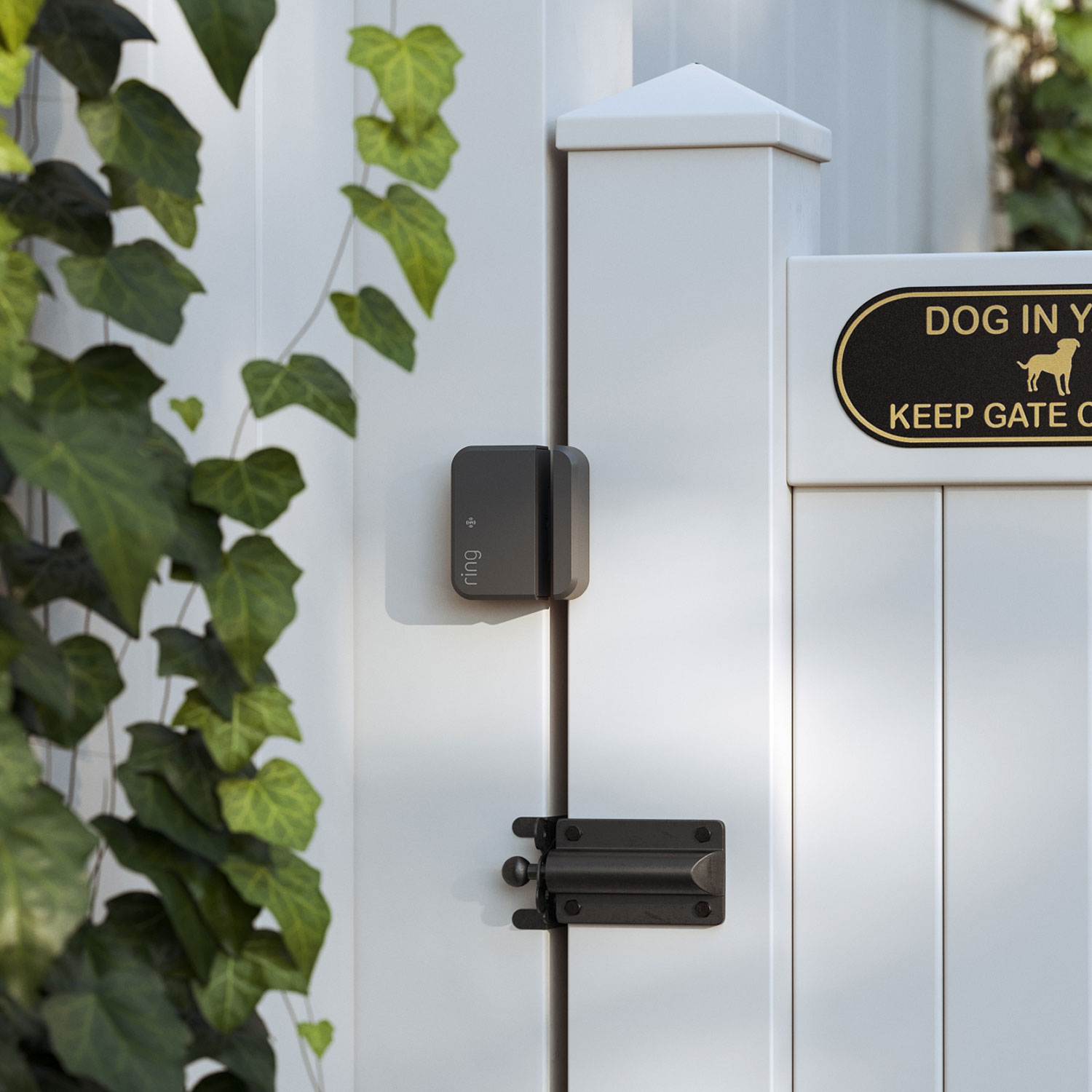
Among the reviewed products, the Ring Alarm Outdoor Contact Sensor is the compatibility outlier. It uses Zigbee, costs about $30 in the research set, and can report that the pool gate opened rather than waiting for a child to enter the water. For readers building around SmartThings, Home Assistant, Hubitat, or Alexa routines, that is the most useful smart-home event in the stack: “gate opened” is earlier than “water disturbed.” For a refresher on why this differs from Wi-Fi accessories, see NestGrid’s Zigbee protocol explainer.
That does not make the Ring sensor a pool alarm. It does not know whether a child crossed the patio, climbed a fence, or fell in. It reports movement at the gate. That narrowness is exactly why it belongs in the prevention layer rather than being mistaken for a drowning detector.
Where Pool Alarms and AI Cameras Fit
Water-entry devices belong after the access layer. ASTM F2208 covers residential pool alarms that detect entry into the water, including surface-wave and subsurface alarms.[4] That standard is useful because it reminds buyers what these products are testing for: an event has already begun.
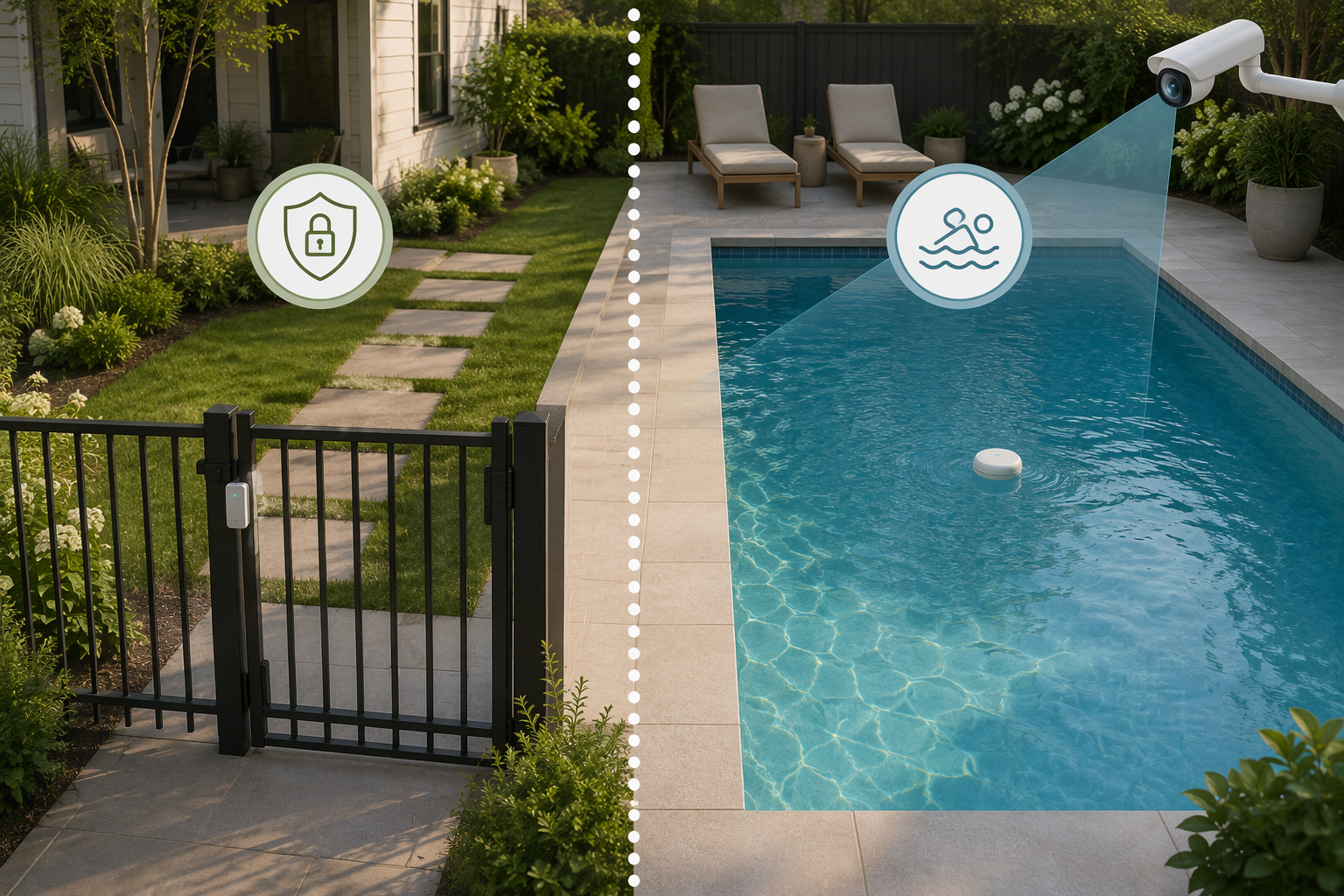
BCone is a surface-wave pool alarm with ASTM F2208 positioning, Wi-Fi app alerts, and Alexa voice-control support.[5] In a smart-home context, that Alexa support may be enough for some households: a voice announcement can be loud and fast if the network reaches the pool area. It is not the same as native Matter, Zigbee, Thread, or Z-Wave support, and the product depends on a usable 2.4 GHz outdoor Wi-Fi signal. If your router barely reaches the patio, fix that before trusting an app alert.
BCone’s detection method also has a practical limit: surface-wave alarms are watching for water disturbance, and a quiet toddler entry may be missed. That does not make BCone useless; it means it should not be treated as the only detector in a home where a child can approach the water unnoticed.
Pool Angel takes a different route. It is a PoE-wired edge-AI camera system with app alerts, offline local processing, and stated ASTM F2208 compliance. Pool Angel publishes claims of 99.7% accuracy and sub-2-second alerts, but those figures are manufacturer-published and no independent verification was found in the reviewed materials.[6] The product may be compelling for households that want camera-based detection without relying entirely on cloud processing, but its strongest claims should be read as vendor disclosures, not settled third-party performance data.
SwamCam is another standalone camera-based pool alert system, with Wi-Fi/app operation and no published Matter, Thread, Zigbee, or Z-Wave support found as of July 2026.[7] It can still be useful as a separate alert channel, especially if the app notification goes to the adult who is actually responsible during non-swim time. The key is not to expect it to behave like a native hub device.
Poolguard PGRM-2 and Safety Turtle 2.0 sit further from the smart-home hub. Poolguard PGRM-2 is a traditional subsurface alarm described in the reviewed materials as having the lowest false-alarm rate among traditional alarm types and detecting pressure changes of 18 pounds or more. Safety Turtle 2.0 is a wearable water-contact alarm: it can trigger when the wristband gets wet, but it fails as a toddler-drowning layer if the child is not wearing the band. These are alarm systems, not integrated smart-home sensors.
The Matter Gap Is Real in July 2026
For a Matter-first household, the disappointing compatibility verdict is simple: none of the reviewed residential pool safety devices publishes native Matter support as of July 2026. That includes BCone, Pool Angel, SwamCam, Safety Turtle, and Poolguard. The finding is based on published manufacturer information in the research scope, so it should be read carefully: no published support is not the same as proof that no workaround can ever exist.
The same gap applies to Thread and Z-Wave for the reviewed pool alarms and camera systems. Ring’s Outdoor Contact Sensor is the only reviewed device with native smart-home protocol integration, and even that is a gate sensor rather than a drowning detector. If your hub strategy starts with Matter, NestGrid’s Matter smart lock guide is a useful comparison point: locks and contact sensors are much further along than pool-specific safety devices.
| Device | Primary job | Native Matter | Thread | Zigbee | Z-Wave | Wi-Fi/app | Buying consequence |
|---|---|---|---|---|---|---|---|
| Ring Alarm Outdoor Contact Sensor | Gate-open detection | No published native Matter support in reviewed materials | No published Thread support | Yes, Zigbee | No published Z-Wave support | Works through Ring ecosystem paths | Best hub-native alert for pool access, but not a water-entry detector |
| BCone | Surface-wave water-entry alarm | No published support as of July 2026 | No published support as of July 2026 | No published support as of July 2026 | No published support as of July 2026 | Yes, Wi-Fi app; Alexa voice-control support | Useful as a standalone detector if outdoor Wi-Fi is strong |
| Pool Angel | AI camera and edge detection | No published support as of July 2026 | No published support as of July 2026 | No published support as of July 2026 | No published support as of July 2026 | App alerts; PoE wired system | Potentially strong detection channel, but separate from native smart-home hubs |
| SwamCam | Camera-based pool monitoring | No published support as of July 2026 | No published support as of July 2026 | No published support as of July 2026 | No published support as of July 2026 | Yes, standalone Wi-Fi/app system | Treat as its own alert system, not a Matter accessory |
| Safety Turtle 2.0 | Wearable water-contact alert | No published support as of July 2026 | No published support as of July 2026 | No published support as of July 2026 | No published support as of July 2026 | No native smart-home integration found | Only works when the child is wearing the band |
| Poolguard PGRM-2 | Subsurface pool alarm | No published support as of July 2026 | No published support as of July 2026 | No published support as of July 2026 | No published support as of July 2026 | No native smart-home integration found | Traditional alarm layer; do not expect hub automations |
This is where a lot of pool-safety marketing becomes slippery. “Smart” may mean Wi-Fi app alerts. It may mean Alexa voice support. It may mean AI analysis on a camera feed. It rarely means the device joins Apple Home, SmartThings, Home Assistant, or a Z-Wave network as a native pool-safety accessory. Before buying, check the exact alert path: who receives it, on which phone, through which app, and what happens if that phone is on silent.
For hub selection, the practical question is whether your automation system can act on a gate event. SmartThings, Hubitat, Home Assistant, and Ring-centered setups can be designed around contact-sensor events more cleanly than around most pool-alarm apps. NestGrid’s home automation hub guide is the better starting point if the pool gate needs to trigger lights, speakers, or household-wide notifications.
Read Standards Before You Read Accuracy Claims
Standards do not make a pool safe by themselves, but they help separate categories that marketing often blends together. ASTM F2208 is about entry alarms after water entry.[4] UL 2017 applies to gate and door alarms. Those are different moments in the incident timeline.
ASTM F3698-24 is newer and more specific: it is the first standard for residential AI drowning detection during active pool use, with a 30-second alert-window requirement in the reviewed materials. As of mid-2026, the reviewed materials identify MYLO by Coral Smart Pool as certified, while Pool Angel describes itself as F3698-aligned rather than certified. That distinction should affect how much confidence a buyer places in the claim. “Aligned” may describe design intent; “certified” means the product has gone through the relevant certification path.
Older device-level reliability research should also be handled carefully. The CPSC’s pool-alarm reliability study is from 2000, while newer CPSC reports focus on fatality statistics rather than current device-by-device testing. A modern Wi-Fi camera or edge-AI system should not be judged entirely by a 2000 alarm test, but current manufacturer claims should not be treated as independent proof either.
A Practical Stack for a Toddler Household
If the pool is at your home, or your toddler regularly visits a home with a pool, build from the outside in. The stack below keeps prevention and detection separate instead of pretending one device can do both.
- Install or verify a four-sided isolation fence with a self-closing, self-latching gate before buying cameras or floating alarms.
- Add a UL 2017 gate alarm so the gate makes a local audible alert when opened.
- Add a Ring Alarm Outdoor Contact Sensor, or another outdoor-rated hub-compatible contact sensor, where native smart-home alerts matter.
- Add a separate detection channel: BCone for a Wi-Fi surface-wave alarm with Alexa support, Pool Angel for PoE edge-AI detection, SwamCam for standalone camera alerts, or a traditional alarm such as Poolguard PGRM-2.
- Use a Water Watcher handoff during any gathering, even when no one is officially swimming.
- Complete CPR training and keep emergency response steps visible, because the smart home can notify people but cannot perform the rescue.
A typical automation rule for the gate should be plain enough that a tired adult understands it: if the pool gate opens, announce it on indoor speakers, send a push alert to the responsible adults, and turn on exterior lights after dusk. That pattern is closer to severe-weather or safety-alert automation than entertainment automation; NestGrid’s smart-home severe weather alerts guide uses the same basic principle of routing urgent information to people who can act.
For Wi-Fi pool devices, test from the device location, not from the kitchen. BCone’s outdoor 2.4 GHz requirement is a reminder that pool areas are often at the edge of the network. A detector that works during setup day but drops offline during a crowded weekend is not a safety layer you can count on. If you are extending Wi-Fi outdoors, the placement discipline is similar to any outdoor smart plug or camera deployment; NestGrid’s Wi-Fi smart plug buying guide covers the network assumptions worth checking.
What Not to Buy as a Single-Device Solution
Do not buy a floating alarm and consider the pool toddler-safe. It may alert after water entry, but it does not secure a gate, assign a watcher, or teach anyone CPR. Do not buy an AI camera and ignore the fence. A camera alert still needs an adult close enough, available enough, and sure enough to respond. Do not buy a wearable water alarm unless the household can honestly keep the band on the child every time the child has access to the pool area.
Also be careful with “Alexa compatible” or “app connected” language. Those features can be useful, especially for louder household announcements, but they do not equal native smart-home protocol support. A product can be valuable and still live outside your main automation system.
The strongest mid-2026 setup is therefore a split ecosystem: prevention hardware first, a Zigbee gate sensor where hub-native alerts matter, and a standalone Wi-Fi, PoE, or traditional pool detector as a second channel. Keep supervision and CPR training outside the automation fantasy. They are not legacy layers waiting to be replaced; they are the people and skills that make every alert matter.
References
- CPSC Report Highlights Persistent Risk of Childhood Drowning, U.S. Consumer Product Safety Commission, June 2026.
- Drowning Facts and Data, National Drowning Prevention Alliance.
- Pool Safety for Toddlers, Pool Guard USA.
- ASTM F2208-08(2019), Standard Safety Specification for Residential Pool Alarms, ASTM International.
- BCone System, Lifebuoy Alarm.
- Pool Angel, Pool Angel.
- SwamCam, SwamCam.
Report an issue with this profile
If a compatibility claim looks stale or incorrect, tell us — we re-verify before changing what's published.