
For smart home severe weather alerts, the practical answer is uneven: Alexa is the easiest consumer choice for free proactive household announcements, Home Assistant is the most powerful if you are willing to build the logic yourself, Vivint is the strongest professionally installed option when power or internet may fail, SmartThings is a workable middle path, and Google Home and Ring Alarm should not be chosen if native proactive severe weather alerting is a deciding requirement as of Q3 2026.
That distinction matters because a weather tile in an app is not the same thing as an alert that interrupts a house. During a tornado warning, severe thunderstorm warning, flash flood warning, or hurricane-related alert, the question is not whether the platform can display weather somewhere. It is whether the right person hears or sees the warning without having to remember to ask.
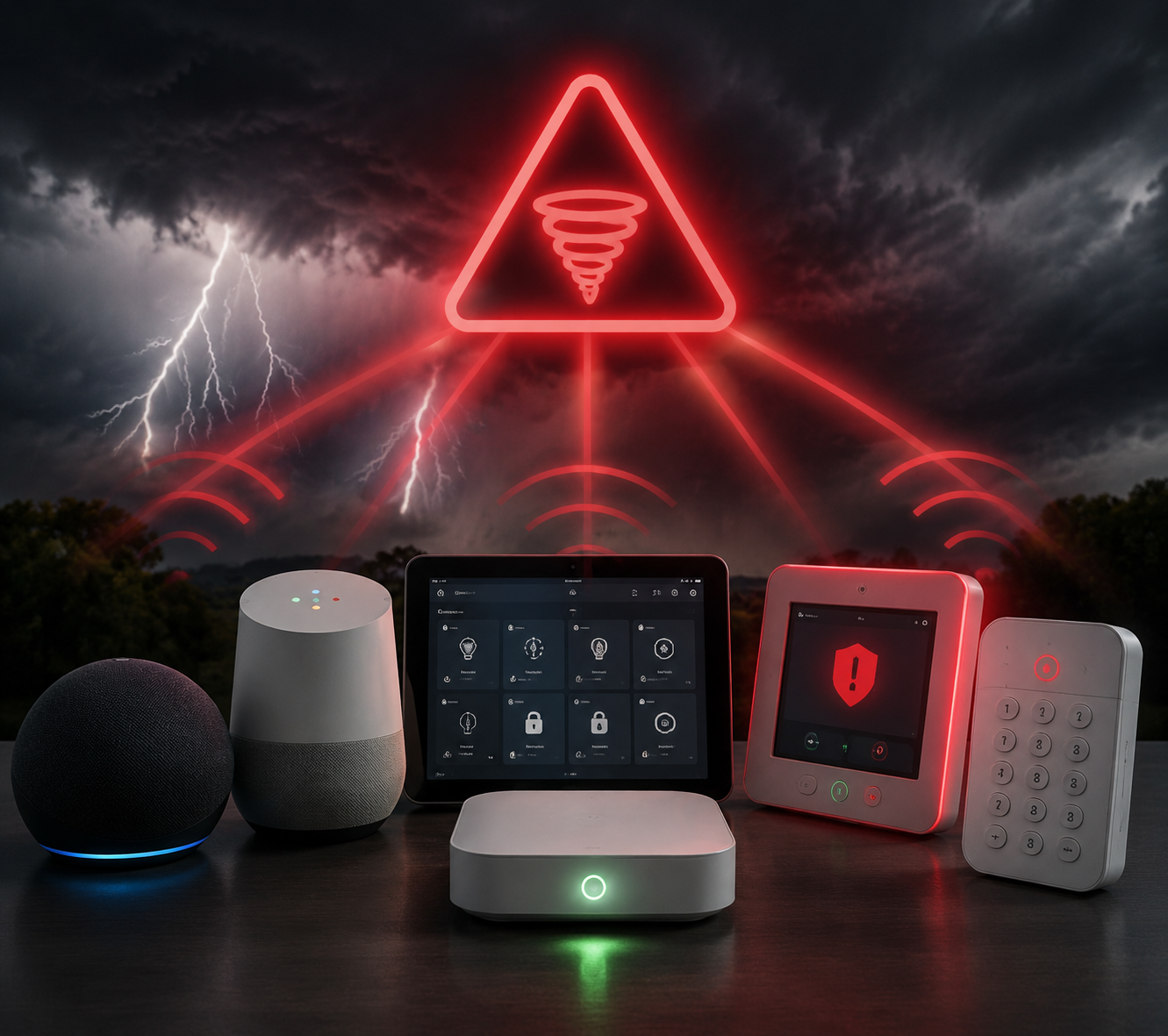
Quick Verdict
| Platform | Best Fit | Severe Weather Alert Judgment |
|---|---|---|
| Amazon Alexa | Most households with Echo devices | Best out-of-the-box option: free proactive severe weather alerts can be enabled by voice command on Echo devices. |
| Home Assistant | DIY users who want automation depth | Most flexible: can use NWS warning data and custom integrations to trigger lights, speakers, dashboards, shutters, valves, and other connected devices. |
| Vivint | Homes that want a monitored, resilient panel | Best hardware-resilient consumer option: Smart Hub Panel supports visual/audio alerts, battery backup, and cellular connectivity. |
| SmartThings | Existing SmartThings users | Usable middle path: built-in severe weather notifications exist in Automations, with community custom SmartApps for more. |
| Google Home/Nest | General assistant users, not weather-alert-first buyers | Weak for this use case: no native proactive severe weather push alerting has been documented, so users rely on manual asking or workarounds. |
| Ring Alarm | Security-first households that do not need weather alerts from Ring | Not a weather-alert platform: user requests show demand for audible weather alert tones, but that is not the same as implemented functionality. |
What Counts as a Good Smart Home Severe Weather Alert
A useful smart home storm alert does at least one thing phones often fail to do: it breaks through the conditions of an ordinary household. Someone may be asleep. A phone may be charging in another room, silenced, or buried under a blanket. A person may be in the basement with weaker reception. The home may lose power or broadband before the worst part of the storm arrives.
So the comparison here weighs platforms in this order: proactive alerting first, delivery method second, resilience third, automation depth fourth, and cost or subscription complexity after that. Speaker quality, camera ecosystems, and general smart home polish are useful in other buying decisions. They do not answer whether a household gets warned in time.
- Proactive alerting: The system should initiate the warning instead of waiting for a manual weather question.
- Household delivery: Audible alerts, panel warnings, lights, displays, and mobile notifications all matter, but they do not reach the same people equally.
- Resilience: Severe weather is exactly when power and internet service become less trustworthy.
- Automation depth: The strongest systems can trigger actions from official warning events instead of merely showing forecast conditions.
- Friction: A feature that requires custom repositories, YAML, dashboards, and ongoing maintenance is not the same kind of product as a voice-enabled toggle.
Amazon Alexa: The Easiest Free Proactive Household Alert
Alexa has the cleanest consumer answer: say, “Alexa, tell me when there’s a severe weather alert,” and Echo devices can provide free proactive severe weather alerts instead of waiting for you to ask for the forecast.[1] For a household that already has Echo speakers in bedrooms, kitchens, or living areas, that is a very low-friction upgrade.
The important part is the direction of the alert. A passive weather widget asks the homeowner to check. Alexa’s proactive alert asks less of the homeowner at the moment when attention is already scattered. That does not make an Echo a replacement for NOAA Weather Radio, local sirens, Wireless Emergency Alerts, or local emergency management instructions. It does make it one of the few mainstream smart home devices that can add a household-level audible warning without a project.
It is also worth separating this from Alexa Guard. Guard was deprecated in 2025 and replaced by Alexa Emergency Assist, a paid service listed at $5.99 per month in the research material.[2] That change has confused older advice because Guard used to sit near safety features in Alexa discussions. The free severe weather alert command is a separate capability and should not be treated as lost just because Guard went away.
Alexa’s weakness is that it is still a consumer assistant feature, not a fully engineered emergency system. It depends on the devices being powered, connected, correctly located, and audible from the rooms where people actually are. But for most non-technical households, it is the rare smart home severe weather alert feature that is both proactive and simple enough to enable before dinner.
Google Home/Nest: Good Weather Answers, Weak Proactive Alerting
Google Home and Nest speakers can answer weather questions, but that is not the same as native proactive severe weather push alerting. Reviewed reported in February 2022 that Google Home/Nest lacked native proactive severe weather push alerts, and the available research shows no known reversal as of mid-2026.[3]
That makes Google frustrating in a very specific way. The assistant can be excellent at answering a direct weather query. It can fit nicely into a home that already uses Google services. But if the requirement is “wake the household or interrupt the room when a severe warning arrives,” the native platform still leaves too much work outside the box.
Third-party workarounds may be possible depending on the rest of the home, but those should be evaluated as workarounds, not as a built-in Google Home severe weather alert feature. If proactive severe weather alerts are one of the reasons you are choosing a platform, Google Home should not be the deciding anchor in Q3 2026.
Home Assistant: The Deepest DIY Warning System
Home Assistant is the platform with the most interesting ceiling. Its official National Weather Service integration can bring NWS weather data into a Home Assistant setup, and the custom NWS Alerts integration available through HACS is documented as a way to expose active NWS alerts for automation and dashboard use.[4][5]
That changes the role of a weather alert. Instead of only sending a notification, Home Assistant can use an NWS warning as a trigger. A severe thunderstorm warning could flash selected lights. A tornado warning could announce through connected speakers, turn on basement lights, and display the alert on a wall tablet. A flood warning could tie into a water-related routine if the home has the right sensors, valves, and automations. These are examples of what the automation model can support; the exact result depends on the devices installed and the logic the owner builds.
The Weather Alerts Card documented with the custom NWS Alerts setup gives Home Assistant users a dashboard-friendly way to display alert information rather than burying it in raw entities.[5] That matters for households that keep a tablet dashboard in a kitchen, mudroom, hallway, or basement. A visible warning panel can be more useful than another phone notification during a noisy storm.
The caveat is not small. HACS, custom integrations, entity configuration, dashboard cards, automations, and testing are normal vocabulary for Home Assistant users. They are not normal setup steps for many homeowners. A strong Home Assistant severe weather setup should be tested, maintained, and understood by someone in the house; otherwise the impressive automation graph can become another thing nobody trusts when the sky turns green.
For readers already comfortable with Home Assistant, this is the platform to explore first. For readers new to automation, start with a broader home automation platform decision framework before assuming that a custom NWS-triggered warning system is a weekend toggle.
Vivint: The Most Resilient Panel-Based Approach
Vivint earns attention for a different reason: its severe weather alerts run through the Smart Hub Panel, which can show visual alerts and provide audio notifications. Vivint’s own severe weather material also describes 24-hour battery backup and dedicated cellular connectivity, which address the failure mode that matters during bad weather: the house may lose power or internet service.[6]
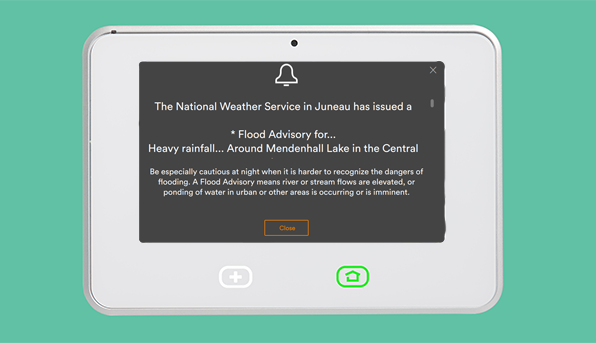
That hardware posture separates Vivint from a smart speaker sitting on a Wi-Fi network. A panel with battery backup and cellular connectivity is better aligned with storm conditions than a system that assumes the router, modem, and wall power will all keep cooperating. It does not make the panel magic, and the details still depend on the installed system and service plan, but it is the most resilience-minded consumer smart home approach in this comparison.
Vivint also cites an average tornado warning lead time of 13 minutes, originally from The Atlantic in 2014.[6] That number should not be read as a guarantee for a specific storm or county. It is useful because it reminds homeowners that the warning window can be short enough that delivery channels matter. A severe weather feature that appears only after someone opens an app may be technically informative and practically late.
The tradeoff is that Vivint is a professionally installed, monitored smart home and security ecosystem, not a free feature on a speaker you already own. If you are weighing Vivint equipment tiers, the Vivint HomeProtect vs. HomeProtect Pro comparison is the better place to sort package differences. For severe weather specifically, the reason to consider Vivint is the panel, the audio/visual delivery, and the backup connectivity.
SmartThings: A Useful Middle Path
SmartThings sits between the low-friction Alexa answer and the deeper Home Assistant project. SmartThings Community discussion confirms that built-in severe weather notifications exist in the Automations section, with community custom SmartApps available for users who want to extend beyond the built-in path.[7]
That makes SmartThings worth considering for households that already have compatible sensors, switches, lights, and routines. A storm warning can be part of an automation mindset rather than a standalone voice-assistant feature. It is also less intimidating than a full Home Assistant build for many people.
The evidence does not support putting SmartThings above Alexa for simple out-of-the-box household alerts or above Home Assistant for NWS-triggered customization. Its appeal is narrower: if SmartThings is already the control layer in the home, its severe weather notification support gives you something real to work with before you consider changing ecosystems.
Ring Alarm: Security Hardware Without the Weather Alert You Would Expect
Ring Alarm is the odd miss in this group. A home security system already has sirens, keypads, base stations, and household attention. That sounds like useful weather-warning hardware. But the research material identifies no implemented Ring Alarm weather alert functionality as of mid-2026.
There is visible user demand. A Ring Community feature request from August 2025 asked for audible weather alert tones and had 67 upvotes, but that is evidence of an unmet request, not a roadmap or a shipped feature.[8] It should not be treated as a reason to buy Ring Alarm for severe weather alerts.
Ring may still make sense for security, cameras, or alarm monitoring depending on the household. For this particular buying question, it belongs in the “do not choose it for native proactive severe weather alerts” column.
Side-by-Side Capability Comparison
| Platform | Native Proactive Alerts | Main Delivery Channel | Resilience | Automation Depth | Cost / Friction |
|---|---|---|---|---|---|
| Amazon Alexa | Yes, via free severe weather alert voice command | Echo voice alerts and Alexa notifications | Depends on power and internet for Echo devices | Limited compared with DIY platforms | Low friction; separate from paid Alexa Emergency Assist |
| Google Home/Nest | No native proactive severe weather push alerting documented as of mid-2026 | Manual assistant queries and possible workarounds | Depends on power and internet | Possible only through external tools or third-party setups | Low daily-use friction, but weak for this specific requirement |
| Home Assistant | Yes, if built through NWS integrations and automations | Notifications, dashboards, speakers, lights, and connected devices | Depends on local hardware, network design, backups, and integrations | Highest in this comparison | High setup and maintenance friction |
| Vivint | Yes, through Smart Hub Panel severe weather alerts | Panel visual and audio alerts | Strongest consumer resilience here: battery backup and cellular connectivity documented | Lower DIY flexibility than Home Assistant | Professionally installed ecosystem with service/package considerations |
| SmartThings | Yes, built-in severe weather notifications in Automations | SmartThings notifications and compatible automations | Depends on hub, internet, power, and device setup | Moderate; community SmartApps can extend it | Moderate friction for existing users |
| Ring Alarm | No implemented weather alert functionality identified | No native weather alert channel | Alarm hardware may be resilient for security, but not used for weather alerts in the documented feature set | Not applicable for native severe weather alerts | Do not buy for this use case |
Best Choice by Household Type
Easiest Free Alert: Amazon Alexa
Choose Alexa if the goal is simple: make the smart speakers you already own speak up when severe weather is coming. It is the cleanest recommendation for renters, families, and homeowners who will not maintain custom automations. The setup is memorable enough to tell another adult in the house: ask Alexa to notify you when there is a severe weather alert.
Most Powerful DIY System: Home Assistant
Choose Home Assistant if you want the warning to do more than announce itself. This is the platform for turning NWS alert data into household behavior: lights changing, speakers announcing, dashboards displaying, blinds or shutters reacting if supported, and other devices joining the routine. It is also the platform where poor setup discipline can hurt you. Build it, document it, test it, and make sure someone else in the house understands what it is supposed to do.
Best for Backup Connectivity: Vivint
Choose Vivint if a professionally installed panel with battery backup and cellular connectivity fits the household better than DIY automation. This is the strongest option here for people who look at a storm forecast and immediately think about power loss, router failure, and whether a warning will still appear somewhere central in the home.
SmartThings as a Middle Path
Choose SmartThings if it is already your automation layer and you want severe weather notifications without rebuilding the home around another system. It is not the strongest overall severe weather platform, but it is real enough to configure and test before buying more gear.
Google Home and Ring: Not for Weather Alerts
Google Home and Ring Alarm may both belong in good smart homes for other reasons. They should not be selected for native proactive severe weather alerting as of Q3 2026. Google’s gap is the lack of documented native proactive push alerts; Ring’s gap is the lack of implemented weather alert functionality despite user requests.
Where Consumer Smart Homes Still Fall Short
Commercial emergency communication systems such as Connect ONE, Everbridge, and HQE Systems show that more formal alerting workflows exist outside ordinary consumer smart homes. They are useful benchmarks because they make clear what a mature alerting system thinks about: delivery channels, escalation, acknowledgments, and operational reliability. They are not direct substitutes for the homeowner choosing between Echo speakers, a Vivint panel, SmartThings routines, or a Home Assistant server.
A careful home setup can also combine channels. Alexa can provide a quick audible layer. A weather radio can remain the dedicated emergency device. Home Assistant can add visual and automation behavior for a household willing to maintain it. Air quality and smoke-related automations raise similar questions about what should happen automatically when outdoor conditions change; the same thinking applies when building air quality monitor automations for wildfire smoke.
The choice comes down to the same tradeoffs: Alexa for the easiest free proactive household alerts, Home Assistant for the deepest DIY NWS-triggered automation, Vivint for the most resilient monitored-panel approach, SmartThings for a usable automation-based middle path, and neither Google Home nor Ring Alarm if native proactive severe weather alerts are the deciding requirement in Q3 2026.
References
- How to get Alexa to notify you about severe weather alerts — Gearbrain
- Alexa Emergency Assist pricing and Guard replacement information — Amazon, 2025
- Google Home severe weather alert coverage — Reviewed.com, February 2022
- National Weather Service integration — Home Assistant
- NWS Alerts custom integration and Weather Alerts Card — MostlyChris, March 2026
- Severe weather alerts on Vivint Smart Hub Panel — Vivint
- Severe weather notifications in Automations discussion — SmartThings Community
- Audible weather alert tones feature request — Ring Community, August 2025