
Which Smart Lighting System Fits Your Home in 2026?
Compare Philips Hue, Lutron Caseta, LIFX, Govee, and WiZ based on bulb count, wiring type, and ecosystem preference — find the system that matches your home's setup.
Last updated
A smart lighting system starts to make sense when it matches the house before it tries to impress the app. In 2026, the first pass is simple: count the lights you want to control, decide whether wall switches can be replaced, and then check whether Alexa, Google Home, Apple HomeKit, or SmartThings needs to be the main control layer.
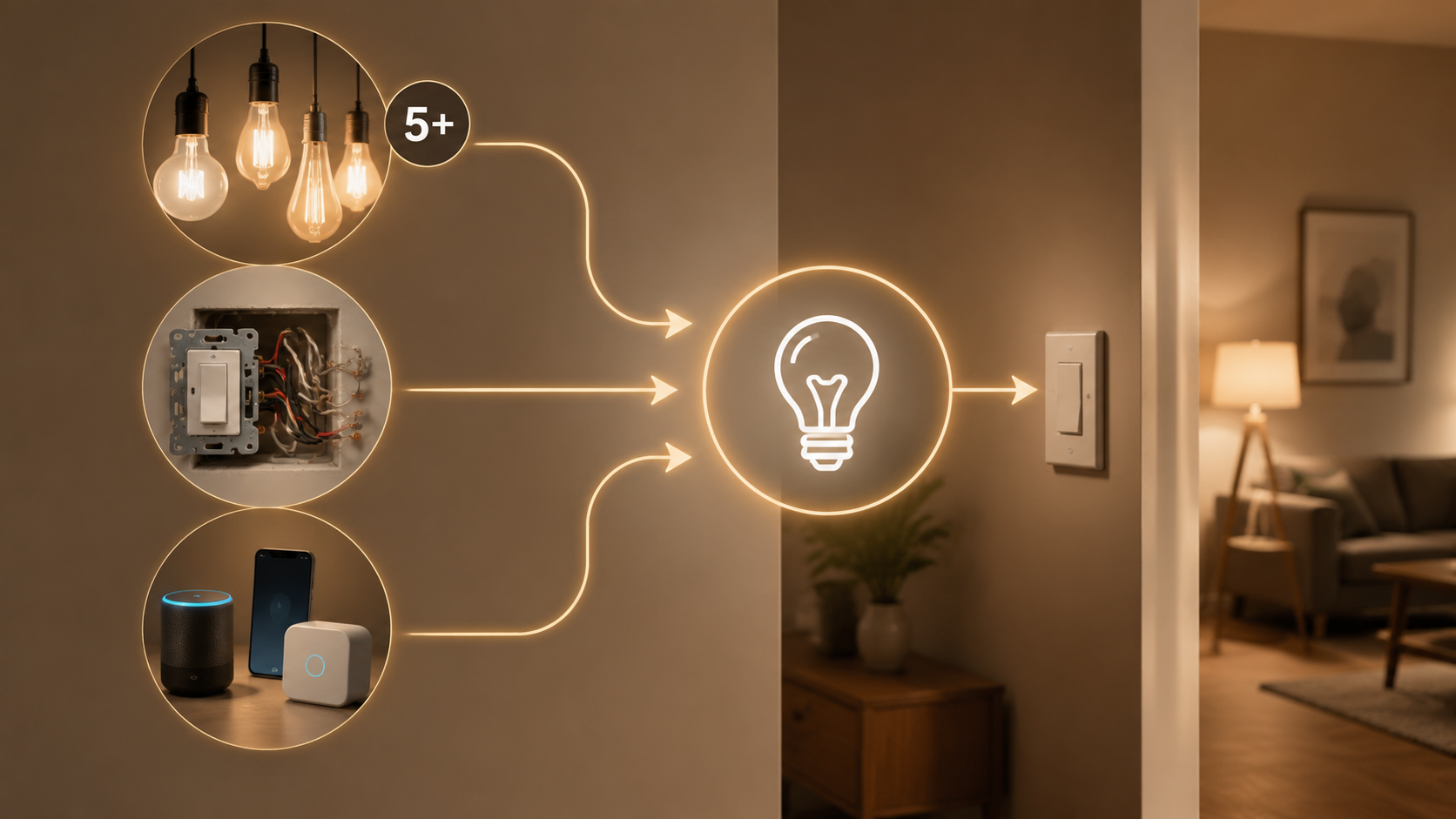
If you are buying for one room with three lamps, start with LIFX, WiZ, or Govee. If you are planning five or more bulbs across multiple rooms, start with Philips Hue and its hub-based Zigbee mesh. If the household mainly cares about normal wall-switch behavior, start with Lutron Caseta. If the room is a desk, gaming setup, TV wall, or music-reactive accent zone, Govee deserves a real look rather than being dismissed as the cheap option.
| Your home looks like this | Start here | Why |
|---|---|---|
| 1–5 bulbs, mostly lamps or renter-friendly fixtures | LIFX or WiZ | No hub, lower entry cost, less installation commitment |
| 5+ bulbs across rooms | Philips Hue | A dedicated bridge and Zigbee mesh reduce dependence on the router |
| Older home, no neutral wire, or strong wall-switch preference | Lutron Caseta | Smart switches preserve familiar control and can fit no-neutral situations |
| Accent lighting, gaming room, TV backlight, music sync | Govee | Strong value for decorative and reactive lighting |
| Mixed-brand future-proofing is the main concern | Matter-capable products, checked carefully by platform | Matter helps compatibility, but support still depends on devices and apps |
The five-bulb point is where hub-free stops being automatically simpler
For one to five bulbs, hub-free lighting can be the cleanest answer. You screw in the bulbs, connect them to Wi-Fi or the brand app, add voice control if needed, and stop. That is why LIFX and WiZ work well for apartments, bedrooms, home offices, and anyone who wants smart lighting without another plastic box beside the router.
The math changes when a smart lighting system becomes a household layer instead of a room upgrade. At roughly five or more bulbs, every additional Wi-Fi bulb is another device asking the router to participate. A hub-based mesh such as Philips Hue’s Zigbee setup keeps lighting traffic on its own network, with the bridge talking to the router rather than every bulb behaving like a separate Wi-Fi client. Independent protocol comparisons make the same practical distinction: Matter-over-Wi-Fi still uses the Wi-Fi network, while Matter-over-Thread and Zigbee move devices onto a mesh that reduces router congestion pressure.[1]
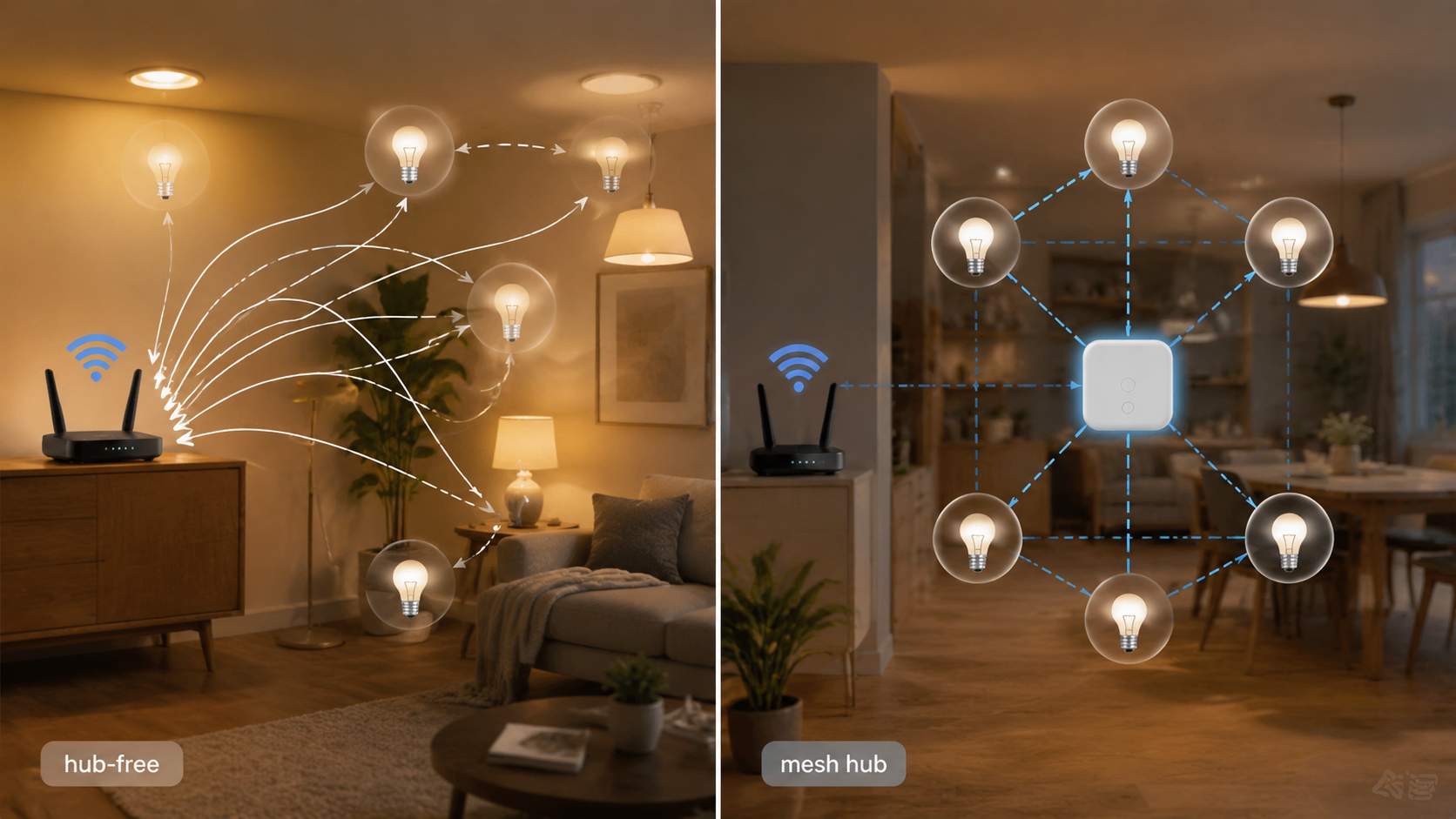
That does not mean every home with six bulbs must buy Hue. It means the burden of proof shifts. A small Wi-Fi deployment can feel simpler because there is no bridge. A larger Wi-Fi deployment can become less simple if the app is slow, automations miss, the router is already busy, or a family member cannot tell whether the light, the switch, the bulb, the app, or the network is the thing that failed.
Philips Hue earns its place here because reliability matters more as lights become infrastructure. Wirecutter’s 2026 smart LED bulb testing and CNET’s 2026 smart lighting coverage both treat reliability and ecosystem fit as central buying factors, not just color effects or app polish.[2][3] For a whole-home setup, that is the right standard. A bulb that looks excellent in one lamp can still be the wrong system if twenty of them make daily control brittle.
Prices make the tradeoff visible, but they do not decide it alone
June 2026 pricing shows why buyers hesitate before choosing a premium system. SmartHomeExplorer’s June 2026 guide lists a Philips Hue 4-bulb kit at $119.99, a Lutron Caseta starter at $151.90, a LIFX 2-pack at $29.98, a Govee 4-pack at $32.99, and a WiZ 3-pack at $24.99.[4] Those prices are publication-sensitive, so they should be checked again before purchase, but they are useful enough to show the real shape of the decision.
| System | June 2026 reference price | What that price is really buying |
|---|---|---|
| Philips Hue | $119.99 for a 4-bulb kit | A premium bulb system built around hub-backed reliability |
| Lutron Caseta | $151.90 for a starter kit | Wall-switch control and strong fit for homes where bulbs are the wrong control point |
| LIFX | $29.98 for a 2-pack | Hub-free bulbs for smaller deployments |
| Govee | $32.99 for a 4-pack | Budget-friendly accent and music-sync lighting |
| WiZ | $24.99 for a 3-pack | Low-cost hub-free bulbs for simple rooms |
A four-pack price can be misleading if the plan is to keep expanding. Ten inexpensive bulbs may still be a good buy in the right home, but the savings are less convincing if the router becomes the lighting backbone by accident. The same goes the other way: Hue can be overbuying for a renter who only wants two bedside lamps and one floor lamp to follow a schedule.
Before choosing bulbs, decide whether the switch still has to behave like a switch
Smart bulbs are easy until someone turns off the wall switch. Then the bulb is no longer smart, because it has no power. In a one-person office, that may be a tolerable habit change. In a kitchen, hallway, guest room, or shared bedroom, it often becomes the reason the system gets blamed.
This is where Lutron Caseta is not competing with Hue, LIFX, WiZ, or Govee on exactly the same axis. It solves a different household problem: keeping the familiar wall control while making the circuit smart. That matters for ceiling fixtures, multi-bulb fixtures, rooms used by guests, and households where voice control is welcome but cannot be the only acceptable interface.
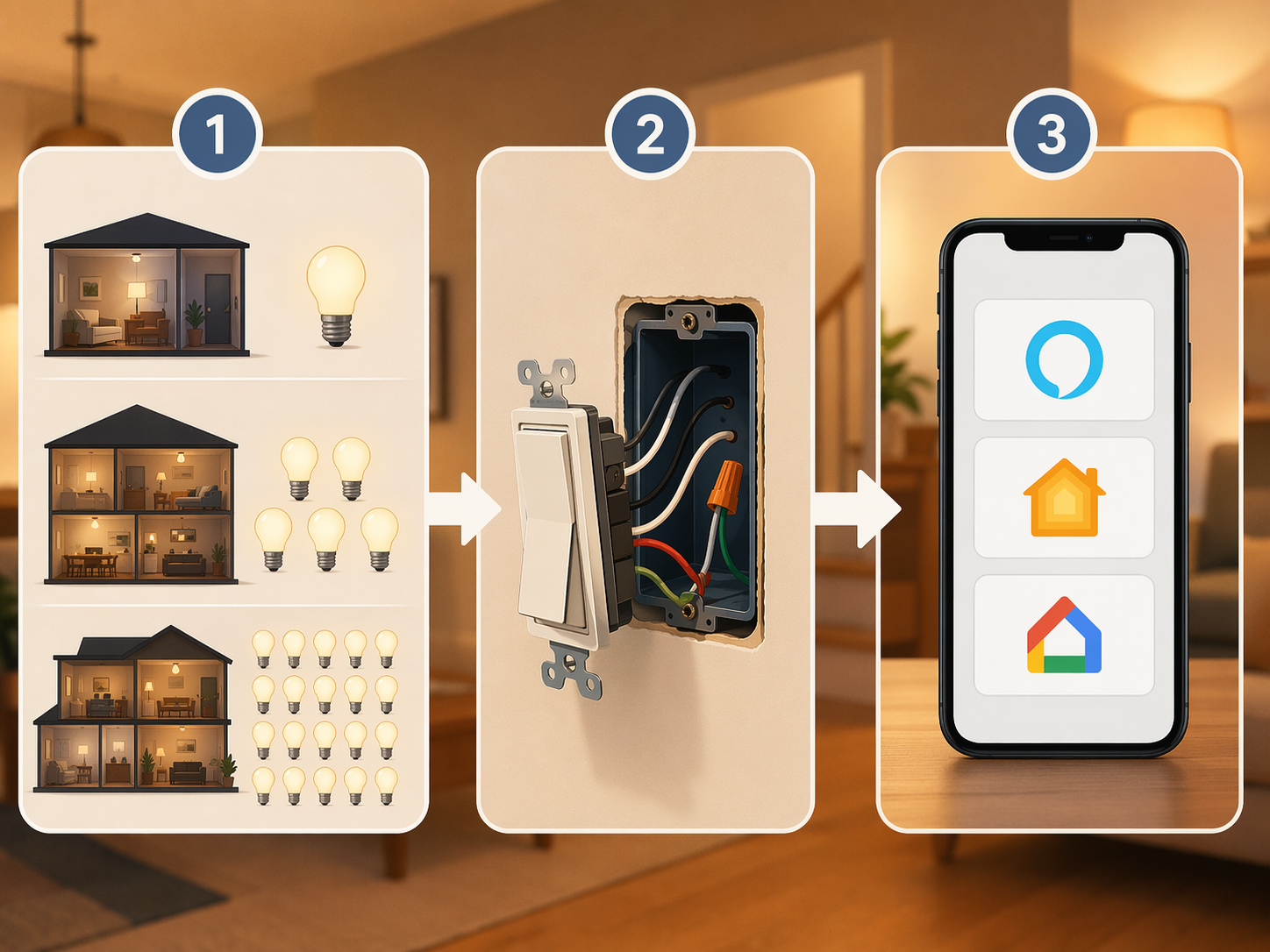
The wiring check can also cancel an otherwise good choice. Many smart switches need a neutral wire in the switch box. Lutron Caseta is the reliable smart switch option for no-neutral-wire homes, a condition common in pre-1985 U.S. homes. If your switch box lacks a neutral, a generic smart switch recommendation is not just incomplete; it may be unusable.
Renters have a different constraint. Even if the wiring is compatible, opening switch boxes may be off-limits or simply not worth the deposit risk. For a rental, smart bulbs, plug-in lamps, light strips, and removable accent lighting are usually the safer starting point. The best system is the one that can leave the apartment with you.
A quick switch-or-bulb test
- Choose smart bulbs when the lights are mostly lamps, the home is rented, or color-changing scenes matter more than wall control.
- Choose smart switches when the fixture has several bulbs, the room is shared, or people will keep using the wall switch.
- Check for a neutral wire before buying most smart switches.
- Treat no-neutral wiring as a selection constraint, not as a minor installation detail.
Where each brand actually fits
Philips Hue: best when lighting becomes a home-wide system
Philips Hue is the safest starting point for a 5+ bulb smart lighting system, especially when lights span rooms and routines matter. Its bridge-based Zigbee mesh is the practical advantage. The more lights you add, the more valuable it becomes to keep lighting off the main Wi-Fi device pile.
Hue is not the cheapest route into smart bulbs. It is the route to consider when the failure mode you are trying to avoid is family-wide annoyance: scenes that do not run, rooms that respond unevenly, and automations that work only when the network is quiet.
LIFX: best for small hub-free rooms that still care about strong bulbs
LIFX fits the one-room buyer who wants good smart bulbs without committing to a hub. At the June 2026 reference price of $29.98 for a 2-pack, it sits well below Hue’s kit price and makes sense for a bedroom, desk area, or media room where the total bulb count stays modest.[4]
The caution is scale. LIFX can be the right product and still be the wrong architecture if the plan quietly grows from two bulbs to every ceiling fixture in the house.
WiZ: best for low-cost, hub-free basics
WiZ is the budget-friendly hub-free option for readers who want simple smart bulbs and do not need a premium lighting ecosystem. At $24.99 for a 3-pack in the June 2026 pricing set, it is the lowest listed entry point among the compared bulb packs.[4]
That makes WiZ attractive for a small apartment, a guest room, or a first experiment. It is less persuasive as the backbone for a large deployment unless the buyer has already checked router capacity, app support, and the total number of Wi-Fi devices in the home.
Lutron Caseta: best when wall control is non-negotiable
Lutron Caseta is the system to examine when the room’s main control point is a switch, not a bulb. It is especially important for older homes, shared spaces, and fixtures where replacing every bulb would be awkward or expensive. Its June 2026 starter price of $151.90 looks high next to bulb packs, but it is buying a different kind of reliability: the light remains controllable in the way people already expect.[4]
For no-neutral-wire homes, that difference is decisive. A cheaper switch that cannot be installed in the box is not a bargain.
Govee: best for accent lighting and music-sync rooms
Govee should not be treated only as the compromise brand. Its strongest use case is decorative: light strips, gaming setups, TV-adjacent color, party rooms, and music-sync effects. At $32.99 for a 4-pack in the June 2026 pricing set, it also gives buyers a low-cost way to add playful lighting without pretending the whole home needs to become a synchronized showroom.[4]
The right boundary is room type. Govee is easy to recommend for accent zones where delight is the point. It is harder to recommend as the first answer for every overhead light in a home, where switch behavior, long-term app tolerance, and network load become more important than effects.
Matter helps, but it does not erase the physical decision
Matter is useful because it aims to make smart-home devices work across ecosystems with less brand lock-in. But for lighting, it should not be read as a guarantee that every bulb, app, hub, and voice assistant will behave identically. The protocol layer still has to survive the actual home: router load, setup flow, platform support, and mixed-brand maintenance.
The timing matters in 2026. Matter 1.6 was released on June 17, 2026, adding NFC commissioning and Joint Fabric, while Thread 1.4 added unified-mesh credential sharing across brands. Those are meaningful improvements, but the release is recent enough that buyers should not assume full app and ecosystem support everywhere by June 30, 2026.[5]
Thread and Zigbee also matter because they describe how devices communicate, not just which logo appears on the box. The cited comparison notes that Zigbee has about three-year battery life versus about two years for Thread, though that battery distinction is more relevant to sensors and remotes than plugged-in bulbs.[5] For lighting buyers, the more immediate question is whether the system creates a mesh outside the main Wi-Fi network.
Only choose by ecosystem after the home passes the practical checks
Alexa, Google Home, Apple HomeKit, and SmartThings preferences matter, but they come after bulb count and wiring. An Apple-focused household still has to ask whether it is controlling three lamps or twenty fixtures. A Google Home household still has to decide whether renters can replace switches. An Alexa household still has to check whether a no-neutral switch box rules out a tempting product.
CNET’s 2026 smart lights coverage treats ecosystem compatibility as a major review dimension, which is exactly how it should be used: as a compatibility filter among systems that already fit the home.[3] It should not be the first filter unless the household is already locked into one platform and unwilling to run anything outside it.
- Alexa households should check direct voice support and routine behavior before buying a large pack.
- Google Home households should confirm whether the chosen bulbs, switches, hub, and Matter support appear cleanly in the app.
- Apple Home households should verify HomeKit or Matter support for the exact product, not just the brand family.
- SmartThings households should check hub and device support if mixing bulbs, switches, and sensors.
Energy savings are a bonus, not the main reason to choose one platform
Smart lighting can reduce lighting costs, but savings should not be used to justify the wrong control system. GDS Lighting and ENERGY STAR material reports 15–35% savings on lighting costs from smart lighting, with full HVAC and shade integration reaching 40–55% on lighting plus 8–12% on cooling.[6] SEIITS Texas uses 2026 electricity rates of 16.18¢ per kWh in its installation and payback calculations.[7]
Those numbers are useful for whole-home planning, especially when motion sensors, schedules, dimming, and occupancy patterns are part of the design. They do not tell a renter whether to buy WiZ or LIFX for three lamps, and they do not solve a no-neutral switch box. Energy savings belong in the calculation after the system can actually be installed and tolerated.
A practical buying path
- Count the lights you want to control in the next year, not just the starter room.
- Mark which lights are lamps, ceiling fixtures, multi-bulb fixtures, strips, or accent lights.
- Decide where normal wall-switch behavior must remain intact.
- If replacing switches, verify neutral-wire availability or choose a no-neutral-compatible system.
- Use the five-bulb threshold to decide whether hub-free still looks simple or a mesh system is safer.
- Check the exact product against your main ecosystem before buying multiples.
- Verify current prices, because the June 2026 figures are a snapshot, not a permanent ranking.
That path produces different answers for different homes, which is the point. A three-bulb apartment can be well served by WiZ or LIFX. A twenty-bulb whole-home plan should look hard at Philips Hue. An older no-neutral house should put Lutron Caseta near the top of the list before comparing bulb colors. A gaming room or music-sync accent project can choose Govee for exactly the reason it exists.
References
- Matter vs Zigbee vs Thread protocol comparison, SuperBrightLEDs
- Best smart LED bulbs 2026, Wirecutter / The New York Times
- Best smart lights 2026, CNET
- 2026 best systems guide, SmartHomeExplorer
- Matter/Thread explained, Data Wire Solutions, June 2026
- Smart lighting energy savings, GDS Lighting / ENERGY STAR
- 2026 smart lighting installation guide, SEIITS Texas, 2026
Known issues with this device / protocol
Spec-version history
For active regressions on this protocol, see Update Watch.
No linked Update Watch entries yet.